Advantame
714229-20-6 · Advantame · advantame hydrate · Advantame monohydrate · E 969 · FEMA NO. 4716 · INS NO.969 · INS-969 · E969 · 969 · (3S)-3-[3-(3-hydroxy-4-methoxyphenyl)propylamino]-4-[[(2S)-1-methoxy-1- oxo-3-phenylpropan-2-yl]amino]-4-oxobutanoic acid;hydrate · (3S)-4-[[(2S)-1-methoxy-1-oxidanylidene-3-phenyl-propan-2-yl]amino]-3-[3-(4-methoxy-3-oxidanyl-phenyl)propylamino]-4-oxidanylidene-butanoic acid;hydrate · (S)-3-((3-(3-Hydroxy-4-methoxyphenyl)propyl)amino)-4-(((S)-1-methoxy-1-oxo-3-phenylpropan-2-yl)amino)-4-oxobutanoic acid hydrate · 4-Hydroxy-3-{[3-(3-hydroxy-4-methoxyphenyl)propyl]amino}-4-[(1-methoxy-1-oxo-3-phenylpropan-2-yl)imino]butanoic acid--water (1/1) · L-PHENYLALANINE, N-(3-(3-HYDROXY-4-METHOXYPHENYL)PROPYL)-L-.ALPHA.-ASPARTYL-, 2-METHYL ESTER, HYDRATE (1:1) · L-PHENYLALANINE, N-(3-(3-HYDROXY-4-METHOXYPHENYL)PROPYL)-L-.ALPHA.-ASPARTYL-, 2-METHYL ESTER, MONOHYDRATE · L-Phenylalanine, N-(3-(3-hydroxy-4-methoxyphenyl)propyl)-l-alpha-aspartyl-, 2-methyl ester, hydrate (1:1) · L-Phenylalanine, N-(3-(3-hydroxy-4-methoxyphenyl)propyl)-l-alpha-aspartyl-, 2-methyl ester, monohydrate · Methyl N-[3-(3-hydroxy-4-methoxyphenyl)propyl]-L-alpha-aspartyl-L-phenylalaninate--water (1/1) · N-(N-(3-(3-HYDROXY-4-METHOXYPHENYL) PROPYL)-L-.ALPHA.-ASPARTYL)-L-PHENYLALANINE-1-METHYL ESTER, MONOHYDRATE · PHENYLALANINE, N-(3-(3-HYDROXY-4-METHOXYPHENYL)PROPYL)-.ALPHA.-ASPARTYL-, 2-METHYL ESTER, MONOHYDRATE · Phenylalanine, N-(3-(3-hydroxy-4-methoxyphenyl)propyl)-alpha-aspartyl-, 2-methyl ester, monohydrate · Advantame · Advantaam · Advantaami · Advantam · Advantamas · Advantame · Advantāms · Adwantam · Αντβαντάμη · АдвантамE number E969INS 969CAS 714229-20-6
Listed as a sweetener by Canada, Codex, the EU and the US.
Listed as sweeteners (CA, EU, US, Codex) · flavour enhancers (Codex)
- Canada: Sweetener — Health Canada, List of Permitted Sweeteners (List 9)
- European Union: Sweeteners — Regulation (EC) No 1333/2008, Annex II, Part B, 2. Sweeteners (consolidated text 02008R1333-20260818)
- United States: Non-nutritive sweetener — FDA, Substances Added to Food: ADVANTAME
- Codex Alimentarius: Sweetener — CXS 192-1995 Table One, INS 969
- Codex Alimentarius: Flavour enhancer — CXS 192-1995 Table One, INS 969
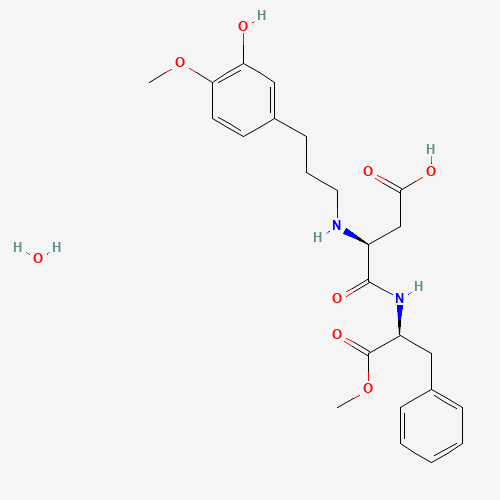
Advantame is the sweetest of the approved intense sweeteners, roughly twenty thousand times as sweet as sugar. It is used in tiny quantities in drinks, dairy products, chewing gum and baked goods.
Where it is and isn’t permitted
| Jurisdiction | Status | Scope and limits | Citation |
|---|---|---|---|
| Australia and New Zealand | Permitted, with conditions | 54 food categories no numerical limit (good manufacturing practice) Show every food category
| Food Standards Code, Schedule 15, S15—5and 53 further provisionsretrieved 2026-10-17 |
| Canada | Permitted, with conditions | highest permitted level 400 mg/kg 14 permitted uses Show every permitted use
| Health Canada, List of Permitted Sweeteners (List 9)and 13 further provisionsretrieved 2026-10-17 |
| European Union | Permitted, with conditions | 36 food categories highest permitted level 400 mg/l Show every food category
| Regulation (EC) No 1333/2008and 35 further provisionsretrieved 2026-10-18 |
| Great Britain | Permitted, with conditions | 34 food categories highest permitted level 20 mg/kg or mg/l Show every food category
| Assimilated Regulation (EC) No 1333/2008and 33 further provisionsretrieved 2026-10-18 |
| Japan | Permitted, with conditions | Designated additive: Appended Table 1, item 26, アドバンテーム (“Advantame” in the unofficial English translation). …Designated additive: Appended Table 1, item 26, アドバンテーム (“Advantame” in the unofficial English translation). Standards for use — Specifications and Standards for Foods, Food Additives, etc. (MHW Notification No. 370 of 1959), Part II (Food Additives), F (Standards for use): The Notification sets no standard for use (使用基準) for this additive, so it is not restricted there to particular foods or amounts. Compositional specifications for this additive, in the same Notification, are not imported and are not shown here; nor are the general rules in F 添加物一般, which apply to every additive. | Regulations for Enforcement of the Food Sanitation Act (MHW Ordinance No. 23 of 1948), Appended Table 1retrieved 2026-10-18 |
| South Korea | No listing matchedThis site imports Part III of South Korea’s Standards and Specifications for Food Additives, matched by CAS number, then INS number, then exact name. Mixed preparations and sanitisers are not imported, and an entry whose identifiers disagreed with a page’s is held for review, so an empty row does not show that South Korea does not permit the substance. | ||
| United States | Permitted, with conditions | 21 CFR 172.803retrieved 2026-10-17 | |
| Codex Alimentarius | Permitted, with conditions | 64 food categories highest permitted level 400 mg/kg Show every food category and its notes
| CXS 192-1995 Table One, INS 969and 63 further provisionsretrieved 2026-09-07 |
How much is permitted
A listing usually limits the quantity as well as the food. Only one of the forms that takes is a figure: quantum satis and good manufacturing practice permit the amount the technological effect requires and no more, which is a limit rather than the absence of one. Figures below are the range across every food category this page is listed in, and categories differ between regulators — see how much is permitted.
| Australia and New Zealand | — | 54 GMP |
|---|---|---|
| Canada | 2 mg/kg – 400 mg/kg | 13 numeric limit, 1 GMP |
| European Union | 2 mg/kg – 400 mg/kg | 33 numeric limit, 3 quantum satis |
| Great Britain | 2 mg/kg – 20 mg/kg | 25 numeric limit, 6 several limits, 3 quantum satis |
| Japan | — | 1 no quantity stated |
| United States | — | 1 no quantity stated |
| Codex Alimentarius | 3 mg/kg – 400 mg/kg | 63 numeric limit, 1 GMP |
What a label must say
Words a food containing Advantame is obliged to carry, quoted from the instrument that imposes them. A required statement is a fact about the regulation, not a finding about the substance — every rule below applies where the additive is authorised.
‘with sweetener(s)’, or ‘with sugar(s) and sweetener(s)’ where the food also contains added sugar. The statement accompanies the name of the food.
Any food containing an authorised sweetener. Regulation (EU) No 1169/2011, Annex III, points 2.1 and 2.2 · Assimilated Regulation (EU) No 1169/2011, Annex III
Every rule collected at what a label must say.
What it is made from
Made by reacting aspartame with an aldehyde derived from isovanillin, with hydrogenation. Like neotame it is a substituted aspartame derivative, and the substitution prevents the release of phenylalanine in digestion.
- Vegan
- Vegetarian
Compare other additives on the dietary indexes.
- CAS registry number
- 714229-20-6
- InChIKey
- NQQIEOGMDRFTDZ-HLRBRJAUSA-N
- PubChem
- CID 56843846
The two specifications, compared
The European Union sets identity and purity by regulation; JECFA publishes its own through FAO, advisory until a country adopts it. Both documents are below in full. These are the parameters each puts a number on.
| Parameter | European Union | JECFA |
|---|---|---|
| Assay | no less than 97 % | no less than 97 % |
| Lead | no more than 1 mg/kg | no more than 1 mg/kg |
| Arsenic | no more than 2 mg/kg | — |
The two documents state the same figures for every parameter compared here.
How the EU defines it
The legal specification an additive must meet to be sold as this E number in the EU — what it is, how it may be made, and the purity it must reach. From Commission Regulation (EU) No 231/2012.
E 969 Advantame
Advantame (ANS9801) is produced by chemical synthesis in a three-step process; production of the principal manufacturing intermediate, 3-hydroxy-4-methoxycinnamaldehyde (HMCA), followed by hydrogenation to form 3-(3-hydroxy-4-methoxyphenyl) propionaldehyde (HMPA). In the final step, the HMPA methanol solution (filtrate) is combined with aspartame to give the imine that under selective hydrogenation forms advantame. The solution is allowed to crystallise and crude crystals are washed. The product is re-crystallised and crystals are separated, washed and dried.
Assay, identification and purity criteria
Description and assay
- CAS No.
- 714229-20-6
- Chemical name
- N-[N-[3-(3-hydroxy-4-methoxyphenyl) propyl]-α-aspartyl]-L-phenylalanine 1-methyl ester, monohydrate (IUPAC); L-phenylalanine, N-[3-(3-hydroxy-4-methoxyphenyl)propyl]-L-alpha-aspartyl-, 2-methyl ester, monohydrate (CA)
- Molecular formula
- C24H30N2O7·H₂O
- Molecular weight
- 476,52 g/mol (monohydrate)
- Assay
- Not less than 97,0 % and not more than 102,0 % on an anhydrous basis
- Description
- White to yellow powder
Identification
- Melting Point
- 101,5 °C
Purity criteria
- N-[N-[3-(3-hydroxy-4-methoxyphenyl)propyl-α-aspartyl]-L-phenylalanine (ANS9801-acid)
- Not more than 1,0 %
- Total other related substances
- Not more than 1,5 %
- Residual Solvents
- Isopropyl acetate: Not more than 2 000 mg/kg Methyl acetate: Not more than 500 mg/kg Methanol: Not more than 500 mg/kg 2-Propanol: Not more than 500 mg/kg
- Water content
- Not more than 5,0 % (Karl Fischer method)
- Residue on ignition
- Not more than 0,2 %
- Arsenic
- Not more than 2 mg/kg
- Lead
- Not more than 1 mg/kg
- Palladium
- Not more than 5,3 mg/kg
- Platinum
- Not more than 1,7 mg/kg
How JECFA defines it
The international specification for identity and purity, prepared by the Joint FAO/WHO Expert Committee on Food Additives and published by FAO. It is a different document from any above, written by a different body and revised on its own cycle; it is advisory, and a country adopts it or does not.
INS 969 Advantame
Advantame is manufactured by N -alkylation of aspartic acid portion of aspartame (L-α-aspartyl-L-phenylalanine methylester) with 3-(3-hydroxy-4-methoxyphenyl) propionaldehyde produced by selective catalytic hydrogenation from 3-hydroxy-4-methoxycinnamaldehyde. The product is purified through re-crystallisation and dried. Only the following solvents may be used for the production: methanol and ethyl acetate.
Synonyms: INS No. 969
Assay, identification and purity criteria
Description and assay
- Specification history
- Prepared at the 80 th JECFA (2015), published in FAO JECFA Monographs 17 (2015), superseding tentative specifications prepared at 77 th JECFA (2013). An ADI of 0-5 mg/kg body weight was established at the 77th JECFA (2013).
- Chemical names
- (3S)-3-[3-(3-hydroxy-4-methoxyphenyl)propylamino]-4-[[(2S)-1-methoxy-1-oxo-3-phenylpropan-2-yl]amino]-4-oxobutanoic acid hydrate, N -[ N -[3-(3-hydroxy-4-methoxyphenyl)propyl]-L-α-aspartyl]-L-phenylalanine 1-methyl ester, monohydrate
- C.A.S. number
- 714229-20-6
- Chemical formula
- C24H30N2O7·H2O
- Formula weight
- 476.52
- Assay
- Not less than 97.0% and not more than 102.0% on the anhydrous basis
- DESCRIPTION
- White to yellow powder
- FUNCTIONAL USES
- Sweetener, flavour enhancer
- METHOD OF ASSAY
- Principle Determine by HPLC using the following conditions: Mobile phase Mobile phase A: Dissolve 13.61 g of potassium dihydrogen phosphate in 1000 ml of water, and adjust the pH to 2.8 with phosphoric acid. Add 250 ml of acetonitrile to 750 ml of this solution, mix well, and sonicate for about 5 min. Mobile phase B: Dissolve 13.61 g of potassium dihydrogen phosphate in 1000 ml of water, and adjust the pH to 2.8 with phosphoric acid. Add 500 ml of acetonitrile to 500 ml of this solution, mix well, and sonicate for about 5 min. Iinternal standard Accurately weigh about 40 mg of benzoic acid and dissolve in a mixture of water and acetonitrile (7:3 v/v) to make exactly 50 ml. Standard stock solution Accurately weigh about 40 mg of advantame reference standard (available from Wako Pure Chemical Industries, Osaka, Japan), dissolve in a mixture of water and acetonitrile (7:3 v/v) to make 50 ml. Standard solution Pipet 8, 9 10, 11, 12 ml of standard stock solution into five volumetric flasks. Add 5 ml of the Internal standard solution to each volumetric flask, and add a mixture of water and acetonitrile (7:3 v/v) to make exactly 50 ml. Sample solution Accurately weigh about 40 mg of advantame and dissolve in a mixture of water and acetonitrile (7:3 v/v) to make exactly 50 ml. Pipet 10 ml of this solution, transfer into 50 ml volumetric flask, add exactly 5 ml of the internal standard solution, and add a mixture of water and acetonitrile (7:3 v/v) to make exactly 50 ml. HPLC conditions Column: Inertsil ODS-2 (25 cm x 4.6 mm i.d., 5 μm) GL Sciences, or equiv. Column temperature: 40° Mobile phase: Mobile phase A: Mixture of phosphate buffer solution (pH 2.8) and acetonitrile (75:25 v/v) Mobile phase B: Mixture of phosphate buffer solution (pH 2.8) and acetonitrile (50:50 v/v) Flow rate: 1.0 ml/min Injection volume: 20 μl Detector: UV at 280 nm Run Time: 55 min Gradient program: Time Mobile phase A Mobile phase B (min) (%) (%) 0 100 0 20 100 0 50 0 100 55 0 100 System suitability Suitability requirement 1: The resolution between the benzoic acid and advantame peaks is not less than 10 in the chromatogram of the standard solution having the concentration of advantame reference standard closest to 160 μg/ml. (Note: The elution order must be benzoic acid then advantame). Suitability requirement 2: When injected six consecutive times, the relative standard deviation for the retention time of the advantame peak is not more than 1.0% for the standard solution having the concentration of advantame reference standard closest to 160 μg/ml. Analysis Separately inject the Standard solutions into the chromatograph (including the stock solution), record the chromatograms, and determine the peak area responses for the major peaks in the resulting chromatographs (Note: The approximate retention time for advantame is 16.5 min). For each standard solution, calculate the ratio of the peak area response of the advantame peak to that of the benzoic acid internal standard peak. Create a standard curve by plotting the resulting peak area response ratios versus the concentrations of the standard solutions. Inject the Sample solution into the chromatograph, record the chromatogram, and determine the peak area responses for the major peaks in the resulting chromatogram. Calculate the ratio of the peak area response of the advantame peak to that of the benzoic acid internal standard peak. Using the standard curve, determine the concentration of advantame (CA) in the sample solution, in μg/m. Calculation Calculate the percentage of advantame (C24H30N2O7) in the sample taken: Advantame (%) = (CA/CU) x 100 where CA is the concentration of advantame in the sample solution as determined from the standard curve (μg/mL) CU is the concentration of the sample solution (μg/mL) See Appendix C for example of chromatogram obtained using the method.
Identification
- Solubility (Vol. 4)
- Very slightly soluble in water, sparingly soluble in ethanol
- Infrared spectrum
- The infrared spectrum of a potassium bromide dispersion of the sample corresponds to the standard infrared spectrum in Appendix A.
Purity criteria
- Water (Vol. 4)
- Not more than 5% (Karl Fischer)
- Residue on ignition (Vol. 4)
- Not more than 0.2% (use 5 g of the sample)
- N-[ N -[3-(3-hydroxy-4- methoxyphenyl) propyl]- α-aspartyl]-L-phenyl- alanine (acid of advantame) Other related substances
- Not more than 1% See description under TESTS Not more than 1.5% (expressed as acid of advantame) See description under TESTS
- Specific rotation (Vol. 4)
- [𝛼] 20 : Between -46° and -39° 𝐷 (0.2% solution in ethanol, on an anhydrous basis)
- Residual solvents
- Methanol: Not more than 500 mg/kg Ethyl acetate: Not more than 500 mg/kg See description under TESTS
- Lead (Vol. 4)
- Not more than 1 mg/kg Determine using an AAS (Electrothermal atomization technique) appropriate to the specified level. The selection of sample size and method of sample preparation may be based on principles of methods described in Volume 4 (under “General Methods, Metallic Impurities”).
- Test: N -[ N -[3-(3-hydroxy-4- methoxyphenyl) propyl]- α-aspartyl]-L-phenyl- alanine (acid of advantame)
- Principle Determination of N -[ N -[3-(3-hydroxy-4-methoxyphenyl) propyl]-α-aspartyl]- L-phenylalanine by HPLC Mobile phase Mobile phase A: Dissolve 13.61 g of potassium dihydrogen phosphate in 1000 ml of water, and adjust the pH to 2.8 with phosphoric acid. Add 100 ml of acetonitrile to 900 ml of this solution, mix well, and sonicate for about 5 min. Mobile phase B: Dissolve 13.61 g of potassium dihydrogen phosphate in 1000 ml of water, and adjust the pH to 2.8 with phosphoric acid. Add 600 ml of acetonitrile to 400 ml of this solution, mix well, and sonicate for about 5 min. Standard solution Dissolve the acid of advantame reference standard (available from Wako Pure Chemicals, Osaka, Japan) in a mixture of water and acetonitrile (7:3 v/v) to concentrations of 15, 10, 5, 2 and 0.2 μg/ml. Preparation of Sample solution : Dissolve the sample in a mixture of water and acetonitrile (7:3 v/v) to a concentration of 1 mg/ml. System suitability solution Prepare a solution containing 10 μg/mL of advantame reference standard and 10 μg/ml of acid of advantame reference standard (both available from Wako Pure Chemicals, Osaka, Japan) in a mixture of water and acetonitrile (7:3 v/v). HPLC conditions: Column: Inertsil ODS-2 (25 cm x 4.6 mm i.d., 5 μm), GL Sciences, or equiv. Column temperature: 50° Mobile phase: Mobile phase A: Mixture of phosphate buffer solution (pH 2.8) and acetonitrile (9:1 v/v) Mobile phase B: Mixture of phosphate buffer solution (pH 2.8) and acetonitrile (2:3 v/v) Flow rate: 1.0 ml/min Injection volume: 20 μl Detector: UV at 210 nm Run Time: 80 min Gradient program: Time (min) Mobile phase A (%) Mobile phase B (%) 0.0 85 15 30.0 85 15 55.0 75 25 75.0 0 100 80.0 0 100 80.1 85 15 90.0 85 15 System suitability requirement The resolution between the advantame and acid of advantame peaks is not less than 3.0 in the chromatogram of the System suitability solution. (Note: The approximate retention times for acid of advantame and advantame are 29.6 min and 56.0, respectively). Analysis Separately inject the Standard solution and the Sample solution into the chromatograph, record the chromatograms, and determine the peak area responses for the peaks in the resulting chromatograms. Calculation Calculate the percentage of acid of advantame in the sample using the following formula: Acid of advantame (%) = (rU/rS) x (CS/CU) x 100 where rU is the peak area response of advantame acid obtained from the chromatogram of the sample solution rS is the peak area response of advantame acid from the chromatogram of the standard solution CS is the concentration of the standard solution (μg/ml) CU is the concentration of the sample solution (μg/ml) See Appendix B for example of chromatogram obtained using the method.
- Test: Other related substances
- Calculation Calculate the total percentage of other related substances from the results of the Test for N -[ N -[3-(3-hydroxy-4-methoxyphenyl) propyl]-α-aspartyl]-L-phenylalanine using the following formula: Total content of other related substances (%) = (rT/rS) x (CS/CU) x 100 where rT is the total peak response of all peaks, except those of advantame and advantame acid obtained from the chromatogram of the sample solution (disregard any peak areas less than 0.02%) rS is the peak area response of advantame acid from the chromatogram of the standard solution CS is the concentration of the standard solution (μg/ml) CU is the concentration of the sample solution (μg/ml)
- Test: Residual solvents
- Principle Proceed as directed in Residual Solvents by Headspace Gas Chromatography (Vol. 4) using the following: Sample solution Accurately weigh about 0.08 g of advantame to an appropriate headspace vial, and add 2 ml of DMF, apply the stopper, cap, and mix. Standard Solution Accurately weigh 0.1 g methanol, and add DMF to make exactly 10 ml (stock solution 1). Accurately weigh 0.1 g of ethyl acetate, and add DMF to make exactly 20 ml (stock solution 2). Transfer 1 ml of stock solution 1 and 1 ml of stock solution 2 into a 10-ml volumetric flask, and add DMF to make exactly 10 ml. Transfer 1 ml of this solution into a 10 ml volumetric flask, and add DMF to make exactly 10 ml (mixture stock solution). Transfer 1 ml of mixture stock solution into a 25 ml volumetric flask, and add DMF to make exactly 25ml. Transfer 2 ml of this solution to an appropriate headspace vial, apply the stopper, cap, and mix. Procedure Analyse using the analytical conditions for Residual Solvents by Headspace Gas Chromatography as described in Vol. 4. Calculation Calculate the content (mg/kg) of each residual solvent using the following formulae: Content of methanol (mg/kg) = WSA / WT × ATA / ASA × 80 Content of ethyl acetate (mg/kg) = WSB / WT × ATB / ASB × 40 where ATA is the peak area of methanol from the Sample solution; ATB is the peak area of ethyl acetate from the Sample solution ASA is the peak area of methanol from the Standard solution; ASB is the peak area of ethyl acetate from the Standard solution; WT is the weight (g) of Advantame in the Sample solution; WSA is the weight (g) of methanol in the Standard solution; and WSB is the weight (g) of ethyl acetate in the Standard solution.
Every name it appears under
32 recorded names. A label may use any of them.
E number
- E969
INS number
- 969
CAS registry number
- 714229-20-6
As it appears in regulation
- Advantame
Other names
- Advantame
- advantame hydrate
- Advantame monohydrate
- E 969
- FEMA NO. 4716
- INS NO.969
- INS-969
Systematic names
- (3S)-3-[3-(3-hydroxy-4-methoxyphenyl)propylamino]-4-[[(2S)-1-methoxy-1- oxo-3-phenylpropan-2-yl]amino]-4-oxobutanoic acid;hydrate
- (3S)-4-[[(2S)-1-methoxy-1-oxidanylidene-3-phenyl-propan-2-yl]amino]-3-[3-(4-methoxy-3-oxidanyl-phenyl)propylamino]-4-oxidanylidene-butanoic acid;hydrate
- (S)-3-((3-(3-Hydroxy-4-methoxyphenyl)propyl)amino)-4-(((S)-1-methoxy-1-oxo-3-phenylpropan-2-yl)amino)-4-oxobutanoic acid hydrate
- 4-Hydroxy-3-{[3-(3-hydroxy-4-methoxyphenyl)propyl]amino}-4-[(1-methoxy-1-oxo-3-phenylpropan-2-yl)imino]butanoic acid--water (1/1)
- L-PHENYLALANINE, N-(3-(3-HYDROXY-4-METHOXYPHENYL)PROPYL)-L-.ALPHA.-ASPARTYL-, 2-METHYL ESTER, HYDRATE (1:1)
- L-PHENYLALANINE, N-(3-(3-HYDROXY-4-METHOXYPHENYL)PROPYL)-L-.ALPHA.-ASPARTYL-, 2-METHYL ESTER, MONOHYDRATE
- L-Phenylalanine, N-(3-(3-hydroxy-4-methoxyphenyl)propyl)-l-alpha-aspartyl-, 2-methyl ester, hydrate (1:1)
- L-Phenylalanine, N-(3-(3-hydroxy-4-methoxyphenyl)propyl)-l-alpha-aspartyl-, 2-methyl ester, monohydrate
- Methyl N-[3-(3-hydroxy-4-methoxyphenyl)propyl]-L-alpha-aspartyl-L-phenylalaninate--water (1/1)
- N-(N-(3-(3-HYDROXY-4-METHOXYPHENYL) PROPYL)-L-.ALPHA.-ASPARTYL)-L-PHENYLALANINE-1-METHYL ESTER, MONOHYDRATE
- PHENYLALANINE, N-(3-(3-HYDROXY-4-METHOXYPHENYL)PROPYL)-.ALPHA.-ASPARTYL-, 2-METHYL ESTER, MONOHYDRATE
- Phenylalanine, N-(3-(3-hydroxy-4-methoxyphenyl)propyl)-alpha-aspartyl-, 2-methyl ester, monohydrate
Hazard reference values
EFSA and JECFA have both set an acceptable daily intake for Advantame, and they agree: 5 mg/kg bw/day. An acceptable daily intake is a reference value set by a committee, not a threshold above which harm begins. See where the two committees differ.
Evidence and how bodies read it
Studies, and the differing conclusions regulators drew from them, are curated rather than machine-read, and none has been written for this substance yet.
Common questions
Assembled from what is above, in the words the questions are usually asked in. Each answer is the same statement the relevant section makes, with the same citations behind it.
- What is E 969?
- E 969 is Advantame. Advantame is the sweetest of the approved intense sweeteners, roughly twenty thousand times as sweet as sugar. It is used in tiny quantities in drinks, dairy products, chewing gum and baked goods.
- What is Advantame used for in food?
- It is listed as a sweetener — the role Canada, Codex, the EU and the US assign it. This page shows every function each regulator records, with the citation for each.
- Where is Advantame permitted?
- Of the seven regulators this site reads, Australia and New Zealand, Canada, the EU, Great Britain, Japan, the US and the Codex standard permit it. Each permission is for named foods at named levels, not a blanket one; the table on this page gives them with citations.
- Is Advantame vegan?
- Yes. Advantame is not derived from animals, and is suitable for vegetarians. This page says what it is made from and how.
Sources for this page
- anz retrieved 2026-10-17
- ca retrieved 2026-10-17
- eu retrieved 2026-10-18
- gb retrieved 2026-10-18
- jp retrieved 2026-10-18
- ecfr retrieved 2026-10-17
- gsfa retrieved 2026-09-07
- euspecs retrieved 2026-10-18
- jecfaspecs retrieved 2026-09-23
Full licence terms and publisher details on Sources. How this page is built and updated: Method.
Machine-readable: a JSON record of this additive is given on request —how to ask for access.
Follow changes to Advantame:Atom feed — regulatory events, and any change the weekly refresh detects in its provisions.