Annatto extracts, norbixin-based
542-40-5 · (ALL-E)-4,8,13,17-TETRAMETHYL-2,4,6,8,10,12,14,16,18-EICOSANONAENEDIOIC ACID · .BETA.-NORBIXIN · 2,4,6,8,10,12,14,16,18-Eicosanonaenedioic acid, 4,8,13,17-tetramethyl- · 6,6'-Diapo-psi,psi-carotenedioic acid · 9'-cis-6,6'-Diapocaroten-6,6'-disaeure · 9'-cis-Diapo-omega,omega-carotinsaeure · ALL-TRANS NORBIXIN · all-trans-Norbixin · ANNATTO EXTRACTS, NORBIXIN-BASED · Annatto norbixin · beta-norbixin · E 160b(ii) · Norbixin · Norbixin (>70%) · trans-norbixin · E160b(ii) · 160b(ii) · (2E,4E,6E,8E,10E,12E,14E,16E,18E)-4,8,13,17-tetramethylicosa-2,4,6,8,10,12,14,16,18-nonaenedioic acid · (2E,4Z,6E,8E,10E,12E,14E,16E,18E)-4,8,13,17-TETRAMETHYLICOSA-2,4,6,8,10,12,14,16,18-NONAENEDIOIC ACID · Annatto norbixin · anato norbiksin · Anato norbiksinas · Annaato norbiksiin · Annato norbiksyna · Annato norbiksīns · Annatto norbixin · Annatto norbixine · Annatto norbixină · ANNATTO ΝΟΡΜΠΙΞΙΝΗ · Annatto-norbiksiini · Annattoekstrakt norbixin · Annattoextrakt norbixin · Norbissina di annatto · Norbixina de anato · Norbixina de bija · Norbixine de rocou · Αννάττο νορμπιξίνη · Анато норбиксинE number E160b(ii)INS 160b(ii)CAS 542-40-5
Listed as a colour by Codex and the EU.
Listed as colours (EU, Codex)
- European Union: Colours — Regulation (EC) No 1333/2008, Annex II, Part B, 1. Colours (consolidated text 02008R1333-20260818)
- Codex Alimentarius: Colour — CXS 192-1995 Table One, INS 160b(ii)
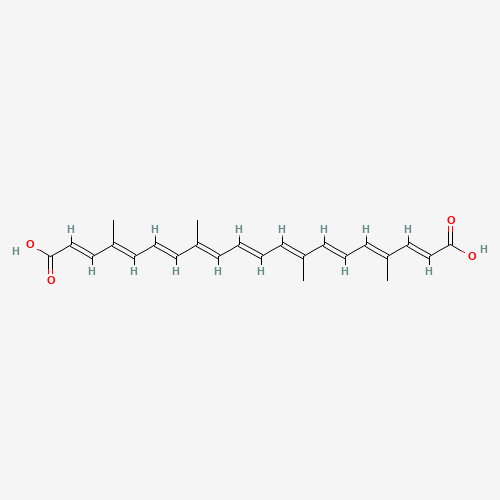
Norbixin is the water-soluble form of annatto, used where the food is aqueous rather than fatty — drinks, smoked fish, some cheeses and cereals.
Where it is and isn’t permitted
| Jurisdiction | Status | Scope and limits | Citation |
|---|---|---|---|
| Australia and New Zealand | No listed food uses foundThis site has not matched this substance to any food use on this jurisdiction’s list of authorised food additives. A food additive may be used only in foods that list names. Flavourings, enzymes, processing aids and added nutrients are regulated separately and do not appear on it. | ||
| Canada | No listing matchedHealth Canada’s lists name additives without E or INS numbers, so this site matches them by exact name. A substance listed there under a name this site does not recognise has no row here. | ||
| European Union | Permitted, with conditions | 27 food categories highest permitted level 50 mg/l Show every food category
| Regulation (EC) No 1333/2008and 26 further provisionsretrieved 2026-10-18 |
| Great Britain | Permitted, with conditions | 26 food categories highest permitted level 50 mg/kg or mg/l Show every food category
| Assimilated Regulation (EC) No 1333/2008and 25 further provisionsretrieved 2026-10-18 |
| Japan | No listing matchedThis site imports only Japan’s list of designated additives (Appended Table 1 to the Regulations for Enforcement of the Food Sanitation Act), matched by English name. Existing additives, natural flavouring agents and ordinary foods used as additives are permitted outside that list and are not imported, so an empty row does not show that Japan does not permit the substance. | ||
| South Korea | Permitted, with conditions | Designated food additive: Standards and Specifications for Food Additives, Part III, 1. …Designated food additive: Standards and Specifications for Food Additives, Part III, 1. 일반식품첨가물 (general food additives), 수용성안나토 (“Annatto, Water-Soluble”, the English the Code prints beside it). Main use (주용도) of 수용성안나토: 착색료. Standard for use (사용기준) of 수용성안나토: (1) [must not be used in the foods listed] “수용성안나토는 아래의 식품에 사용하여서는 아니 된다. 1. 천연식품[식육류, 어패류, 과일류, 채소류, 해조류, 콩류 등 및 그 단순가공품(탈피, 절단 등)] 2. 다류 3. 커피 4. 고춧가루, 실고추 5. 김치류 6. 고추장, 조미고추장 7. 식초 8. 향신료가공품(고추 또는 고춧가루 함유제품에 한함)” The Korean is the standard as published. There is no official English translation of the current Code (the English version on MFDS’s website is the 2020 edition and has no legal effect); the English in square brackets is this site’s description of what each sentence does, not a translation of the foods or the levels. Compositional specifications (Part IV) are not imported, nor are the general standards in Part II, which apply to every additive. | Standards and Specifications for Food Additives (식품첨가물의 기준 및 규격), MFDS Notification, Part III (Standards for use, by item)retrieved 2026-10-18 |
| United States | Not listedDoes not appear on this jurisdiction’s permitted list. That is not the same as being prohibited. | ||
| Codex Alimentarius | Permitted, with conditions | 66 food categories highest permitted level 100 mg/kg Show every food category and its notes
| CXS 192-1995 Table One, INS 160b(ii)and 65 further provisionsretrieved 2026-09-07 |
How much is permitted
A listing usually limits the quantity as well as the food. Only one of the forms that takes is a figure: quantum satis and good manufacturing practice permit the amount the technological effect requires and no more, which is a limit rather than the absence of one. Figures below are the range across every food category this page is listed in, and categories differ between regulators — see how much is permitted.
| European Union | 4 mg/kg – 50 mg/kg | 27 numeric limit |
|---|---|---|
| Great Britain | 4 mg/kg – 50 mg/kg | 24 numeric limit, 2 several limits |
| South Korea | — | 1 no quantity stated |
| Codex Alimentarius | 1 mg/kg – 100 mg/kg | 66 numeric limit |
What it is made from
Made by treating annatto seed extract with alkali, which converts the oil-soluble bixin into the water-soluble norbixin salt. Same plant, same pigment family, different solubility and therefore a separate listing.
- Vegan
- Vegetarian
Compare other additives on the dietary indexes.
- CAS registry number
- 542-40-5
- InChIKey
- ZVKOASAVGLETCT-UOGKPENDSA-N
- PubChem
- CID 5281249
The two specifications, compared
The European Union sets identity and purity by regulation; JECFA publishes its own through FAO, advisory until a country adopts it. Both documents are below in full. These are the parameters each puts a number on.
| Parameter | European Union | JECFA |
|---|---|---|
| Assay | no less than 85 % | no less than 35 % |
| Lead | no more than 1 mg/kg | no more than 2 mg/kg |
| Arsenic | no more than 2 mg/kg | no more than 3 mg/kg |
| Mercury | no more than 1 mg/kg | no more than 1 mg/kg |
| Cadmium | no more than 0.5 mg/kg | — |
3 parameters differ between the two documents. A difference is not a disagreement about safety: the two are revised on their own cycles, and an assay or a drying loss can be measured against a different preparation of the substance, which is why only the contaminant ceilings are marked. Within the EU the EU's figure is the one that binds.
How the EU defines it
The legal specification an additive must meet to be sold as this E number in the EU — what it is, how it may be made, and the purity it must reach. From Commission Regulation (EU) No 231/2012.
E 160b(ii) Annatto norbixin
Solvent-extracted norbixin is obtained from the outer coating of the seeds of the annatto tree (Bixa orellana L.) by washing with one or more of the following food grade solvents: acetone, methanol, hexane, ethanol, isopropyl alcohol, ethyl acetate, alkaline alcohol or supercritical carbon dioxide followed by solvent removal, crystallization and drying. Aqueous alkali is added to the resultant powder, which is then heated to hydrolyse the colouring matter and cooled. The aqueous solution is filtered, and acidified to precipitate the norbixin. The precipitate is filtered, washed, dried and milled, to give a granular powder. Solvent-extracted norbixin contains several coloured components; the major colouring principle is cis-norbixin, a minor colouring principle is trans-norbixin; thermal degradation products of norbixin may also be present as a result of processing.
Synonyms: Annatto C, Orlean, Terre orellana, L. Orange, CI Natural Orange 4
Assay, identification and purity criteria
Description and assay
- Colour Index No
- 75120
- Einecs
- 208-810-8
- Chemical name
- cis-Norbixin: 6,6'-Diapo-Ψ,Ψ-carotenedioic acid cis-Norbixin dipotassium salt: Dipotassium 6,6'-diapo-Ψ,Ψ-carotenedioate cis-Norbixin disodium salt: Disodium 6,6'-diapo-Ψ,Ψ-carotenedioate
- Chemical formula
- cis-Norbixin: C₂₄H₂₈O₄ cis-Norbixin dipotassium salt: C₂₄H₂₆K₂O₄ cis-Norbixin disodium salt: C₂₄H₂₆Na₂O₄
- Molecular weight
- 380,5 (acid), 456,7 (dipotassium salt), 424,5 (disodium salt)
- Assay
- Not less than 85 % colouring matter (expressed as norbixin) E1 % 1cm 2870 at ca. 482 nm in 0,5 % potassium hydroxide solution
- Description
- Dark red-brown to red-purple powder
Identification
- Solubility
- Soluble in alkaline water, slightly soluble in ethanol
- Spectrometry
- The sample in 0,5 % potassium hydroxide solution shows absorbance maxima at about 453 nm and 482 nm
- Solubility
- Soluble in alkaline water, slightly soluble in ethanol
- Spectrometry
- The sample in 0,5 % potassium hydroxide solution shows absorbance maxima at about 453 nm and 482 nm
- Solubility
- Soluble in alkaline water, slightly soluble in ethanol
- Spectrometry
- The sample in 0,5 % potassium hydroxide solution shows absorbance maxima at about 453 nm and 482 nm
Purity criteria
- Residual Solvents
- Acetone: Not more than 30 mg/kg Methanol: Not more than 50 mg/kg Hexane: Not more than 25 mg/kg
- Ethanol: Isopropyl alcohol: Ethyl acetate:
- not more than 50 mg/kg, singly or in combination
- Arsenic
- Not more than 2 mg/kg
- Lead
- Not more than 1 mg/kg
- Mercury
- Not more than 1 mg/kg
- Cadmium
- Not more than 0,5 mg/kg
- Colour Index No
- 75120
- Einecs
- 208-810-8
- Chemical name
- cis-Norbixin: 6,6'-Diapo-Ψ,Ψ-carotenedioic acid cis-Norbixin dipotassium salt: Dipotassium 6,6'-diapo-Ψ,Ψ-carotenedioate cis-Norbixin disodium salt: Disodium 6,6'-diapo-Ψ,Ψ-carotenedioate
- Chemical formula
- cis-Norbixin: C₂₄H₂₈O₄ cis-Norbixin dipotassium salt: C₂₄H₂₆K₂O₄ cis-Norbixin disodium salt: C₂₄H₂₆Na₂O₄
- Molecular weight
- 380,5 (acid), 456,7 (dipotassium salt), 424,5 (disodium salt)
- Assay
- Not less than 35 % colouring matter (expressed as norbixin) E1 % 1cm 2870 at ca. 482 nm in 0,5 % potassium hydroxide solution
- Description
- Dark red-brown to red-purple powder
- Arsenic
- Not more than 2 mg/kg
- Lead
- Not more than 1 mg/kg
- Mercury
- Not more than 1 mg/kg
- Cadmium
- Not more than 0,5 mg/kg
- Colour Index No
- 75120
- Einecs
- 208-810-8
- Chemical name
- cis-Norbixin: 6,6'-Diapo-Ψ,Ψ-carotenedioic acid cis-Norbixin dipotassium salt: Dipotassium 6,6'-diapo-Ψ,Ψ-carotenedioate cis-Norbixin disodium salt: Disodium 6,6'-diapo-Ψ,Ψ-carotenedioate
- Chemical formula
- cis-Norbixin: C₂₄H₂₈O₄ cis-Norbixin dipotassium salt: C₂₄H₂₆K₂O₄ cis-Norbixin disodium salt: C₂₄H₂₆Na₂O₄
- Molecular weight
- 380,5 (acid), 456,7 (dipotassium salt), 424,5 (disodium salt)
- Assay
- Not less than 15 % colouring matter (expressed as norbixin) E1 % 1cm 2870 at ca. 482 nm in 0,5 % potassium hydroxide solution
- Description
- Dark red-brown to red-purple powder
- Arsenic
- Not more than 2 mg/kg
- Lead
- Not more than 1 mg/kg
- Mercury
- Not more than 1 mg/kg
- Cadmium
- Not more than 0,5 mg/kg
How JECFA defines it
The international specification for identity and purity, prepared by the Joint FAO/WHO Expert Committee on Food Additives and published by FAO. It is a different document from any above, written by a different body and revised on its own cycle; it is advisory, and a country adopts it or does not.
INS 160b(ii) Annatto Extract (Alkali-Processed Norbixin, Acid Precipitated)
Alkali-processed norbixin (acid-precipitated) is prepared by removal of the outer coating of the seeds of the annatto tree ( Bixa orellana L) with aqueous alkali. The bixin is hydrolysed to norbixin in hot alkaline solution and is acidified to precipitate the norbixin. The precipitate is filtered, dried and milled to give a granular powder. Alkali-processed norbixin contains several coloured components; the major colouring principle is cis -norbixin, a minor colouring principle is trans -norbixin; thermal degradation products of norbixin may also be present as a result of processing. Products supplied to the food industry may be formulated with appropriate carriers of food grade quality.
Synonyms: Annatto F, Orlean, Terre orellana, L. Orange, CI (1975) 75120 (Natural Orange 4), INS 160b(ii) Annatto F; CI (1975) 75120 (Natural Orange 4); L. Orange; Orlean; Terre orellana
Assay, identification and purity criteria
Description and assay
- Specification history
- ANNATTO EXTRACTS (ALKALI-PROCESSED NORBIXIN, ACID- PRECIPITATED) Prepared at the 67 th JECFA (2006) and published in FAO JECFA Monographs 3 (2006), superseding specifications prepared at the 61 st JECFA (2003) and published in FNP 52 Add 11 (2003) and in the Combined Compendium of Food Additive Specifications, FAO JECFA Monographs 1 (2005). An ADI for bixin of 0 – 12 mg/kg bw and a group ADI for norbixin and its disodium and dipotassium salts of 0 – 0.6 mg/kg bw expressed as norbixin were established at the 67 th JECFA (2006). The colouring matters bixin and norbixin derived from annatto extracts (solvent-extracted bixin; solvent-extracted norbixin; aqueous-processed bixin; alkali-processed norbixin, acid-precipitated; and alkali-processed norbixin, not acid-precipitated) are included in the ADIs for bixin and norbixin. All previous ADIs for annatto extracts were withdrawn.
- Chemical name
- cis -Norbixin: 6,6'-Diapo- Ψ , Ψ -carotenedioic acid cis -Norbixin dipotassium salt: Dipotassium 6,6'-diapo- Ψ , Ψ - carotenedioate cis -Norbixin disodium salt: Disodium 6,6'-diapo- Ψ , Ψ -carotenedioate
- C.A.S. number
- cis -Norbixin: 542-40-5 cis -Norbixin dipotassium salt: 33261-80-2 cis -Norbixin disodium salt: 33261-81-3
- Chemical formula
- C24H28O4, C24H26K2O4, C24H26Na2O4
- Structural formula
- (COONa) (COOK) COOH COOH H3C (COOK) (COONa) cis -Norbixin
- Formula weight
- 380.5 (acid), 456.7 (dipotassium salt), 424.5 (disodium salt)
- Assay
- Not less than 35% colouring matter (expressed as norbixin)
- DESCRIPTION
- Dark red-brown to red-purple powder
- FUNCTIONAL USES
- Colour
- METHOD OF ASSAY
- Proceed as directed in Food Colours, Colouring Matters Content by Spectrophotometry (Vol. 4), procedure 1, using 0.5 % potassium hydroxide as solvent. Measure the absorbance at the Amax of about 482 nm. The specific absorbance (A 1% 1 cm) is 2870.
Identification
- Solubility (Vol. 4)
- Soluble in alkaline water, slightly soluble in ethanol
- UV/VIS absorption (Vol. 4 )
- The sample in 0.5% potassium hydroxide solution shows absorbance maxima at about 453 nm and 482 nm.
- Thin Layer Chromatography
- Activate a TLC plate (e.g. LK6D SILICA GEL 60 A (layer thickness: 250 μ m, size: 5 x 20 cm)) for 1 h at 110 ˚ . Prepare a 5% solution of the sample in 95% ethanol and apply 10 μl to the plate. Allow to dry and develop using a mixture of n-butanol, methyl ethyl ketone and 10% aqueous ammonia (3:2:2 by volume) until the solvent front has ascended about 10 cm. Allow to dry. Bixin and norbixin appear as yellow spots with Rf values of about 0.50 to 0.45, respectively. Spray with 5% sodium nitrite solution and then with 0.5 mol/l sulfuric acid and the spots immediately decolourise.
Purity criteria
- Arsenic (Vol. 4)
- Not more than 3 mg/kg Determine using an ICP-AES/AAS-Hydride technique. Alternatively, determine arsenic using Method II of the Arsenic Limit Test. The selection of sample size and method of sample preparation may be based on the principles of the methods described in Volume 4.
- Lead (Vol. 4)
- Not more than 2 mg/kg Determine using an AAS ICP-AES technique appropriate to the specified level. The selection of the sample size and method of sample preparation may be based on the principles of the method described in Volume 4.
- Mercury (Vol. 4)
- Not more than 1 mg/kg Determine using cold vapour atomic absorption technique. Select sample size appropriate to the specified level.
INS 160b(ii) Annatto Extract (Alkali-Processed Norbixin, not Acid Precipitated)
Alkali-processed norbixin (not acid-precipitated) is prepared by removal of the outer coating of the seeds of the annatto tree ( Bixa orellana L) with aqueous alkali. The bixin is hydrolysed to norbixin in hot alkaline solution. The precipitate is filtered, dried and milled to give a granular powder. Extracts contain mainly the potassium or sodium salt of norbixin as the major colouring matter. Alkali-processed norbixin (not acid-precipitated) contains several coloured components; the major colouring principle is cis -norbixin, a minor colouring principle is trans -norbixin; thermal degradation products of norbixin may also be present as a result of processing. Products supplied to the food industry may be formulated with appropriate carriers of food grade quality.
Synonyms: Annatto G, Orlean, Terre orellana, L. Orange, CI (1975) 75120 (Natural Orange 4), INS 160b(ii) Annatto G; CI (1975) 75120 (Natural Orange 4); L. Orange; Orlean; Terre orellana
Assay, identification and purity criteria
Description and assay
- Specification history
- ANNATTO EXTRACTS (ALKALI-PROCESSED NORBIXIN, NOT ACID- PRECIPITATED) Prepared at the 67 th JECFA (2006) and published in FAO JECFA Monographs 3 (2006), superseding specifications prepared at the 61 st JECFA (2003) and published in FNP 52 Add 11 (2003) and in the Combined Compendium of Food Additive Specifications, FAO JECFA Monographs 1 (2005). An ADI for bixin of 0 – 12 mg/kg bw and a group ADI for norbixin and its disodium and dipotassium salts of 0 – 0.6 mg/kg bw expressed as norbixin were established at the 67 th JECFA (2006). The colouring matters bixin and norbixin derived from annatto extracts (solvent-extracted bixin; solvent-extracted norbixin; aqueous-processed bixin; alkali-processed norbixin, acid-precipitated; and alkali-processed norbixin, not acid-precipitated) are included in the ADIs for bixin and norbixin. All previous ADIs for annatto extracts were withdrawn.
- Chemical name
- cis -Norbixin: 6,6'-Diapo- Ψ , Ψ -carotenedioic acid cis -Norbixin dipotassium salt: Dipotassium 6,6'-diapo- Ψ , Ψ - carotenedioate cis -Norbixin disodium salt: Disodium 6,6'-diapo- Ψ , Ψ -carotenedioate
- C.A.S. number
- cis -Norbixin: 542-40-5 cis -Norbixin dipotassium salt: 33261-80-2 cis -Norbixin disodium salt: 33261-81-3
- Chemical formula
- C24H28O4, C24H26K2O4 , C24H26Na2O4
- Structural formula
- (COONa) (COOK) COOH COOH H3C (COOK) (COONa) cis -Norbixin
- Formula weight
- 380.5 (acid), 456.7 (dipotassium salt), 425 (disodium salt)
- Assay
- Not less than 15% colouring matter (expressed as norbixin)
- DESCRIPTION
- Dark red-brown to red-purple powder
- FUNCTIONAL USES
- Colour
- METHOD OF ASSAY
- Proceed as directed in Food Colours, Colouring Matters Content by Spectrophotometry (Vol. 4), procedure 1, using 0.5 % potassium hydroxide as solvent. Measure the absorbance at the Amax of about 482 nm. The specific absorbance (A 1% 1 cm) is 2870.
Identification
- Solubility (Vol. 4)
- Soluble in alkaline water, slightly soluble in ethanol
- UV/VIS absorption (Vol. 4 )
- The sample in 0.5% potassium hydroxide solution shows absorbance maxima at about 453 nm and 482 nm.
- Thin Layer Chromatography
- Activate a TLC plate (e.g. LK6D SILICA GEL 60 A (layer thickness: 250 μ m, size: 5 x 20 cm)) for 1 h at 110 ˚ . Prepare a 5% solution of the sample in 95% ethanol and apply 10 μl to the plate. Allow to dry and develop using a mixture of n-butanol, methyl ethyl ketone and 10% aqueous ammonia (3:2:2 by volume) until the solvent front has ascended about 10 cm. Allow to dry. Bixin and norbixin appear as yellow spots with Rf values of about 0.50 to 0.45, respectively. Spray with 5% sodium nitrite solution and then with 0.5 mol/l sulfuric acid and the spots immediately decolourise.
Purity criteria
- Arsenic (Vol. 4)
- Not more than 3 mg/kg Determine using an ICP-AES/AAS-Hydride technique. Alternatively, determine arsenic using Method II of the Arsenic Limit Test. The selection of sample size and method of sample preparation may be based on the principles of the methods described in Volume 4.
- Lead (Vol. 4)
- Not more than 2 mg/kg Determine using an AAS ICP-AES technique appropriate to the specified level. The selection of the sample size and method of sample preparation may be based on the principles of the method described in Volume 4.
- Mercury (Vol. 4)
- Not more than 1 mg/kg Determine using cold vapour atomic absorption technique. Select sample size appropriate to the specified level.
INS 160b(ii) Annatto extract (solvent-extracted norbixin)
Solvent-extracted norbixin is obtained from the outer coating of the seeds of the annatto tree (Bixa orellana L.) by washing with one or more of the following food grade solvents: acetone, methanol, hexane, ethanol, isopropyl alcohol, ethyl acetate, alkaline alcohol or supercritical carbon dioxide followed by solvent removal, crystallization and drying. Aqueous alkali is added to the resultant powder, which is then heated to hydrolyse the colouring matter and cooled. The aqueous solution is filtered, and acidified to precipitate the norbixin. The precipitate is filtered, washed, dried and milled, to give a granular powder. Solvent-extracted norbixin contains several coloured components; the major colouring principle is cis -norbixin, a minor colouring principle is trans -norbixin; thermal degradation products of norbixin may also be present as a result of processing. Products supplied to the food industry may be formulated with appropriate carriers of food grade quality.
Synonyms: Annatto B, Orlean, Terre orellana, L. Orange, CI (1975) 75120 (Natural Orange 4), INS 160b(ii) Annatto C; CI (1975) 75120 (Natural Orange 4); L. Orange; Orlean; Terre orellana
Assay, identification and purity criteria
Description and assay
- Specification history
- ANNATTO EXTRACTS (SOLVENT-EXTRACTED NORBIXIN) Prepared at the 80 th JECFA and published in FAO JECFA Monographs 17 (2015) superseding specifications prepared at the 67th JECFA (2006) published in FAO JECFA Monographs 3 (2006). A group ADI for norbixin and its disodium and dipotassium salts of 0 – 0.6 mg/kg bw expressed as norbixin was established at the 67 th JECFA (2006).
- Chemical name
- cis -Norbixin: 6,6'-Diapo-Ψ,Ψ-carotenedioic acid cis -Norbixin dipotassium salt: Dipotassium 6,6'-diapo-Ψ,Ψ- carotenedioate cis -Norbixin disodium salt: Disodium 6,6'-diapo-Ψ,Ψ-carotenedioate
- C.A.S. number
- cis -Norbixin: 542-40-5 cis -Norbixin dipotassium salt: 33261-80-2 cis -Norbixin disodium salt: 33261-81-3
- Chemical formula
- cis -Norbixin: C24H28O4, cis -Norbixin dipotassium salt: C24H26K2O4, cis - Norbixin disodium salt: C24H26Na2O4
- Structural formula
- (COONa) (COOK) COOH COOH H3C (COOK) (COONa) cis -Norbixin
- Formula weight
- 380.5 (acid), 456.7 (dipotassium salt), 424.5 (disodium salt)
- Assay DESCRIPTION
- Not less than 85 % colouring matter (expressed as norbixin) Dark red-brown to red-purple powder
- FUNCTIONAL USES
- Colour
- METHOD OF ASSAY
- Proceed as directed in Food Colours, Colouring Matters Content by Spectrophotometry (Vol. 4), procedure 1, using 0.5 % potassium hydroxide as solvent. Measure the absorbance at the Amax of about 482 nm. The specific absorbance ( A 1% ) is 2870. 1cm
Identification
- Solubility (Vol. 4)
- Soluble in alkaline water, slightly soluble in ethanol
- UV/VIS absorption (Vol. 4)
- The sample in 0.5% potassium hydroxide solution shows absorbance maxima at about 453 nm and 482 nm.
- Thin Layer Chromatography
- Activate a TLC plate (e.g. LK6D SILICA GEL 60 A (layer thickness: 250 μ m, size: 5 x 20 cm)) for 1 h at 110˚. Prepare a 5% solution of the sample in 95% ethanol and apply 10 μl to the plate. Allow to dry and develop using a mixture of n-butanol, methyl ethyl ketone and 10% aqueous ammonia (3:2:2 by volume) until the solvent front has ascended about 10 cm. Allow to dry. Bixin and norbixin appear as yellow spots with Rf values of about 0.50 to 0.45, respectively. Spray with 5% sodium nitrite solution and then with 0.5 mol/l sulfuric acid and the spots immediately decolourise.
Purity criteria
- Residual Solvents
- Acetone: Not more than 30 mg/kg Methanol: Not more than 50 mg/kg Hexane: Not more than 25 mg/kg Ethanol: Isopropyl alcohol: Not more than 50 mg/kg, singly or in combination Ethyl acetate: See Description under TEST
- Arsenic (Vol. 4)
- Not more than 3 mg/kg Determine using an AAS (Hydride generation technique) appropriate to the specified level. The selection of sample size and method of sample preparation may be based on principles of methods described in Volume 4 (under “General Methods, Metallic Impurities”).
- Lead (Vol. 4)
- Not more than 2 mg/kg Determine using an AAS (Electrothermal atomization technique) appropriate to the specified level. The selection of sample size and method of sample preparation may be based on principles of methods described in Volume 4 (under “General Methods, Metallic Impurities”).
- Mercury (Vol. 4)
- Not more than 1 mg/kg Determine using AAS (Cold vapour generation technique). The selection of sample size and method of sample preparation may be based on principles of methods described in Volume 4 (under “General Methods, Metallic Impurities”).
- Residual solvents
- Proceed as directed in Residual Solvents by Headspace Gas Chromatography (Vol. 4) using the following: Stock standard solution Add 10 ml dimethylformamide to a 20 ml volumetric flasks. Accurately weigh, to within 0.01 mg, each flask. Pipet 250 μl each of chromatography grade methanol, ethanol, isopropanol, and ethyl acetate, and 150 μl each of acetone and hexane into each of the flask. Reweigh accurately and then fill the flask with dimethylformamide. Mix well. Standard mixture solution A: Pipet each 3.0 ml of stock standard solution into a 20 ml volumetric flask and fill the flask with dimethylformamide. Standard mixture solution B: Pipet 4.0 ml solution A into a 10 ml volumetric flask and fill the flask with dimethylformamide. Standard mixture solution C: Pipet 2.0 ml solution A into a 20 ml volumetric flask and fill the flask with dimethylformamide. Standard mixture solution D: Pipet 1.0 ml solution A into a 20 ml volumetric flask and fill the flask with dimethylformamide. Samples Weigh accurately 0.2 g sample into a 20 ml injection vial. Add 2.5 ml dimethylformamide and seal. Standard solutions Introduce 0.1 ml of the each standard mixture solution (A, B, C and D) into each 20 ml injection vial. Add 2.4 ml dimethylformamide and seal. Standard curves Place the four standard solutions in the sample tray on head-space gas chromatography. Heat vials at 60° for 20 min with continuous agitation. Analyze using the analytical condition as described above. Measure the peak area for each solvent. Construct the standard curves by plotting the ratios of the peak areas of each solvent against the concentrations of each solvent (mg/ml) in the standards solutions. Procedure Place the sample solution in the sample tray on head-space gas chromatograph. Heat vials at 60° for 20 min with continuous agitation. Analyze using the analytical conditions for Residual Solvents by Headspace Gas Chromatography as described in Vol. 4. Measure the peak area for each solvent and obtain the concentration of each solvent (C, mg/ml) from the standard curves. Calculation Calculate the concentration of each residual solvent in samples from; Residual solvent (mg/kg) = C × 2.5/W × 1000 Where: W is weight of sample (g).
Every name it appears under
39 recorded names. A label may use any of them.
E number
- E160b(ii)
INS number
- 160b(ii)
CAS registry number
- 542-40-5
As it appears in regulation
- Annatto norbixin
Other names
- (ALL-E)-4,8,13,17-TETRAMETHYL-2,4,6,8,10,12,14,16,18-EICOSANONAENEDIOIC ACID
- .BETA.-NORBIXIN
- 2,4,6,8,10,12,14,16,18-Eicosanonaenedioic acid, 4,8,13,17-tetramethyl-
- 6,6'-Diapo-psi,psi-carotenedioic acid
- 9'-cis-6,6'-Diapocaroten-6,6'-disaeure
- 9'-cis-Diapo-omega,omega-carotinsaeure
- ALL-TRANS NORBIXIN
- all-trans-Norbixin
- ANNATTO EXTRACTS, NORBIXIN-BASED
- Annatto norbixin
- beta-norbixin
- E 160b(ii)
- Norbixin
- Norbixin (>70%)
- trans-norbixin
Systematic names
- (2E,4E,6E,8E,10E,12E,14E,16E,18E)-4,8,13,17-tetramethylicosa-2,4,6,8,10,12,14,16,18-nonaenedioic acid
- (2E,4Z,6E,8E,10E,12E,14E,16E,18E)-4,8,13,17-TETRAMETHYLICOSA-2,4,6,8,10,12,14,16,18-NONAENEDIOIC ACID
Hazard reference values
| Type | Value | Population | Assessed by | Opinion |
|---|---|---|---|---|
| ADI | 0.3 mg/kg bw/day | consumers | EFSA | 2017 |
Evidence and how bodies read it
What assessing bodies concluded
Each conclusion is paraphrased in the body's own framing, from the published opinion linked beneath it. Where bodies differ, both stand; this site does not adjudicate between them or add a view of its own.
EFSA 2019
The FAF Panel concluded that annatto E does not raise concern for genotoxicity, so the 2016 ADIs for bixin (6 mg/kg bw/day) and norbixin (0.3 mg/kg bw/day) also apply to it. Bixin exposure did not exceed its ADI; norbixin reached its ADI for high-consuming toddlers in one country, which, given likely overestimation, the Panel concluded does not raise a health concern.
EFSA 2016
The ANS Panel concluded that the safety of the currently authorised annatto extracts (E 160b) could not be assessed for lack of identity and toxicity data, and recommended specifications for newly defined extracts. For those, it derived ADIs of 6 mg bixin/kg bw/day and 0.3 mg norbixin/kg bw/day; bixin exposure was below its ADI, while norbixin exposure exceeded its ADI at high percentiles for some groups under the proposed extension of use.
Common questions
Assembled from what is above, in the words the questions are usually asked in. Each answer is the same statement the relevant section makes, with the same citations behind it.
- What is E 160b(ii)?
- E 160b(ii) is Annatto extracts, norbixin-based. Norbixin is the water-soluble form of annatto, used where the food is aqueous rather than fatty — drinks, smoked fish, some cheeses and cereals.
- What is Annatto extracts, norbixin-based used for in food?
- It is listed as a colour — the role Codex and the EU assign it. This page shows every function each regulator records, with the citation for each.
- Where is Annatto extracts, norbixin-based permitted?
- Of the seven regulators this site reads, the EU, Great Britain, South Korea and the Codex standard permit it. Each permission is for named foods at named levels, not a blanket one; the table on this page gives them with citations.
- Is Annatto extracts, norbixin-based vegan?
- Yes. Annatto extracts, norbixin-based is not derived from animals, and is suitable for vegetarians. This page says what it is made from and how.
Sources for this page
- eu retrieved 2026-10-18
- gb retrieved 2026-10-18
- kr retrieved 2026-10-18
- gsfa retrieved 2026-09-07
- euspecs retrieved 2026-10-18
- jecfaspecs retrieved 2026-09-23
Full licence terms and publisher details on Sources. How this page is built and updated: Method.
Machine-readable: a JSON record of this additive is given on request —how to ask for access.
Follow changes to Annatto extracts, norbixin-based:Atom feed — regulatory events, and any change the weekly refresh detects in its provisions.