Azodicarbonamide
123-77-3 · (E)-(carbamoylimino)urea · 1,1'-AZOBIS(FORMAMIDE) · 1,1'-Azobis[formamide] · 1,1'-Azobiscarbamide · 1,1'-Azobisformamide · 1,1'-Azodiformamide · 1,2-Diazenedicarboxamide · ABFA · AZM 2S · Azobis CA 110B · Azobis CA 51C · Azobiscarbonamide · Azobiscarboxamide · Azobisformamide · Azocel · Azodicarbamide · Azodicarboamide · Azodicarbonamide · Azodicarboxamide · Azodicarboxylic acid diamide · Azodiformamide · Azoform A · Azoformamide · Azoplastone · C,C'-Azodi(formamide) · Celogen AZ · Celogen AZ 130 · Celogen AZ 199 · Celosen AZ · ChKhz 21 · ChKhZ 21r · delta(1,1')-Biurea · Diazenedicarboxamide · Evipor · Ficel EP-A · Formamide, 1,1'-azobis- · Genitron AC · Genitron AC 2 · Genitron AC 4 · Genitron EPC · Kempore · Kempore 125 · Kempore 60/40 · Kempore R 125 · Lucel ADA · Nitropore · Pinhole ACR 3 · Pinhole AK 2 · Poramid K 1 · Porofor 505 · Porofor ADC/R · Porofor ChKhZ 21 · Porofor ChKhZ 21R · Porofor DhKhZ 21 · Porofor-lk 1074 (bayer) · Unifoam AZ · Unifoam AZH 25 · Uniform AZ · Yunihomu AZ · AzodicarbonamideCAS 123-77-3
Listed as a flour treatment agent by Canada and the US.
Listed as flour treatment agents (CA, US) · dough strengtheners (US)
- Canada: Flour treatment agent — Health Canada, List of Permitted Flour Treatment Agents (List 2)
- United States: Flour treating agent — FDA, Substances Added to Food: AZODICARBONAMIDE
- United States: Dough strengthener — FDA, Substances Added to Food: AZODICARBONAMIDE
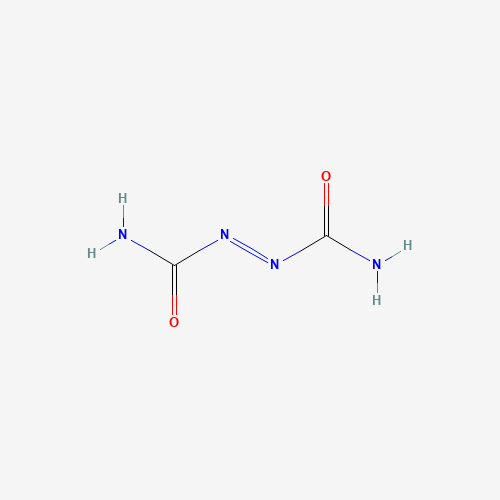
Azodicarbonamide is a flour bleaching agent and dough conditioner. The same compound is used as a blowing agent in making foamed plastics.
Where it is and isn’t permitted
| Jurisdiction | Status | Scope and limits | Citation |
|---|---|---|---|
| Australia and New Zealand | No listed food uses foundThis site has not matched this substance to any food use on this jurisdiction’s list of authorised food additives. A food additive may be used only in foods that list names. Flavourings, enzymes, processing aids and added nutrients are regulated separately and do not appear on it. | ||
| Canada | Permitted, with conditions | highest permitted level 45 mg/kg 2 permitted uses Show every permitted use
| Health Canada, List of Permitted Flour Treatment Agents (List 2)and 1 further provisionretrieved 2026-10-17 |
| European Union | No listed food uses foundThis site has not matched this substance to any food use on this jurisdiction’s list of authorised food additives. A food additive may be used only in foods that list names. Flavourings, enzymes, processing aids and added nutrients are regulated separately and do not appear on it. | ||
| Great Britain | No listed food uses foundThis site has not matched this substance to any food use on this jurisdiction’s list of authorised food additives. A food additive may be used only in foods that list names. Flavourings, enzymes, processing aids and added nutrients are regulated separately and do not appear on it. | ||
| Japan | No listing matchedThis site imports only Japan’s list of designated additives (Appended Table 1 to the Regulations for Enforcement of the Food Sanitation Act), matched by English name. Existing additives, natural flavouring agents and ordinary foods used as additives are permitted outside that list and are not imported, so an empty row does not show that Japan does not permit the substance. | ||
| South Korea | Permitted, with conditions | Designated food additive: Standards and Specifications for Food Additives, Part III, 1. …Designated food additive: Standards and Specifications for Food Additives, Part III, 1. 일반식품첨가물 (general food additives), 아조디카르본아미드 (“Azodicarbonamide”, the English the Code prints beside it). Main use (주용도) of 아조디카르본아미드: 밀가루개량제. Standard for use (사용기준) of 아조디카르본아미드: (1) [may be used only in the foods listed] “아조디카르본아미드는 아래의 식품에 한하여 사용하여야 한다. 1. 밀가루류 : 45mg/kg 이하” The Korean is the standard as published. There is no official English translation of the current Code (the English version on MFDS’s website is the 2020 edition and has no legal effect); the English in square brackets is this site’s description of what each sentence does, not a translation of the foods or the levels. Compositional specifications (Part IV) are not imported, nor are the general standards in Part II, which apply to every additive. | Standards and Specifications for Food Additives (식품첨가물의 기준 및 규격), MFDS Notification, Part III (Standards for use, by item)retrieved 2026-10-18 |
| United States | Permitted, with conditions | 21 CFR 172.806retrieved 2026-10-17 | |
| Codex Alimentarius | Not listedDoes not appear on this jurisdiction’s permitted list. That is not the same as being prohibited. |
How much is permitted
A listing usually limits the quantity as well as the food. Only one of the forms that takes is a figure: quantum satis and good manufacturing practice permit the amount the technological effect requires and no more, which is a limit rather than the absence of one. Figures below are the range across every food category this page is listed in, and categories differ between regulators — see how much is permitted.
| Canada | 45 mg/kg | 1 numeric limit, 1 no quantity stated |
|---|---|---|
| South Korea | — | 1 no quantity stated |
| United States | — | 1 no quantity stated |
What it is made from
Produced by chemical synthesis from urea and hydrazine. In dough it decomposes rapidly to biurea; the regulatory questions concern that breakdown and the trace semicarbazide it can form during baking.
- Vegan
- Vegetarian
Compare other additives on the dietary indexes.
- CAS registry number
- 123-77-3
- InChIKey
- XOZUGNYVDXMRKW-AATRIKPKSA-N
- PubChem
- CID 5462814
How JECFA defines it
The international specification for identity and purity, prepared by the Joint FAO/WHO Expert Committee on Food Additives and published by FAO. It is a different document from any above, written by a different body and revised on its own cycle; it is advisory, and a country adopts it or does not.
INS 927a Azodicarbonamide
Synonyms: Azobisformamide; INS No. 927a
Assay, identification and purity criteria
Description and assay
- Specification history
- Prepared at the 19th JECFA (1975), published in NMRS 55B (1976) and in FNP 52 (1992). Metals and arsenic specifications revised at the 63rd JECFA (2004) An acceptable level of treatment of 0-45 mg/kg was established at the 9th JECFA (1965)
- Chemical names
- Azodicarbonamide, azodicarboxylic acid diamide
- C.A.S. number
- 123-77-3
- Chemical formula
- C 2 H 4 N 4 O 2
- Formula weight
- 116.08
- Assay
- Not less than 98.6%; not less than 47.2% and not more than 48.7% of N on the dried basis
- DESCRIPTION
- Yellow to orange-red, odourless, crystalline powder
- FUNCTIONAL USES
- Maturing agent for flour
- METHOD OF ASSAY
- Titrimetric method/azodicarbonamide: Transfer about 225 mg of the accurately weighed sample, previously dried in a vacuum oven at 50 o for 2 h, into a 250-ml glass-stoppered iodine flask. Add about 23 ml of dimethyl sulfoxide to the flask, washing any adhered sample down with the solvent, stopper the flask, and place about 2 ml of the solvent in the cup or lip of the flask. Swirl occasionally until complete solution of the sample is effected, and then loosen the stopper to drain the remainder of solvent into the flask and to rinse down any dissolved sample into the solution. Add 5 g of potassium iodide followed by 15 ml of water, immediately pipet 10 ml of 0.5 N hydrochloric acid into the flask, and stopper quickly. Swirl until the potassium iodide dissolves, and allow to stand for 20-25 min protected from light. Titrate the liberated iodine with 0.1 N sodium thiosulfate to the disappearance of the yellow colour. Titrate with additional thiosulfate if any yellow colour appears within 15 min. Perform a blank determination on a solution consisting of 25 ml of dimethyl sulfoxide, 5 g of potassium iodide, 15 ml of water, and 5 ml of 0.5 N hydrochloric acid, and make any necessary correction. Each ml of 0.1 N sodium thiosulfate is equivalent to 5.804 mg of C 2 H 4 N 4 O 2 . Kjeldahl method (semimicro)/nitrogen: Transfer about 50 mg of the accurately weighed sample, previously dried in a vacuum oven at 50 o for 2 h, into a 100-ml Kjeldahl flask, add 3 ml of hydriodic acid (min. 57%) and digest the mixture for 75 min adding sufficient water, when necessary, to maintain the original volume. Increase the heat at the end of the digestion period and continue heating until the volume is reduced by about one-half. Cool to room temperature, add 1.5 g of potassium sulfate and 3 ml of water. Carefully add 4.5 ml of concentrated sulfuric acid and heat until iodine fumes are no longer evolved. Allow the mixture to cool, wash down the sides of the flask with water, heat until charring occurs, and again cool to room temperature. To the charred material add 40 mg of mercuric oxide, heat until the colour of the solution is pale yellow, then cool, wash down the sides of the flask with a few ml of water and digest the mixture for 3 h. Cool the digest, add 20 ml ammonia-free water, 16 ml of a 50% sodium hydroxide solution and 5 ml of a 44% sodium thiosulfate solution. Connect the flask to a distillation apparatus and distil, collecting the distillate in 10 ml of a 4% boric acid solution. Add a few drops of methyl red-methylene blue TS to the distillate and titrate with 0.05 N sulfuric acid. Perform a blank determination. Each ml of 0.05 N sulfuric acid is equivalent to 0.7004 mg of N.
Identification
- Solubility (Vol. 4)
- Practically insoluble in water and in ethanol; slightly soluble in dimethyl sulfoxide
- Melting range (Vol. 4)
- Above 180 o with decomposition
- Test for oxidation
- Liberates iodine from potassium iodide TS solution in the presence of 10% sulfuric acid
- Test for carbon dioxide
- Heat about 10 mg of the sample in a crucible. A drop of barium hydroxide solution held above the sample by means of a glass rod becomes turbid
Purity criteria
- Loss on drying (Vol. 4)
- Not more than 0.5% (50 o , 2h in vacuo)
- pH (Vol. 4)
- Not less than 5.0 (1 in 50 suspension made by adding 2 g of sample to 100 ml of water and agitating the mixture with a power stirrer for 5 min).
- Sulfated ash (Vol. 4)
- Not more than 0.15% Test 1.5 g of the sample (Method I)
- Lead (Vol. 4)
- Not more than 2 mg/kg Determine using an atomic absorption technique appropriate to the specified level. The selection of sample size and method of sample preparation may be based on the principles of the method described in Volume 4, “Instrumental Methods.”
Every name it appears under
61 recorded names. A label may use any of them.
CAS registry number
- 123-77-3
As it appears in regulation
- Azodicarbonamide
Other names
- (E)-(carbamoylimino)urea
- 1,1'-AZOBIS(FORMAMIDE)
- 1,1'-Azobis[formamide]
- 1,1'-Azobiscarbamide
- 1,1'-Azobisformamide
- 1,1'-Azodiformamide
- 1,2-Diazenedicarboxamide
- ABFA
- AZM 2S
- Azobis CA 110B
- Azobis CA 51C
- Azobiscarbonamide
- Azobiscarboxamide
- Azobisformamide
- Azocel
- Azodicarbamide
- Azodicarboamide
- Azodicarbonamide
- Azodicarboxamide
- Azodicarboxylic acid diamide
- Azodiformamide
- Azoform A
- Azoformamide
- Azoplastone
- C,C'-Azodi(formamide)
- Celogen AZ
- Celogen AZ 130
- Celogen AZ 199
- Celosen AZ
- ChKhz 21
- ChKhZ 21r
- delta(1,1')-Biurea
- Diazenedicarboxamide
- Evipor
- Ficel EP-A
- Formamide, 1,1'-azobis-
- Genitron AC
- Genitron AC 2
- Genitron AC 4
- Genitron EPC
- Kempore
- Kempore 125
- Kempore 60/40
- Kempore R 125
- Lucel ADA
- Nitropore
- Pinhole ACR 3
- Pinhole AK 2
- Poramid K 1
- Porofor 505
- Porofor ADC/R
- Porofor ChKhZ 21
- Porofor ChKhZ 21R
- Porofor DhKhZ 21
- Porofor-lk 1074 (bayer)
- Unifoam AZ
- Unifoam AZH 25
- Uniform AZ
- Yunihomu AZ
Hazard reference values
No reference value for this substance in the sources we hold.
Evidence and how bodies read it
Studies, and the differing conclusions regulators drew from them, are curated rather than machine-read, and none has been written for this substance yet.
Common questions
Assembled from what is above, in the words the questions are usually asked in. Each answer is the same statement the relevant section makes, with the same citations behind it.
- What is Azodicarbonamide?
- Azodicarbonamide is a flour bleaching agent and dough conditioner. The same compound is used as a blowing agent in making foamed plastics.
- What is Azodicarbonamide used for in food?
- It is listed as a flour treatment agent — the role Canada and the US assign it. This page shows every function each regulator records, with the citation for each.
- Is Azodicarbonamide banned in Europe?
- No. Azodicarbonamide does not appear on the EU's list of authorised food additives, which is not the same as being banned: the EU permits an additive only where it has authorised it, and usually the reason for an absence is that no one applied. The EU has made no finding against this substance. It does mean it may not be used as a food additive in the EU today.
- Where is Azodicarbonamide permitted?
- Of the seven regulators this site reads, Canada, South Korea and the US permit it. Each permission is for named foods at named levels, not a blanket one; the table on this page gives them with citations.
- Is Azodicarbonamide vegan?
- Yes. Azodicarbonamide is not derived from animals, and is suitable for vegetarians. This page says what it is made from and how.
Sources for this page
- ca retrieved 2026-10-17
- kr retrieved 2026-10-18
- ecfr retrieved 2026-10-17
- jecfaspecs retrieved 2026-09-23
Full licence terms and publisher details on Sources. How this page is built and updated: Method.
Machine-readable: a JSON record of this additive is given on request —how to ask for access.
Follow changes to Azodicarbonamide:Atom feed — regulatory events, and any change the weekly refresh detects in its provisions.