Brown FK
8062-14-4 · 1545 Brown · Brown FK · Brown-FK · C.I. Food Brown 1 · CI Food Brown 1 · EEC No. 124 · Golden Brown RK-FQ · trisodium;4-[(2,4-diamino-5-methylphenyl)diazenyl]benzenesulfonate;4-[[2,4-diamino-5-[(4-sulfonatophenyl)diazenyl]phenyl]diazenyl]benzenesulfonateE number E154INS 154CAS 8062-14-4
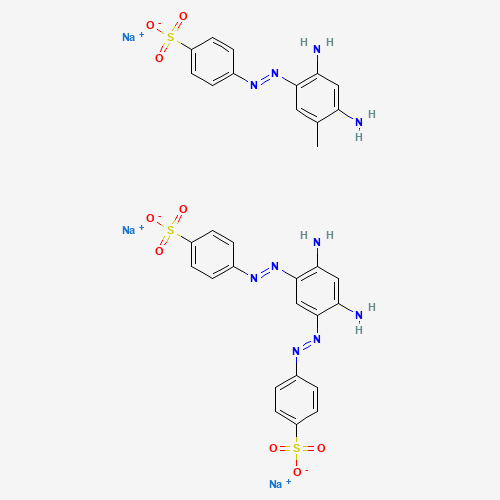
Brown FK is a brown colour that is not one substance but a mixture: six mono-, bis- and trisazo dyes together with subsidiary colouring matters, sodium chloride and sodium sulfate. JECFA's specification sets a separate ceiling for each of the six components.
Where it is and isn’t permitted
| Jurisdiction | Status | Scope and limits | Citation |
|---|---|---|---|
| Australia and New Zealand | No listed food uses foundThis site has not matched this substance to any food use on this jurisdiction’s list of authorised food additives. A food additive may be used only in foods that list names. Flavourings, enzymes, processing aids and added nutrients are regulated separately and do not appear on it. | ||
| Canada | No listing matchedHealth Canada’s lists name additives without E or INS numbers, so this site matches them by exact name. A substance listed there under a name this site does not recognise has no row here. | ||
| European Union | No listed food uses foundThis site has not matched this substance to any food use on this jurisdiction’s list of authorised food additives. A food additive may be used only in foods that list names. Flavourings, enzymes, processing aids and added nutrients are regulated separately and do not appear on it. | ||
| Great Britain | No listed food uses foundThis site has not matched this substance to any food use on this jurisdiction’s list of authorised food additives. A food additive may be used only in foods that list names. Flavourings, enzymes, processing aids and added nutrients are regulated separately and do not appear on it. | ||
| Japan | No listing matchedThis site imports only Japan’s list of designated additives (Appended Table 1 to the Regulations for Enforcement of the Food Sanitation Act), matched by English name. Existing additives, natural flavouring agents and ordinary foods used as additives are permitted outside that list and are not imported, so an empty row does not show that Japan does not permit the substance. | ||
| South Korea | No listing matchedThis site imports Part III of South Korea’s Standards and Specifications for Food Additives, matched by CAS number, then INS number, then exact name. Mixed preparations and sanitisers are not imported, and an entry whose identifiers disagreed with a page’s is held for review, so an empty row does not show that South Korea does not permit the substance. | ||
| United States | Not listedDoes not appear on this jurisdiction’s permitted list. That is not the same as being prohibited. | ||
| Codex Alimentarius | Not listedDoes not appear on this jurisdiction’s permitted list. That is not the same as being prohibited. |
What it is made from
The six dyes are made by diazotising aromatic amines and coupling them, the same chemistry as the other azo colours, from petroleum feedstocks. The product as manufactured is often diluted with sodium chloride to bring it to about half colouring matter.
- Vegan
- Vegetarian
Compare other additives on the dietary indexes.
- CAS registry number
- 8062-14-4
- InChIKey
- YJCJAUSWVUZMSY-UHFFFAOYSA-K
- PubChem
- CID 82276
How JECFA defines it
The international specification for identity and purity, prepared by the Joint FAO/WHO Expert Committee on Food Additives and published by FAO. It is a different document from any above, written by a different body and revised on its own cycle; it is advisory, and a country adopts it or does not.
INS 154 Brown FK
A mixture of six mono-, bis- and trisazo colours (see ‘Chemical names’ below) and subsidiary colouring matters together with water, sodium chloride and/or sodium sulfate as the principal uncoloured components. This product as manufactured, and to which these specifications apply, is often diluted with sodium chloride to a total colouring matters content of about 50% to meet the needs of users.
Synonyms: CI Food Brown 1; INS No. 154
Assay, identification and purity criteria
Description and assay
- Specification history
- Prepared at the 30th JECFA (1986), published in FNP 37 (1986) and in FNP 52 (1992). Metals and arsenic specifications revised at the 59th JECFA (2002). No ADI was allocated at the 30th (JECFA 1986)
- Chemical names
- A mixture of I Sodium 4-(2,4-diaminophenylazo) benzenesulfonate II Sodium 4-(4,6-diamino-m-tolylazo) benzenesulfonate III Disodium 4,4'-(4,6-diamino-1,3-phenylenebisazo)- di(benzenesulfonate) IV Disodium 4,4'-(2,4-diamino-1,3-phenylenebisazo)- di(benzenesulfonate) V Disodium 4,4'-(2,4-diamino-5-methyl-1,3-phenylene- bisazo)di(benzene-sulfonate) VI Trisodium 4,4',4''-(2,4-diaminobenzene-1,3,5- trisazo)tri-(benzene-sulfonate)
- C.A.S. number
- 8062-14-4
- Chemical formula
- I C 12 H 11 N 4 NaO 3 S II C 13 H 13 N 4 NaO 3 S III C 18 H 14 N 6 Na 2 O 6 S 2 IV C 18 H 14 N 6 Na 2 O 6 S 2 V C 19 H 16 N 6 Na 2 O 6 S 2 VI C 24 H 17 N 8 Na 3 O 9 S 3
- Formula weight
- I 314.30 II 328.33 III 520.46 IV 520.46 V 534.47 VI 726.59
- Assay
- Not less than 70% total colouring matters. Of the total colouring matters present the proportions of the components shall not exceed: I 26% II 17% III 17% IV 16% V 20% VI 16%
- DESCRIPTION
- Red-brown powder or granules
- FUNCTIONAL USES
- Colour
- METHOD OF ASSAY
- Determination of the amount of component colouring matters and subsidiary colouring matters. Apparatus - Glass tank capable of holding 20 cm x 20 cm glass TLC plates. - Micrometer syringe capable of delivering 0.10 ml with a tolerance of ± 0.002 ml - Spectrophotometer Reagents: All of recognized analytical grade - Chromatography solvent: A mixture of 4 parts phenol and 1 part water by volume - Diethyl ether - Kieselgel G - Extraction solvent: Mix 100 ml 10% sodium carbonate solution with 500 ml methanol and dilute to 1 L with water Procedure Prepare a 20 x 20 cm TLC plate with a 0.5 mm thick coating of Kieselgel G. Using the micrometer syringe apply a solution containing 0.4 mg Brown FK as evenly as possible in an area near the bottom of the plate. Develop the chromatogram in the phenol/water mixture allowing the solvent to ascend the full height of the plate; then remove it from the tank and allow it to dry. The diagram shows a typical Brown FK chromatogram with the bands numerically identified. Remove each band from the plate and transfer it to a small beaker. The subsidiary colouring matters are located in the area between bands I and V. Remove this area of Kieselgel G. Transfer it to a beaker and wash it with a small quantity of ether to remove the phenol. Allow the residual ether to evaporate. Add 10 ml of extraction solvent to each beaker and swirl to extract the colour. Filter through a small filter paper and measure the absorbance versus extraction solvent in 10 mm cells at the wavelength of maximum absorption. Calculate the concentration of each component colouring matter and of the subsidiary colouring matters using the absorptivity figures given in the table below. Component Wavelength(nm) Absorptivity I 453 55.1 II 464 59.6 III 355 88.2 IV 412 70.5 V 448 60.3 VI 410 59.7 Subsidiary Colouring Matters 425 74.2 Calculation of (i) Total colouring matters content (ii) Percentages of component colours (iii) Percentage of subsidiary colours Note : Component colours are expressed as percentages of the total colouring matters present, i.e. as percentages of the sum of component colours and subsidiary colours. Subsidiary colours are expressed for the purposes of the specification limit as a percentage of the sample. Let the absorptivities of the component colours be a 1 , a 2 ....a 6 . and the absorbances of the extracts of the component colours be A 1 , A 2 ...... A 6 . Let the Absorptivity of the subsidiary colours be a 7 and the absorbance of the extract of the subsidiary colours be A 7 . The weight (in mg) of component colour I in the 10 ml extract is calculated from the expression: In a similar manner calculate the weights (W 2 , W 3 .......W 7 ) of the remaining component colours and the subsidiary colours. (i) Total colouring matters content (%) = (ii) The percentage of component colour 1 = In a similar manner calculate the percentages of the other component colours. (iii) The percentage of subsidiary colours =
Identification
- Solubility (Vol. 4)
- Soluble in water; sparingly soluble in ethanol
- Identification of colouring matters (Vol. 4)
- Passes test
Purity criteria
- Loss on drying at 135 o
- Not more than 30% together with chloride and sulfate calculated as sodium
- (Vol. 4)
- salts
- Water insoluble matter (Vol. 4)
- Not more than 0.2%
- Lead (Vol. 4)
- Not more than 2 mg/kg Determine using an atomic absorption technique appropriate to the specified level. The selection of sample size and method of sample preparation may be based on the principles of the method described in Volume 4, “Instrumental Methods.”
- Subsidiary colouring matters
- Not more than 3.5% See description under METHOD OF ASSAY
- Organic compounds other than colouring matters
- Not more than - 0.7% of 4-aminobenzene-1-sulfonic acid - 0.35% of - m-phenylenediamine and 4-methyl-m-phenylenediamine See description under TESTS
- Unsulfonated primary aromatic amines (Vol. 4)
- Not more than 0.007% calculated as aniline (other than m-phenylene diamine and 4-methyl-m-phenylene diamine)
- Ether extractable matter (Vol. 4)
- Not more than 0.2%
- Organic compounds other
- Use liquid chromatography (see Volume 4) under the following conditions:
- than colouring matters
- Detector: A UV HPLC detector recording absorbances at 254 nm Column: 250 x 4 mm Li Chromosorb RP8, 7 μm Solvent system A: 0.075 M sodium acetate solution adjusted to pH 6.0 using glacial acetic acid. B: A:methanol (2:3) Flow rate: 1 ml/min Gradient: 0 min: 100% (A), 0% (B) 15 min: 0% (A), 100% (B) 20 min: 0% (A), 100% (B) 25 min: 100% (A), 0% (B)
Every name it appears under
9 recorded names. A label may use any of them.
CAS registry number
- 8062-14-4
Other names
- 1545 Brown
- Brown FK
- Brown-FK
- C.I. Food Brown 1
- CI Food Brown 1
- EEC No. 124
- Golden Brown RK-FQ
Systematic names
- trisodium;4-[(2,4-diamino-5-methylphenyl)diazenyl]benzenesulfonate;4-[[2,4-diamino-5-[(4-sulfonatophenyl)diazenyl]phenyl]diazenyl]benzenesulfonate
The EU re-evaluation programme
Every additive authorised in the EU before 20 January 2009 was put back through EFSA by Commission Regulation (EU) No 257/2010, and this one is named in it. What the Regulation required is below; whether the opinion has since been published is not something this site records.
- To be evaluated by 15 April 2010. Named in Annex II, Part I, point 1 as “Brown FK”, among the additives given priority within its class.
Hazard reference values
No reference value for this substance in the sources we hold.
Evidence and how bodies read it
Studies, and the differing conclusions regulators drew from them, are curated rather than machine-read, and none has been written for this substance yet.
Common questions
Assembled from what is above, in the words the questions are usually asked in. Each answer is the same statement the relevant section makes, with the same citations behind it.
- What is E 154?
- E 154 is Brown FK. Brown FK is a brown colour that is not one substance but a mixture: six mono-, bis- and trisazo dyes together with subsidiary colouring matters, sodium chloride and sodium sulfate. JECFA's specification sets a separate ceiling for each of the six components.
- Is Brown FK vegan?
- Yes. Brown FK is not derived from animals, and is suitable for vegetarians. This page says what it is made from and how.
Sources for this page
- jecfaspecs retrieved 2026-09-23
Full licence terms and publisher details on Sources. How this page is built and updated: Method.
Machine-readable: a JSON record of this additive is given on request —how to ask for access.
Follow changes to Brown FK:Atom feed — regulatory events, and any change the weekly refresh detects in its provisions.