Calcium cyclamate
139-06-0 · calcium bis(cyclohexylsulfamate) · Calcium bis(cyclohexylsulphamate) · Calcium Cycalmate · Calcium cyclamate · Calcium cyclamate anhydrous · Calcium cyclamate dihydrate · Calcium cyclamate(1:2) · Calcium cyclohexane sulphamate · Calcium cyclohexanesulfamate · Calcium cyclohexanesulfamate dihydrate · Calcium cyclohexylsulfamate (1:2) · Calcium cyclohexylsulfamate dihydrate · Calcium cyclohexylsulphamate · CALCIUM N-CYCLOHEXYLSULPHAMATE · calcium;N-cyclohexylsulfamate · Calciumcyclohexylsulfamat · CCRIS 186 · Cyclamate calcium · Cyclamate Calcium (2:1) Salt · CYCLAMATE CALCIUM ANHYDROUS · Cyclamate, calcium salt · cyclamic acid hemicalcium · Cyclan · Cyclohexanesulfamic acid, calcium salt (2:1) · Cyclohexanesulfamic acid, calcium salt (2:1), dihydrate · CYCLOHEXYLSULFAMIC ACID CALCIUM SALT · Cylan · Dietil · HSDB 823 · INS NO.952(II) · INS-952(II) · Kalziumzyklamate · Sucaryl calcium · Sulfamic acid, cyclohexyl-, calcium salt (2:1) · Sulfamic acid, cyclohexyl-, calcium salt (2:1), dihydrate · Sulfamic acid, N-cyclohexyl-, calcium salt (2:1) · UKLJMHXGZUJRTL-UHFFFAOYSA-L · X12LMJ1WYL · E952 · 952(ii) · Cyclamic acid and its Na and Ca salts · ACID CICLAMIC · AĊIDU ĊIKLAMIKU · CALCIUM CYCLAMATE · CALCIUMCYCLAMAAT · CALCIUMCYCLAMAT · CICLAMAT DE CALCIU · CICLAMAT DE SODIU · CICLAMATO CÁLCICO · CICLAMATO SÓDICO · Ciclamatos · Ciclamați · Ciclammati · CICLAMMATO DI CALCIO · CICLAMMATO DI SODIO · Ciklamatai · Ciklamati · CIKLAMINSAV · CIKLAMINSKA KISELINA · CIKLAMNA KISLINA · Ciklamátok · CIKLĀMSKĀBE · CYCLAAMZUUR · Cyclamat · Cyclamaten · Cyclamater · Cyclamates · CYCLAMIC ACID · CYCLAMINSYRE · Cyklamater · CYKLAMINIAN SODU · CYKLAMINIAN WAPNIA · Cyklaminiany · CYKLAMINSYRA · CYKLAMÁT SODNÝ · CYKLAMÁT VÁPENATÝ · Cyklamáty · I SYKLAAMIHAPPO · I) ACIDE CYCLAMIQUE · i) CIKLAMO RŪGŠTIS · i) KYSELINA CYKLÁMOVÁ · i) TSÜKLAMIINHAPE · i) ÁCIDO CICLÂMICO · I) ЦИКЛАМОВА КИСЕЛИНА · II NATRIUMSYKLAMAATTI · ii) CICLAMATO DE SÓDIO · II) CYCLAMATE DE SODIUM · ii) CYKLAMÁT SODNÝ · ii) NAATRIUMTSÜKLAMAAT · ii) NATRIO CIKLAMATAS · II) НАТРИЕВ ЦИКЛАМАТ · III KALSIUMSYKLAMAATTI · iii) CICLAMATO DE CÁLCIO · III) CYCLAMATE DE CALCIUM · iii) CYKLAMÁT VÁPENATÝ · iii) KALCIO CIKLAMATAS · iii) KALTSIUMTSÜKLAMAAT · III) КАЛЦИЕВ ЦИКЛАМАТ · KALCIJA CIKLAMĀTS · KALCIJEV CIKLAMAT · KALCIUM-CIKLAMÁT · KALCIUMCYKLAMAT · KWAS CYKLAMINOWY · KYSELINA CYKLAMOVÁ · Kyselina cyklamová a její sodná a vápenatá sůl · NATRIJEV CIKLAMAT · NATRIUMCYCLAMAAT · NATRIUMCYCLAMAT · NATRIUMCYKLAMAT · NÁTRIUM-CIKLAMÁT · NĀTRIJA CIKLAMĀTS · SODIUM CYCLAMATE · Syklamaatit · Tsüklamaadid · ÁCIDO CICLÁMICO · ĊIKLAMAT TAL-KALĊJU · ĊIKLAMAT TAS-SODJU · Ενώσεις του κυκλαμικού οξέος · ΚΥΚΛΑΜΙΚΟ ΑΣΒΕΣΤΙΟ · ΚΥΚΛΑΜΙΚΟ ΝΑΤΡΙΟ · ΚΥΚΛΑΜΙΚΟ ΟΞΥ · ЦикламатиINS 952(ii)CAS 5897-16-5
Listed as a sweetener by Codex, the EU and the US.
Listed as sweeteners (EU, US, Codex)
- European Union: Sweeteners — Regulation (EC) No 1333/2008, Annex II, Part B, 2. Sweeteners (consolidated text 02008R1333-20260818)
- United States: Non-nutritive sweetener — FDA, Substances Added to Food: CALCIUM CYCLAMATE--PROHIBITED
- Codex Alimentarius: Sweetener — CXS 192-1995 Table One, INS 952(ii)
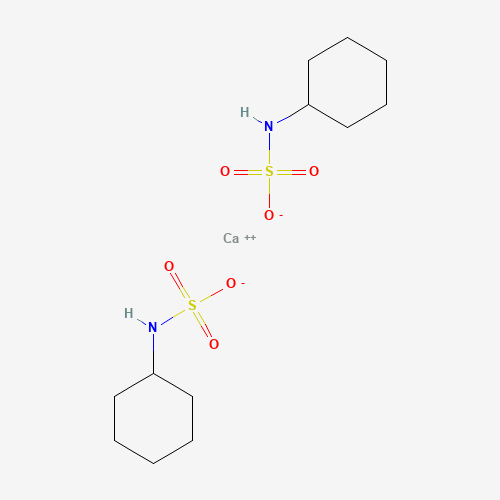
Calcium cyclamate is the cyclamate salt used where a sodium-free preparation is wanted, typically in tabletop sweeteners.
Where it is and isn’t permitted
| Jurisdiction | Status | Scope and limits | Citation |
|---|---|---|---|
| Australia and New Zealand | Permitted, with conditions | 9 food categories highest permitted level 20,000 mg/kg Show every food category
| Food Standards Code, Schedule 15, S15—5and 8 further provisionsretrieved 2026-10-17 |
| Canada | No listing matchedHealth Canada’s lists name additives without E or INS numbers, so this site matches them by exact name. A substance listed there under a name this site does not recognise has no row here. | ||
| European Union | Permitted, with conditions | 22 food categories highest permitted level 1,000 mg/l Show every food category
| Regulation (EC) No 1333/2008, Annex IIand 21 further provisionsretrieved 2026-10-18 |
| Great Britain | Permitted, with conditions | 19 food categories highest permitted level 1,000 mg/kg or mg/l Show every food category
| Assimilated Regulation (EC) No 1333/2008, Annex II (as at 28 June 2024), under E 952and 18 further provisionsretrieved 2026-10-18 |
| Japan | No listing matchedThis site imports only Japan’s list of designated additives (Appended Table 1 to the Regulations for Enforcement of the Food Sanitation Act), matched by English name. Existing additives, natural flavouring agents and ordinary foods used as additives are permitted outside that list and are not imported, so an empty row does not show that Japan does not permit the substance. | ||
| South Korea | No listing matchedThis site imports Part III of South Korea’s Standards and Specifications for Food Additives, matched by CAS number, then INS number, then exact name. Mixed preparations and sanitisers are not imported, and an entry whose identifiers disagreed with a page’s is held for review, so an empty row does not show that South Korea does not permit the substance. | ||
| United States | Prohibited | 21 CFR 189.135 prohibits cyclamate and its derivatives: paragraph (a) names the calcium, sodium, magnesium and potassium salts of cyclohexane sulfamic acid, and paragraph (b) provi …21 CFR 189.135 prohibits cyclamate and its derivatives: paragraph (a) names the calcium, sodium, magnesium and potassium salts of cyclohexane sulfamic acid, and paragraph (b) provides that food containing any added or detectable level of cyclamate is deemed to be adulterated, on an order published in the Federal Register of October 21, 1969 (34 FR 17063). The section is held on this site as the page cyclamate-and-its-derivatives. | 21 CFR 189.135retrieved 2026-10-18 |
| Codex Alimentarius | Permitted, with conditions | 34 food categories highest permitted level 3,000 mg/kg Show every food category and its notes
| CXS 192-1995 Table One, INS 952(ii)and 33 further provisionsretrieved 2026-09-07 |
How much is permitted
A listing usually limits the quantity as well as the food. Only one of the forms that takes is a figure: quantum satis and good manufacturing practice permit the amount the technological effect requires and no more, which is a limit rather than the absence of one. Figures below are the range across every food category this page is listed in, and categories differ between regulators — see how much is permitted.
| Australia and New Zealand | 350 mg/kg – 20,000 mg/kg | 8 numeric limit, 1 GMP |
|---|---|---|
| European Union | 250 mg/kg – 1,000 mg/kg | 18 numeric limit, 3 quantum satis, 1 no quantity stated |
| Great Britain | 250 mg/kg – 1,000 mg/kg | 14 numeric limit, 2 several limits, 3 quantum satis |
| Codex Alimentarius | 250 mg/kg – 3,000 mg/kg | 33 numeric limit, 1 GMP |
What a label must say
Words a food containing Calcium cyclamate is obliged to carry, quoted from the instrument that imposes them. A required statement is a fact about the regulation, not a finding about the substance — every rule below applies where the additive is authorised.
‘with sweetener(s)’, or ‘with sugar(s) and sweetener(s)’ where the food also contains added sugar. The statement accompanies the name of the food.
Any food containing an authorised sweetener. Regulation (EU) No 1169/2011, Annex III, points 2.1 and 2.2 · Assimilated Regulation (EU) No 1169/2011, Annex III
Every rule collected at what a label must say.
What it is made from
Made by neutralising cyclamic acid with a calcium base. The acid is produced by sulfonating petroleum-derived cyclohexylamine.
- Vegan
- Vegetarian
Compare other additives on the dietary indexes.
- CAS registry number
- 5897-16-5
- InChIKey
- UKLJMHXGZUJRTL-UHFFFAOYSA-L
- PubChem
- CID 8752
How JECFA defines it
The international specification for identity and purity, prepared by the Joint FAO/WHO Expert Committee on Food Additives and published by FAO. It is a different document from any above, written by a different body and revised on its own cycle; it is advisory, and a country adopts it or does not.
INS 952(ii) Calcium Cyclamate
Synonyms: INS No. 952(ii)
Assay, identification and purity criteria
Description and assay
- Specification history
- Prepared at the 46th JECFA (1996), published in FNP 52 Add 4 (1996) superseding specifications prepared at the 24th JECFA (1980), published in FNP 17 (1980). Metals and arsenic specifications revised at the 63rd JECFA (2004). A group ADI of 0-11 mg/kg bw for cyclamic acid and its calcium and sodium salts (as cyclamic acid) was established at the 26th JECFA (1982)
- Chemical names
- Calcium cyclohexylsulfamate, calcium cyclohexanesulfamate
- C.A.S. number
- 139-06-0
- Chemical formula
- C12H24CaN2O6S2 · 2H2O
- Formula weight
- 432.57
- Assay
- Not less than 98.0% and not more than 101.0% on the anhydrous basis
- DESCRIPTION
- White colourless crystals or crystalline powder. Approximately 30 times sweeter than sucrose
- FUNCTIONAL USES
- Sweetener
- METHOD OF ASSAY
- Dissolve about 0.4 g of the sample accurately weighed, in a mixture of 50 ml of water and 5 ml of dilute hydrochloric acid TS and titrate with 0.1M sodium nitrite. Add the last ml of titrant dropwise until a blue colour is produced immediately when a glass rod dipped into the titrated solution is streaked on a piece of starch iodide test paper or alternatively the end point may be detected electro-metrically. When the titration is complete, the end-point is reproducible after the mixture has been allowed to stand for 1 min. Each ml of 0.1M sodium nitrite is equivalent to 19.83 mg of C12H24CaN2O6S2, calculated on the anhydrous basis.
Identification
- Solubility (Vol. 4)
- Soluble in water, sparingly soluble in ethanol
- Precipitate formation
- To 10 ml of a 1 in 100 solution of the sample add 1 ml of hydrochloric acid TS, mix, add 1 ml of barium chloride TS. The solution remains clear, but upon the addition of 1 ml sodium nitrite TS, a white precipitate is formed
- Test for calcium (Vol. 4)
- Passes test
Purity criteria
- Loss on drying (Vol. 4)
- Not less than 6.0% and not more than 9.0% (140 o , 2 h)
- Cyclohexylamine (Vol. 4)
- Not more than 10 mg/kg Transfer 25 g of the sample into a 100 ml volumetric flask, dissolve in water, dilute to volume with water, and mix. Use this solution as the test preparation.
- Dicyclohexylamine (Vol. 4)
- Not more than 1 mg/kg
- Lead (Vol. 4)
- Not more than 1 mg/kg Determine using an atomic absorption technique appropriate to the specified level. The selection of sample size and method of sample preparation may be based on the principles of the method described in Volume 4, “Instrumental Methods.”
Every name it appears under
123 recorded names. A label may use any of them.
E number
- E952
INS number
- 952(ii)
CAS registry number
- 139-06-0
As it appears in regulation
- Cyclamic acid and its Na and Ca salts
Other names
- calcium bis(cyclohexylsulfamate)
- Calcium bis(cyclohexylsulphamate)
- Calcium Cycalmate
- Calcium cyclamate
- Calcium cyclamate anhydrous
- Calcium cyclamate dihydrate
- Calcium cyclamate(1:2)
- Calcium cyclohexane sulphamate
- Calcium cyclohexanesulfamate
- Calcium cyclohexanesulfamate dihydrate
- Calcium cyclohexylsulfamate (1:2)
- Calcium cyclohexylsulfamate dihydrate
- Calcium cyclohexylsulphamate
- CALCIUM N-CYCLOHEXYLSULPHAMATE
- calcium;N-cyclohexylsulfamate
- Calciumcyclohexylsulfamat
- CCRIS 186
- Cyclamate calcium
- Cyclamate Calcium (2:1) Salt
- CYCLAMATE CALCIUM ANHYDROUS
- Cyclamate, calcium salt
- cyclamic acid hemicalcium
- Cyclan
- Cyclohexanesulfamic acid, calcium salt (2:1)
- Cyclohexanesulfamic acid, calcium salt (2:1), dihydrate
- CYCLOHEXYLSULFAMIC ACID CALCIUM SALT
- Cylan
- Dietil
- HSDB 823
- INS NO.952(II)
- INS-952(II)
- Kalziumzyklamate
- Sucaryl calcium
- Sulfamic acid, cyclohexyl-, calcium salt (2:1)
- Sulfamic acid, cyclohexyl-, calcium salt (2:1), dihydrate
- Sulfamic acid, N-cyclohexyl-, calcium salt (2:1)
- UKLJMHXGZUJRTL-UHFFFAOYSA-L
- X12LMJ1WYL
Hazard reference values
| Type | Value | Population | Assessed by | Opinion |
|---|---|---|---|---|
| ADI | 11 mg/kg bw/day | — | JECFA | 1982 |
Evidence and how bodies read it
Studies, and the differing conclusions regulators drew from them, are curated rather than machine-read, and none has been written for this substance yet.
Common questions
Assembled from what is above, in the words the questions are usually asked in. Each answer is the same statement the relevant section makes, with the same citations behind it.
- What is INS 952(ii)?
- INS 952(ii) is Calcium cyclamate. Calcium cyclamate is the cyclamate salt used where a sodium-free preparation is wanted, typically in tabletop sweeteners.
- What is Calcium cyclamate used for in food?
- It is listed as a sweetener — the role Codex, the EU and the US assign it. This page shows every function each regulator records, with the citation for each.
- Where is Calcium cyclamate permitted?
- Of the seven regulators this site reads, Australia and New Zealand, the EU, Great Britain and the Codex standard permit it. Each permission is for named foods at named levels, not a blanket one; the table on this page gives them with citations.
- Is Calcium cyclamate vegan?
- Yes. Calcium cyclamate is not derived from animals, and is suitable for vegetarians. This page says what it is made from and how.
Sources for this page
- anz retrieved 2026-10-17
- eu retrieved 2026-10-18
- gb retrieved 2026-10-18
- us-listings retrieved 2026-10-18
- gsfa retrieved 2026-09-07
- jecfaspecs retrieved 2026-09-23
Full licence terms and publisher details on Sources. How this page is built and updated: Method.
Machine-readable: a JSON record of this additive is given on request —how to ask for access.
Follow changes to Calcium cyclamate:Atom feed — regulatory events, and any change the weekly refresh detects in its provisions.