Calcium L-5-methyltetrahydrofolate
151533-22-1 · (6s)-5-methyltetrahydrofolic acid calcium salt · 6(S)-5-METHYLTETRAHYDROFOLIC ACID, CALCIUM SALT [NDI] · BAY 86-7660 · BEYAZ COMPONENT LEVOMEFOLATE CALCIUM · Bodyfolin · calcium (2S)-2-[4-({[(6S)-2 · Calcium L-5-methyltetrahydrofolate · CALCIUM L-METHYLFOLATE · Calcium levomefolate · CALCIUM-5-METHYLTETRAHYDROFOLATE · Denovo · Drospirenone, Ethinyl Estradiol and Levomefolate Calcium and Levomefolate Calcium · Extrafolate-S · L-5-methyl tetrahydrofolic · L-5-Methyletrahydrofolate calcium · L-5-Methyltetrahydrofolate calcium · L-5-Methyltetrahydrofolic acid, calcium salt · L-5-MTHF calcium · L-5-MTHF-Ca · L-Methylfolate, calcium · L-methylfolate-calcium · L-Methyltetrahyrofolate, calcium salt · Levomefolate calcium · Levomefolate calcium (USAN) · Levomefolic acid calcium salt · Levomefolinate calcium · LMC-A · LMCA · Metafolin · Metafolin (TN) · NDI 638 · SAFYRAL COMPONENT LEVOMEFOLATE CALCIUM · (S)-2-(4-((((S)-2-Amino-5-methyl-4-oxo-3,4,5,6,7,8-hexahydropteridin-6-yl)methyl)amino)benzamido)pentanedioic acid, calcium salt · (S)-2-(4-((((S)-2-Amino-5-methyl-4-oxo-3,4,5,6,7,8-hexahydropteridin-6-yl)methyl)amino)benzamido)pentanedioicacid,calciumsalt · calcium (2S)-2-[4-({[(6S)-2-amino-5-methyl-4-oxo-3,4,5,6,7,8-hexahydropteridin-6-yl]methyl}amino)benzamido]pentanedioate · calcium (2S)-2-{[4-({[(6S)-2-amino-5-methyl-4-oxo-3,4,5,6,7,8-hexahydropteridin-6-yl]methyl}amino)phenyl]formamido}pentanedioate · calcium (4-((((S)-2-amino-5-methyl-4-oxo-3,4,5,6,7,8-hexahydropteridin-6-yl)methyl)amino)benzoyl)-L-glutamate · Calcium (S)-2-[4-[[[(S)-2-Amino-5-methyl-4-oxo-3,4,5,6,7,8-hexahydropteridin-6-yl]methyl]amino]benzamido]pentanedioate · Calcium N-(4-((((6S)-2-amino-5-methyl-4-oxo-1,4,5,6,7,8-hexahydropteridin-6-yl)methyl)amino)benzoyl)-L-glutamate · calcium;(2S)-2-[[4-[[(6S)-2-amino-5-methyl-4-oxo-3,6,7,8-tetrahydropteridin-6-yl]methylamino]benzoyl]amino]pentanedioate · L-Glutamic acid, N-(4-((((6S)-2-amino-1,4,5,6,7,8-hexahydro-5-methyl-4-oxo-6-pteridinyl)methyl)amino)benzoyl)-, calcium salt (1:1) · L-Glutamic acid, N-[4-[[[(6S)-2-amino-3,4,5,6,7,8-hexahydro-5-methyl-4-oxo-6-pteridinyl]methyl]amino]benzoyl]-, calcium salt (1:1) · N-(4-(((2-Amino-1,4,5,6,7,8-hexahydro-5-methyl-4-oxo-6-pteridinyl)methyl)amino)benzoyl)-L-glutamic acid calcium saltCAS 151533-22-1
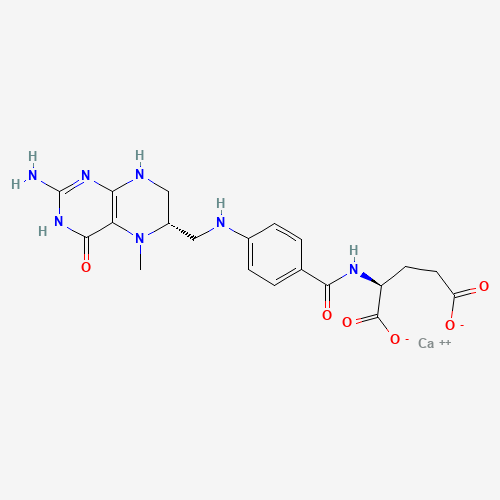
The calcium salt of L-5-methyltetrahydrofolate, the form of folate that circulates in the body, used as a source of folate in foods and supplements rather than for any technological effect.
Where it is and isn’t permitted
| Jurisdiction | Status | Scope and limits | Citation |
|---|---|---|---|
| Australia and New Zealand | No listed food uses foundThis site has not matched this substance to any food use on this jurisdiction’s list of authorised food additives. A food additive may be used only in foods that list names. Flavourings, enzymes, processing aids and added nutrients are regulated separately and do not appear on it. | ||
| Canada | No listing matchedHealth Canada’s lists name additives without E or INS numbers, so this site matches them by exact name. A substance listed there under a name this site does not recognise has no row here. | ||
| European Union | No listed food uses foundThis site has not matched this substance to any food use on this jurisdiction’s list of authorised food additives. A food additive may be used only in foods that list names. Flavourings, enzymes, processing aids and added nutrients are regulated separately and do not appear on it. | ||
| Great Britain | No listed food uses foundThis site has not matched this substance to any food use on this jurisdiction’s list of authorised food additives. A food additive may be used only in foods that list names. Flavourings, enzymes, processing aids and added nutrients are regulated separately and do not appear on it. | ||
| Japan | No listing matchedThis site imports only Japan’s list of designated additives (Appended Table 1 to the Regulations for Enforcement of the Food Sanitation Act), matched by English name. Existing additives, natural flavouring agents and ordinary foods used as additives are permitted outside that list and are not imported, so an empty row does not show that Japan does not permit the substance. | ||
| South Korea | No listing matchedThis site imports Part III of South Korea’s Standards and Specifications for Food Additives, matched by CAS number, then INS number, then exact name. Mixed preparations and sanitisers are not imported, and an entry whose identifiers disagreed with a page’s is held for review, so an empty row does not show that South Korea does not permit the substance. | ||
| United States | Not listedDoes not appear on this jurisdiction’s permitted list. That is not the same as being prohibited. | ||
| Codex Alimentarius | Not listedDoes not appear on this jurisdiction’s permitted list. That is not the same as being prohibited. |
GRAS notices to the FDA
A GRAS notice is a company’s conclusion that a substance is generally recognised as safe for the use it describes. FDA’s letter responds to that conclusion, for that notifier and that use. It is not a listing in 21 CFR, and it is not counted as a US permission above. The substance and use are as FDA’s inventory words them; this site matched the notice to this page by exact name.
GRN No. 915 · Calcium L-methylfolate · DSM Nutritional Products
Intended use: Intended for use in non-exempt and exempt infant formulas as a partial or complete replacement for folic acid as a source of the vitamin folate.
FDA’s response (2021-02-23): FDA has no questions
What it is made from
Made by reducing folic acid to tetrahydrofolic acid, methylating it, and crystallising the L-form as its calcium salt from water.
- Vegan
- Vegetarian
Compare other additives on the dietary indexes.
- CAS registry number
- 151533-22-1
- InChIKey
- VWBBRFHSPXRJQD-QNTKWALQSA-L
- PubChem
- CID 135564391
How JECFA defines it
The international specification for identity and purity, prepared by the Joint FAO/WHO Expert Committee on Food Additives and published by FAO. It is a different document from any above, written by a different body and revised on its own cycle; it is advisory, and a country adopts it or does not.
Calcium L-5-Methyltetrahydrofolate
Calcium L-5-methyltetrahydrofolate (L-5-MTHF-Ca) is a synthetic derivative of folic acid, the predominant, naturally occurring form of folate. It is synthesized by reduction of folic acid to tetrahydrofolic acid followed by methylation and diastereoselective crystallization (in water) of L-5-MTHF as its calcium salt. The product contains variable amounts of water of crystallization.
Synonyms: L-5-Methyltetrahydrofolic acid, calcium salt L-Methyltetrahydrofolate, calcium salt L-Methylfolate, calcium L-5-MTHF-Ca L-Methyltetrahyrofolate, calcium salt
Assay, identification and purity criteria
Description and assay
- Specification history
- New specifications prepared at the 65th JECFA (2005) and published in FNP 52 Add 13 (2005). At the 65th JECFA (2005) the Committee had no safety concerns for the use of the substance in dry crystalline or microencapsulated form as an alternative to folic acid used in dietary supplements, foods for special dietary uses and other foods.
- Chemical name
- N-{4-[[((6S)-2-amino-3,4,5,6,7,8-hexahydro-5-methyl-4-oxo-6-pteridinyl)methyl]amino]benzoyl}-L-glutamic acid, calcium salt
- C.A.S. number
- 151533-22-1
- Chemical formula
- C 20 H 23 CaN 7 O 6 (anhydrous form)
- Structural formula
- (anhydrous form)
- Formula weight
- 497.5 (anhydrous form)
- Assay
- 95.0 – 102.0% (anhydrous basis)
- DESCRIPTION
- White to light yellowish, almost odourless, crystalline powder
- FUNCTIONAL USES
- Nutrient supplement
- METHOD OF ASSAY
- Calculate the percentage of L-5-MTHF-Ca in the sample from the content of 5-MTHF-Ca (L- and D-diastereoisomers), determined in the test for "Other folates and related substances", and the content of D-5-MTHF-Ca, determined in the test for D-5-Methylfolate, and correcting for water content, as follows: L-5-MTHF-Ca (%) = 100 × A T × W S × S × (100 - D) × 1.083 / A S × W × (100 - %H 2 O) where A T is taken from the calculation for the D-5-Methylfolate analysis D = the percentage of D-5-Methylfolate in the sample A S , W, W S , and S are taken from the determination of Other folates and related substances %H 2 O = water content (%) 1.083 is the ratio of the formula weight of 5-MTHF-Ca to that of 5-MTHF.
Identification
- Solubility (Vol. 4)
- Sparingly soluble in water and very slightly soluble or insoluble in most organic solvents; soluble in alkaline solutions
- Infrared absorption
- The infrared absorption spectrum of a potassium bromide dispersion of the sample corresponds to that of a L-5-MTHF-Ca standard (see Appendix).
- Calcium
- Dilute 30 g of acetic acid (glacial) to 100 ml with water. Dissolve 5.3 g of K 4 Fe(CN) 6 in 100 ml of water. To 5 ml of the acetic acid solution, add 20 mg of the sample and then 0.5 ml of the potassium ferrocyanide solution. Mix and add 50 mg of ammonium chloride. A white crystalline precipitate is formed.
- Liquid chromatography
- Retention time matches that of a reference standard (see under TESTS)
Purity criteria
- Water (Vol. 4)
- Not more than 17.0% (Karl Fischer method) (Note: Allow sufficient time (15 min) for release of bound water.)
- Calcium
- 7.0 - 8.5% (anhydrous basis) Accurately weigh 500 mg of sample and transfer to a 500-ml conical flask. Add 150 ml of water to dissolve the sample and 20 ml of a pH 10 buffer (NH 3 /NH 4 Cl). Using eriochrome black T as indicator, titrate (continuous stirring) with standardized 0.1 M EDTA until the colour changes from violet to blue/green. Each 1.0 ml of 0.1 M EDTA corresponds to 4.008 mg of calcium. Calculate the calcium content on the anhydrous basis.
- Other folates and related substances
- Not more than 2.5% See description under TESTS
- D-5-Methylfolate
- Not more than 1.0% See description under TESTS
- Total viable aerobic count (Vol. 4)
- Not more than 1000 CFU/g
- Lead (Vol. 4)
- Not more than 2 mg/kg Determine using an atomic absorption technique appropriate to the specified level. The selection of sample size and method of sample preparation may be based on the principles of the methods described in Volume 4, "Instrumental methods".
- Test: Other folates and related substances
- Using a L-5-MTHF-Ca reference standard, Quantitate other folates and related substances by HPLC. The suitability of the applied HPLC system is checked daily by a "system suitability test" (see below). Reference standard solution : Accurately weigh 50 mg of L-5-MTHF-Ca (L-5-methyltetrahydrofolic acid, calcium salt (Merck Eprova AG, CH-8200 Schaffhausen, Switzerland) into a 100-ml volumetric flask. Dissolve in a small quantity of water and dilute to volume. Sample solution : Prepare as for the reference standard using 50 mg of the sample. Mobile phase solutions A: Dissolve 7.80 g of NaH 2 PO 4 · 2H 2 O (0.05 mol) in 1000 ml of water and adjust the pH to 6.5 with 32% NaOH. Filter and degas the solution. B: Dissolve 5.07 g of NaH 2 PO 4 · 2H 2 O (0.03 mol) in 650 ml of water and 350 ml of methanol (chromatography grade) and adjust the pH to 8.0 with 32% NaOH. Filter and degas the solution. Chromatography Conditions Column: Hypersil-ODS, 5 μm; 250 x 4 mm (Thermo Hypersil Keystone or equivalent) Flow rate: 1.1 ml/min Gradient: Time % Mobile phase % Mobile phase Remark (min) A B 0 100 0 Start 0 - 14 100 – 45 0 – 55 Linear gradient 14 – 17 45 – 0 100 Linear gradient 17 – 22 0 100 Hold 22 – 31 100 0 Reconditionin g Temperature: Room temperature Injection volume: 10 μl Detection: UV (280 nm) Run time: 22 min Retention times given below are approximate: Folates and related substances Retention time (min) 4-Aminobenzoylglutamic acid (ABGA) 3.1 4 α -Hydroxy-5-methyltetrahydrofolic acid 4.3 (HOMeTHFA) D-Pyrazino-s-triazine derivative (D-Mefox) 6.1 L-Pyrazino-s-triazine derivative (L-Mefox) 6.3 Tetrahydrofolic acid (THFA) 8.5 7,8-Dihydrofolic acid (DHFA) 11.2 Folic acid (FA) 11.4 5,10-Methylenetetrahydrofolic acid (CH 2 THFA) 11.7 5-Methyltetrahydrofolic acid (5-MTHF) 13.6 5-Methyltetrahydropteroic acid (MeTHPA) 15.1 N 2 -Methylamino-5-methyltetrahydrofolic acid 17.6 (DiMeTHFA) Sample analysis : Inject the reference standard solution and the sample solutions immediately after preparation, using the conditions described above. (Note: After analysis, flush the column with methanol/water 85:15 and store it under the same conditions.) Calculate the content of each folate (other than 5-MTHF) and related substance, X i (%), listed in the above table according to the following formula: X i (%) = A i ×W S × S × (RF) i /A S × W where A i = the peak area for each folate (other than 5-MTHF) and related substance A S = the peak area for the L-5-MTHF-Ca Standard W S = the weight (mg) of L-5-MTHF-Ca Standard W = the weight (mg) of the sample S = the percent of L-5-MTHF in the L-5-MTHF-Ca Standard, calculated as free acid (RF) i = Response Factor for the i-th substance (absorbance at 280 nm in the applied eluent system relative to that of L-5-MTHF) Other folates and related substances RF ABGA 0.93 HOMeTHFA 1.11 L-Mefox and D-Mefox 1.11 DHFA 0.98 FA 0.86 MeTHPA 0.68 THFA 1.00 CH 2 THFA 1.00 DiMeTHFA 1.00 If there are any unidentified impurities, apply a RF of 1.00. Calculate the total amount of "Other folates and related substances" by summing the X i for all impurities. System suitability test procedure Mixed folates solution : Weigh 25 mg each of ABGA, HOMeTHFA, L-Mefox, DHFA, FA and MeTHPA (all available from Merck Eprova AG) into a 100-ml volumetric flask. Add a small quantity of water to dissolve the mixture; add some sodium hydrogen carbonate and sodium carbonate to aid the dissolution, and fill to the mark with water. System suitability test solution (SST solution) : Weigh accurately 50 mg of a L-5-MTHF-Ca sample containing DiMeTHFA into a 100-ml volumetric flask. (Available from Merck Eprova AG). Add 1 ml of the Mixed folates solution and a small quantity of water to dissolve, mix and dilute to volume with water. System suitability test : Inject 10 μl of the SST solution immediately. The resolution between L-5-MTHF and MeTHPA must be at least 5.
- Test: D-5-Methylfolate
- D-5-Methylfolate is quantitated by HPLC using a chromatographic system which allows separation of the D- from the L-stereoisomer. The suitability of the applied HPLC system is checked daily by a "system suitability test" (see below). Sample preparation : Accurately weigh 50 mg of the sample into a 100 ml volumetric flask. Dissolve in water and dilute to volume with water. Mobile phase : Mix 970 ml of 0.03 M NaH 2 PO 4 (obtained by dissolving 4.68 g of NaH 2 PO 4 · 2H 2 O in water and diluting with water to 1000 ml) with 30 ml of acetonitrile (chromatography grade) and adjust the pH to 6.8 with 32% NaOH. Filter and degas the solution. Chromatography Conditions Column: Chiral Protein HSA, 5 μm, 150 x 4 mm (ChromTech or equivalent) Flow rate: 1 ml/min Temperature: 40° Injection volume: 10 μl Detection: UV (280 nm) Run time: 22 min Solvent: Water Sample analysis : Inject the sample solution immediately after preparation using the conditions described above. Determine the areas under peak for L-5-MTHF (retention time: ca. 11 min) and D-5-MTHF (retention time: ca. 15 min) . Calculation Determine the ratio of the peak area for the D-isomer (A D ) to the sum of the peak areas for the D- and L-isomers (A T ), and calculate the D-5-MTHF content as follows: D-5-MTHF (%) = 100A D /A T System suitability test procedure System suitability test solution (SST solution) : Weigh and transfer into a 200-ml volumetric flask the following: 1.0 mg of HOMeTHFA, 1.5 mg ABGA, 2.0 mg each of L-Mefox and MeTHPA, 3.0 mg of FA, 4.0 mg of DHFA, 10 mg of L,D-5-MTHF and D,D-5-MTHF (L-5-MTHF and D-5-MTHF carrying D-glutamic acid substitution), and 50 mg of racemic 5-MTHF-Ca (L-5-MTHF and D-5-MTHF carrying L-glutamic acid substitution) (all available from Merck Eprova AG). Add a small quantity of water to dissolve the mixture; add some sodium hydrogen carbonate to aid the dissolution, and fill to the mark with water. Immediately inject into the HPLC system. The resolution between L-5-MTHF and D-5-MTHF must be at least 2.
Every name it appears under
44 recorded names. A label may use any of them.
CAS registry number
- 151533-22-1
Other names
- (6s)-5-methyltetrahydrofolic acid calcium salt
- 6(S)-5-METHYLTETRAHYDROFOLIC ACID, CALCIUM SALT [NDI]
- BAY 86-7660
- BEYAZ COMPONENT LEVOMEFOLATE CALCIUM
- Bodyfolin
- calcium (2S)-2-[4-({[(6S)-2
- Calcium L-5-methyltetrahydrofolate
- CALCIUM L-METHYLFOLATE
- Calcium levomefolate
- CALCIUM-5-METHYLTETRAHYDROFOLATE
- Denovo
- Drospirenone, Ethinyl Estradiol and Levomefolate Calcium and Levomefolate Calcium
- Extrafolate-S
- L-5-methyl tetrahydrofolic
- L-5-Methyletrahydrofolate calcium
- L-5-Methyltetrahydrofolate calcium
- L-5-Methyltetrahydrofolic acid, calcium salt
- L-5-MTHF calcium
- L-5-MTHF-Ca
- L-Methylfolate, calcium
- L-methylfolate-calcium
- L-Methyltetrahyrofolate, calcium salt
- Levomefolate calcium
- Levomefolate calcium (USAN)
- Levomefolic acid calcium salt
- Levomefolinate calcium
- LMC-A
- LMCA
- Metafolin
- Metafolin (TN)
- NDI 638
- SAFYRAL COMPONENT LEVOMEFOLATE CALCIUM
Systematic names
- (S)-2-(4-((((S)-2-Amino-5-methyl-4-oxo-3,4,5,6,7,8-hexahydropteridin-6-yl)methyl)amino)benzamido)pentanedioic acid, calcium salt
- (S)-2-(4-((((S)-2-Amino-5-methyl-4-oxo-3,4,5,6,7,8-hexahydropteridin-6-yl)methyl)amino)benzamido)pentanedioicacid,calciumsalt
- calcium (2S)-2-[4-({[(6S)-2-amino-5-methyl-4-oxo-3,4,5,6,7,8-hexahydropteridin-6-yl]methyl}amino)benzamido]pentanedioate
- calcium (2S)-2-{[4-({[(6S)-2-amino-5-methyl-4-oxo-3,4,5,6,7,8-hexahydropteridin-6-yl]methyl}amino)phenyl]formamido}pentanedioate
- calcium (4-((((S)-2-amino-5-methyl-4-oxo-3,4,5,6,7,8-hexahydropteridin-6-yl)methyl)amino)benzoyl)-L-glutamate
- Calcium (S)-2-[4-[[[(S)-2-Amino-5-methyl-4-oxo-3,4,5,6,7,8-hexahydropteridin-6-yl]methyl]amino]benzamido]pentanedioate
- Calcium N-(4-((((6S)-2-amino-5-methyl-4-oxo-1,4,5,6,7,8-hexahydropteridin-6-yl)methyl)amino)benzoyl)-L-glutamate
- calcium;(2S)-2-[[4-[[(6S)-2-amino-5-methyl-4-oxo-3,6,7,8-tetrahydropteridin-6-yl]methylamino]benzoyl]amino]pentanedioate
- L-Glutamic acid, N-(4-((((6S)-2-amino-1,4,5,6,7,8-hexahydro-5-methyl-4-oxo-6-pteridinyl)methyl)amino)benzoyl)-, calcium salt (1:1)
- L-Glutamic acid, N-[4-[[[(6S)-2-amino-3,4,5,6,7,8-hexahydro-5-methyl-4-oxo-6-pteridinyl]methyl]amino]benzoyl]-, calcium salt (1:1)
- N-(4-(((2-Amino-1,4,5,6,7,8-hexahydro-5-methyl-4-oxo-6-pteridinyl)methyl)amino)benzoyl)-L-glutamic acid calcium salt
Hazard reference values
No reference value for this substance in the sources we hold.
Evidence and how bodies read it
Studies, and the differing conclusions regulators drew from them, are curated rather than machine-read, and none has been written for this substance yet.
Common questions
Assembled from what is above, in the words the questions are usually asked in. Each answer is the same statement the relevant section makes, with the same citations behind it.
- What is Calcium L-5-methyltetrahydrofolate?
- The calcium salt of L-5-methyltetrahydrofolate, the form of folate that circulates in the body, used as a source of folate in foods and supplements rather than for any technological effect.
- Is Calcium L-5-methyltetrahydrofolate vegan?
- Yes. Calcium L-5-methyltetrahydrofolate is not derived from animals, and is suitable for vegetarians. This page says what it is made from and how.
Sources for this page
- jecfaspecs retrieved 2026-09-23
Full licence terms and publisher details on Sources. How this page is built and updated: Method.
Machine-readable: a JSON record of this additive is given on request —how to ask for access.
Follow changes to Calcium L-5-methyltetrahydrofolate:Atom feed — regulatory events, and any change the weekly refresh detects in its provisions.