Calcium sorbate
7492-55-9 · 2,4-Hexadienoic acid, calcium salt · 2,4-Hexadienoic acid, calcium salt (2:1), (2E,4E)- · 2,4-Hexadienoic acid, calcium salt, (2E,4E)- · 2,4-Hexadienoic acid, calcium salt, (E,E)- · 2,4Hexadienoic acid, calcium salt · 2,4Hexadienoic acid, calcium salt, (E,E) · C12H14CaO4 · calcium (2E,4E)-hexa-2,4-dienoate · Calcium (2E4E)-hexa-24-dienoate · Calcium 2,4-hexadienoate, (E,E)- · Calcium 2,4hexadienoate, (E,E) · calcium bis((2E,4E)-hexa-2,4-dienoate) · Calcium di[(2E,4E)-2,4-hexadienoate] · Calcium dihexa-2,4-dienoate · Calcium sorbate · E 203 · HSDB 587 · INS NO.203 · INS-203 · MCFVRESNTICQSJ-RJNTXXOISA-L · Sorbic Acid Calcium Salt · E203 · 203 · calcium (2E,4E)-dihexa-2,4-dienoate · Calcium sorbate · Calcium sorbate/Deleted from the Union listE number E203INS 203CAS 7492-55-9
Listed as a preservative by Canada, Codex and the US.
Listed as preservatives (CA, US, Codex)
- Canada: Preservative — Health Canada, List of Permitted Preservatives (List 11)
- United States: Preservative — FDA, Substances Added to Food: CALCIUM SORBATE
- Codex Alimentarius: Preservative — CXS 192-1995 Table One, INS 203
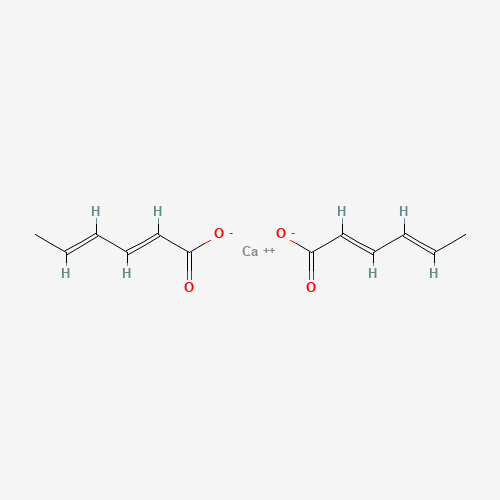
Calcium sorbate is a mould and yeast inhibitor from the sorbate family, used in cheese, baked goods and dried fruit.
Where it is and isn’t permitted
| Jurisdiction | Status | Scope and limits | Citation |
|---|---|---|---|
| Australia and New Zealand | Permitted, with conditions | 34 food categories highest permitted level 9,000 mg/kg Show every food category
| Food Standards Code, Schedule 15, S15—5and 33 further provisionsretrieved 2026-10-17 |
| Canada | Permitted, with conditions | highest permitted level 3,350 mg/kg 11 permitted uses Show every permitted use
| Health Canada, List of Permitted Preservatives (List 11)and 10 further provisionsretrieved 2026-10-17 |
| European Union | No listed food uses foundThis site has not matched this substance to any food use on this jurisdiction’s list of authorised food additives. A food additive may be used only in foods that list names. Flavourings, enzymes, processing aids and added nutrients are regulated separately and do not appear on it. | ||
| Great Britain | No listed food uses foundThis site has not matched this substance to any food use on this jurisdiction’s list of authorised food additives. A food additive may be used only in foods that list names. Flavourings, enzymes, processing aids and added nutrients are regulated separately and do not appear on it. | ||
| Japan | Permitted, with conditions | Designated additive: Appended Table 1, item 245, ソルビン酸カルシウム (“Calcium Sorbate” in the unofficial English translation). …Designated additive: Appended Table 1, item 245, ソルビン酸カルシウム (“Calcium Sorbate” in the unofficial English translation). Standards for use — Specifications and Standards for Foods, Food Additives, etc. (MHW Notification No. 370 of 1959), Part II (Food Additives), F (Standards for use), entry ソルビン酸カルシウム: (1) [may be used only in the foods stated] “ソルビン酸カルシウムは、甘酒(3倍以上に希釈して飲用するものに限る。以下この目において同じ。)、あん類、うに、果実酒、菓子の製造に用いる果実ペースト(果実をすり潰し、又は裏ごししてペースト状としたものをいう。以下この目において同じ。)及び果汁(濃縮果汁を含む。以下この目において同じ。)、かす漬、こうじ漬、塩漬、しょう油漬、酢漬及びみそ漬の漬物、キャンデッドチェリー(除核したさくらんぼを砂糖漬にしたもの又はこれに砂糖の結晶を付けたもの若しくはこれをシロップ漬にしたものをいう。以下この目において同じ。)、魚介乾製品、魚肉ねり製品(魚肉すり身を除く。以下この目において同じ。)、鯨肉製品、ケチャップ、雑酒、ジャム、食肉製品、シロップ、スープ(ポタージュスープを除く。以下この目において同じ。)、たくあん漬(生大根又は干し大根を塩漬にした後、これを調味料、香辛料、色素等を加えたぬか又はふすまで漬けたものをいう。ただし、一丁漬たくあん及び早漬たくあんを除く。以下この目において同じ。)、たれ、チーズ、つくだ煮、つゆ、煮豆、乳酸菌飲料(殺菌したものを除く。)、ニョッキ、はっ酵乳(乳酸菌飲料の原料に供するものに限る。以下この目において同じ。)、フラワーペースト類(小麦粉、でん粉、ナッツ類若しくはその加工品、ココア、チョコレート、コーヒー、果肉、果汁、いも類、豆類又は野菜類を主要原料とし、これに砂糖、油脂、粉乳、卵、小麦粉等を加え、加熱殺菌してペースト状とし、パン又は菓子に充填又は塗布して食用に供するものをいう。以下この目において同じ。)、干しすもも、マーガリン並びにみそ以外の食品に使用してはならない。” (2) [sets maximum levels of use for the foods stated] “ソルビン酸カルシウムの使用量は、ソルビン酸として、チーズにあってはその1kgにつき3.0g(プロピオン酸、プロピオン酸カルシウム又はプロピオン酸ナトリウムを併用する場合には、ソルビン酸としての使用量及びプロピオン酸としての使用量の合計量が3.0g)以下、うに、魚肉ねり製品、鯨肉製品及び食肉製品にあってはその1kgにつき2.0g以下、いかくん製品及びたこくん製品にあってはその1kgにつき1.5g以下、あん類、菓子の製造に用いる果実ペースト及び果汁、かす漬、こうじ漬、塩漬、しょう油漬及びみそ漬の漬物、キャンデッドチェリー、魚介乾製品(いかくん製品及びたこくん製品を除く。)、ジャム、シロップ、たくあん漬、つくだ煮、煮豆、ニョッキ、フラワーペースト類、マーガリン並びにみそにあってはその1kgにつき1.0g(マーガリンにあっては安息香酸又は安息香酸ナトリウムを併用する場合には、安息香酸としての使用量及びソルビン酸としての使用量の合計量が1.0g)以下、ケチャップ、酢漬の漬物、スープ、たれ、つゆ及び干しすももにあってはその1kgにつき0.50g以下、甘酒及びはっ酵乳にあってはその1kgにつき0.30g以下、果実酒及び雑酒にあってはその1kgにつき0.20g以下、乳酸菌飲料(殺菌したものを除く。以下この目において同じ。)にあってはその1kgにつき0.050g(乳酸菌飲料の原料に供するものにあっては0.30g)以下でなければならない。” The Japanese is the standard as published. There is no official English translation of the Notification; the English in square brackets is this site’s description of what each sentence does, not a translation of the foods or the levels. Compositional specifications for this additive, in the same Notification, are not imported and are not shown here; nor are the general rules in F 添加物一般, which apply to every additive. | Regulations for Enforcement of the Food Sanitation Act (MHW Ordinance No. 23 of 1948), Appended Table 1retrieved 2026-10-18 |
| South Korea | Permitted, with conditions | Designated food additive: Standards and Specifications for Food Additives, Part III, 1. …Designated food additive: Standards and Specifications for Food Additives, Part III, 1. 일반식품첨가물 (general food additives), 소브산칼슘 (“Calcium Sorbate”, the English the Code prints beside it). Main use (주용도) of 소브산칼슘: 보존료. Standard for use (사용기준) of 소브산칼슘: (1) [may be used only in the foods listed; sets a limit on the amount used] “소브산칼슘은 아래의 식품에 한하여 사용하여야 한다. 소브산칼슘의 사용량은 소브산으로서 1. 치즈류 : 3.0g/kg 이하(프로피온산, 프로피온산나트륨 또는 프로피온산칼슘과 병용할 때에는 소브산으로서 사용량과 프로피온산으로서 사용량의 합계가 3.0g/kg 이하) 2. 식육가공품(양념육류, 식육추출가공품 제외), 기타동물성가공식품(기타식육이 함유된 제품에 한함), 어육가공품류, 성게젓, 땅콩버터, 모조치즈 : 2.0g/kg 이하(다만, 콜라겐케이싱을 사용한 소시지류의 경우, 소브산으로서 사용량의 합계가 2.0g/kg 이하) 3. 콜라겐케이싱 : 0.1g/kg 이하 4. 젓갈류(단, 식염함량 8% 이하의 제품에 한함), 한식된장, 된장, 고추장, 혼합장, 춘장, 청국장(단, 비건조 제품에 한함), 혼합장, 어패건제품, 조림류(농산물을 주원료로 한 것에 한함), 플라워페이스트, 소스∶1.0g/kg 이하(다만, 소스의 경우, 파라옥시안식향산메틸 또는 파라옥시안식향산에틸과 병용할 때에는 소브산으로서 사용량과 파라옥시안식향산으로서 사용량의 합계가 1.0g/kg 이하이어야 하며, 그 중 파라옥시안식향산으로서의 사용량은 0.2g/kg 이하) 5. 알로에 겔 건강기능식품(단, 두가지 이상의 건강기능식품원료를 사용하는 경우에는 사용된 알로에 겔 건강기능식품성분의 배합비율을 적용) : 1.0g/kg 이하(안식향산, 안식향산나트륨, 안식향산칼륨 또는 안식향산칼슘과 병용할 때에는 소브산으로서 사용량과 안식향산으로서 사용량의 합계가 1.5g/kg 이하이어야 하며, 그 중 안식향산으로서의 사용량은 0.5g/kg 이하) 6. 농축과일즙, 과·채주스 : 1.0g/kg 이하(안식향산, 안식향산나트륨, 안식향산칼륨 또는 안식향산칼슘과 병용할 때에는 소브산으로서 사용량과 안식향산으로서 사용량의 합계가1.0g/kg 이하이어야 하며, 그 중 안식향산으로서의 사용량은 0.6g/kg 이하) 7. 탄산음료 : 0.5g/kg 이하(안식향산, 안식향산나트륨, 안식향산칼륨 또는 안식향산칼슘과 병용할 때에는 소브산으로서 사용량과 안식향산으로서 사용량의 합계가 0.6g/kg 이하, 그 중 소브산으로서의 사용량은 0.5g/kg 이하) 8. 잼류 : 1.0g/kg 이하(안식향산, 안식향산나트륨, 안식향산칼륨, 안식향산칼슘, 파라옥시안식향산메틸, 파라옥시안식향산에틸, 프로피온산, 프로피온산나트륨 또는 프로피온산칼슘과 병용할 때에는 소브산으로서 사용량, 안식향산으로서 사용량, 파라옥시안식향산으로서 사용량 및 프로피온산으로서 사용량의 합계가 1.0g/kg 이하) 9. 건조과일류, 토마토케첩, 당절임(건조당절임 제외) : 0.5g/kg 이하 10. 절임식품, 마요네즈 : 1.0g/kg 이하(안식향산, 안식향산나트륨, 안식향산칼륨 또는 안식향산칼슘과 병용할 때에는 소브산으로서 사용량과 안식향산으로서 사용량의 합계가 1.5g/kg 이하이어야 하며, 그 중 안식향산으로서의 사용량은 1.0g/kg 이하) 11. 발효음료류(살균한것은 제외) : 0.05g/kg 이하. 12. 과실주, 탁주, 약주 : 0.2g/kg 이하 13. 마가린:2.0g/㎏이하(안식향산, 안식향산나트륨, 안식향산칼륨 또는 안식향산칼슘과 병용할 때에는 소브산으로서 사용량과 안식향산으로서 사용량의 합계가 2.0g/kg 이하이어야 하며, 그 중 안식향산으로서의 사용량은 1.0g/kg 이하) 14. 당류가공품(시럽상 또는 페이스트상에 한함), 식물성크림, 유함유가공품 : 1.0g/kg 이하 15. 향신료조제품(건조제품 제외) : 1.0g/kg 이하 16. 건강기능식품(액상제품에 한하며, 알로에 겔 제품은 제외) : 2.0g/kg 이하” The Korean is the standard as published. There is no official English translation of the current Code (the English version on MFDS’s website is the 2020 edition and has no legal effect); the English in square brackets is this site’s description of what each sentence does, not a translation of the foods or the levels. Compositional specifications (Part IV) are not imported, nor are the general standards in Part II, which apply to every additive. | Standards and Specifications for Food Additives (식품첨가물의 기준 및 규격), MFDS Notification, Part III (Standards for use, by item)retrieved 2026-10-18 |
| United States | Permitted | 21 CFR 182.3225retrieved 2026-10-17 | |
| Codex Alimentarius | Permitted, with conditions | 81 food categories highest permitted level 10,000 mg/kg Show every food category and its notes
| CXS 192-1995 Table One, INS 203and 80 further provisionsretrieved 2026-09-07 |
How much is permitted
A listing usually limits the quantity as well as the food. Only one of the forms that takes is a figure: quantum satis and good manufacturing practice permit the amount the technological effect requires and no more, which is a limit rather than the absence of one. Figures below are the range across every food category this page is listed in, and categories differ between regulators — see how much is permitted.
| Australia and New Zealand | 100 mg/kg – 9,000 mg/kg | 33 numeric limit, 1 GMP |
|---|---|---|
| Canada | 3,350 mg/kg | 1 numeric limit, 1 GMP, 9 no quantity stated |
| Japan | — | 1 no quantity stated |
| South Korea | — | 1 no quantity stated |
| United States | — | 1 no quantity stated |
| Codex Alimentarius | 20 mg/kg – 10,000 mg/kg | 81 numeric limit |
What it is made from
Made by neutralising synthetic sorbic acid with a calcium base.
- Vegan
- Vegetarian
Compare other additives on the dietary indexes.
- CAS registry number
- 7492-55-9
- InChIKey
- MCFVRESNTICQSJ-RJNTXXOISA-L
- PubChem
- CID 6433506
How JECFA defines it
The international specification for identity and purity, prepared by the Joint FAO/WHO Expert Committee on Food Additives and published by FAO. It is a different document from any above, written by a different body and revised on its own cycle; it is advisory, and a country adopts it or does not.
INS 203 Calcium Sorbate
Synonyms: INS No. 203
Assay, identification and purity criteria
Description and assay
- Specification history
- Prepared at the 51st JECFA (1998), published in FNP 52 Add 6 (1998) superseding specifications prepared at the 17th JECFA (1973), published in FNP 4 (1978) and republished in FNP 52 (1992). Group ADI 0-25 mg/kg bw for sorbic acid and its calcium, potassium and sodium salts, expressed as sorbic acid, established at the 17th JECFA in 1973.
- Chemical names
- Calcium sorbate; calcium salt of trans, trans -2,4-hexadienoic acid.
- C.A.S. number
- 7492-55-9
- Chemical formula
- C 12 H 14 CaO 4
- Formula weight
- 262.32
- Assay
- Not less than 98% and not more than 102% after drying
- DESCRIPTION
- Fine white crystalline powder not showing any change in colour after heating at 105 o for 90 min
- FUNCTIONAL USES
- Preservative
- METHOD OF ASSAY
- Weigh to the nearest mg, 0.25 g of the dried sample. Dissolve in 35 ml of glacial acetic acid and 4 ml of acetic anhydride in a 250-ml glass-stoppered flask, warming to effect solution. Cool to room temperature, add 2 drops of crystal violet TS and titrate with 0.1 N perchloric acid in glacial acetic acid to a blue-green end point which persists for at least 30 sec. Perform a blank determination and make any necessary correction. Each ml of 0.1 N perchloric acid is equivalent to 13.12 mg of C 12 H 14 CaO 4 .
Identification
- Solubility (Vol. 4)
- Soluble in water; practically insoluble in ethanol.
- Test for calcium (Vol. 4)
- Passes test
- Melting range of sorbic acid derived from the sample (Vol. 4)
- 132 - 135 o Acidify a solution of the sample with dilute hydrochloric acid TS. Collect the precipitated sorbic acid on a filter paper, wash free of chloride with water and dry under vacuum over sulfuric acid.
- Test for unsaturation
- To 2 ml of a 1 in 10 solution of the sample, add a few drops of bromine TS. The colour of the bromine disappears.
Purity criteria
- Loss on drying (Vol. 4)
- Not more than 3% (over sulfuric acid in vacuum, 4h)
- Fluoride (Vol. 4)
- Not more than 10 mg/kg Weigh 5 g of the sample to the nearest mg and proceed as directed in the Fluoride Limit Test (Method I or III)
- Aldehydes
- Not more than 0.1% (as formaldehyde) Prepare a 0.3% solution of the sample, adjust the pH to 4 with 1N HCl and filter. To 5 ml of the filtrate add 2.5 ml of Schiff's reagent TS and allow to stand for 10-15 min. Compare the colour with that produced by 5 ml of a control solution containing 15 μg of formaldehyde instead of the sample. The colour of the test solution should not be more intense than that of the control solution.
- Lead (Vol. 4)
- Not more than 2 mg/kg Determine using an atomic absorption technique appropriate to the specified level. The selection of sample size and method of sample preparation may be based on the principles of the method described in Volume 4, “Instrumental Methods.”
Every name it appears under
27 recorded names. A label may use any of them.
E number
- E203
INS number
- 203
CAS registry number
- 7492-55-9
As it appears in regulation
- Calcium sorbate
- Calcium sorbate/Deleted from the Union list
Other names
- 2,4-Hexadienoic acid, calcium salt
- 2,4-Hexadienoic acid, calcium salt (2:1), (2E,4E)-
- 2,4-Hexadienoic acid, calcium salt, (2E,4E)-
- 2,4-Hexadienoic acid, calcium salt, (E,E)-
- 2,4Hexadienoic acid, calcium salt
- 2,4Hexadienoic acid, calcium salt, (E,E)
- C12H14CaO4
- calcium (2E,4E)-hexa-2,4-dienoate
- Calcium (2E4E)-hexa-24-dienoate
- Calcium 2,4-hexadienoate, (E,E)-
- Calcium 2,4hexadienoate, (E,E)
- calcium bis((2E,4E)-hexa-2,4-dienoate)
- Calcium di[(2E,4E)-2,4-hexadienoate]
- Calcium dihexa-2,4-dienoate
- Calcium sorbate
- E 203
- HSDB 587
- INS NO.203
- INS-203
- MCFVRESNTICQSJ-RJNTXXOISA-L
- Sorbic Acid Calcium Salt
Systematic names
- calcium (2E,4E)-dihexa-2,4-dienoate
Hazard reference values
| Type | Value | Population | Assessed by | Opinion |
|---|---|---|---|---|
| ADI | 25 mg/kg bw/day | — | JECFA | 1973 |
Evidence and how bodies read it
What assessing bodies concluded
Each conclusion is paraphrased in the body's own framing, from the published opinion linked beneath it. Where bodies differ, both stand; this site does not adjudicate between them or add a view of its own.
EFSA 2015
The ANS Panel set a temporary group ADI of 3 mg/kg bw/day (as sorbic acid) for sorbic acid (E 200) and potassium sorbate (E 202), replacing the SCF's group ADI of 25 mg/kg bw/day on the basis of reproductive toxicity data. It concluded that calcium sorbate (E 203) should be excluded from the group ADI because genotoxicity data were lacking.
Common questions
Assembled from what is above, in the words the questions are usually asked in. Each answer is the same statement the relevant section makes, with the same citations behind it.
- What is E 203?
- E 203 is Calcium sorbate. Calcium sorbate is a mould and yeast inhibitor from the sorbate family, used in cheese, baked goods and dried fruit.
- What is Calcium sorbate used for in food?
- It is listed as a preservative — the role Canada, Codex and the US assign it. This page shows every function each regulator records, with the citation for each.
- Is Calcium sorbate banned in Europe?
- No. Calcium sorbate does not appear on the EU's list of authorised food additives, which is not the same as being banned: the EU permits an additive only where it has authorised it, and usually the reason for an absence is that no one applied. The EU has made no finding against this substance. It does mean it may not be used as a food additive in the EU today.
- Where is Calcium sorbate permitted?
- Of the seven regulators this site reads, Australia and New Zealand, Canada, Japan, South Korea, the US and the Codex standard permit it. Each permission is for named foods at named levels, not a blanket one; the table on this page gives them with citations.
- Is Calcium sorbate vegan?
- Yes. Calcium sorbate is not derived from animals, and is suitable for vegetarians. This page says what it is made from and how.
Sources for this page
- anz retrieved 2026-10-17
- ca retrieved 2026-10-17
- jp retrieved 2026-10-18
- kr retrieved 2026-10-18
- ecfr retrieved 2026-10-17
- gsfa retrieved 2026-09-07
- jecfaspecs retrieved 2026-09-23
Full licence terms and publisher details on Sources. How this page is built and updated: Method.
Machine-readable: a JSON record of this additive is given on request —how to ask for access.
Follow changes to Calcium sorbate:Atom feed — regulatory events, and any change the weekly refresh detects in its provisions.