Canthaxanthin
514-78-3 · .BETA.-CAROTENE-4,4'-DIONE · 4,4'-DIKETO-.BETA.-CAROTENE · 4,4'-Diketo-b-carotene · 4,4'-Diketo-beta-carotene · 4,4'-Dioxo-b-carotene · 4,4'-Dioxo-beta-carotene · 4-07-00-02680 (Beilstein Handbook Reference) · all-trans,beta-Carotene-4,4'-dione · all-trans-beta-carotene-4,4'-dione · All-trans-Canthaxanthin · all-trans-Canthaxanthin (E 161g) · all-trans-Canthaxanthin - Technical grade · Aphanicin; Chlorellaxanthin · beta,beta-Carotene-4,4'-dione · beta-CAROTENE-4,4'-DIONE, all-trans- · BRN 1898520 · C.I. Food Orange 8 · Cantaxanthin · Cantaxanthine · CANTHA · CANTHAX · Canthaxanthin · CANTHAXANTHIN (euglenanone) · Canthaxanthin (Standard) · Canthaxanthin (trans) · Canthaxanthin (trans), analytical standard · Canthaxanthin(E 161g) · Canthaxanthin, >=95.0% (HPLC) · CanthaXanthin, Powder · Canthaxanthin, tech. · Canthaxanthine · Canthaxanthine 10 microg/mL in Acetonitrile · Carophyll Red · Carotene-4,4'-dione, beta- · CAS-514-78-3 · CCRIS 3276 · CI Food Orange 8 · CI-FOOD ORANGE 8 · E 161g · E 161g;all-trans-Canthaxanthin · Food orange 8 · INS NO.161G · INS-161G · Isomer of Canthaxanthin · KANTAKISANTIN · L-Orange 7 · LUCANTIN RED · Orobronze · Roxanthin Red 10 · β-Carotene-4,4’-dione · E161G · 161g · 2,4,4-trimethyl-3-[(1E,3E,5E,7E,9E,11E,13E,15E,17E)-3,7,12,16-tetramethyl-18-(2,6,6-trimethyl-3-oxo-cyclohexen-1-yl)octadeca-1,3,5,7,9,11,13,15,17-nonaenyl]cyclohex-2-en-1-one · 2,4,4-trimethyl-3-[(1E,3E,5E,7E,9E,11E,13E,15E,17E)-3,7,12,16-tetramethyl-18-(2,6,6-trimethyl-3-oxocyclohexen-1-yl)octadeca-1,3,5,7,9,11,13,15,17-nonaenyl]cyclohex-2-en-1-one · 3,3'-((1E,3E,5E,7E,9E,11E,13E,15E,17E)-3,7,12,16-tetramethyloctadeca-1,3,5,7,9,11,13,15,17-nonaene-1,18-diyl)bis(2,4,4-trimethylcyclohex-2-en-1-one) · Canthaxanthin · Cantaxantina · Canthaxanthin · Canthaxanthine · Kantaksantiin · Kantaksantiini · kantaksantin · KANTAKSANTINA · Kantaksantinas · Kantaksantyna · Kantaksantīns · Kantaxantin · Kantażantina · Kanthaxanthin · Κανθαξανθίνη · КантаксантинE number E161gINS 161gCAS 514-78-3
Listed as a colour by Canada, Codex, the EU and the US.
Listed as colours (CA, EU, US, Codex)
- Canada: Food colour — Health Canada, List of Permitted Food Colours (List 3)
- European Union: Colours — Regulation (EC) No 1333/2008, Annex II, Part B, 1. Colours (consolidated text 02008R1333-20260818)
- United States: Color additive (21 CFR part 73) — 21 CFR 73.75
- United States: Color or coloring adjunct — FDA, Substances Added to Food: CANTHAXANTHIN
- Codex Alimentarius: Colour — CXS 192-1995 Table One, INS 161g
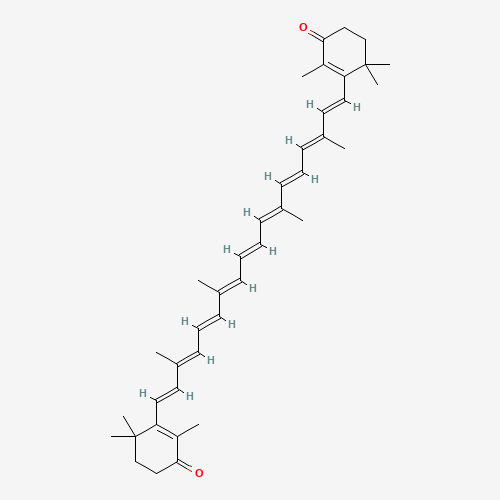
Canthaxanthin is an orange-red carotenoid. Its largest use is not in food at all but in poultry and fish feed, where it deepens the colour of egg yolks and farmed salmon flesh; direct use in food is more limited.
Where it is and isn’t permitted
| Jurisdiction | Status | Scope and limits | Citation |
|---|---|---|---|
| Australia and New Zealand | No listed food uses foundThis site has not matched this substance to any food use on this jurisdiction’s list of authorised food additives. A food additive may be used only in foods that list names. Flavourings, enzymes, processing aids and added nutrients are regulated separately and do not appear on it. | ||
| Canada | Permitted | no numerical limit (good manufacturing practice) 4 permitted uses Show every permitted use
| Health Canada, List of Permitted Food Colours (List 3)and 3 further provisionsretrieved 2026-10-17 |
| European Union | No listed food uses foundThis site has not matched this substance to any food use on this jurisdiction’s list of authorised food additives. A food additive may be used only in foods that list names. Flavourings, enzymes, processing aids and added nutrients are regulated separately and do not appear on it. | ||
| Great Britain | No listed food uses foundThis site has not matched this substance to any food use on this jurisdiction’s list of authorised food additives. A food additive may be used only in foods that list names. Flavourings, enzymes, processing aids and added nutrients are regulated separately and do not appear on it. | ||
| Japan | Permitted, with conditions | Designated additive: Appended Table 1, item 106, カンタキサンチン (“Canthaxanthin” in the unofficial English translation). …Designated additive: Appended Table 1, item 106, カンタキサンチン (“Canthaxanthin” in the unofficial English translation). Standards for use — Specifications and Standards for Foods, Food Additives, etc. (MHW Notification No. 370 of 1959), Part II (Food Additives), F (Standards for use), entry カンタキサンチン: (1) [may be used only in the foods stated] “カンタキサンチンは、魚肉ねり製品(かまぼこに限る。以下この目において同じ。)以外の食品に使用してはならない。” (2) [sets maximum levels of use for the foods stated] “カンタキサンチンの使用量は、魚肉ねり製品1kgにつき0.035g以下でなければならない。” The Japanese is the standard as published. There is no official English translation of the Notification; the English in square brackets is this site’s description of what each sentence does, not a translation of the foods or the levels. Compositional specifications for this additive, in the same Notification, are not imported and are not shown here; nor are the general rules in F 添加物一般, which apply to every additive. | Regulations for Enforcement of the Food Sanitation Act (MHW Ordinance No. 23 of 1948), Appended Table 1retrieved 2026-10-18 |
| South Korea | No listing matchedThis site imports Part III of South Korea’s Standards and Specifications for Food Additives, matched by CAS number, then INS number, then exact name. Mixed preparations and sanitisers are not imported, and an entry whose identifiers disagreed with a page’s is held for review, so an empty row does not show that South Korea does not permit the substance. | ||
| United States | Permitted | 21 CFR 73.75retrieved 2026-10-17 | |
| Codex Alimentarius | Permitted, with conditions | 34 food categories highest permitted level 200 mg/kg Show every food category and its notes
| CXS 192-1995 Table One, INS 161gand 33 further provisionsretrieved 2026-09-07 |
How much is permitted
A listing usually limits the quantity as well as the food. Only one of the forms that takes is a figure: quantum satis and good manufacturing practice permit the amount the technological effect requires and no more, which is a limit rather than the absence of one. Figures below are the range across every food category this page is listed in, and categories differ between regulators — see how much is permitted.
| Canada | — | 4 GMP |
|---|---|---|
| Japan | — | 1 no quantity stated |
| United States | — | 1 no quantity stated |
| Codex Alimentarius | 5 mg/kg – 200 mg/kg | 33 numeric limit, 1 GMP |
What it is made from
Produced by chemical synthesis, and also found naturally in some mushrooms and crustaceans. It is a carotenoid closely related to beta-carotene but with additional oxygen-bearing groups.
- Vegan
- Vegetarian
Compare other additives on the dietary indexes.
- CAS registry number
- 514-78-3
- InChIKey
- FDSDTBUPSURDBL-DKLMTRRASA-N
- PubChem
- CID 5281227
The two specifications, compared
The European Union sets identity and purity by regulation; JECFA publishes its own through FAO, advisory until a country adopts it. Both documents are below in full. These are the parameters each puts a number on.
| Parameter | European Union | JECFA |
|---|---|---|
| Assay | no less than 96 % | no less than 96 % |
| Sulphated ash | no more than 0.1 % | no more than 0.1 % |
| Lead | no more than 2 mg/kg | no more than 2 mg/kg |
| Arsenic | no more than 3 mg/kg | — |
| Mercury | no more than 1 mg/kg | — |
| Cadmium | no more than 1 mg/kg | — |
The two documents state the same figures for every parameter compared here.
How the EU defines it
The legal specification an additive must meet to be sold as this E number in the EU — what it is, how it may be made, and the purity it must reach. From Commission Regulation (EU) No 231/2012.
A specification does not authorise use. This site holds no EU permission for Canthaxanthin in food; see the EU row in the status panel above.
E 161g Canthaxanthin
These specifications apply to predominantly all-trans isomers of canthaxanthin together with minor amounts of other carotenoids. Diluted and stabilised forms are prepared from canthaxanthin meeting these specifications and include solutions or suspensions of canthaxanthin in edible fats or oils, emulsions and water dispersible powders. These preparations may have different cis/trans isomer ratios.
Synonyms: CI Food Orange 8
Assay, identification and purity criteria
Description and assay
- Colour Index No
- 40850
- Einecs
- 208-187-2
- Chemical name
- β-Carotene-4,4′-dione; canthaxanthin; 4,4′-dioxo-β-carotene
- Chemical formula
- C₄₀H₅₂O₂
- Molecular weight
- 564,86
- Assay
- Not less than 96 % of total colouring matters (expressed as canthaxanthin)
- [image] 2 200 | [image]
- at ca. 485 nm in chloroform at 468-472 nm in cyclohexane at 464-467 nm in petroleum ether
- Description
- Deep violet crystals or crystalline powder
Identification
- Spectrometry
- Maximum in chloroform at ca. 485 nm Maximum in cyclohexane at 468-472 nm Maximum in petroleum ether at 464-467 nm
Purity criteria
- Sulphated ash
- Not more than 0,1 %
- Subsidiary colouring matters
- Carotenoids other than canthaxanthin: not more than 5,0 % of total colouring matters
- Arsenic
- Not more than 3 mg/kg
- Lead
- Not more than 2 mg/kg
- Mercury
- Not more than 1 mg/kg
- Cadmium
- Not more than 1 mg/kg
How JECFA defines it
The international specification for identity and purity, prepared by the Joint FAO/WHO Expert Committee on Food Additives and published by FAO. It is a different document from any above, written by a different body and revised on its own cycle; it is advisory, and a country adopts it or does not.
INS 161g Canthaxanthin
Consists predominantly of trans-ß-carotene-4,4'-dione together with minor amounts of other isomers; diluted and stabilized forms are prepared from canthaxanthin meeting these specifications and include solutions or suspensions of canthaxanthin in edible fats or oils, emulsions and water dispersible powders; these preparations may have different cis/trans isomer ratios; the analytical methods described for the parent colour are not necessarily suitable for the assay of or determination of impurities in the stabilized forms (appropriate methods should be available from the manufacturer). These specifications define only synthetic canthaxanthin and do not cover any commercially available food colour from natural sources.
Synonyms: CI Food Orange 8; INS No. 161 g; CI (1975) No 40850
Assay, identification and purity criteria
Description and assay
- Specification history
- Prepared at the 51st JECFA (1998), published in the Combined Compendium of Food Additive Specifications, FAO JECFA Monographs 1 (2005). Corrected at the 69 th JECFA. An ADI of 0-0.03 mg/kg bw was established at the 44th JECFA (1995).
- Chemical names
- ß-Carotene-4,4'-dione; canthaxanthin; 4,4'-dioxo-ß-carotene
- C.A.S. number
- 514-78-3
- Chemical formula
- C40H52O2
- Formula weight
- 564.86
- Assay
- Not less than 96% total colouring matters (expressed as canthaxanthin)
- DESCRIPTION
- Deep violet crystals or crystalline powder; sensitive to oxygen and light and should therefore be kept in a light-resistant container under inert gas
- FUNCTIONAL USES
- Colour
- METHOD OF ASSAY
- Proceed as directed under Total Content by Spectrophotometry (see Volume 4) using the following conditions: W = 0.1 g V1 = V2 = V3 = 100 ml v1 = v2 = 5 ml A 1% 1 cm = 2200 wavelength max = about 470 nm
Identification
- Solubility (Vol. 4)
- Insoluble in water, insoluble in ethanol, practically insoluble in vegetable oils, very slightly soluble in acetone
- Spectrophotometry (Vol. 4)
- A solution in cyclohexane has an absorbance maximum between 468 and 472 nm
- Positive test for carotenoids The colour of a solution of canthaxanthin in acetone disappears after
- successive additions of a 5 % solution of sodium nitrite and 1 N sulfuric acid
Purity criteria
- Sulfated ash (Vol. 4)
- Not more than 0.1% Test 2 g of the sample (Method I)
- Subsidiary colouring matters
- Carotenoids other than canthaxanthin: not more than 5% of total colouring matters See description under TESTS
- Lead (Vol. 4)
- Not more than 2 mg/kg Determine using an atomic absorption technique appropriate to the specified level. The selection of sample size and method of sample preparation may be based on the principles of the methods described in Volume 4, “Instrumental Methods”.
- Test: Subsidiary colouring matters
- Dissolve about 80 mg of sample in 100 ml chloroform. Apply 400 μl of this solution as a streak 2 cm from the bottom of a TLC-plate (Silicagel 0.25 mm). Immediately develop the chromatogram with a solvent mixture of 95 parts dichloromethane and 5 parts diethyl ether in a saturated chamber, suitably protected from light, until the solvent front has moved 15 cm above the initial streak. Remove the plate, allow the main part of the solvent to evaporate at room temperature and mark the principal band as well as the bands corresponding to other carotenoids. Remove the silicagel adsorbent that contains the principal band, transfer it to a glass-stoppered 100 ml centrifuge tube and add 40.0 ml chloroform (solution 1). Remove the silicagel adsorbent that contains the combined bands corresponding to the other carotenoids, transfer it to a glass-stoppered, 50 ml centrifuge tube and add 20.0 ml chloroform (solution 2). Shake the centrifuge tubes by mechanical means for 10 min and centrifuge for 5 min. Dilute 10.0 ml of Solution 1 to 50.0 ml with chloroform (solution 3). Determine, with a suitable spectrophotometer, the absorbances of Solutions 2 and 3 in 1-cm cells at the wavelength maximum about 485 nm, using chloroform as blank. Calculation Carotenoids other than canthaxantin (%) = where A2 = absorbance of Solution 2 A3 = absorbance of Solution 3
Every name it appears under
72 recorded names. A label may use any of them.
E number
- E161G
INS number
- 161g
CAS registry number
- 514-78-3
As it appears in regulation
- Canthaxanthin
Other names
- .BETA.-CAROTENE-4,4'-DIONE
- 4,4'-DIKETO-.BETA.-CAROTENE
- 4,4'-Diketo-b-carotene
- 4,4'-Diketo-beta-carotene
- 4,4'-Dioxo-b-carotene
- 4,4'-Dioxo-beta-carotene
- 4-07-00-02680 (Beilstein Handbook Reference)
- all-trans,beta-Carotene-4,4'-dione
- all-trans-beta-carotene-4,4'-dione
- All-trans-Canthaxanthin
- all-trans-Canthaxanthin (E 161g)
- all-trans-Canthaxanthin - Technical grade
- Aphanicin; Chlorellaxanthin
- beta,beta-Carotene-4,4'-dione
- beta-CAROTENE-4,4'-DIONE, all-trans-
- BRN 1898520
- C.I. Food Orange 8
- Cantaxanthin
- Cantaxanthine
- CANTHA
- CANTHAX
- Canthaxanthin
- CANTHAXANTHIN (euglenanone)
- Canthaxanthin (Standard)
- Canthaxanthin (trans)
- Canthaxanthin (trans), analytical standard
- Canthaxanthin(E 161g)
- Canthaxanthin, >=95.0% (HPLC)
- CanthaXanthin, Powder
- Canthaxanthin, tech.
- Canthaxanthine
- Canthaxanthine 10 microg/mL in Acetonitrile
- Carophyll Red
- Carotene-4,4'-dione, beta-
- CAS-514-78-3
- CCRIS 3276
- CI Food Orange 8
- CI-FOOD ORANGE 8
- E 161g
- E 161g;all-trans-Canthaxanthin
- Food orange 8
- INS NO.161G
- INS-161G
- Isomer of Canthaxanthin
- KANTAKISANTIN
- L-Orange 7
- LUCANTIN RED
- Orobronze
- Roxanthin Red 10
- β-Carotene-4,4’-dione
Systematic names
- 2,4,4-trimethyl-3-[(1E,3E,5E,7E,9E,11E,13E,15E,17E)-3,7,12,16-tetramethyl-18-(2,6,6-trimethyl-3-oxo-cyclohexen-1-yl)octadeca-1,3,5,7,9,11,13,15,17-nonaenyl]cyclohex-2-en-1-one
- 2,4,4-trimethyl-3-[(1E,3E,5E,7E,9E,11E,13E,15E,17E)-3,7,12,16-tetramethyl-18-(2,6,6-trimethyl-3-oxocyclohexen-1-yl)octadeca-1,3,5,7,9,11,13,15,17-nonaenyl]cyclohex-2-en-1-one
- 3,3'-((1E,3E,5E,7E,9E,11E,13E,15E,17E)-3,7,12,16-tetramethyloctadeca-1,3,5,7,9,11,13,15,17-nonaene-1,18-diyl)bis(2,4,4-trimethylcyclohex-2-en-1-one)
The EU re-evaluation programme
Every additive authorised in the EU before 20 January 2009 was put back through EFSA by Commission Regulation (EU) No 257/2010, and this one is named in it. What the Regulation required is below; whether the opinion has since been published is not something this site records.
- To be evaluated by 31 December 2010. Named in Annex II, Part I, point 2 as “Canthaxanthin”, among the additives given priority within its class.
Hazard reference values
EFSA and JECFA have both set an acceptable daily intake for Canthaxanthin, and they agree: 0.03 mg/kg bw/day. An acceptable daily intake is a reference value set by a committee, not a threshold above which harm begins. See where the two committees differ.
Evidence and how bodies read it
What assessing bodies concluded
Each conclusion is paraphrased in the body's own framing, from the published opinion linked beneath it. Where bodies differ, both stand; this site does not adjudicate between them or add a view of its own.
EFSA 2010
The ANS Panel allocated an ADI of 0.03 mg/kg bw/day for canthaxanthin (E 161g), based on crystal deposits in the retina observed in humans, in line with earlier JECFA and SCF values. It concluded that combined exposure from food and feed additive use was unlikely to exceed the ADI, and noted that the specifications needed updating for heavy metals and to reflect synthetic manufacture.
Common questions
Assembled from what is above, in the words the questions are usually asked in. Each answer is the same statement the relevant section makes, with the same citations behind it.
- What is E 161g?
- E 161g is Canthaxanthin. Canthaxanthin is an orange-red carotenoid. Its largest use is not in food at all but in poultry and fish feed, where it deepens the colour of egg yolks and farmed salmon flesh; direct use in food is more limited.
- What is Canthaxanthin used for in food?
- It is listed as a colour — the role Canada, Codex, the EU and the US assign it. This page shows every function each regulator records, with the citation for each.
- Is Canthaxanthin banned in Europe?
- No. Canthaxanthin does not appear on the EU's list of authorised food additives, which is not the same as being banned: the EU permits an additive only where it has authorised it, and usually the reason for an absence is that no one applied. The EU has made no finding against this substance. It does mean it may not be used as a food additive in the EU today.
- Where is Canthaxanthin permitted?
- Of the seven regulators this site reads, Canada, Japan, the US and the Codex standard permit it. Each permission is for named foods at named levels, not a blanket one; the table on this page gives them with citations.
- Is Canthaxanthin vegan?
- Yes. Canthaxanthin is not derived from animals, and is suitable for vegetarians. This page says what it is made from and how.
Sources for this page
- ca retrieved 2026-10-17
- jp retrieved 2026-10-18
- ecfr retrieved 2026-10-17
- gsfa retrieved 2026-09-07
- euspecs retrieved 2026-10-18
- jecfaspecs retrieved 2026-09-23
Full licence terms and publisher details on Sources. How this page is built and updated: Method.
Machine-readable: a JSON record of this additive is given on request —how to ask for access.
Follow changes to Canthaxanthin:Atom feed — regulatory events, and any change the weekly refresh detects in its provisions.