Caprylic acid
124-07-2 · 0ctanoic acid · 1-heptanecarboxylic acid · 1-octanoic acid · Acid C8 · Acid C8; Caprylic acid · Acide octanoique · Acido octanoico · Acidum octanocium · acidum octanoicum · BRN 1747180 · C-8 acid · Caprylic acid-8-13C · caprylic acid · Caprylic acid (natural) · Caprylic acid (NF) · Caprylic acid CRS · caprylic-acid · Caprylsaeure · CAS-124-07-2 · CCRIS 4689 · CH3-[CH2]6-COOH · Copper as octanoate · EDENOR C 8-98-100 · Emery 657 · Enantic acid · F8:0 · fatty acid 8:0 · fatty acid 8:0 (caprylic acid) · FEMA No. 2799 · Heptane-1-carboxylic acid · Hexacid 898 · HSDB 821 · hydron;octanoate · Kaprylsaeure · Kortacid 0899 · Kyselina kaprylova · Lunac 8-95 · Lunac 8-98 · n-caprylic acid · n-heptanecarboxylic acid · n-octanoic acid · n-octanoicacid · n-octic acid · n-Octoic acid · n-octylic acid · OBL58JN025 · octanic acid · Octanoic acid-7-13C · octanoic acid · OCTANOIC ACID (CAPRYLIC ACID) · Octanoic acid (Standard) · Octanoic acid (USAN) · Octanoic acid, 99% · Octanoic acid, >=98% · Octanoic acid, >=99% · Octansaeure · Octic acid · octoic acid · Octylic acid · Octylic acid; C8:0 · Prifac 2901 · octanoic acid · Caprylic acidCAS 124-07-2
Listed as a flavouring agent by the US.
Listed as flavouring agents and adjuvants (US)
- United States: Flavoring agent or adjuvant — FDA, Substances Added to Food: OCTANOIC ACID
- United States: Flavoring agents and adjuvants — 21 CFR 184.1025, citing 21 CFR 170.3(o)(12)
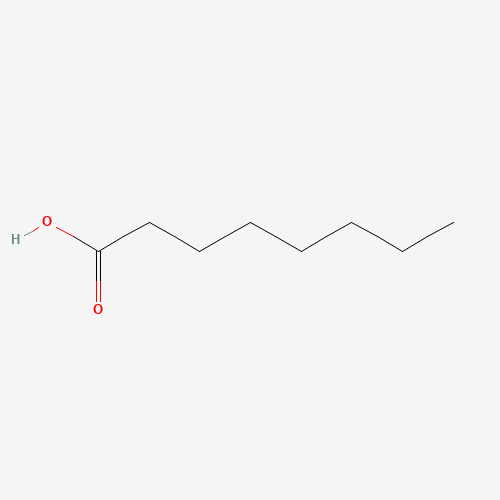
Caprylic acid is a flavouring and antimicrobial, a medium-chain fatty acid found naturally in coconut oil, palm kernel oil and milk fat.
Where it is and isn’t permitted
| Jurisdiction | Status | Scope and limits | Citation |
|---|---|---|---|
| Australia and New Zealand | No listed food uses foundThis site has not matched this substance to any food use on this jurisdiction’s list of authorised food additives. A food additive may be used only in foods that list names. Flavourings, enzymes, processing aids and added nutrients are regulated separately and do not appear on it. | ||
| Canada | No listing matchedHealth Canada’s lists name additives without E or INS numbers, so this site matches them by exact name. A substance listed there under a name this site does not recognise has no row here. | ||
| European Union | No listed food uses foundThis site has not matched this substance to any food use on this jurisdiction’s list of authorised food additives. A food additive may be used only in foods that list names. Flavourings, enzymes, processing aids and added nutrients are regulated separately and do not appear on it. | ||
| Great Britain | No listed food uses foundThis site has not matched this substance to any food use on this jurisdiction’s list of authorised food additives. A food additive may be used only in foods that list names. Flavourings, enzymes, processing aids and added nutrients are regulated separately and do not appear on it. | ||
| Japan | Permitted, with conditions | Designated additive: Appended Table 1, item 93, オクタン酸 (“Octanoic Acid” in the unofficial English translation). …Designated additive: Appended Table 1, item 93, オクタン酸 (“Octanoic Acid” in the unofficial English translation). Standards for use — Specifications and Standards for Foods, Food Additives, etc. (MHW Notification No. 370 of 1959), Part II (Food Additives), F (Standards for use), entry オクタン酸: (1) [must not be used in the foods stated] “オクタン酸は、着香の目的で使用する場合及び過酢酸製剤として使用する場合以外に使用してはならない。” The Japanese is the standard as published. There is no official English translation of the Notification; the English in square brackets is this site’s description of what each sentence does, not a translation of the foods or the levels. Compositional specifications for this additive, in the same Notification, are not imported and are not shown here; nor are the general rules in F 添加物一般, which apply to every additive. | Regulations for Enforcement of the Food Sanitation Act (MHW Ordinance No. 23 of 1948), Appended Table 1retrieved 2026-10-18 |
| South Korea | Permitted, with conditions | Designated food additive: Standards and Specifications for Food Additives, Part III, 2. …Designated food additive: Standards and Specifications for Food Additives, Part III, 2. 가공보조제 (processing aids), 카프릴산 (“Caprylic Acid”, the English the Code prints beside it). Main use (주용도) of 카프릴산: 제조용제. Standard for use (사용기준) of 카프릴산: (1) [to be used under the general standard for use in II. 2. 1), the minimum amount that achieves the technical effect, with no limit set for this additive in particular] “II. 2. 1)의 규정에 따라 사용하여야 한다.” The Korean is the standard as published. There is no official English translation of the current Code (the English version on MFDS’s website is the 2020 edition and has no legal effect); the English in square brackets is this site’s description of what each sentence does, not a translation of the foods or the levels. Compositional specifications (Part IV) are not imported, nor are the general standards in Part II, which apply to every additive. | Standards and Specifications for Food Additives (식품첨가물의 기준 및 규격), MFDS Notification, Part III (Standards for use, by item)retrieved 2026-10-18 |
| United States | Permitted | 21 CFR 184.1025retrieved 2026-10-17 | |
| Codex Alimentarius | Not listedDoes not appear on this jurisdiction’s permitted list. That is not the same as being prohibited. |
How much is permitted
A listing usually limits the quantity as well as the food. Only one of the forms that takes is a figure: quantum satis and good manufacturing practice permit the amount the technological effect requires and no more, which is a limit rather than the absence of one. Figures below are the range across every food category this page is listed in, and categories differ between regulators — see how much is permitted.
| Japan | — | 1 no quantity stated |
|---|---|---|
| South Korea | — | 1 no quantity stated |
| United States | — | 1 no quantity stated |
No regulator sets a figure for Caprylic acid. That is not an absence of control: where the listing says quantum satis or good manufacturing practice, the quantity is limited to what the effect requires.
What it is made from
Obtained by splitting coconut or palm kernel oil and separating the fatty acids, or by chemical synthesis.
- Vegan
- Vegetarian
Compare other additives on the dietary indexes.
- CAS registry number
- 124-07-2
- InChIKey
- WWZKQHOCKIZLMA-UHFFFAOYSA-N
- PubChem
- CID 379
How JECFA defines it
The international specification for identity and purity, prepared by the Joint FAO/WHO Expert Committee on Food Additives and published by FAO. It is a different document from any above, written by a different body and revised on its own cycle; it is advisory, and a country adopts it or does not.
Octanoic acid
Octanoic acid is manufactured from vegetable oils (coconut, palm, kernel, or palm stearin) by first refining the oil, followed by methyl transesterification and separation by distillation. The separated methyl octanoate is saponified and acidified to give octanoic acid.
Synonyms: Caprylic acid
Assay, identification and purity criteria
Description and assay
- Specification history
- Prepared at the 82 nd JECFA (2016), published in FAO JECFA Monograph 19 (2016), superseding specifications prepared at the 63 rd JECFA (2004) and published in FNP 52 Add 12 (2004). Small residues of octanoic acid on food (which has been treated with antimicrobial washing solutions) at the time of consumption would not pose a safety concern (63 rd JECFA, 2004).
- Chemical name
- Octanoic acid
- C.A.S. number
- 124-07-2
- Chemical formula
- CH 3 (CH 2 ) 6 CO 2 H
- Formula weight
- 144.21
- Assay
- Not less than 95%
- DESCRIPTION
- Colourless oily liquid
- FUNCTIONAL USES
- Antifoaming agent, surfactant, flavouring agent (see JECFA No. 99)
- METHOD OF ASSAY
- Determine using an appropriate gas chromatographic technique. The selection of sample size and method of sample preparation may be based on AOCS Method Ce 1-62 and Ce 1j-07 and follow the principles of the method described in Vol. 4 (under Analytical Techniques, Gas Chromatography). The percentage of octanoic acid is the area percent of the methyl octanoate peak. Decanoic acid may be determined using the same gas chromatographic technique.
Identification
- Solubility (Vol. 4)
- Slightly soluble in water; soluble in most organic solvents
- frared spectrum (Vol. 4)
- The infrared spectrum of a liquid film of a sample corresponds to the reference infrared spectrum in the Annex. Hold 1 to 2 drops of a sample between two optical plates and examine the liquid film of a sample between the plates using an infrared spectrometer. The optical plates are usually made by sodium chloride or potassium bromide.
- Acid value (Vol. 4)
- Between 366 and 396
Purity criteria
- Water (Vol. 4)
- Not more than 0.4% (Karl Fischer Method)
- Sulfated ash (Vol. 4)
- Not more than 0.1% Test 10 g of the sample (Method II)
- Unsaponifiable matter
- Not more than 0.2% See description under TESTS
- Iodine value (Vol. 4)
- Not more than 2.0
- Decanoic acid
- Not more than 3% See description under METHOD OF ASSAY
- Lead (Vol. 4)
- Not more than 2 mg/kg Determine using a method appropriate to the specified level. The selection of sample size and method of sample preparation may be based on the principles of the method described in Volume 4 (under “General Methods, Metallic Impurities”).
- Test: Unsaponifiable matter
- Weigh accurately 5.0 g of the sample into a 250 ml flask, add a solution of 2 g of potassium hydroxide in 40 ml of ethanol, and boil gently under a reflux condenser for 1 h or until saponification is complete. Transfer the contents of the flask to a glass-stoppered graduated extraction cylinder. Wash the flask with sufficient ethanol to make a volume of 40 ml in the cylinder, and complete the transfer with warm and then cold water until the total volume is 80 ml. Finally, wash the flask with a few ml of petroleum ether, add the washings to the cylinder, cool the contents of the cylinder to room temperature, and add 50 ml of petroleum ether. Insert the stopper, shake the cylinder vigorously for at least 1 min, and allow both layers to become clear. Siphon the upper layer as completely as possible without removing any of the lower layer, collecting the ether fraction in a 500-ml separator. Repeat the extraction and siphoning at least six times with 50-ml portions of petroleum ether, shaking vigorously each time. Wash the combined extracts, with vigorous shaking, with 25-ml portions of 10% ethanol until the wash water is neutral to phenolphthalein, and discard the washings. Transfer the petroleum ether extract to a tared beaker, and rinse the separator with 10 ml of petroleum ether, adding the rinsings to the beaker. Evaporate the solvent on a steam bath just to dryness, and dry the residue to constant weight, preferably at 75 to 80 under a vacuum of not more than 200 mm of Hg, or at 100 for 30 min. Cool in a desiccator, and weigh to obtain the uncorrected weight of unsaponifiable matter. Determine the quantity of fatty acids in the residue as follows: Dissolve the residue in 50 ml of warm ethanol (containing phenolphthalein TS and previously neutralized with sodium hydroxide to a faint pink colour), and titrate with 0.02 M sodium hydroxide to the same color. Each ml of 0.02 M sodium hydroxide is equivalent to 5.659 mg of fatty acids, calculated as oleic acid. Subtract the calculated weight of fatty acids from the weight of the residue to obtain the corrected weight of unsaponifiable matter in the sample.
- Test: Appendix
- Infrared spectrum of octanoic acid standard
Every name it appears under
64 recorded names. A label may use any of them.
CAS registry number
- 124-07-2
As it appears in regulation
- Caprylic acid
Other names
- 0ctanoic acid
- 1-heptanecarboxylic acid
- 1-octanoic acid
- Acid C8
- Acid C8; Caprylic acid
- Acide octanoique
- Acido octanoico
- Acidum octanocium
- acidum octanoicum
- BRN 1747180
- C-8 acid
- Caprylic acid-8-13C
- caprylic acid
- Caprylic acid (natural)
- Caprylic acid (NF)
- Caprylic acid CRS
- caprylic-acid
- Caprylsaeure
- CAS-124-07-2
- CCRIS 4689
- CH3-[CH2]6-COOH
- Copper as octanoate
- EDENOR C 8-98-100
- Emery 657
- Enantic acid
- F8:0
- fatty acid 8:0
- fatty acid 8:0 (caprylic acid)
- FEMA No. 2799
- Heptane-1-carboxylic acid
- Hexacid 898
- HSDB 821
- hydron;octanoate
- Kaprylsaeure
- Kortacid 0899
- Kyselina kaprylova
- Lunac 8-95
- Lunac 8-98
- n-caprylic acid
- n-heptanecarboxylic acid
- n-octanoic acid
- n-octanoicacid
- n-octic acid
- n-Octoic acid
- n-octylic acid
- OBL58JN025
- octanic acid
- Octanoic acid-7-13C
- octanoic acid
- OCTANOIC ACID (CAPRYLIC ACID)
- Octanoic acid (Standard)
- Octanoic acid (USAN)
- Octanoic acid, 99%
- Octanoic acid, >=98%
- Octanoic acid, >=99%
- Octansaeure
- Octic acid
- octoic acid
- Octylic acid
- Octylic acid; C8:0
- Prifac 2901
Systematic names
- octanoic acid
Hazard reference values
No reference value for this substance in the sources we hold.
Evidence and how bodies read it
Studies, and the differing conclusions regulators drew from them, are curated rather than machine-read, and none has been written for this substance yet.
Common questions
Assembled from what is above, in the words the questions are usually asked in. Each answer is the same statement the relevant section makes, with the same citations behind it.
- What is Caprylic acid?
- Caprylic acid is a flavouring and antimicrobial, a medium-chain fatty acid found naturally in coconut oil, palm kernel oil and milk fat.
- What is Caprylic acid used for in food?
- It is listed as a flavouring agent — the role the US assigns it. This page shows every function each regulator records, with the citation for each.
- Is Caprylic acid banned in Europe?
- No. Caprylic acid is not on the EU's list of authorised food additives, but it would not be expected to be: every role regulators give it — flavouring agent — the EU regulates under separate law. Its absence from the additives list says nothing about whether it is permitted in Europe.
- Where is Caprylic acid permitted?
- Of the seven regulators this site reads, Japan, South Korea and the US permit it. Each permission is for named foods at named levels, not a blanket one; the table on this page gives them with citations.
- Is Caprylic acid vegan?
- Yes. Caprylic acid is not derived from animals, and is suitable for vegetarians. This page says what it is made from and how.
Sources for this page
- jp retrieved 2026-10-18
- kr retrieved 2026-10-18
- ecfr retrieved 2026-10-17
- jecfaspecs retrieved 2026-09-23
Full licence terms and publisher details on Sources. How this page is built and updated: Method.
Machine-readable: a JSON record of this additive is given on request —how to ask for access.
Follow changes to Caprylic acid:Atom feed — regulatory events, and any change the weekly refresh detects in its provisions.