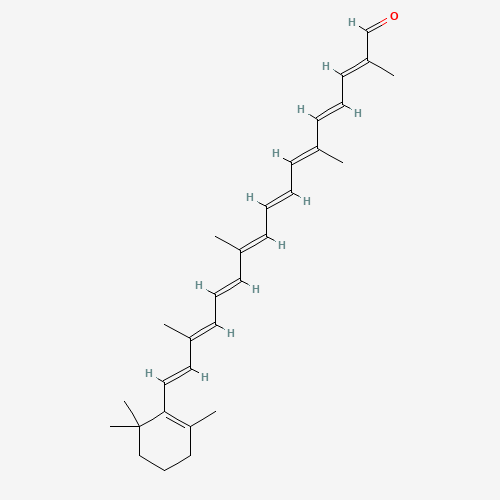
Carotenal, beta-apo-8'-

E number E160eINS 160eCAS 1107-26-2

Listed as a colour by Codex, the EU and the US.

Listed as colours (EU, US, Codex)
Chemical structure of Carotenal, beta-apo-8'-, from PubChem compound 5478003
Structure from PubChem CID 5478003 (National Library of Medicine, public domain). A depiction of one compound: where a listing covers a family, or a substance has no single structure, this page shows none.

Beta-apo-8'-carotenal is a synthetic carotenoid giving an orange to orange-red colour, used in drinks, dairy products and sauces. It is chemically related to beta-carotene but gives a redder shade.

Where it is and isn’t permitted

Status of Carotenal, beta-apo-8'- by jurisdiction. Every jurisdiction this site covers is listed, including those where the substance does not appear.
JurisdictionStatusScope and limitsCitation
Australia and New ZealandFood Standards Australia New ZealandPermitted, with conditions

48 food categories

no numerical limit (good manufacturing practice)

Show every food category
  • 0.2 Colourings — GMP
  • 0.3 Flavourings — GMP
  • 1.1.2 Liquid milk products and flavoured liquid milk — GMP
  • 1.2.2 Fermented milk products and rennetted milk products — GMP
  • 1.3 Condensed milk and evaporated milk — GMP
  • 1.4.2 Cream products (flavoured, whipped, thickened, sour cream etc) — GMP
  • 1.5 Dried milk, milk powder, cream powder — GMP
  • 1.6 Cheese and cheese products — GMP
  • 11.1.1 Rainbow sugar — GMP
  • 11.4 Tabletop sweeteners — GMP
  • 12.1.2 Reduced sodium salt mixture — GMP
  • 12.1.3 Salt substitute — GMP
  • 12.3 Vinegars and related products — GMP
  • 12.5 Yeast and yeast products — GMP
  • 12.6 Vegetable protein products — GMP
  • 13.3 Formulated meal replacements and formulated supplementary foods — GMP
  • 13.4 Formulated supplementary sports foods — GMP
  • 13.5 Food for special medical purposes — GMP
  • 14.1.1.2 Carbonated, mineralised and soda waters — GMP
  • 14.1.2.1 Fruit and vegetable juices — GMPFor juice separated by other than mechanical means only.
  • 14.1.2.2 Fruit and vegetable juice products — GMP
  • 14.1.3 Water based flavoured drinks — GMP
  • 14.1.4 Formulated Beverages — GMP
  • 14.2.3 Wine based drinks and reduced alcohol wines — GMP
  • 14.2.4.1 Fruit wine products and vegetable wine products — GMP
  • 14.2.5 Spirits and liqueurs — GMP
  • 14.3 Alcoholic beverages not included in item 14.2 — GMP
  • 2.1 Edible oils essentially free of water — GMPNot for olive oil.
  • 2.2.1.1 Butter — GMP
  • 2.2.1.2 Butter products — GMP
  • 2.2.1.3 Margarine and similar products — GMP
  • 2.2.2 Oil emulsions (<80% oil) — GMP
  • 20 Foods not included in items 0 to 14 — GMP
  • 3 Ice cream and edible ices — GMP
  • 4.3 Processed fruits and vegetables — GMP
  • 5.1 Chocolate and cocoa products — GMPPermitted on the surface of chocolate only.
  • 5.2 Sugar confectionery — GMP
  • 5.4 Icings and frostings — GMP
  • 6.3 Processed cereal and meal products — GMP
  • 6.4 Flour products (including noodles and pasta) — GMP
  • 7 Breads and bakery products — GMP
  • 8.2 Processed meat, poultry and game products in whole cuts or pieces — GMP
  • 8.3 Processed comminuted meat, poultry and game products, other than products listed in item 8.3.2 — GMPNot for sausage or sausage meat containing raw, unprocessed meat.
  • 8.4 Edible casings — GMP
  • 8.5 Animal protein products — GMP
  • 9.2 Processed fish and fish products — GMP
  • 9.3 Semi preserved fish and fish products — GMP
  • 9.4 Fully preserved fish including canned fish products — GMP
Food Standards Code, Schedule 15, S15—5and 47 further provisionsretrieved 2026-10-17
CanadaHealth CanadaNo listing matchedHealth Canada’s lists name additives without E or INS numbers, so this site matches them by exact name. A substance listed there under a name this site does not recognise has no row here.
European UnionEuropean Commission / EFSAPermitted, with conditions

27 food categories

highest permitted level 500 mg/l

Show every food category
  • 1.4 flavoured fermented milk products including heat-treated products — 150 mg/lPermitted as a member of Group III, Colours with combined maximum limit. ML = 150 mg/l. Period of application: from 1 August 2014. Note 74: Maximum limit for aluminium coming from all aluminium lakes 15 mg/kg. For the purposes of Article 22 (1) (g) of Regulation (EC) No 1333/2008 that limit shall apply from 1 February 2013.
  • 1.6.3 other creams — 150 mg/kgPermitted as a member of Group III, Colours with combined maximum limit. ML = 150 mg/kg. only flavoured creams.
  • 1.7.1 unripened cheese excluding products falling in category 16 — 150 mg/kgPermitted as a member of Group III, Colours with combined maximum limit. ML = 150 mg/kg. only flavoured unripened cheese.
  • 1.7.3 edible cheese rind — quantum satisPermitted as a member of Group III, Colours with combined maximum limit. quantum satis. Period of application: from 1 August 2014. Note 67: Maximum limit for aluminium coming from aluminium lakes of E 120 cochineal, carminic acid, carmines and E 180 litholrubine BK 10 mg/kg. No other aluminium lakes may be used. For the purposes of Article 22 (1) (g) of Regulation (EC) No 1333/2008 that limit shall apply from 1 February 2013.
  • 1.7.5 processed cheese — 100 mg/kgML = 100 mg/kg. only flavoured processed cheese. Note 33: Maximum individually or for the combination of E 100, E 102, E 120, E 122, E 160e and E 161b.
  • 1.7.6 cheese products (excluding products falling in category 16) — 100 mg/kgPermitted as a member of Group III, Colours with combined maximum limit. ML = 100 mg/kg. only flavoured unripened products.
  • 12.4 Mustard — 300 mg/kgPermitted as a member of Group III, Colours with combined maximum limit. ML = 300 mg/kg.
  • 12.5 Soups and broths — 50 mg/kgPermitted as a member of Group III, Colours with combined maximum limit. ML = 50 mg/kg.
  • 12.9 Protein products excluding products covered in category 1 8 — 100 mg/kgPermitted as a member of Group III, Colours with combined maximum limit. ML = 100 mg/kg. only meat and fish analouges based on vegetable proteins.
  • 13.2 Foods for special medical purposes as defined by Regulation (EU) No 609/2013 (excluding products from food category 13.1.5.) — 50 mg/kgPermitted as a member of Group III, Colours with combined maximum limit. ML = 50 mg/kg.
  • 13.3 Total diet replacement for weight control food as defined by Regulation (EU) No 609/2013 — 50 mg/kgPermitted as a member of Group III, Colours with combined maximum limit. ML = 50 mg/kg.
  • 14.2.3 Cider and perry — 200 mg/lPermitted as a member of Group III, Colours with combined maximum limit. ML = 200 mg/l. excluding cidre bouché, cydr jakościowy, perry jakościowe, cydr lodowy, perry lodowe.
  • 14.2.4 Fruit wine and made wine — 200 mg/lPermitted as a member of Group III, Colours with combined maximum limit. ML = 200 mg/l. excluding wino owocowe jakościowe.
  • 14.2.6 Spirit drinks as defined in Regulation (EU) 2019/787 — 200 mg/lPermitted as a member of Group III, Colours with combined maximum limit. ML = 200 mg/l. except: spirit drinks as defined in categories 1-17, 22, 36, 37 and 41 of Annex I of Regulation (EU) 2019/787. Note 87: Maximum limit for aluminium coming from aluminium lakes of E 120 cochineal, carminic acid, carmines 1,5 mg/kg. No other aluminium lakes may be used. For the purposes of Article 22(1)(g) of Regulation (EC) No 1333/2008 that limit shall apply from 1 February 2013.
  • 14.2.7.3 Aromatised wine-product cocktails — 200 mg/lPermitted as a member of Group III, Colours with combined maximum limit. ML = 200 mg/l. Note 87: Maximum limit for aluminium coming from aluminium lakes of E 120 cochineal, carminic acid, carmines 1,5 mg/kg. No other aluminium lakes may be used. For the purposes of Article 22(1)(g) of Regulation (EC) No 1333/2008 that limit shall apply from 1 February 2013.
  • 14.2.8 Other alcoholic beverages including mixtures of alcoholic beverages with non-alcoholic beverages and other alcoholic beverages based on distilled alcohol with alcoholic strength by volume less than 15 % — 200 mg/lPermitted as a member of Group III, Colours with combined maximum limit. ML = 200 mg/l. only alcoholic beverages with alcoholic strength by volume less than 15 %. Note 87: Maximum limit for aluminium coming from aluminium lakes of E 120 cochineal, carminic acid, carmines 1,5 mg/kg. No other aluminium lakes may be used. For the purposes of Article 22(1)(g) of Regulation (EC) No 1333/2008 that limit shall apply from 1 February 2013.
  • 15.2 Processed nuts — 100 mg/kgPermitted as a member of Group III, Colours with combined maximum limit. ML = 100 mg/kg. only savoury coated nuts.
  • 17.2 food supplements supplied in a liquid form excluding food supplements for Infants and young children — 100 mg/lPermitted as a member of Group III, Colours with combined maximum limit. ML = 100 mg/l.
  • 18.2 Meal replacement for weight control as referred to in Commission Regulation (EU) No 432/2012 — 50 mg/kgPermitted as a member of Group III, Colours with combined maximum limit. ML = 50 mg/kg.
  • 3 edible ices — 150 mg/kgPermitted as a member of Group III, Colours with combined maximum limit. ML = 150 mg/kg. Note 25: The quantities of each of the colours E 122 and E 155 may not exceed 50 mg/kg or mg/l.
  • 4.2.4.1 fruit and vegetable preparations excluding compote — 100 mg/kgML = 100 mg/kg. Only seaweed based fish roe analogues.
  • 4.2.4.1 fruit and vegetable preparations excluding compote — 200 mg/kgPermitted as a member of Group III, Colours with combined maximum limit. ML = 200 mg/kg. only mostarda di frutta.
  • 6.6 Batters — 500 mg/kgPermitted as a member of Group III, Colours with combined maximum limit. ML = 500 mg/kg. only batters for coating.
  • 8.3.3 Casings and coatings and decorations for meat — 500 mg/kgPermitted as a member of Group III, Colours with combined maximum limit. ML = 500 mg/kg. only decorations and coatings except edible external coating of pasturmas Period of application: from 1 August 2014. Note 78: Maximum limit for aluminium coming from aluminium lakes of E 120 cochineal, carminic acid, carmines 10 mg/kg. No other aluminium lakes may be used. For the purposes of Article 22 (1) (g) of Regulation (EC) No 1333/2008 that limit shall apply from 1 February 2013.
  • 9.2 Processed fish and fishery products including molluscs and crustaceans — 100 mg/kgML = 100 mg/kg. only fish paste and crustacean paste. Note 35: Maximum individually or for the combination of E 100, E 102, E 120, E 122, E 142, E 151, E 160e, E 161b.
  • 9.2 Processed fish and fishery products including molluscs and crustaceans — 500 mg/kgPermitted as a member of Group III, Colours with combined maximum limit. ML = 500 mg/kg. only surimi and similar products and salmon substitutes based on Theragra chalcogramma, Pollachius virens and Clupea harengus’. Note 84: Maximum limit for aluminium coming from aluminium lakes of E 120 cochineal, carminic acid, carmines 4 mg/kg. As a derogation to this rule, the maximum limit only for salmon substitutes shall be 5,5 mg/kg. No other aluminium lakes may be used. For the purposes of Article 22(1)(g) of Regulation (EC) No 1333/2008 that limit shall apply from 1 February 2013.
  • 9.3 fish roe — 300 mg/kgPermitted as a member of Group III, Colours with combined maximum limit. ML = 300 mg/kg. except Sturgeons' eggs (Caviar). Note 86: Maximum limit for aluminium coming from aluminium lakes of E 120 cochineal, carminic acid, carmines 3 mg/kg. As a derogation to this rule, the maximum limit only for pasteurised products shall be 50 mg/kg. No other aluminium lakes may be used. For the purposes of Article 22(1)(g) of Regulation (EC) No 1333/2008 that limit shall apply from 1 February 2013.
Regulation (EC) No 1333/2008, Annex IIand 26 further provisionsretrieved 2026-10-18
Great BritainFood Standards Agency / Food Standards ScotlandPermitted, with conditions

36 food categories

highest permitted level 500 mg/kg or mg/l

Show every food category
  • 1.4 Flavoured fermented milk products including heat-treated products — 150 mg/kg or mg/lPermitted as a member of Group III: Food colours with combined maximum limit. ML = 150. Period of application: from 1 August 2014. Note (74): Maximum limit for aluminium coming from all aluminium lakes 15 mg/kg. For the purposes of Article 22 (1) (g) of Regulation (EC) No 1333/2008 that limit shall apply from 1 February 2013.
  • 1.6.3 Other creams — 150 mg/kg or mg/lPermitted as a member of Group III: Food colours with combined maximum limit. ML = 150. only flavoured creams.
  • 1.7.1 Unripened cheese excluding products falling in category 16 — 150 mg/kg or mg/lPermitted as a member of Group III: Food colours with combined maximum limit. ML = 150. only flavoured unripened cheese.
  • 1.7.3 Edible cheese rind — quantum satisPermitted as a member of Group III: Food colours with combined maximum limit. quantum satis. Period of application: from 1 August 2014. Note (67): Maximum limit for aluminium coming from aluminium lakes of E 120 carminic acid, carmine and E 180 litholrubine BK 10 mg/kg. No other aluminium lakes may be used. For the purposes of Article 22(1)(g) of this Regulation, that limit shall apply from 1 February 2013.
  • 1.7.5 Processed cheese — 100 mg/kg or mg/lML = 100. only flavoured processed cheese. Note (33): Maximum individually or for the combination of E 100, E 102, E 120, E 122, E 160e and E 161b.
  • 1.7.6 Cheese products (excluding products falling in category 16) — 100 mg/kg or mg/lPermitted as a member of Group III: Food colours with combined maximum limit. ML = 100. only flavoured unripened products.
  • 12.2.2 Seasonings and condiments — 500 mg/kg or mg/lPermitted as a member of Group III: Food colours with combined maximum limit. ML = 500. only seasonings, for example curry powder, tandoori Period of application: from 1 August 2014. Note (70): Maximum limit for aluminium coming from all aluminium lakes 120 mg/kg. For the purposes of Article 22 (1) (g) of Regulation (EC) No 1333/2008 that limit shall apply from 1 February 2013.
  • 12.4 Mustard — 300 mg/kg or mg/lPermitted as a member of Group III: Food colours with combined maximum limit. ML = 300.
  • 12.5 Soups and broths — 50 mg/kg or mg/lPermitted as a member of Group III: Food colours with combined maximum limit. ML = 50.
  • 12.6 Sauces — 500 mg/kg or mg/lPermitted as a member of Group III: Food colours with combined maximum limit. ML = 500. including pickles, relishes, chutney and picalilli; excluding tomato-based sauces Period of application: from 1 August 2014. Note (65): Maximum limit for aluminium coming from aluminium lakes of E 120 carminic acid, carmine 10 mg/kg. No other aluminium lakes may be used. For the puroposes of Article 22 (1) (g) of Regulation (EC) No 1333/2008 that limit shall apply from 1 February 2013.
  • 12.9 Protein products, excluding products covered in category 1.8 — 100 mg/kg or mg/lPermitted as a member of Group III: Food colours with combined maximum limit. ML = 100. only meat and fish analogues based on vegetable proteins.
  • 13.2 Dietary foods for special medical purposes defined in Directive 1999/21/EC (excluding products from food category 13.1.5) — 50 mg/kg or mg/lPermitted as a member of Group III: Food colours with combined maximum limit. ML = 50. Note (88): Maximum limit for aluminium coming from aluminium lakes of E 120 carminic acid, carmine 3 mg/kg only in liquid heat-treated products. No other aluminium lakes may be used. For the purposes of Article 22(1)(g) of Regulation (EC) No 1333/2008 that limit shall apply from 1 February 2013.
  • 13.3 Dietary foods for weight control diets intended to replace total daily food intake or an individual meal (the whole or part of the total daily diet) — 50 mg/kg or mg/lPermitted as a member of Group III: Food colours with combined maximum limit. ML = 50.
  • 14.1.4 Flavoured drinks — 100 mg/kg or mg/lPermitted as a member of Group III: Food colours with combined maximum limit. ML = 100. excluding chocolate milk and malt products Period of application: from 1 August 2014. Note (25): The quantities of each of the colours E 122 and E 155 may not exceed 50 mg/kg or mg/l. Note (74): Maximum limit for aluminium coming from all aluminium lakes 15 mg/kg. For the purposes of Article 22 (1) (g) of Regulation (EC) No 1333/2008 that limit shall apply from 1 February 2013.
  • 14.2.3 Cider and perry — 200 mg/kg or mg/lPermitted as a member of Group III: Food colours with combined maximum limit. ML = 200. excluding cidre bouché.
  • 14.2.4 Fruit wine and made wine — 200 mg/kg or mg/lPermitted as a member of Group III: Food colours with combined maximum limit. ML = 200. Excluding wino owocowe markowe.
  • 14.2.6 Spirit drinks as defined in Regulation (EC) No 110/2008 — 200 mg/kg or mg/lPermitted as a member of Group III: Food colours with combined maximum limit. ML = 200. except: spirit drinks as defined in Article 5(1) and sales denominations listed in Annex II, paragraphs 1-14 of Regulation (EC) No 110/2008 and spirits (preceded by the name of the fruit) obtained by maceration and distillation, Geist (with the name of the fruit or the raw material used), London Gin, Sambuca, Maraschino, Marrasquino or Maraskino and Mistrà. Note (87): Maximum limit for aluminium coming from aluminium lakes of E 120 carminic acid, carmine 1,5 mg/kg. No other aluminium lakes may be used. For the purposes of Article 22(1)(g) of Regulation (EC) No 1333/2008 that limit shall apply from 1 February 2013.
  • 14.2.7.3 Aromatised wine-product cocktails — 200 mg/kg or mg/lPermitted as a member of Group III: Food colours with combined maximum limit. ML = 200. Note (87): Maximum limit for aluminium coming from aluminium lakes of E 120 carminic acid, carmine 1,5 mg/kg. No other aluminium lakes may be used. For the purposes of Article 22(1)(g) of Regulation (EC) No 1333/2008 that limit shall apply from 1 February 2013.
  • 14.2.8 Other alcoholic drinks including mixtures of alcoholic drinks with non-alcoholic drinks and spirits with less than 15 % of alcohol — 200 mg/kg or mg/lPermitted as a member of Group III: Food colours with combined maximum limit. ML = 200. only alcoholic drinks with less than 15 % of alcohol and nalewka na winie owocowym, aromatyzowana nalewka na winie owocowym, nalewka na winie z soku winogronowego, aromatyzowana nalewka na winie z soku winogronowego, napój winny owocowy lub miodowy, aromatyzowany napój winny owocowy lub miodowy, wino owocowe niskoalkoholowe and aromatyzowane wino owocowe niskoalkoholowe. Note (87): Maximum limit for aluminium coming from aluminium lakes of E 120 carminic acid, carmine 1,5 mg/kg. No other aluminium lakes may be used. For the purposes of Article 22(1)(g) of Regulation (EC) No 1333/2008 that limit shall apply from 1 February 2013.
  • 15.1 Potato-, cereal-, flour- or starch-based snacks — several limitsPermitted as a member of Group III: Food colours with combined maximum limit. (1) ML 100: excluding extruded or expanded savoury snack products Period of application: from 1 August 2014; (2) ML 200: only extruded or expanded savoury snack products Period of application: from 1 August 2014. Note (71): Maximum limit for aluminium coming from all aluminium lakes 30 mg/kg. For the purposes of Article 22 (1) (g) of Regulation (EC) No 1333/2008 that limit shall apply from 1 February 2013.
  • 15.2 Processed nuts — 100 mg/kg or mg/lPermitted as a member of Group III: Food colours with combined maximum limit. ML = 100. only savoury-coated nuts.
  • 16 Desserts excluding products covered in categories 1, 3 and 4 — 150 mg/kg or mg/lPermitted as a member of Group III: Food colours with combined maximum limit. ML = 150. Period of application: from 1 August 2014. Note (74): Maximum limit for aluminium coming from all aluminium lakes 15 mg/kg. For the purposes of Article 22 (1) (g) of Regulation (EC) No 1333/2008 that limit shall apply from 1 February 2013.
  • 17.1 Food supplements supplied in a solid form, excluding food supplements for infants and young children — 300 mg/kg or mg/lPermitted as a member of Group III: Food colours with combined maximum limit. ML = 300. Period of application: from 1 August 2014. Note (69): Maximum limit for aluminium coming from all aluminium lakes 150 mg/kg. For the purposes of Article 22 (1) (g) of Regulation (EC) No 1333/2008 that limit shall apply from 1 February 2013.
  • 17.2 Food supplements supplied in a liquid form, excluding food supplements for infants and young children — 100 mg/kg or mg/lPermitted as a member of Group III: Food colours with combined maximum limit. ML = 100.
  • 3 Edible ices — 150 mg/kg or mg/lPermitted as a member of Group III: Food colours with combined maximum limit. ML = 150. Note (25): The quantities of each of the colours E 122 and E 155 may not exceed 50 mg/kg or mg/l.
  • 4.2.4.1 Fruit and vegetable preparations excluding compote — 200 mg/kg or mg/lPermitted as a member of Group III: Food colours with combined maximum limit. ML = 200. only mostarda di frutta.
  • 4.2.4.1 Fruit and vegetable preparations excluding compote — 100 mg/kg or mg/lML = 100. Only seaweed based fish roe analogues.
  • 5.2 Other confectionery including breath refreshening microsweets — several limitsPermitted as a member of Group III: Food colours with combined maximum limit. (1) ML 300: except candied fruit and vegetables Period of application: from 1 August 2014; (2) ML 200: only candied fruit and vegetables Period of application: from 1 August 2014. Note (25): The quantities of each of the colours E 122 and E 155 may not exceed 50 mg/kg or mg/l. Note (72): Maximum limit for aluminium coming from all aluminium lakes 70 mg/kg. As a derogation to this rule, the maximum limit only for microsweets shall be 40 mg/kg. For the purposes of Article 22 (1) (g) of Regulation (EC) No 1333/2008 that limit shall apply from 1 February 2013.
  • 5.3 Chewing gum — 300 mg/kg or mg/lPermitted as a member of Group III: Food colours with combined maximum limit. ML = 300. Period of application: from 1 August 2014. Note (25): The quantities of each of the colours E 122 and E 155 may not exceed 50 mg/kg or mg/l. Note (73): Maximum limit for aluminium coming from all aluminium lakes 300 mg/kg For the purposes of Article 22 (1) (g) of Regulation (EC) No 1333/2008 that limit shall apply from 1 February 2013.
  • 5.4 Decorations, coatings and fillings, except fruit based fillings covered by category 4.2.4 — several limitsPermitted as a member of Group III: Food colours with combined maximum limit. (1) ML 500: only decorations, coatings and sauces, except fillings Period of application: from 1 August 2014; (2) ML 300: only fillings Period of application: from 1 August 2014. Note (73): Maximum limit for aluminium coming from all aluminium lakes 300 mg/kg. For the puroposes of Article 22 (1) (g) of Regulation (EC) No 1333/2008 that limit shall apply from 1 February 2013. Note (25): The quantities of each of the colours E 122 and E 155 may not exceed 50 mg/kg or mg/l.
  • 6.6 Batters — 500 mg/kg or mg/lPermitted as a member of Group III: Food colours with combined maximum limit. ML = 500. only batters for coating.
  • 7.2 Fine bakery wares — 200 mg/kg or mg/lPermitted as a member of Group III: Food colours with combined maximum limit. ML = 200. Period of application: from 1 August 2014. Note (25): The quantities of each of the colours E 122 and E 155 may not exceed 50 mg/kg or mg/l. Note (76): Maximum limit for aluminium coming from aluminium lakes of E 120 carminic acid, carmine 5 mg/kg. No other aluminium lakes may be used. For the purposes of Article 22 (1) (g) of Regulation (EC) No 1333/2008 that limit shall apply from 1 February 2013.
  • 8.3.3 Casings and coatings and decorations for meat — several limitsPermitted as a member of Group III: Food colours with combined maximum limit. (1) ML 500: only decorations and coatings except edible external coating of pasturma s Period of application: from 1 August 2014; (2) quantum satis: only edible casings Period of application: From 1 August 2014. Note (78): Maximum limit for aluminium coming from aluminium lakes of E 120 carminic acid, carmine 10 mg/kg. No other aluminium lakes may be used. For the purposes of Article 22(1)(g) of this Regulation, that limit shall apply from 1 February 2013.
  • 9.2 Processed fish and fishery products including mollusks and crustaceans — 500 mg/kg or mg/lPermitted as a member of Group III: Food colours with combined maximum limit. ML = 500. only surimi and similar products and salmon substitutes based on Theragra chalcogramma , Pollachius virens and Clupea harengus. Note (84): Maximum limit for aluminium coming from aluminium lakes of E 120 carminic acid, carmine 4 mg/kg. As a derogation to this rule, the maximum limit only for salmon substitutes shall be 5,5 mg/kg. No other aluminium lakes may be used. For the purposes of Article 22(1)(g) of Regulation (EC) No 1333/2008 that limit shall apply from 1 February 2013.
  • 9.2 Processed fish and fishery products including mollusks and crustaceans — several limits(1) ML 100: only fish paste and crustacean paste; (2) ML 250: only precooked crustacean; (3) ML 100: only smoked fish. Note (35): Maximum individually or for the combination of E 100, E 102, E 120, E 122, E 142, E 151, E 160e, E 161b. Note (36): Maximum individually or for the combination of E 100, E 102, E 120, E 122, E 129, E 142, E 151, E 160e, E 161b. Note (37): Maximum individually or for the combination of E 100, E 102, E 120, E 151, E 160e.
  • 9.3 Fish roe — 300 mg/kg or mg/lPermitted as a member of Group III: Food colours with combined maximum limit. ML = 300. except Sturgeons' eggs (Caviar). Note (86): Maximum limit for aluminium coming from aluminium lakes of E 120 carminic acid, carmine 3 mg/kg. As a derogation to this rule, the maximum limit only for pasteurised products shall be 50 mg/kg. No other aluminium lakes may be used. For the purposes of Article 22(1)(g) of Regulation (EC) No 1333/2008 that limit shall apply from 1 February 2013.
Assimilated Regulation (EC) No 1333/2008and 35 further provisionsretrieved 2026-10-18
JapanConsumer Affairs AgencyNo listing matchedThis site imports only Japan’s list of designated additives (Appended Table 1 to the Regulations for Enforcement of the Food Sanitation Act), matched by English name. Existing additives, natural flavouring agents and ordinary foods used as additives are permitted outside that list and are not imported, so an empty row does not show that Japan does not permit the substance.
South KoreaMinistry of Food and Drug SafetyPermitted, with conditions
Designated food additive: Standards and Specifications for Food Additives, Part III, 1. …

Designated food additive: Standards and Specifications for Food Additives, Part III, 1. 일반식품첨가물 (general food additives), β-아포-8'-카로티날 (“β-Apo-8'-Carotenal”, the English the Code prints beside it). Main use (주용도) of β-아포-8'-카로티날: 착색료. Standard for use (사용기준) of β-아포-8'-카로티날: (1) [must not be used in the foods listed] “β-아포-8'-카로티날은 아래의 식품에 사용하여서는 아니 된다. 1. 천연식품[식육류, 어패류, 과일류, 채소류, 해조류, 콩류 등 및 그 단순 가공품(탈피, 절단 등)] 2. 다류 3. 커피 4. 고춧가루, 실고추 5. 김치류 6. 고추장, 조미고추장 7. 식초” The Korean is the standard as published. There is no official English translation of the current Code (the English version on MFDS’s website is the 2020 edition and has no legal effect); the English in square brackets is this site’s description of what each sentence does, not a translation of the foods or the levels. Compositional specifications (Part IV) are not imported, nor are the general standards in Part II, which apply to every additive.

Standards and Specifications for Food Additives (식품첨가물의 기준 및 규격), MFDS Notification, Part III (Standards for use, by item)retrieved 2026-10-18
United StatesFood and Drug AdministrationPermitted

21 CFR 73.90 lists the colour additive β-apo-8′-carotenal for food use under part 73. The section is also held on this site as the page apo-8-carotenal; read it for the specifications.

21 CFR 73.90retrieved 2026-10-18
Codex AlimentariusCodex Alimentarius Commission / JECFAPermitted, with conditions

30 food categories

highest permitted level 2,000 mg/kg

Show every food category and its notes
  • 01.1.4 Flavoured Fluid Milk Drinks — 10 mg/kg
    • Note 52 Excluding chocolate milk.
    • Note XS243 Excluding products conforming to the Standard for Fermented Milks (CXS 243-2003).
  • 01.6.1 Unripened cheese — 1 mg/kg
    • Note 291 Except for use in products conforming to the General Standard for Unripened Cheese including Fresh Cheese (CXS 221-2001) at 35 mg/kg.
    • Note 473 Except for use in products conforming to the Standard for Cream Cheese (CXS 275-1973) at 35 mg/kg.
    • Note XS262 Excluding products conforming to the Standard for Mozzarella (CODEX STAN 262-2006).
    • Note XS273 Excluding products conforming to the Standard for Cottage Cheese (CXS 273-1968).
  • 01.6.2.1 Ripened cheese, includes rind — 12 mg/kg
    • Note 458 Except for use in cheese mass only for products conforming to the Standards for Cheddar (CXS 263-1966), Danbo (CXS 264-1966), Edam (CXS 265-1966), Gouda (CXS 266-1966), Havarti (CXS 267-1966), Samsø (CXS 268-1966), Emmental (CXS 269-1967), Tilsiter (CXS 270-1968), Saint-Paulin (CXS 271-1968), Provolone (CXS 272-1968), Coulommiers (CXS 274-1969), Camembert (CXS 276-1973) and Brie (CXS 277-1973) at 35 mg/kg.
    • Note 301 Except for use in products conforming to the General Standard for Cheese (CXS283-1978) at 35 mg/kg.
    • Note XS208 Excluding products conforming to the Standard for Cheese in Brine (CODEX STAN 208-1999).
    • Note XS278 Excluding products conforming to the Standard for Extra Hard Grating Cheese (CXS 278-1978).
  • 01.6.2.2 Rind of ripened cheese — 50 mg/kg
  • 01.6.2.3 Cheese powder (for reconstitution; e.g. for cheese sauces) — 15 mg/kg
  • 01.6.4 Processed cheese — 18 mg/kg
  • 03.0 Edible ices, including sherbet and sorbet — 20 mg/kg
  • 04.1.2.7 Candied fruit — 2 mg/kg
  • 05.1.3 Cocoa-based spreads, incl. fillings — 10 mg/kg
    • Note XS86 Excluding products conforming to the Standard for Cocoa Butter (CODEX STAN 86-1981).
  • 05.1.4 Cocoa and chocolate products — 10 mg/kg
    • Note 183 For use in surface decoration only.
    • Note 401 Except for use in chocolate lentils at 50 mg/kg.
  • 05.2 Confectionery including hard and soft candy, nougats, etc. other than food categories 05.1, 05.3, and 05.4 — 50 mg/kg
    • Note XS309R Excluding products conforming to the Codex Regional Standard for Halawa Tehenia (CODEX STAN 309R-211).
  • 05.3 Chewing gum — 25 mg/kg
  • 05.4 Decorations (e.g. for fine bakery wares), toppings (non-fruit), and sweet sauces — 11 mg/kg
  • 06.5 Cereal and starch based desserts (e.g. rice pudding, tapioca pudding) — 11 mg/kg
  • 06.8.1 Soybean-based beverages — 10 mg/kg
    • Note 127 On the served to the consumer basis.
    • Note 643 For use only in composite/ flavoured soybean beverages and soybean-based beverages conforming to the Regional Standard for Non-Fermented Soybean Products (Asia) (CXS 322R-2015).
  • 07.1.2 Crackers, excluding sweet crackers — 15 mg/kg
  • 07.1.4 Bread-type products, including bread stuffing and bread crumbs — 15 mg/kg
    • Note 116 For use in doughs only.
  • 07.1.5 Steamed breads and buns — 15 mg/kg
  • 07.2 Fine bakery wares (sweet, salty, savoury) and mixes — 20 mg/kg
  • 08.4 Edible casings (e.g. sausage casings) — 2,000 mg/kg
    • Note 365 On a casings basis.
  • 09.2 Processed fish and fish products, including molluscs, crustaceans, and echinoderms — 100 mg/kg
    • Note 336 For non-standardized foods: for use in surimi, fish roe products, and dried mollusks and crustaceans, only.
    • Note 439 For use only in breaded or batter coatings in products conforming to the Standard for Quick Frozen Fish Sticks (Fish Fingers), Fish Portions and Fish Fillets - Breaded or in Batter (CODEX STAN 166-1989), singly or in combination: beta-Carotenes (beta-carotenes, synthetic (INS 160a(i)), beta-carotenes, Blakeslea trispora (INS 160a(iii)), beta-Carotene-Rich Extract from Dunaliella salina (INS160a(iv)), carotenal, beta-apo-8’ (INS 160e), and beta-carotenes, vegetable (INS 160a(ii)).
    • Note XS36 Excluding products conforming to the Standard for Quick Frozen Finfish, Uneviscerated and Eviscerated (CODEX STAN 36-1981).
    • Note XS92 Excluding products conforming to the Standard for Quick Frozen Shrimps and Prawns (CODEX STAN 92-1981).
    • Note XS95 Excluding products conforming to the Standard for Quick Frozen Lobsters (CODEX STAN 95-1981).
    • Note XS165 Excluding products conforming to the Standard for Quick Frozen Blocks of Fish Fillet, Minced Fish Flesh and Mixtures of Fillets and Minced Fish Flesh (CODEX STAN 165-1989).
    • Note XS167 Excluding products conforming to the Standard for Salted Fish and Dried Salted Fish of the Gadidae Family of Fishes (CODEX STAN 167-1989).
    • Note XS189 Excluding products conforming to the Standard for Dried Shark Fins (CODEX STAN 189-1993).
    • Note XS190 Excluding products conforming to the Standard for Quick Frozen Fish Fillets (CODEX STAN 190-1995).
    • Note XS191 Excluding products conforming to the Standard for Quick Frozen Raw Squid (CODEX STAN 191-1995).
    • Note XS222 Excluding products conforming to the Standard for Crackers from Marine and Freshwater Fish, Crustaceans and Molluscan Shellfish (CODEX STAN 222-2001).
    • Note XS236 Excluding products conforming to the Standard for Boiled Dried Salted Anchovies (CODEX STAN 236-2003).
    • Note XS244 Excluding products conforming to the Standard for Salted Atlantic Herring and Salted Sprat (CODEX STAN 244-2004).
    • Note XS292 Excluding products conforming to the Standard for Live and Raw Bivalve Molluscs (CODEX STAN 292-2008).
    • Note XS311 Excluding products conforming to the Standard for Smoked Fish, Smoked-flavoured Fish and Smoke-dried Fish (CODEX STAN 311-2013).
    • Note XS312 Excluding products conforming to the Standard for Live Abalone and for Raw Fresh Chilled or Frozen Abalone for Direct Consumption or for Further Processing (CODEX STAN 312-2013).
    • Note XS315 Excluding products conforming to the Standard for Fresh and Quick Frozen Raw Scallop Products (CODEX STAN 315-2014).
  • 09.3 Semi-preserved fish and fish products, including molluscs, crustaceans, and echinoderms — 20 mg/kg
    • Note 95 For non-standardized foods: for use in surimi and fish roe products only.
    • Note XS291 Excluding products conforming to the Standard for Sturgeon Caviar (CODEX STAN 291-2010).
  • 09.4 Fully preserved, including canned or fermented fish and fish products, including molluscs, crustaceans, and echinoderms — 20 mg/kg
    • Note 95 For non-standardized foods: for use in surimi and fish roe products only.
    • Note XS3 Excluding products conforming to the Standard for Canned Salmon (CODEX STAN 3-1981).
    • Note XS37 Excluding products conforming to the Standard for Canned Shrimps or Prawns (CODEX STAN 37-1991).
    • Note XS70 Excluding products conforming to the Standard for Canned Tuna and Bonito (70-1981).
    • Note XS90 Excluding products conforming to the Standard for Canned Crab Meat (CODEX STAN 90-1981).
    • Note XS94 Excluding products conforming to the Standard for Canned Sardines and Sardine-Type Products (CODEX STAN 94-1981).
    • Note XS119 Excluding products conforming to the Standard for Canned Finfish (CODEX STAN 119-1981).
  • 10.4 Egg-based desserts (e.g. custard) — 11 mg/kg
  • 12.2.2 Seasonings and condiments — 50 mg/kg
  • 12.5 Soups and broths — 15 mg/kg
    • Note 448 For use in products conforming to the Codex Standard for Bouillons and Consommés (CODEX STAN 117-1981), singly or in combination: beta-Carotenes (INS 160a(i), 160a(iii), and 160a(iv)), Carotenes, beta-, vegetable (INS 160a(ii)) and carotenal, beta-apo-8’- (INS 160e) at 50 mg/kg.
  • 12.6 Sauces and like products — 80 mg/kg
    • Note XS302 Excluding products conforming to the Standard for Fish Sauce (CODEX STAN 302-2011).
  • 13.6 Food supplements — 210 mg/kg
  • 14.1.4 Water-based flavoured drinks, including "sport," “energy,” or "electrolyte" drinks and particulated drinks — 10 mg/kg
    • Note 127 On the served to the consumer basis.
  • 15.1 Snacks - potato, cereal, flour or starch based (from roots and tubers, pulses and legumes) — 30 mg/kg
CXS 192-1995 Table One, INS 160eand 29 further provisionsretrieved 2026-09-07

How much is permitted

A listing usually limits the quantity as well as the food. Only one of the forms that takes is a figure: quantum satis and good manufacturing practice permit the amount the technological effect requires and no more, which is a limit rather than the absence of one. Figures below are the range across every food category this page is listed in, and categories differ between regulators — see how much is permitted.

Australia and New Zealand—48 GMP
European Union50 mg/kg – 500 mg/kg26 numeric limit, 1 quantum satis
Great Britain50 mg/kg – 500 mg/kg30 numeric limit, 5 several limits, 1 quantum satis
South Korea—1 no quantity stated
United States—1 no quantity stated
Codex Alimentarius1 mg/kg – 2,000 mg/kg30 numeric limit

What it is made from

Produced by chemical synthesis. Although the same molecule occurs in small amounts in citrus and spinach, the additive is not extracted from them.

  • Vegan
  • Vegetarian

Compare other additives on the dietary indexes.

CAS registry number
1107-26-2
InChIKey
DFMMVLFMMAQXHZ-DOKBYWHISA-N
PubChem
CID 5478003

The two specifications, compared

The European Union sets identity and purity by regulation; JECFA publishes its own through FAO, advisory until a country adopts it. Both documents are below in full. These are the parameters each puts a number on.

ParameterEuropean UnionJECFA
Assayno less than 96 %no less than 96 %
Sulphated ashno more than 0.1 %no more than 0.1 %
Leadno more than 2 mg/kgno more than 2 mg/kg
Arsenicno more than 3 mg/kg—
Mercuryno more than 1 mg/kg—
Cadmiumno more than 1 mg/kg—

The two documents state the same figures for every parameter compared here.

How the EU defines it

The legal specification an additive must meet to be sold as this E number in the EU — what it is, how it may be made, and the purity it must reach. From Commission Regulation (EU) No 231/2012.

E 160e Beta-apo-8′-carotenal (c30)

These specifications apply predominantly to the all-trans isomer of β-apo-8′-carotenal together with minor amounts of other carotenoids. Diluted and stabilised forms are prepared from β-apo-8′-carotenal meeting these specifications and include solutions or suspensions of ß-apo-8′carotenal in edible fats or oils, emulsions and water dispersible powders. These preparations may have different cis/trans isomer ratios.

Synonyms: CI Food Orange 6

Assay, identification and purity criteria

Description and assay

Colour Index No
40820
Einecs
214-171-6
Chemical name
β-Apo-8′-carotenal; trans-β-Apo-8′carotene-aldehyde
Chemical formula
C₃₀H₄₀O
Molecular weight
416,65
Assay
Not less than 96 % of total colouring matters [image] 2 640 at 460-462 nm in cyclohexane
Description
Dark violet crystals with metallic lustre or crystalline powder

Identification

Spectrometry
Maximum in cyclohexane at 460-462 nm

Purity criteria

Sulphated ash
Not more than 0,1 %
Subsidiary colouring matters
Carotenoids other than β-apo-8′-carotenal: not more than 3,0 % of total colouring matters
Arsenic
Not more than 3 mg/kg
Lead
Not more than 2 mg/kg
Mercury
Not more than 1 mg/kg
Cadmium
Not more than 1 mg/kg

Commission Regulation (EU) No 231/2012, Annex, E 160e

How JECFA defines it

The international specification for identity and purity, prepared by the Joint FAO/WHO Expert Committee on Food Additives and published by FAO. It is a different document from any above, written by a different body and revised on its own cycle; it is advisory, and a country adopts it or does not.

INS 160e beta-Apo-8'-carotenal

These specifications apply to β-apo-8’-carotenal which consists predominantly of all-trans- β-apo-8’-carotenal and may also contain minor quantities of other carotenoids such as all-trans-crocetindialdehyde, all ‐ trans ‐ β ‐ apo ‐ 12’ ‐ carotenal and all ‐ trans-β ‐ carotene. Commercial preparations of β-apo-8’-carotenal intended for use in food are prepared from β-apo-8’-carotenal meeting these specifications and are formulated as suspensions in edible oil, emulsions and water dispersible powders. These preparations may also contain cis isomers.

Synonyms: CI Food Orange 6; CI (1975) No. 40820; INS No. 160e

Assay, identification and purity criteria

Description and assay

Specification history
β -apo-8’-CAROTENAL Prepared at the 87 th JECFA (2019) and published in FAO Monographs 23 (2019), superseding specifications prepared at the 74thJECFA (2011) and published in FAO Monographs 11 (2011). A group ADI of 0-5 mg/kg bw expressed as the sum of carotenoids including β-carotene, β-apo-8’-carotenal, and the methyl and ethyl esters of β-apo-8’-carotenoic acid was established at the 18 th JECFA (1974).
Chemical names
ß-Apo-8’-carotenal, 8’-apo-ß-carotene-al 2E,4E,6E,8E,10E,12E,14E,16E)-2,6,11,15-tetramethyl-17-(2,6,6-trimethyl-1-cyclohexenyl)heptadeca-2,4,6,8,10,12,14,16-octaenal
C.A.S. number
1107-26-2
Chemical formula
C 40 H 40 O
Structural formula
All- trans -β-apo-8’-carotenal (main compound)
Formula weight
416.65
Assay
Not less than 96% total colouring matters
DESCRIPTION
Deep violet crystals with metallic lustre or crystalline powder; sensitive to oxygen and light and should therefore be kept in a light-resistant container under inert gas.
FUNCTIONAL USES
Colour
METHOD OF ASSAY
Total colouring matters content by spectrophotometry Proceed as directed under Total Colouring Matters Content – Colouring Matters Content by Spectrophotometry, Procedure 2, using the following conditions: Sample weight (W): 0.08 g (±0.01 g); Volume of the three volumetric flasks: V 1 = V 2 = V 3 = 100 ml; Volume of the two pipets: v 1 = v 2 = 5 ml; Specific absorbance of the standard: A 1% = 2640 ; 1cm Wavelength of maximum absorption: λ max about 461 nm. Calculation Calculate the percentage of total colouring matters using the following formula: A × V 1 × D Total colouring matters (%, w/w) = 1% A 1cm × W where A is the absorbance of the twice-diluted sample solution at 461 nm; and D is the dilution factor (V 2 xV 3 )/(v 1 /v 2 ).

Identification

Solubility (Vol. 4)
Insoluble in water; slightly soluble in ethanol; sparingly soluble in vegetable oils.
Spectrophotometry (Vol. 4)
Determine the absorbance of the diluted sample solution used in the Method of Assay at 460 nm and 488 nm. Determine the absorbance at 332 nm of a solution containing a ten-fold higher concentration as that of the diluted sample solution used in the Method of Assay. The ratio A 488 /A 460 is between 0.77 and 0.85. The ratio of A 332 /A 460 is between 0.63 and 0.75.

Purity criteria

Sulfated ash (Vol. 4)
Not more than 0.1% Test 2 g of the sample (Method I)
Carotenoids other than ß-apo-8’- carotenal
Not more than 3% of total colouring matters. See description under TESTS
Lead (Vol. 4)
Not more than 2 mg/kg. Determine using a method appropriate to the specified level. The selection of sample size and method of sample preparation may be based on the principles of the methods described in Volume 4 (under “General Methods, Metallic Impurities”).
Test: Carotenoids other than ß-apo-8’- carotenal
Chromatographic system − HPLC equipped with a UV/Vis detector or a photodiode array detector, refrigerated auto sampler and integrator − Detector wavelength: 463 nm − Column: Reverse phase C18; Suplex pkb-100 (250 x 4.6 mm, 5 μm) from Supelco or equivalent − Mobile phase: In a 1000 ml volumetric flask, dissolve 50 mg BHT in 20 ml 2 ‐ propanol and add 0.2 ml N ‐ ethyldiisopropyl ‐ amine, 25 ml 0.2% aqueous ammonium acetate solution, 455 ml acetonitrile, and 3pprox.. 450 ml methanol. Mixture cools and contracts. Allow to reach room temperature and dilute to volume with methanol. Discard after 2 days. − Isocratic elution − Column temperature: 30° − Flow rate: 0.6 ml/min − Injection volume: 10 μl − Temperature of the autosampler: (3pprox.. 15°) − Run time: 4pprox.. 35 min Reagents - Butylated hydroxytoluene (BHT), reagent grade - 2-Propanol, HPLC grade - N-ethyldiisopropyl-amine, reagent grade - Ammonium acetate, reagent grade - Acetonitrile, HPLC grade - Methanol, HPLC grade - Ethanol, HPLC grade - Tetrahydrofuran, HPLC grade Sample solution Weigh accurately (to ±0.1 mg) 0.010 g of the sample and dissolve in tetrahydrofuran (stabilized with 0.025% BHT). Transfer to a 100 ml volumetric flask and bring to volume with tetrahydrofuran. Dilute to the ratio of 1:10 with ethanol. Procedure Inject the sample solution using the conditions detailed under Chromatographic system . The retention times for all- trans -β- apo-8’-carotenal is in the range of 7-9 min and corresponds to the largest peak in the chromatogram. The relative retention times of minor carotenoids with respect to the retention time of all- trans -β-apo-8’-carotenal are: all- trans-crocetindialdehyde (0.54); all ‐ trans ‐ β ‐ apo ‐ 12’ ‐ carotenal (0.84); all ‐ trans -β ‐ carotene (2.55). Integrate the areas of the peaks in the chromatogram. Calculation Calculate the percentage of carotenoids other than β-apo-8’- carotenal (%, w/w) using the following formula: w Carotenoids other than β − apo − 8’ − carotenal (%, ) w A total – A β −apo−8’−carotenal = A total where A total is the sum of the area of all the peaks in the chromatogram, excluding the solvent peak (area units); and A β-apo-8’-carotenal is the area of the peak of β-apo-8’-carotenal in the chromatogram (area units).

FAO JECFA Monograph 23 (2019)

Every name it appears under

81 recorded names. A label may use any of them.

E number

  • E160e

INS number

  • 160e

CAS registry number

  • 1107-26-2
  • 12676-20-9

As it appears in regulation

  • Beta-apo-8'-carotenal
  • Beta-apo-8'-carotenal (C 30)
  • C 30

Other names

  • -po-8'-arotenal
  • .beta.-apo-8'-Carotenal
  • 4-07-00-01782 (Beilstein Handbook Reference)
  • 8'-APO-.BETA.,.PSI.-CAROTENAL
  • 8'-apo-.beta.-Caroten-8'-al
  • 8'-APO-.BETA.-CAROTENAL
  • 8'-apo-beta,psi-caroten-8'-al
  • 8'-Apo-beta,psi-carotenal
  • 8'-Apo-beta-caroten-8'-al
  • 8'-Apo-beta-carotenal
  • 8'-Apo-beta-carotenal, all-trans-
  • 8'-Apoaldehyde
  • 8'Apo-beta,psi-carotenal
  • all-trans-8'-apo-beta-carotenal
  • all-trans-beta-Apo-8'-carotenal
  • Apocarotenal
  • Apocarotenal, United States Pharmacopeia (USP) Reference Standard
  • beta-apo-8'-carotenal
  • Beta-apo-8'-carotenal (C 30)
  • beta-Apo-8'-carotenal (C30)
  • BETA-APO-8'-CAROTENAL (TRANS)
  • beta-apo-Carotenal
  • beta-Apocarotenal
  • BRN 2064131
  • C Orange 16
  • C.I. Food Orange 6
  • Carotenal, beta-apo-8'-
  • CCRIS 7933
  • CI Food Orange 6
  • E 160e
  • Food orange 6
  • INS NO.160E
  • INS-160E
  • trans-8'-Apo-?-Caroten-8'-al
  • trans-?-Apo-8?-carotenal
  • trans-beta-Apo-8'-carotenal
  • trans-beta-Apo-8'-carotenal, >=96.0% (UV)
  • trans-|A-Apo-8 inverted exclamation marka-carotenal
  • |?-Apo-8'-carotenal
  • |_-Apo-8 inverted exclamation marka-carotenal
  • |A- Apo- 8'- carotenal
  • |A-?Apo-?8'-?carotenal (Standard)

Systematic names

  • (2E,4E,6E,8E,10E,12E,14E,16E)-2,6,11,15-tetramethyl-17-(2,6,6-trimethylcyclohe x-1-enyl)heptadeca-2,4,6,8,10,12,14,16-octaenal
  • (2E,4E,6E,8E,10E,12E,14E,16E)-2,6,11,15-tetramethyl-17-(2,6,6-trimethylcyclohex-1-en-1-yl)heptadeca-2,4,6,8,10,12,14,16-octaenal
  • (2E,4E,6E,8E,10E,12E,14E,16E)-2,6,11,15-tetramethyl-17-(2,6,6-trimethylcyclohexen-1-yl)heptadeca-2,4,6,8,10,12,14,16-octaenal
  • 2,4,6,8,10,12,14,16-Heptadecaoctaenal, 2,6,11,15-tetramethyl-17-(2,6,6-trimethyl-1-cyclohexen-1-yl)-, (2E,4E,6E,8E,10E,12E,14E,16E)-
  • 2,4,6,8,10,12,14,16-Heptadecaoctaenal, 2,6,11,15-tetramethyl-17-(2,6,6-trimethyl-1-cyclohexen-1-yl)-, (all-E)-
  • 2,6,11,15-tetramethyl-17-(2,6,6-trimethylcyclohex-1-en-1-yl)heptadeca-2,4,6,8,10,12,14,16-octaenal

The EU re-evaluation programme

Every additive authorised in the EU before 20 January 2009 was put back through EFSA by Commission Regulation (EU) No 257/2010, and this one is named in it. What the Regulation required is below; whether the opinion has since been published is not something this site records.

  • To be evaluated by 31 December 2015. Named in Annex II, Part I, point 3 as “Beta-apo-8’-carotenal (C30)”, among the additives given priority within its class.

Hazard reference values

Values set by assessing bodies. A body that has not set a value is not listed here.
TypeValuePopulationAssessed byOpinion
ADI0.3 mg/kg bw/day—JECFA2019

Evidence and how bodies read it

What assessing bodies concluded

Each conclusion is paraphrased in the body's own framing, from the published opinion linked beneath it. Where bodies differ, both stand; this site does not adjudicate between them or add a view of its own.

  1. EFSA 2014

    After a re-examination of the kidney slides from the 13-week rat study underlying its 2012 ADI, the ANS Panel revised the ADI for β-apo-8'-carotenal (E 160e) from 0.05 to 0.3 mg/kg bw/day. It concluded that the reported uses and use levels, based on a limited number of food categories, would not be of safety concern.

    Source document

  2. EFSA 2012

    The ANS Panel concluded that β-apo-8'-carotenal (E 160e) raised no genotoxicity concern and, based on kidney findings in a 13-week rat study, established an ADI of 0.05 mg/kg bw/day (the SCF had withdrawn the earlier ADI of 5 mg/kg bw/day in 2000). Refined exposure estimates reached this ADI for adults on average and exceeded it for high-consuming adults and for children.

    Source document

Common questions

Assembled from what is above, in the words the questions are usually asked in. Each answer is the same statement the relevant section makes, with the same citations behind it.

What is E 160e?
E 160e is Carotenal, beta-apo-8'-. Beta-apo-8'-carotenal is a synthetic carotenoid giving an orange to orange-red colour, used in drinks, dairy products and sauces. It is chemically related to beta-carotene but gives a redder shade.
What is Carotenal, beta-apo-8'- used for in food?
It is listed as a colour — the role Codex, the EU and the US assign it. This page shows every function each regulator records, with the citation for each.
Where is Carotenal, beta-apo-8'- permitted?
Of the seven regulators this site reads, Australia and New Zealand, the EU, Great Britain, South Korea, the US and the Codex standard permit it. Each permission is for named foods at named levels, not a blanket one; the table on this page gives them with citations.
Is Carotenal, beta-apo-8'- vegan?
Yes. Carotenal, beta-apo-8'- is not derived from animals, and is suitable for vegetarians. This page says what it is made from and how.

Sources for this page

  • anz retrieved 2026-10-17
  • eu retrieved 2026-10-18
  • gb retrieved 2026-10-18
  • kr retrieved 2026-10-18
  • us-listings retrieved 2026-10-18
  • gsfa retrieved 2026-09-07
  • euspecs retrieved 2026-10-18
  • jecfaspecs retrieved 2026-09-23

Full licence terms and publisher details on Sources. How this page is built and updated: Method.

Machine-readable: a JSON record of this additive is given on request —how to ask for access.

Follow changes to Carotenal, beta-apo-8'-:Atom feed — regulatory events, and any change the weekly refresh detects in its provisions.