Carthamus red
36338-96-2 · C.I. Natural Red 26 · carthamic acid · Carthamin · Carthamine · Carthamus · Carthamus red · Carthamus Red AP · CI (1975) No. 75140 · CI Natural Red 26 · Liofresh Red CR · LIOFRESH RED CR-7000 · Natural Red 26 · P9ZT730WWS · Safflower red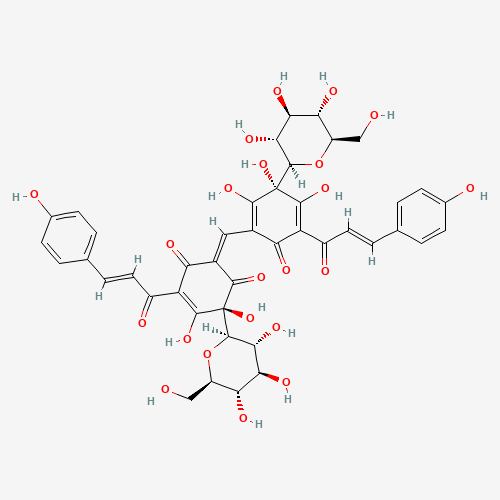
A red flavonoid colour from the dried petals of safflower, Carthamus tinctorius. Its principal colouring matter is carthamin, and it is the red fraction left after the yellow has been washed out of the petals.
Where it is and isn’t permitted
| Jurisdiction | Status | Scope and limits | Citation |
|---|---|---|---|
| Australia and New Zealand | No listed food uses foundThis site has not matched this substance to any food use on this jurisdiction’s list of authorised food additives. A food additive may be used only in foods that list names. Flavourings, enzymes, processing aids and added nutrients are regulated separately and do not appear on it. | ||
| Canada | No listing matchedHealth Canada’s lists name additives without E or INS numbers, so this site matches them by exact name. A substance listed there under a name this site does not recognise has no row here. | ||
| European Union | No listed food uses foundThis site has not matched this substance to any food use on this jurisdiction’s list of authorised food additives. A food additive may be used only in foods that list names. Flavourings, enzymes, processing aids and added nutrients are regulated separately and do not appear on it. | ||
| Great Britain | No listed food uses foundThis site has not matched this substance to any food use on this jurisdiction’s list of authorised food additives. A food additive may be used only in foods that list names. Flavourings, enzymes, processing aids and added nutrients are regulated separately and do not appear on it. | ||
| Japan | No listing matchedThis site imports only Japan’s list of designated additives (Appended Table 1 to the Regulations for Enforcement of the Food Sanitation Act), matched by English name. Existing additives, natural flavouring agents and ordinary foods used as additives are permitted outside that list and are not imported, so an empty row does not show that Japan does not permit the substance. | ||
| South Korea | Permitted, with conditions | Designated food additive: Standards and Specifications for Food Additives, Part III, 1. …Designated food additive: Standards and Specifications for Food Additives, Part III, 1. 일반식품첨가물 (general food additives), 홍화적색소 (“Carthamus Red”, the English the Code prints beside it). Main use (주용도) of 홍화적색소: 착색료. Standard for use (사용기준) of 홍화적색소: (1) [must not be used in the foods listed] “홍화적색소는 아래의 식품에 사용하여서는 아니 된다. 1. 천연식품〔식육류, 어패류, 과일류, 채소류, 해조류, 콩류 등 및 그 단순가공품(탈피, 절단 등)〕 2. 다류 3. 커피 4. 고춧가루, 실고추 5. 김치류 6. 고추장, 조미고추장 7. 식초 8. 향신료가공품(고추 또는 고춧가루 함유 제품에 한함)” The Korean is the standard as published. There is no official English translation of the current Code (the English version on MFDS’s website is the 2020 edition and has no legal effect); the English in square brackets is this site’s description of what each sentence does, not a translation of the foods or the levels. Compositional specifications (Part IV) are not imported, nor are the general standards in Part II, which apply to every additive. | Standards and Specifications for Food Additives (식품첨가물의 기준 및 규격), MFDS Notification, Part III (Standards for use, by item)retrieved 2026-10-18 |
| United States | Not listedDoes not appear on this jurisdiction’s permitted list. That is not the same as being prohibited. | ||
| Codex Alimentarius | Not listedDoes not appear on this jurisdiction’s permitted list. That is not the same as being prohibited. |
How much is permitted
A listing usually limits the quantity as well as the food. Only one of the forms that takes is a figure: quantum satis and good manufacturing practice permit the amount the technological effect requires and no more, which is a limit rather than the absence of one. Figures below are the range across every food category this page is listed in, and categories differ between regulators — see how much is permitted.
| South Korea | — | 1 no quantity stated |
|---|
No regulator sets a figure for Carthamus red. That is not an absence of control: where the listing says quantum satis or good manufacturing practice, the quantity is limited to what the effect requires.
What it is made from
The yellow is extracted from the petals with water first; the residue is treated with alkali, and the red is then precipitated with acid, filtered and dried. Food-grade carriers may be added.
- Vegan
- Vegetarian
Compare other additives on the dietary indexes.
- InChIKey
- WLYGSPLCNKYESI-RSUQVHIMSA-N
- PubChem
- CID 135565560
How JECFA defines it
The international specification for identity and purity, prepared by the Joint FAO/WHO Expert Committee on Food Additives and published by FAO. It is a different document from any above, written by a different body and revised on its own cycle; it is advisory, and a country adopts it or does not.
Carthamus Red
Carthamus Red, a flavonoid, is obtained from the dried petals of Carthamus tinctorius L. To obtain carthamus red, carthamus yellow is extracted from the petals with water and the residue treated with aqueous sodium hydroxide or other alkali. Carthamus red is precipitated from the extract by addition of acid, separated by filtration and dried. The principal colouring matter is carthamin. Food grade materials such as dextrin may be added as carriers for manufacturing dry, powdered items of commerce.
Synonyms: Safflower red, carthamic acid, CI Natural Red 26 (No. 75140) carthamic acid; CI (1975) No. 75140; CI Natural Red 26; Safflower red
Assay, identification and purity criteria
Description and assay
- Specification history
- Prepared at the 51st JECFA (1998), published in FNP 52 Add 6 (1998) superseding specifications prepared at the 49th JECFA (1997), published in FNP 52 Add 5 (1997). ADI - not evaluated by JECFA for an ADI. Metals and arsenic specifications revised at the 59th JECFA (2002)
- Chemical formula
- C 43 H 42 O 22 (carthamin)
- Structural formula
- Carthamin
- Formula weight
- 910.81 (carthamin)
- Assay
- Content of colouring matters (calculated as carthamin) not less than declared
- DESCRIPTION
- Dark red to red-brown powder with a characteristic slight odour
- FUNCTIONAL USES
- Colour
- METHOD OF ASSAY
- Transfer about 0.01 g of the sample, accurately weighed, in a 300-ml ground stoppered flask, add 150 ml of dimethylformamide (DMFA), dissolve by shaking occasionally and allow stand for 2 hours. Filter this solution through a glass filter into a 200-ml volumetric flask. Wash the flask and filter with two 25-ml portions of DMFA, combine the filtrate and the washings, add DMFA to volume and mix. Dilute if necessary. Determine the absorbance (A) at the maximum absorbance in the range of 525-535 nm using a 1-cm cell with DMFA as a blank and calculate the percent of colouring matter (P) with the following formula/taking any additional dilution into account: where W = weight of sample in g A 1% of carthamin = 992 1 cm lambda max = 525 - 535 nm
Identification
- Solubility (Vol. 4)
- Very slightly soluble in water and in ethanol; practically insoluble in ether
- Spectrophotometry (Vol. 4)
- A solution of the sample in dimethyl formamide is red and shows an absorption maximum between 525-535 nm.
- Thin layer chromatography
- Passes test See description under TESTS
- Colour reactions
- Passes test See description under TESTS
- Test: Thin layer chromatography (Vol. 4)
- Activate some silica gel for 1 h at 110° and prepare a TLC plate. Prepare an 0.02% solution of the sample in dimethylformamide and apply 20 μl to the plate. Allow to dry and develop using a mixture of n-butanol, acetic acid and water (4:1:2 by volume) until the solvent front has ascended about 10 cm. Allow to dry. Carthamin appears as a red spot with an Rf value of about 0.40.
- Test: Colour reactions
- Dissolve 10 mg of the sample in 50 ml water. The colour of the solution is red. Add alkali to raise the pH to above 7. The colour changes to orange-yellow. To 0.05 g of the sample add 2 ml of 5% phosphoric acid and heat for 1 h on a water bath. After cooling, filter and wash the residue with 3 ml of water. Combine the filtrate and the washings. Neutralize the combined solution with sodium hydroxide TS, add 5 ml of Fehling’s TS and heat on a water bath for 10 min. A red precipitate is produced.
Purity criteria
- Synthetic dyes
- Passes test See description under TESTS
- Lead ( Vol. 4)
- Not more than 5 mg/kg Determine using an atomic absorption technique appropriate to the specified level. The selection of sample size and method of sample preparation may be based on the principles of the method described in Volume 4, “Instrumental Methods.”
- Test: Synthetic dyes
- Basic dyes: To 1 g of the sample add 100 ml of 1% sodium hydroxide solution, and mix well. Extract 30 ml of this solution with 15 ml of ether. Then extract the ether layer twice with dilute acetic acid (5 ml); the dilute acetic acid layer does not contain any colour. Acidic dyes: To 1 g of the sample add 1 ml of ammonia TS and 8 ml of water, and shake well. Discard an oily layer when separated. Proceed as directed in Paper Chromatography (Ascending Chromatography) using 20 μl of the solution as the sample solution, and a mixture of pyridine and ammonia TS (2:1 by volume) as the developing solvent. Stop the development when the solvent front has advanced about 15 cm from the point of application. No spot is observed at the solvent front after drying under daylight. If any spot is observed, it should be decolourized when sprayed with a solution of stannous chloride in hydrochloric acid (2 in 5).
Every name it appears under
15 recorded names. A label may use any of them.
CAS registry number
- 36338-96-2
Other names
- C.I. Natural Red 26
- carthamic acid
- Carthamin
- Carthamine
- Carthamus
- Carthamus red
- Carthamus Red AP
- CI (1975) No. 75140
- CI Natural Red 26
- Liofresh Red CR
- LIOFRESH RED CR-7000
- Natural Red 26
- P9ZT730WWS
- Safflower red
Hazard reference values
No reference value for this substance in the sources we hold.
Evidence and how bodies read it
Studies, and the differing conclusions regulators drew from them, are curated rather than machine-read, and none has been written for this substance yet.
Common questions
Assembled from what is above, in the words the questions are usually asked in. Each answer is the same statement the relevant section makes, with the same citations behind it.
- What is Carthamus red?
- A red flavonoid colour from the dried petals of safflower, Carthamus tinctorius. Its principal colouring matter is carthamin, and it is the red fraction left after the yellow has been washed out of the petals.
- Where is Carthamus red permitted?
- Of the seven regulators this site reads, South Korea permits it. Each permission is for named foods at named levels, not a blanket one; the table on this page gives them with citations.
- Is Carthamus red vegan?
- Yes. Carthamus red is not derived from animals, and is suitable for vegetarians. This page says what it is made from and how.
Sources for this page
- kr retrieved 2026-10-18
- jecfaspecs retrieved 2026-09-23
Full licence terms and publisher details on Sources. How this page is built and updated: Method.
Machine-readable: a JSON record of this additive is given on request —how to ask for access.
Follow changes to Carthamus red:Atom feed — regulatory events, and any change the weekly refresh detects in its provisions.