Citranaxanthin
3604-90-8 · 4QIX1TA44L · 5',6'-Dihydro-5'-apo-18'-nor-b-caroten-6'-one · 5',6'-Dihydro-5'-apo-18'-nor-beta-caroten-6'-one · Citranaxanthin · Citranxanthin · PRDJTOVRIHGKNU-ZWERVMMHSA-N · E161I · (3E,5E,7E,9E,11E,13E,15E,17E,19E)-5,9,14,18-TETRAMETHYL-20-(2,6,6-TRIMETHYL-1-CYCLOHEXEN-1-YL)-3,5,7,9,11,13,15,17,19-EICOSANONAEN-2-ONE · (3E,5E,7E,9E,11E,13E,15E,17E,19E)-5,9,14,18-tetramethyl-20-(2,6,6-trimethylcyclohex-1-en-1-yl)icosa-3,5,7,9,11,13,15,17,19-nonaen-2-one · (3E,5E,7E,9E,11E,13E,15E,17E,19E)-5,9,14,18-tetramethyl-20-(2,6,6-trimethylcyclohexen-1-yl)icosa-3,5,7,9,11,13,15,17,19-nonaen-2-one · (E)-5,9,14,18-Tetramethyl-20-(2,6,6-trimethylcyclohexenyl)-3,5,7,9,11,13,15,17,19-icosanonaen-2-one · 3,5,7,9,11,13,15,17,19-Eicosanonaen-2-one, 5,9,14,18-tetramethyl-20-(2,6,6-trimethyl-1-cyclohexen-1-yl)-, (3E,5E,7E,9E,11E,13E,15E,17E,19E)-CAS 3604-90-8
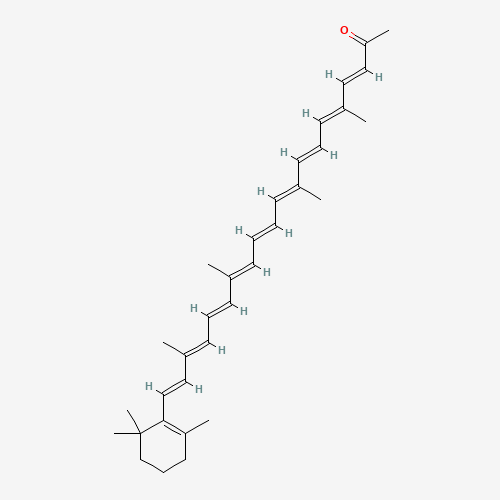
Citranaxanthin is a carotenoid colour, supplied as deep violet crystals or as the diluted and stabilised forms — suspensions in edible oil, emulsions and water-dispersible powders — that are what actually goes into a food.
Where it is and isn’t permitted
| Jurisdiction | Status | Scope and limits | Citation |
|---|---|---|---|
| Australia and New Zealand | No listed food uses foundThis site has not matched this substance to any food use on this jurisdiction’s list of authorised food additives. A food additive may be used only in foods that list names. Flavourings, enzymes, processing aids and added nutrients are regulated separately and do not appear on it. | ||
| Canada | No listing matchedHealth Canada’s lists name additives without E or INS numbers, so this site matches them by exact name. A substance listed there under a name this site does not recognise has no row here. | ||
| European Union | No listed food uses foundThis site has not matched this substance to any food use on this jurisdiction’s list of authorised food additives. A food additive may be used only in foods that list names. Flavourings, enzymes, processing aids and added nutrients are regulated separately and do not appear on it. | ||
| Great Britain | No listed food uses foundThis site has not matched this substance to any food use on this jurisdiction’s list of authorised food additives. A food additive may be used only in foods that list names. Flavourings, enzymes, processing aids and added nutrients are regulated separately and do not appear on it. | ||
| Japan | No listing matchedThis site imports only Japan’s list of designated additives (Appended Table 1 to the Regulations for Enforcement of the Food Sanitation Act), matched by English name. Existing additives, natural flavouring agents and ordinary foods used as additives are permitted outside that list and are not imported, so an empty row does not show that Japan does not permit the substance. | ||
| South Korea | No listing matchedThis site imports Part III of South Korea’s Standards and Specifications for Food Additives, matched by CAS number, then INS number, then exact name. Mixed preparations and sanitisers are not imported, and an entry whose identifiers disagreed with a page’s is held for review, so an empty row does not show that South Korea does not permit the substance. | ||
| United States | Not listedDoes not appear on this jurisdiction’s permitted list. That is not the same as being prohibited. | ||
| Codex Alimentarius | Not listedDoes not appear on this jurisdiction’s permitted list. That is not the same as being prohibited. |
What it is made from
Made synthetically. The crystals are sensitive to oxygen and light and are kept under inert gas in light-resistant containers.
- Vegan
- Vegetarian
Compare other additives on the dietary indexes.
- CAS registry number
- 3604-90-8
- InChIKey
- PRDJTOVRIHGKNU-ZWERVMMHSA-N
- PubChem
- CID 6436724
How JECFA defines it
The international specification for identity and purity, prepared by the Joint FAO/WHO Expert Committee on Food Additives and published by FAO. It is a different document from any above, written by a different body and revised on its own cycle; it is advisory, and a country adopts it or does not.
Citranaxanthin
These specifications apply to predominantly all trans (z) isomer of citranaxanthin together with minor amounts of other carotenoids; diluted and stabilized forms are prepared from citranaxanthin meeting these specifications and include solutions or suspensions of citranaxanthin in edible fats or oils, emulsions and water dispersible powders; these preparations may have different cis/trans isomer ratios. These specifications define only synthetic citranaxanthin. The Committee was aware of naturally occurring citranaxanthin but had no indication of a commercial available food colour obtained from natural sources. The analytical methods described for the parent colour are not necessarily suitable for the assay of or determination of impurities in the stabilized forms. (Appropriate methods should be available from the manufacturer).
Assay, identification and purity criteria
Description and assay
- Specification history
- Prepared at the 31st JECFA (1987), published in FNP 38 (1988) and in FNP 52 (1992). Metals and arsenic specifications revised at the 63rd JECFA (2004). No ADI was allocated at the 31st JECFA (1987)
- Chemical names
- Citranaxanthin, 6'-methyl-6'-apo- ß-carotene-6'-one, 5',6'-dehydro-5'-apo-18'- nor- ß-caroten-6'one
- C.A.S. number
- 3604-90-8
- Chemical formula
- C 33 H 44 0
- Formula weight
- 456.71
- Assay
- Not less than 96% total colouring matters (expressed as citranaxanthin)
- DESCRIPTION
- Deep violet crystals; sensitive to oxygen and light and should therefore be kept in a light-resistant container under inert gas
- FUNCTIONAL USES
- Colour
- METHOD OF ASSAY
- Proceed as directed under Total Content by Spectrophotometry (see Volume 4) using the following conditions: W = 0,08 g V 1 = V 2 = V 3 = 100 ml v 1 = v 2 = 5 ml A 1% = 2680 1 cm lambdamax = about 473 nm
Identification
- Solubility (Vol. 4)
- Insoluble in water; very slightly soluble in ethanol; slightly soluble in vegetable oils; soluble in chloroform
- Spectrophotometry
- A solution of citranaxanthin in chloroform has an absorbance maximum between 478 and 482 nm.
- Test for carotenoid
- The colour of a solution of the sample in acetone disappears after successive additions of a 5% solution of sodium nitrite and 1N sulfuric acid
- Carr-Price reaction
- A solution of the sample in chloroform turns blue on addition of an excess of Carr-Price reagent TS
Purity criteria
- Sulfated ash (Vol. 4)
- Not more than 0.1% Test 2 g of the sample (Method I)
- Subsidiary colouring matters
- Not more than 4% of total colouring matters are carotenoids other than citranaxanthin See description under TESTS
- Lead (Vol. 4)
- Not more than 2 mg/kg Determine using an atomic absorption technique appropriate to the specified level. The selection of sample size and method of sample preparation may be based on the principles of the method described in Volume 4, “Instrumental Methods.”
- Test: Subsidiary colouring matters
- Dissolve about 80 mg of sample in 100 ml chloroform. Apply 400 μl of this solution as streak: 2 cm from the bottom of a TLC-plate (Silicagel 0.25 mm). Pretreat the thin-layer plate by soaking in a tank with 3% potassium hydroxide in methanol so that it is completely wetted. Then dry the plate for 5 min in the air and activate for 1 h at 110º in an oven. Let cool over CaCl 2 and keep in a desiccator over CaCl 2 . Immediately develop the chromatogram with a solvent mixture of 95 parts dichloromethane and 5 parts diethyl ether in a saturated chamber, suitably protected from light, until the solvent front has moved 15 cm above the initial streak. Remove the plate, allow the main part of the solvent to evaporate at room temperature and mark the principal band as well as the bands corresponding to other carotenoids. Remove the silicagel adsorbent that contains the principal band, transfer it to a glass-stoppered 100 ml centrifuge tube and add 40.0 ml chloroform (solution 1). Remove the silicagel adsorbent containing the combined bands corresponding to the other carotenoids, transfer it to a glass-stoppered, 50 ml centrifuge tube and add 20.0 ml chloroform (solution 2). Shake the centrifuge tubes by mechanical means for 10 min and centrifuge for 5 min. Dilute 10.0 ml of Solution 1 to 50.0 ml with chloroform (solution 3). Determine, with a suitable spectrophotometer, the absorbances of Solutions 2 and 3 in 1-cm cells at the maximum wavelength in chloroform, about 482 nm, using chloroform as blank. Calculate the percentage of carotenoids other than citranaxanthin (%) from where A 2 = absorbance of solution 2 A 3 = absorbance of solution 3
Every name it appears under
13 recorded names. A label may use any of them.
E number
- E161I
CAS registry number
- 3604-90-8
Other names
- 4QIX1TA44L
- 5',6'-Dihydro-5'-apo-18'-nor-b-caroten-6'-one
- 5',6'-Dihydro-5'-apo-18'-nor-beta-caroten-6'-one
- Citranaxanthin
- Citranxanthin
- PRDJTOVRIHGKNU-ZWERVMMHSA-N
Systematic names
- (3E,5E,7E,9E,11E,13E,15E,17E,19E)-5,9,14,18-TETRAMETHYL-20-(2,6,6-TRIMETHYL-1-CYCLOHEXEN-1-YL)-3,5,7,9,11,13,15,17,19-EICOSANONAEN-2-ONE
- (3E,5E,7E,9E,11E,13E,15E,17E,19E)-5,9,14,18-tetramethyl-20-(2,6,6-trimethylcyclohex-1-en-1-yl)icosa-3,5,7,9,11,13,15,17,19-nonaen-2-one
- (3E,5E,7E,9E,11E,13E,15E,17E,19E)-5,9,14,18-tetramethyl-20-(2,6,6-trimethylcyclohexen-1-yl)icosa-3,5,7,9,11,13,15,17,19-nonaen-2-one
- (E)-5,9,14,18-Tetramethyl-20-(2,6,6-trimethylcyclohexenyl)-3,5,7,9,11,13,15,17,19-icosanonaen-2-one
- 3,5,7,9,11,13,15,17,19-Eicosanonaen-2-one, 5,9,14,18-tetramethyl-20-(2,6,6-trimethyl-1-cyclohexen-1-yl)-, (3E,5E,7E,9E,11E,13E,15E,17E,19E)-
Hazard reference values
No reference value for this substance in the sources we hold.
Evidence and how bodies read it
Studies, and the differing conclusions regulators drew from them, are curated rather than machine-read, and none has been written for this substance yet.
Common questions
Assembled from what is above, in the words the questions are usually asked in. Each answer is the same statement the relevant section makes, with the same citations behind it.
- What is Citranaxanthin?
- Citranaxanthin is a carotenoid colour, supplied as deep violet crystals or as the diluted and stabilised forms — suspensions in edible oil, emulsions and water-dispersible powders — that are what actually goes into a food.
- Is Citranaxanthin vegan?
- Yes. Citranaxanthin is not derived from animals, and is suitable for vegetarians. This page says what it is made from and how.
Sources for this page
- jecfaspecs retrieved 2026-09-23
Full licence terms and publisher details on Sources. How this page is built and updated: Method.
Machine-readable: a JSON record of this additive is given on request —how to ask for access.
Follow changes to Citranaxanthin:Atom feed — regulatory events, and any change the weekly refresh detects in its provisions.