Cyclotetraglucose
159640-28-5 · CYCLIC NIGEROSYL-(1->6)-NIGEROSE · Cyclic nigerosylnigerose · Cycloalternan · CYCLOALTERNANOTETRAOSE · cyclobis-(1->3)-alpha-isomaltosyl · cyclobis-(1->6)-alpha-nigerosyl · Cyclobis-1,6-alpha-nigerosyl · Cycloisomaltotetraose · Cyclotetraglucose · CYCLOTETRAOSE · INS NO.1504(I) · INS NO.1504(II) · .ALPHA.-D-GLUCOPYRANOSE, O-.ALPHA.-D-GLUCOPYRANOSYL-(1-3)-O-.ALPHA.-D-GLUCOPYRANOSYL-(1-6)-O-.ALPHA.-D-GLUCOPYRANOSYL-(1-3)-, CYCLIC 1,6'''-ANHYDRIDE · alpha-D-Glucopyranose, o-alpha-D-glucopyranosyl-(1-3)-o-alpha-D-glucopyranosyl-(1-6)-o-alpha-D-glucopyranosyl-(1-3)-, cyclic 1,6'''-anhydrideINS 1504(i)
Listed as a carrier by Codex.
Listed as carriers (Codex)
- Codex Alimentarius: Carrier — CXS 192-1995 Table Three, INS 1504(i)
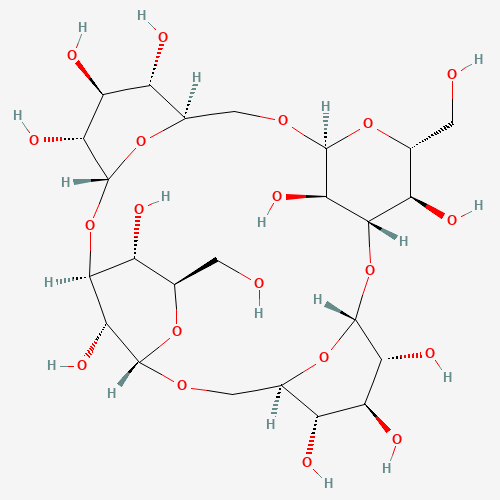
Cyclotetraglucose is a ring of four glucose units with a cavity in the middle, used to trap and protect flavour and colour compounds — the molecule works as a container rather than as a nutrient.
Where it is and isn’t permitted
| Jurisdiction | Status | Scope and limits | Citation |
|---|---|---|---|
| Australia and New Zealand | No listed food uses foundThis site has not matched this substance to any food use on this jurisdiction’s list of authorised food additives. A food additive may be used only in foods that list names. Flavourings, enzymes, processing aids and added nutrients are regulated separately and do not appear on it. | ||
| Canada | No listing matchedHealth Canada’s lists name additives without E or INS numbers, so this site matches them by exact name. A substance listed there under a name this site does not recognise has no row here. | ||
| European Union | No listed food uses foundThis site has not matched this substance to any food use on this jurisdiction’s list of authorised food additives. A food additive may be used only in foods that list names. Flavourings, enzymes, processing aids and added nutrients are regulated separately and do not appear on it. | ||
| Great Britain | No listed food uses foundThis site has not matched this substance to any food use on this jurisdiction’s list of authorised food additives. A food additive may be used only in foods that list names. Flavourings, enzymes, processing aids and added nutrients are regulated separately and do not appear on it. | ||
| Japan | No listing matchedThis site imports only Japan’s list of designated additives (Appended Table 1 to the Regulations for Enforcement of the Food Sanitation Act), matched by English name. Existing additives, natural flavouring agents and ordinary foods used as additives are permitted outside that list and are not imported, so an empty row does not show that Japan does not permit the substance. | ||
| South Korea | No listing matchedThis site imports Part III of South Korea’s Standards and Specifications for Food Additives, matched by CAS number, then INS number, then exact name. Mixed preparations and sanitisers are not imported, and an entry whose identifiers disagreed with a page’s is held for review, so an empty row does not show that South Korea does not permit the substance. | ||
| United States | Not listedDoes not appear on this jurisdiction’s permitted list. That is not the same as being prohibited. | ||
| Codex Alimentarius | Permitted | no numerical limit (good manufacturing practice) | CXS 192-1995 Table Three, INS 1504(i)retrieved 2026-09-07 |
How much is permitted
A listing usually limits the quantity as well as the food. Only one of the forms that takes is a figure: quantum satis and good manufacturing practice permit the amount the technological effect requires and no more, which is a limit rather than the absence of one. Figures below are the range across every food category this page is listed in, and categories differ between regulators — see how much is permitted.
| Codex Alimentarius | — | 1 GMP |
|---|
No regulator sets a figure for Cyclotetraglucose. That is not an absence of control: where the listing says quantum satis or good manufacturing practice, the quantity is limited to what the effect requires.
What it is made from
Produced enzymatically from starch, which is rearranged into a closed ring.
- Vegan
- Vegetarian
Compare other additives on the dietary indexes.
- InChIKey
- NIFXVRWMHZPIFE-KCLHJWPFSA-N
- PubChem
- CID 11686063
How JECFA defines it
The international specification for identity and purity, prepared by the Joint FAO/WHO Expert Committee on Food Additives and published by FAO. It is a different document from any above, written by a different body and revised on its own cycle; it is advisory, and a country adopts it or does not.
INS 1504(i) Cyclotetraglucose
Cyclotetraglucose has been found to occur naturally in sake lees (i.e., the sediment that forms during sake production), in sake itself, and in the cells of Saccharomyces cerevisiae. It is a non-reducing cyclic tetrasaccharide consisting of four D-glucopyranosyl units linked by alternating α (1 → 3) and α (1 → 6) glycosidic bonds. It is produced from hydrolyzed food-grade starch by the actions of a mixture of 6- α - glucosyltransferase α -isomaltosyltransferase derived from Sporosarcina globispora , and cyclodextrin glucosyltransferase derived from Bacillus stearothermophilus. After purification the product contains 0 to 5 molecules of water of crystallization per molecule of cyclotetraglucose.
Synonyms: Cyclotetraose; Cyclic nigerosyl-(1 → 6)-nigerose; cycloalternan; cycloalternanotetraose; INS No. 1504(i) Cyclic nigerosyl-(1?6)-nigerose
Assay, identification and purity criteria
Description and assay
- Specification history
- Prepared at the 68 th JECFA (2007) and published in FAO JECFA Monographs 4 (2007). An ADI “not specified” was established at the 71 st JECFA (2009).
- Chemical names
- cyclo [ → 6)- α -D-glucopyranosyl-(1 → 3)- α -D-glucopyranosyl-(1 → 6)- α -D-glucopyranosyl-(1 → 3)- α -D-glucopyranosyl-(1 → ]
- C.A.S. number
- Cyclotetraglucose, anhydrous: 159640-28-5 Cyclotetraglucose, monohydrate: 532945-75-8 Cyclotetraglucose, pentahydrate: 532945-76-9
- Chemical formula
- C24H40O20 (anhydrous)
- Formula weight
- 648.56 (anhydrous)
- Assay
- Not less than 98% on the anhydrous basis
- DESCRIPTION
- Virtually odourless, white or almost white powder
- FUNCTIONAL USES
- Carrier
- METHOD OF ASSAY
- Determine by HPLC (Vol. 4) using the following conditions: NOTE: Use deionized water Sample solution Weigh accurately about 500 mg of test sample into a 50-ml volumetric flask and add about 40 ml of water. Dissolve the sample completely and dilute to the mark with water. Standard solution Dissolve accurately weighed cyclotetraglucose standard (available under the name of cyclotetraose from Hayashibara Co., Ltd, 2-3 Shimoishii 1-chome, Okayama 700, Japan) in water to obtain a solution of about 10 mg/ ml. Chromatography Liquid chromatograph equipped with a column oven and a refractive index detector. Column and packing: strong acidic cation exchange resin - length: 200 – 400 mm - diameter: 8 – 10 mm - temperature: 80° Mobile phase: water Flow rate: Adjust to obtain a retention time of 55 – 65 min Injection volume: 20 μ l The retention time of cyclotetraglucose is approx. 62 min. System suitability Upon chromatography of a solution containing about 0.4% cyclotetraglucose and 0.4% glucose, the resolution (Vol. 4) is not less than 1.0 between glucose (first peak) and cyclotetraglucose (second peak). Procedure Inject the sample solution into the chromatograph, and measure the area of the cyclotetraglucose peak. Repeat for the standard solution. Calculate the percentage of cyclotetraglucose in the test sample as follows: % cyclotetraglucose (anhydrous basis) = 100 x (AS/AR)(WR/WS) where AS and AR are the areas of the peaks due to cyclotetraglucose for the sample solution and standard solution, respectively; and WS and WR are the weights (mg) of the test sample and cyclotetraglucose standard, respectively, corrected for water content.
Identification
- Melting range (Vol.4)
- Decomposes above 300°
- Solubility (Vol. 4)
- Freely soluble in water
- Anthrone reaction
- Add 5 ml of Anthrone TS (Vol. 4) to 2 ml of a 0.1% aqueous solution of the test sample. React at 80° for 15 min. A deep blue colour develops.
- Specific rotation (Vol.4)
- 20 [ α ] D between +240° and +248° (10% solution)
Purity criteria
- Water (Vol. 4)
- Not more than 15.0% (Karl Fischer Method)
- Total ash (Vol. 4)
- Not more than 0.1% (500°, 5h)
- Lead (Vol. 4)
- Not more than 1 mg/kg Determine using an AAS/ICP-AES technique appropriate to the specified level. The selection of sample size and method of sample preparation may be based on the principles of the methods described in Volume 4 (under “General Methods, Metallic Impurities”).
Every name it appears under
15 recorded names. A label may use any of them.
CAS registry number
- 159640-28-5
Other names
- CYCLIC NIGEROSYL-(1->6)-NIGEROSE
- Cyclic nigerosylnigerose
- Cycloalternan
- CYCLOALTERNANOTETRAOSE
- cyclobis-(1->3)-alpha-isomaltosyl
- cyclobis-(1->6)-alpha-nigerosyl
- Cyclobis-1,6-alpha-nigerosyl
- Cycloisomaltotetraose
- Cyclotetraglucose
- CYCLOTETRAOSE
- INS NO.1504(I)
- INS NO.1504(II)
Systematic names
- .ALPHA.-D-GLUCOPYRANOSE, O-.ALPHA.-D-GLUCOPYRANOSYL-(1-3)-O-.ALPHA.-D-GLUCOPYRANOSYL-(1-6)-O-.ALPHA.-D-GLUCOPYRANOSYL-(1-3)-, CYCLIC 1,6'''-ANHYDRIDE
- alpha-D-Glucopyranose, o-alpha-D-glucopyranosyl-(1-3)-o-alpha-D-glucopyranosyl-(1-6)-o-alpha-D-glucopyranosyl-(1-3)-, cyclic 1,6'''-anhydride
Hazard reference values
| Type | Value | Population | Assessed by | Opinion |
|---|---|---|---|---|
| ADI | not specified | — | JECFA | 2009 |
Evidence and how bodies read it
Studies, and the differing conclusions regulators drew from them, are curated rather than machine-read, and none has been written for this substance yet.
Common questions
Assembled from what is above, in the words the questions are usually asked in. Each answer is the same statement the relevant section makes, with the same citations behind it.
- What is INS 1504(i)?
- INS 1504(i) is Cyclotetraglucose. Cyclotetraglucose is a ring of four glucose units with a cavity in the middle, used to trap and protect flavour and colour compounds — the molecule works as a container rather than as a nutrient.
- What is Cyclotetraglucose used for in food?
- It is listed as a carrier — the role Codex assigns it. This page shows every function each regulator records, with the citation for each.
- Where is Cyclotetraglucose permitted?
- Of the seven regulators this site reads, the Codex standard permits it. Each permission is for named foods at named levels, not a blanket one; the table on this page gives them with citations.
- Is Cyclotetraglucose vegan?
- Yes. Cyclotetraglucose is not derived from animals, and is suitable for vegetarians. This page says what it is made from and how.
Sources for this page
- gsfa retrieved 2026-09-07
- jecfaspecs retrieved 2026-09-23
Full licence terms and publisher details on Sources. How this page is built and updated: Method.
Machine-readable: a JSON record of this additive is given on request —how to ask for access.
Follow changes to Cyclotetraglucose:Atom feed — regulatory events, and any change the weekly refresh detects in its provisions.