Dilauryl thiodipropionate
115628-90-5 · 123-28-4 · 31852-09-2 · 53571-83-8 · 3,3'-Thiobispropionic acid, didodecyl ester · 3,3'-Thiodipropionic acid di-n-dodecyl ester · 3,3'-Thiodipropionic Acid Didodecyl Ester · 3,3'-Thiodipropionic Acid Didodecyl Ester; Didodecyl 3,3'-thiodipropionate · 3,3'-Thiodipropionic acid, bis-dodecyl ester · Advastab 800 · Antiox L · Antioxidant AS · Antioxidant LTDP · Bis(dodecyloxycarbonylethyl) sulfide · BRN 1808848 · Carstab dltdp · CCRIS 3936 · Cyanox LTDP · D 1 (antioxidant) · Didodecyl 3,3'-thiodipropionate · Didodecyl 3,3-thiodipropionate · Didodecyl thiobispropanoate · Didodecyl thiodipropionate · Dilauryl .beta.,.beta.'-thiodipropionate · Dilauryl .beta.-thiodipropionate · Dilauryl 3,3'-thiodipropionate · Dilauryl beta-thiodipropionate · DILAURYL THIODIPROPIONATE · Dilauryl thiodipropionic acid · Dilaurylester kyseliny .beta.',.beta.'-thiodipropionove · Dilaurylthiodipropionate · DLT · Dltdp · DLTP · Dmptp · dodecyl 3-(3-dodecoxy-3-oxopropyl)sulfanylpropanoate · HSDB 353 · Ipognox 89 · Irganox PS 800 · Lauryl 3,3'-thiodipropionate · Lusmit · Milban F · Neganox DLTP · Plastanox LTDP · Plastanox LTDP Antioxidant · Propanoic acid 3,3'-thiobis(didodecyl) ester · Propanoic acid, 3,3'-thiobis-, 1,1'-didodecyl ester · Propanoic acid, 3,3'-thiobis-, didodecyl ester · Propanoic acid, thiobis-, didodecyl ester · Propionic acid, 3,3'-thiobis-, didodecyl ester · Propionic acid, 3,3'-thiodi-, didodecyl ester · PTDE · Rasumitto · Stabilizer DLT · Sumilizer TPL · Thiobis(dodecyl propionate) · Thiobis[dodecyl propionate] · Thiodipropionic acid didodecyl ester · Thiodipropionic acid dilauryl ester · Tyox B · 389 · Dilauryl thiodipropionateINS 389CAS 123-28-4
Listed as an antioxidant by Codex.
Listed as antioxidants (Codex)
- Codex Alimentarius: Antioxidant — CXS 192-1995 Table One, INS 389
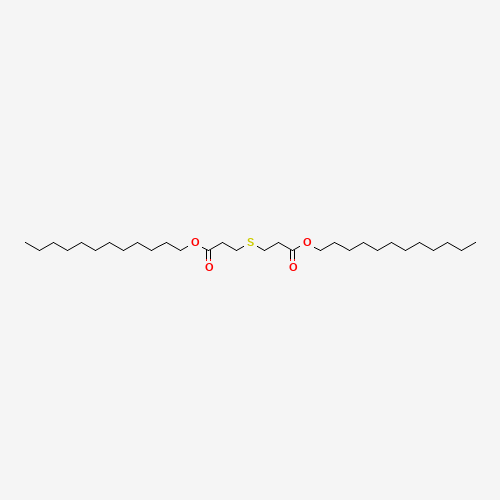
Dilauryl thiodipropionate is an antioxidant for fats and oils, working by a different mechanism from BHA and BHT — it destroys peroxides rather than intercepting radicals, so it is often used alongside them.
Where it is and isn’t permitted
| Jurisdiction | Status | Scope and limits | Citation |
|---|---|---|---|
| Australia and New Zealand | No listed food uses foundThis site has not matched this substance to any food use on this jurisdiction’s list of authorised food additives. A food additive may be used only in foods that list names. Flavourings, enzymes, processing aids and added nutrients are regulated separately and do not appear on it. | ||
| Canada | No listing matchedHealth Canada’s lists name additives without E or INS numbers, so this site matches them by exact name. A substance listed there under a name this site does not recognise has no row here. | ||
| European Union | No listed food uses foundThis site has not matched this substance to any food use on this jurisdiction’s list of authorised food additives. A food additive may be used only in foods that list names. Flavourings, enzymes, processing aids and added nutrients are regulated separately and do not appear on it. | ||
| Great Britain | No listed food uses foundThis site has not matched this substance to any food use on this jurisdiction’s list of authorised food additives. A food additive may be used only in foods that list names. Flavourings, enzymes, processing aids and added nutrients are regulated separately and do not appear on it. | ||
| Japan | No listing matchedThis site imports only Japan’s list of designated additives (Appended Table 1 to the Regulations for Enforcement of the Food Sanitation Act), matched by English name. Existing additives, natural flavouring agents and ordinary foods used as additives are permitted outside that list and are not imported, so an empty row does not show that Japan does not permit the substance. | ||
| South Korea | No listing matchedThis site imports Part III of South Korea’s Standards and Specifications for Food Additives, matched by CAS number, then INS number, then exact name. Mixed preparations and sanitisers are not imported, and an entry whose identifiers disagreed with a page’s is held for review, so an empty row does not show that South Korea does not permit the substance. | ||
| United States | Permitted | 21 CFR 182.3280retrieved 2026-10-17 | |
| Codex Alimentarius | Permitted, with conditions | 6 food categories highest permitted level 1,000 mg/kg Show every food category and its notes
| CXS 192-1995 Table One, INS 389and 5 further provisionsretrieved 2026-09-07 |
How much is permitted
A listing usually limits the quantity as well as the food. Only one of the forms that takes is a figure: quantum satis and good manufacturing practice permit the amount the technological effect requires and no more, which is a limit rather than the absence of one. Figures below are the range across every food category this page is listed in, and categories differ between regulators — see how much is permitted.
| United States | — | 1 no quantity stated |
|---|---|---|
| Codex Alimentarius | 200 mg/kg – 1,000 mg/kg | 6 numeric limit |
What it is made from
Made by reacting thiodipropionic acid with lauryl alcohol, usually from coconut or palm kernel oil.
- Vegan
- Vegetarian
Compare other additives on the dietary indexes.
- CAS registry number
- 123-28-4
- InChIKey
- GHKOFFNLGXMVNJ-UHFFFAOYSA-N
- PubChem
- CID 31250
How JECFA defines it
The international specification for identity and purity, prepared by the Joint FAO/WHO Expert Committee on Food Additives and published by FAO. It is a different document from any above, written by a different body and revised on its own cycle; it is advisory, and a country adopts it or does not.
INS 389 Dilauryl Thiodipropionate
Ester of thiodipropionic acid and a food grade lauryl alcohol
Synonyms: INS No. 389
Assay, identification and purity criteria
Description and assay
- Specification history
- Prepared at the 17th JECFA (1973), published in FNP 4 (1978) and FNP 52 (1992). Metals and arsenic specifications revised at the 61st JECFA (2003). An ADI of 0-3 mg/kg bw was established at the 17thJECFA (1973)
- Chemical names
- Didodecyl 3,3'-thiodipropionic acid, dilauryl ester of ß,ß'-thiodi-propionic acid
- C.A.S. number
- 123-28-4
- Chemical formula
- C 30 H 58 O 4 S
- Formula weight
- 514.86
- Assay
- Not less than 99%
- DESCRIPTION
- White crystalline flakes having a characteristic sweetish ester-like odour
- FUNCTIONAL USES
- Antioxidant
- METHOD OF ASSAY
- Weigh out 0.700 g of the sample, transfer to a 250-ml Erlenmeyer flask, add 100 ml of acetic acid and 50 ml of ethanol, and heat the mixture gently until the sample dissolves completely. Add 3 ml of hydrochloric acid and 4 drops of p-ethoxy-chrysoidin TS and immediately titrate with 0.1 N bromide-bromate TS. As the end-point is approached (pink colour), add 4 more drops of the indicator solution and continue the titration, dropwise, to a colour change from red to pale yellow. Perform a blank determination and make any necessary correction. Each ml of 0.1 N bromide-bromate TS is equivalent to 25.74 mg of C 30 H 58 O 4 S. Convert to percentage and subtract thiodipropionic acid content determined in the Acidity test to obtain percentage of C 30 H 58 O 4 S.
Identification
- Solubility (Vol. 4)
- Insoluble in water, soluble in ethanol and ether
- Solidification point
- Not below 40 o
- Saponification value (Vol. 4)
- 205 - 215
Purity criteria
- Acidity
- Not more than 0.2% (as thiopropionic acid) To 50 ml of a mixture of 1 part of methanol and 3 parts of benzene, add 5 drops of phenolphthalein TS and neutralize with ethanolic potassium hydroxide. Add 2 g, accurately weighed, of the sample, swirl to dissolve and titrate with 0.1 N ethanolic potassium hydroxide. Each ml of 0.1 N ethanolic potassium hydroxide is equivalent to 8.91 mg C 6 H 10 O 4 S.
- Lead (Vol. 4)
- Not more than 2 mg/kg Determine using an atomic absorption technique appropriate to the specified level. The selection of sample size and method of sample preparation may be based on the principles of the method described in Volume 4, “Instrumental Methods.”
Every name it appears under
62 recorded names. A label may use any of them.
INS number
- 389
CAS registry number
- 115628-90-5
- 123-28-4
- 31852-09-2
- 53571-83-8
As it appears in regulation
- Dilauryl thiodipropionate
Other names
- 3,3'-Thiobispropionic acid, didodecyl ester
- 3,3'-Thiodipropionic acid di-n-dodecyl ester
- 3,3'-Thiodipropionic Acid Didodecyl Ester
- 3,3'-Thiodipropionic Acid Didodecyl Ester; Didodecyl 3,3'-thiodipropionate
- 3,3'-Thiodipropionic acid, bis-dodecyl ester
- Advastab 800
- Antiox L
- Antioxidant AS
- Antioxidant LTDP
- Bis(dodecyloxycarbonylethyl) sulfide
- BRN 1808848
- Carstab dltdp
- CCRIS 3936
- Cyanox LTDP
- D 1 (antioxidant)
- Didodecyl 3,3'-thiodipropionate
- Didodecyl 3,3-thiodipropionate
- Didodecyl thiobispropanoate
- Didodecyl thiodipropionate
- Dilauryl .beta.,.beta.'-thiodipropionate
- Dilauryl .beta.-thiodipropionate
- Dilauryl 3,3'-thiodipropionate
- Dilauryl beta-thiodipropionate
- DILAURYL THIODIPROPIONATE
- Dilauryl thiodipropionic acid
- Dilaurylester kyseliny .beta.',.beta.'-thiodipropionove
- Dilaurylthiodipropionate
- DLT
- Dltdp
- DLTP
- Dmptp
- dodecyl 3-(3-dodecoxy-3-oxopropyl)sulfanylpropanoate
- HSDB 353
- Ipognox 89
- Irganox PS 800
- Lauryl 3,3'-thiodipropionate
- Lusmit
- Milban F
- Neganox DLTP
- Plastanox LTDP
- Plastanox LTDP Antioxidant
- Propanoic acid 3,3'-thiobis(didodecyl) ester
- Propanoic acid, 3,3'-thiobis-, 1,1'-didodecyl ester
- Propanoic acid, 3,3'-thiobis-, didodecyl ester
- Propanoic acid, thiobis-, didodecyl ester
- Propionic acid, 3,3'-thiobis-, didodecyl ester
- Propionic acid, 3,3'-thiodi-, didodecyl ester
- PTDE
- Rasumitto
- Stabilizer DLT
- Sumilizer TPL
- Thiobis(dodecyl propionate)
- Thiobis[dodecyl propionate]
- Thiodipropionic acid didodecyl ester
- Thiodipropionic acid dilauryl ester
- Tyox B
Hazard reference values
| Type | Value | Population | Assessed by | Opinion |
|---|---|---|---|---|
| ADI | 3 mg/kg bw/day | — | JECFA | 1973 |
Evidence and how bodies read it
Studies, and the differing conclusions regulators drew from them, are curated rather than machine-read, and none has been written for this substance yet.
Common questions
Assembled from what is above, in the words the questions are usually asked in. Each answer is the same statement the relevant section makes, with the same citations behind it.
- What is INS 389?
- INS 389 is Dilauryl thiodipropionate. Dilauryl thiodipropionate is an antioxidant for fats and oils, working by a different mechanism from BHA and BHT — it destroys peroxides rather than intercepting radicals, so it is often used alongside them.
- What is Dilauryl thiodipropionate used for in food?
- It is listed as an antioxidant — the role Codex assigns it. This page shows every function each regulator records, with the citation for each.
- Is Dilauryl thiodipropionate banned in Europe?
- No. Dilauryl thiodipropionate does not appear on the EU's list of authorised food additives, which is not the same as being banned: the EU permits an additive only where it has authorised it, and usually the reason for an absence is that no one applied. The EU has made no finding against this substance. It does mean it may not be used as a food additive in the EU today.
- Where is Dilauryl thiodipropionate permitted?
- Of the seven regulators this site reads, the US and the Codex standard permit it. Each permission is for named foods at named levels, not a blanket one; the table on this page gives them with citations.
- Is Dilauryl thiodipropionate vegan?
- Yes. Dilauryl thiodipropionate is not derived from animals, and is suitable for vegetarians. This page says what it is made from and how.
Sources for this page
- ecfr retrieved 2026-10-17
- gsfa retrieved 2026-09-07
- jecfaspecs retrieved 2026-09-23
Full licence terms and publisher details on Sources. How this page is built and updated: Method.
Machine-readable: a JSON record of this additive is given on request —how to ask for access.
Follow changes to Dilauryl thiodipropionate:Atom feed — regulatory events, and any change the weekly refresh detects in its provisions.