Ferrous ammonium phosphate
10101-60-7 · Ammonium iron phosphate · AMMONIUM IRON PHOSPHATE (NH4FEPO4) · Ammonium iron(2+) phosphate (1/1/1) · azanium;iron(2+);phosphate · Ferrous ammonium phosphate · Iron(II) ammonium phosphate · Phosphoric acid, ammonium iron(2+) salt (1:1:1) · Phosphoric acid, ammonium iron(II) saltCAS 10101-60-7
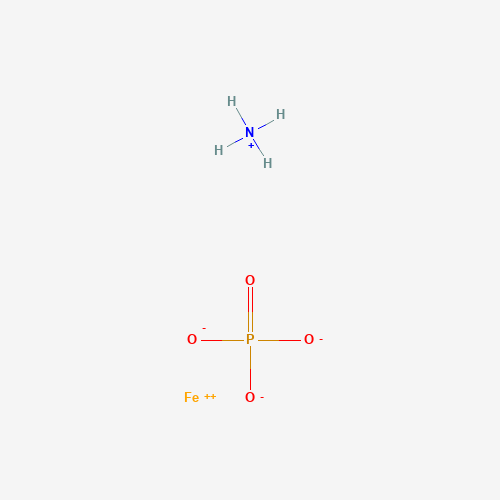
A greyish-green iron salt used to fortify foods with iron. Iron compounds differ in how much colour and flavour they impart, which is why several are specified.
Where it is and isn’t permitted
| Jurisdiction | Status | Scope and limits | Citation |
|---|---|---|---|
| Australia and New Zealand | No listed food uses foundThis site has not matched this substance to any food use on this jurisdiction’s list of authorised food additives. A food additive may be used only in foods that list names. Flavourings, enzymes, processing aids and added nutrients are regulated separately and do not appear on it. | ||
| Canada | No listing matchedHealth Canada’s lists name additives without E or INS numbers, so this site matches them by exact name. A substance listed there under a name this site does not recognise has no row here. | ||
| European Union | No listed food uses foundThis site has not matched this substance to any food use on this jurisdiction’s list of authorised food additives. A food additive may be used only in foods that list names. Flavourings, enzymes, processing aids and added nutrients are regulated separately and do not appear on it. | ||
| Great Britain | No listed food uses foundThis site has not matched this substance to any food use on this jurisdiction’s list of authorised food additives. A food additive may be used only in foods that list names. Flavourings, enzymes, processing aids and added nutrients are regulated separately and do not appear on it. | ||
| Japan | No listing matchedThis site imports only Japan’s list of designated additives (Appended Table 1 to the Regulations for Enforcement of the Food Sanitation Act), matched by English name. Existing additives, natural flavouring agents and ordinary foods used as additives are permitted outside that list and are not imported, so an empty row does not show that Japan does not permit the substance. | ||
| South Korea | No listing matchedThis site imports Part III of South Korea’s Standards and Specifications for Food Additives, matched by CAS number, then INS number, then exact name. Mixed preparations and sanitisers are not imported, and an entry whose identifiers disagreed with a page’s is held for review, so an empty row does not show that South Korea does not permit the substance. | ||
| United States | Not listedDoes not appear on this jurisdiction’s permitted list. That is not the same as being prohibited. | ||
| Codex Alimentarius | Not listedDoes not appear on this jurisdiction’s permitted list. That is not the same as being prohibited. |
GRAS notices to the FDA
A GRAS notice is a company’s conclusion that a substance is generally recognised as safe for the use it describes. FDA’s letter responds to that conclusion, for that notifier and that use. It is not a listing in 21 CFR, and it is not counted as a US permission above. The substance and use are as FDA’s inventory words them; this site matched the notice to this page by exact name.
GRN No. 271 · Ferrous ammonium phosphate · Nestle USA, Inc.
Intended use: Use in various food categories as a source of dietary iron for food enrichment and fortification purposes consistent with iron supplementation guidelines
FDA’s response (2009-05-29): FDA has no questions
What it is made from
Made by reacting iron powder with phosphoric acid in water and then adding ammonia; the product is spray-dried and milled.
- Vegan
- Vegetarian
Compare other additives on the dietary indexes.
- CAS registry number
- 10101-60-7
- InChIKey
- PTZOLXYHGCJRHA-UHFFFAOYSA-L
- PubChem
- CID 165813
How JECFA defines it
The international specification for identity and purity, prepared by the Joint FAO/WHO Expert Committee on Food Additives and published by FAO. It is a different document from any above, written by a different body and revised on its own cycle; it is advisory, and a country adopts it or does not.
Ferrous ammonium phosphate
Ferrous ammonium phosphate is manufactured by first combining iron powder and phosphoric acid in deionized water with stirring and heating the mixture to get ferrous hydrogen phosphate as a slurry. Ammonia is added to get ferrous ammonium phosphate. The product is then spray dried and milled. Ferrous ammonium phosphate consists primarily of the anhydrous salt with small amounts of the hydrate.
Synonyms: Iron(II) ammonium phosphate; Phosphoric acid, ammonium iron (II) salt
Assay, identification and purity criteria
Description and assay
- Specification history
- New specifications prepared at the 71 st JECFA (2009) and published in FAO JECFA Monographs 7 (2009). A PMTDI of 0.8 mg/kg bw for iron was established at the 35 th JECFA (1989).
- C.A.S. number
- 10101-60-7
- Chemical formula
- FeNH4PO4
- Formula weight
- 168.85 anhydrous
- Assay
- Not less than 24 % and not more than 30% expressed as Iron(II)
- DESCRIPTION
- Greyish-green powder
- FUNCTIONAL USES
- Nutrient supplement
- METHOD OF ASSAY
- Weigh accurately about 0.3 g of the sample into a 250 ml conical flask, add 25 ml of dilute sulfuric acid (16% v/v) and dissolve with heating. Cool and add 75 ml of water. Add 0.1 ml of ferroin indicator solution (0.1% w/v in water). Titrate immediately with 0.1 N cerium sulfate until the colour changes from orange to light bluish-green. Each ml of 0.1 N cerium sulfate is equivalent to 5.585 mg of iron (II).
Identification
- Solubility (Vol. 4)
- Insoluble in water, soluble in dilute mineral acids
- Iron (Vol. 4)
- Passes test
- Ammonium (Vol. 4)
- Passes test
- Phosphate (Vol. 4)
- Passes test
Purity criteria
- Water (Vol. 4)
- Not more than 3% (Karl Fischer method)
- Fluoride (Vol. 4)
- Not more than 50 mg/kg (Method I or II)
- Iron (III)
- Not more than 7% See description under TESTS
- Lead (Vol. 4)
- Not more than 2 mg/kg Determine using an AAS/ICP-AES technique appropriate to the specified level. The selection of sample size and method of sample preparation may be based on principles of methods described in Volume 4 (under “General Methods, Metallic Impurities”).
- Mercury (Vol. 4)
- Not more than 1 mg/kg Determine using cold vapour atomic absorption technique. The selection of sample size and method of sample preparation may be based on the principles of the method described in Volume 4 (under “General Methods, Metallic Impurities”).
- Cadmium (Vol. 4)
- Not more than 1 mg/kg Determine using AAS/ICP-AES technique appropriate to the specified level. The selection of sample size and method of sample preparation may be based on the principles of the method described in Volume 4 (under “General Methods, Metallic Impurities”).
- Arsenic (Vol. 4)
- Not more than 3 mg/kg (Method II) Determine using atomic absorption hydride technique. Use Method I for sample preparation.
- Test: Iron (III)
- Transfer 1 g of sample into a 250 ml Erlenmeyer flask, add 20 ml of water, 10 ml of hydrochloric acid TS, heat to dissolve and cool to room temperature. Add 3 g of potassium iodide, stopper, swirl to mix, and allow to stand in the dark for 15 min. Remove the stopper, add approx. 100 ml of water, and titrate with 0.1 N sodium thiosulfate, adding starch TS near the end point. Each ml of 0.1 N sodium thiosulfate is equivalent to 5.585 mg of iron (III).
Every name it appears under
9 recorded names. A label may use any of them.
CAS registry number
- 10101-60-7
Other names
- Ammonium iron phosphate
- AMMONIUM IRON PHOSPHATE (NH4FEPO4)
- Ammonium iron(2+) phosphate (1/1/1)
- azanium;iron(2+);phosphate
- Ferrous ammonium phosphate
- Iron(II) ammonium phosphate
- Phosphoric acid, ammonium iron(2+) salt (1:1:1)
- Phosphoric acid, ammonium iron(II) salt
Hazard reference values
No reference value for this substance in the sources we hold.
Evidence and how bodies read it
Studies, and the differing conclusions regulators drew from them, are curated rather than machine-read, and none has been written for this substance yet.
Common questions
Assembled from what is above, in the words the questions are usually asked in. Each answer is the same statement the relevant section makes, with the same citations behind it.
- What is Ferrous ammonium phosphate?
- A greyish-green iron salt used to fortify foods with iron. Iron compounds differ in how much colour and flavour they impart, which is why several are specified.
- Is Ferrous ammonium phosphate vegan?
- Yes. Ferrous ammonium phosphate is not derived from animals, and is suitable for vegetarians. This page says what it is made from and how.
Sources for this page
- jecfaspecs retrieved 2026-09-23
Full licence terms and publisher details on Sources. How this page is built and updated: Method.
Machine-readable: a JSON record of this additive is given on request —how to ask for access.
Follow changes to Ferrous ammonium phosphate:Atom feed — regulatory events, and any change the weekly refresh detects in its provisions.