Lauric arginate ethyl ester
48076-74-0 · E 243 · ethyl (2S)-2-(dodecanoylamino)-5-guanidino-pentanoate · ethyl (2S)-5-(diaminomethylideneamino)-2-(dodecanoylamino)pentanoate · Ethyl dodecanoyl-L-argininate · Ethyl lauroyl arginate · ethyl N(alpha)-lauroyl-L-arginate · ethyl N(alpha)-lauroylarginate · ethyl n2-dodecanoyl-l-argininate · ETHYL N5-(DIAMINOMETHYLENE)-N2-DODECANOYL-L-ORNITHINATE · Ethyl N~5~-(diaminomethylidene)-N~2~-dodecanoyl-L-ornithinate · ethyl-Να- lauroyl-L-arginate·HCl · L-Arginine, N2-(1-oxododecyl)-, ethyl ester · L-EthylLauroylArginate · L-ORNITHINE, N5-(DIAMINOMETHYLENE)-N2-(1-OXODODECYL)-, ETHYL ESTER · LAE · lauramide arginine ethyl ester · LAURAMIDE ARGININE ETHYL ESTER FREE BASE · lauric arginate · LAURIC ARGINATE ETHYL ESTER · lauroyl arginine ethyl ester · N alpha-Lauroyl-L-arginine ethyl ester · N(alpha)-Cocoyl-L-arginine ethyl ester · N(alpha)-Cocoylarginine ethyl ester · N(alpha)-Cocylarginine ethyl ester · N(alpha)-Lauroyl-arginine ethyl ester · N(alpha)-Lauroylarginine ethyl ester · N-(alpha)-Cae · N-(alpha)-cocoyl-L-arginine ethyl ester · N-(alpha)-cocoylarginine ethyl ester · N-(alpha)-cocylarginine ethyl ester · N-(alpha)-Lae · N-(alpha)-lauroyl-arginine ethyl ester · N-(alpha)-Lauroyl-L-arginine ethyl ester, DL-pyroglutamic acid salt · N-(alpha)-lauroylarginine ethyl ester · N.ALPHA.-LAUROYL-L-ARGININE ETHYL ESTER · Nacaee · nalpha-lauroyl-l-arginine ethyl ester · N|A-Lauroyl-L-arginine ethyl ester · E243 · 243 · ethyl (2S)-5-(diaminomethylideneamino)-2-(dodecanoylamino)pentanoate · Ethyl lauroyl arginate · Arginato de etil-lauroílo · Arginian etylowo-lauroilowy · Ethyl lauroyl arginate · Ethyl-lauroyl-argininát · Ethyllauroylarginaat · Ethyllauroylarginat · Ethyllaurylarginat · Etil lauroil arginat · Etil lauroil arginato · etil lavroil arginat · Etil lawrojl arġinat · Etil-lauroil-arginát · Etillauroilargināts · Etilo lauroilarginatas · ETYL N-DODEKANOYL-L-ARGINÁT · Etyl-N-dodekanoyl-L-arginát · Etyllauroylarginat · Etyylilauryyliarginaatti · Etüüllauroüülarginaat · ЕтиллауроиларгинатE number E243INS 243CAS 48076-74-0
Listed as a preservative by Canada and Codex.
Listed as preservatives (CA, Codex)
- Canada: Preservative — Health Canada, List of Permitted Preservatives (List 11)
- Codex Alimentarius: Preservative — CXS 192-1995 Table One, INS 243
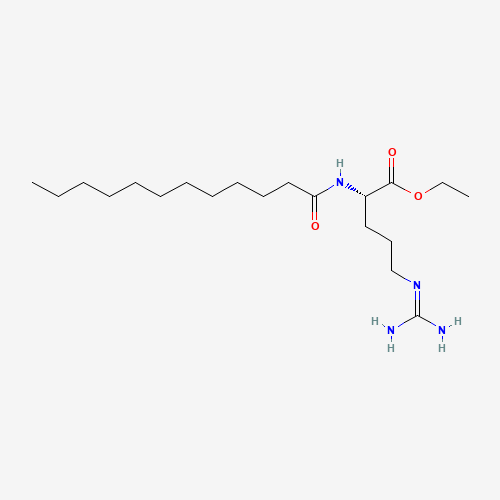
Lauric arginate is an antimicrobial used on the surface of processed meats and in some drinks, effective against Listeria.
Where it is and isn’t permitted
| Jurisdiction | Status | Scope and limits | Citation |
|---|---|---|---|
| Australia and New Zealand | Permitted, with conditions | 16 food categories highest permitted level 400 mg/kg Show every food category
| Food Standards Code, Schedule 15, S15—5and 15 further provisionsretrieved 2026-10-17 |
| Canada | Permitted, with conditions | highest permitted level 200 mg/kg 4 permitted uses Show every permitted use
| Health Canada, List of Permitted Preservatives (List 11)and 3 further provisionsretrieved 2026-10-17 |
| European Union | Permitted, with conditions | 1 food category highest permitted level 160 mg/kg ML = 160 mg/kg. except emulsified sausages, smoked sausages and liver paste. | Regulation (EC) No 1333/2008, Annex II, as amended by (EU) No 2015/1725retrieved 2026-10-18 |
| Great Britain | Permitted, with conditions | 1 food category highest permitted level 160 mg/kg or mg/l ML = 160. Except emulsified sausages, smoked sausages and liver paste. | Assimilated Regulation (EC) No 1333/2008, Annex II (as at 28 June 2024)retrieved 2026-10-18 |
| Japan | No listing matchedThis site imports only Japan’s list of designated additives (Appended Table 1 to the Regulations for Enforcement of the Food Sanitation Act), matched by English name. Existing additives, natural flavouring agents and ordinary foods used as additives are permitted outside that list and are not imported, so an empty row does not show that Japan does not permit the substance. | ||
| South Korea | No listing matchedThis site imports Part III of South Korea’s Standards and Specifications for Food Additives, matched by CAS number, then INS number, then exact name. Mixed preparations and sanitisers are not imported, and an entry whose identifiers disagreed with a page’s is held for review, so an empty row does not show that South Korea does not permit the substance. | ||
| United States | Not listedDoes not appear on this jurisdiction’s permitted list. That is not the same as being prohibited. | ||
| Codex Alimentarius | Permitted, with conditions | 39 food categories highest permitted level 315 mg/kg Show every food category and its notes
| CXS 192-1995 Table One, INS 243and 38 further provisionsretrieved 2026-09-07 |
How much is permitted
A listing usually limits the quantity as well as the food. Only one of the forms that takes is a figure: quantum satis and good manufacturing practice permit the amount the technological effect requires and no more, which is a limit rather than the absence of one. Figures below are the range across every food category this page is listed in, and categories differ between regulators — see how much is permitted.
| Australia and New Zealand | 50 mg/kg – 400 mg/kg | 16 numeric limit |
|---|---|---|
| Canada | 50 mg/kg – 200 mg/kg | 4 numeric limit |
| European Union | 160 mg/kg | 1 numeric limit |
| Great Britain | 160 mg/kg | 1 numeric limit |
| Codex Alimentarius | 50 mg/kg – 315 mg/kg | 39 numeric limit |
GRAS notices to the FDA
A GRAS notice is a company’s conclusion that a substance is generally recognised as safe for the use it describes. FDA’s letter responds to that conclusion, for that notifier and that use. It is not a listing in 21 CFR, and it is not counted as a US permission above. The substance and use are as FDA’s inventory words them; this site matched the notice to this page by exact name.
GRN No. 164 · Lauramide arginine ethyl ester · Laboratorios Miret, S.A. (LAMIRSA)
Intended use: Antimicrobial ingredient added directly to food, including meat and poultry
FDA’s response (2005-09-01): FDA has no questions
What it is made from
Made from lauric acid, the amino acid arginine and ethanol. The lauric acid usually comes from coconut or palm kernel oil but a general fat source is possible; the arginine is fermentation-derived.
- Vegan status depends on the source
- Vegetarian status depends on the source
- May raise a halal question
- May raise a kosher question
This is not an omission. What this additive is made from is not fixed — depending on the manufacturer it may be plant, animal or microbial in origin, nobody is required to say which, and the same product can change source between production runs. Ask the manufacturer if it matters to you; a label cannot answer it.
Compare other additives on the dietary indexes.
- CAS registry number
- 48076-74-0
- InChIKey
- XJTMYVOVQZMMKX-KRWDZBQOSA-N
- PubChem
- CID 188214
The two specifications, compared
The European Union sets identity and purity by regulation; JECFA publishes its own through FAO, advisory until a country adopts it. Both documents are below in full. These are the parameters each puts a number on.
| Parameter | European Union | JECFA |
|---|---|---|
| Assay | no less than 85 % | no less than 85 % |
| Lead | no more than 1 mg/kg | no more than 1 mg/kg |
| Arsenic | no more than 3 mg/kg | — |
| Mercury | no more than 1 mg/kg | — |
| Cadmium | no more than 1 mg/kg | — |
The two documents state the same figures for every parameter compared here.
How the EU defines it
The legal specification an additive must meet to be sold as this E number in the EU — what it is, how it may be made, and the purity it must reach. From Commission Regulation (EU) No 231/2012.
E 243 Ethyl lauroyl arginate
Ethyl lauroyl arginate is synthesized by esterifying arginine with ethanol, followed by reacting the ester with lauroyl chloride, in aqueous media at a controlled temperature between 10 and 15 °C and at a pH between 6,7 and 6,9. The resultant ethyl lauroyl arginate is recovered as the hydrochloride salt, which is filtered and dried.
Synonyms: Lauric arginate ethyl ester; lauramide arginine ethyl ester; ethyl-Να-lauroyl-L-arginate·HCl; LAE;
Assay, identification and purity criteria
Description and assay
- ELINCS
- 434-630-6
- Chemical name
- Ethyl-Να-dodecanoyl-L-arginate·HCl
- Chemical formula
- C20H41N4O3Cl
- Molecular Weight
- 421,02
- Assay
- Not less than 85 % and not more than 95 %
- Description
- White powder
Identification
- Solubility
- Freely soluble in water, ethanol, propylene glycol and glycerol
Purity criteria
- Να-Lauroyl-L-arginine
- Not more than 3 %
- Lauric acid
- Not more than 5 %
- Ethyl laurate
- Not more than 3 %
- L-Arginine·HCl
- Not more than 1 %
- Ethyl arginate·2HCl
- Not more than 1 %
- Lead
- Not more than 1 mg/kg
- Arsenic
- Not more than 3 mg/kg
- Cadmium
- Not more than 1 mg/kg
- Mercury
- Not more than 1 mg/kg
How JECFA defines it
The international specification for identity and purity, prepared by the Joint FAO/WHO Expert Committee on Food Additives and published by FAO. It is a different document from any above, written by a different body and revised on its own cycle; it is advisory, and a country adopts it or does not.
INS 243 Ethyl lauroyl arginate
Ethyl lauroyl arginate is synthesized by esterifying arginine with ethanol, followed by reacting the ester with lauroyl chloride. The resultant ethyl lauroyl arginate is recovered as the hydrochloride salt, which is filtered and dried.
Synonyms: lauroyl-L-arginate·HCl; LAE; INS No. 243 Ethyl-N-alpha-lauroyl-L-arginate HCl; Lauramide arginine ethyl ester; Lauric arginate ethyl ester
Assay, identification and purity criteria
Description and assay
- Specification history
- Prepared at the 71 st JECFA (2009) and published in FAO JECFA Monographs 7 (2009), superseding specifications prepared at the 69 th JECFA (2008) and published in FAO JECFA Monographs 5 (2008). An ADI of 0-4 mg/kg bw per day for ethyl-N α -lauroyl-L- arginate was established at the 69 th JECFA (2008). Lauric arginate ethyl ester; lauramide arginine ethyl ester; ethyl-N α -
- Chemical name
- Ethyl-N α -dodecanoyl-L-arginate·HCl
- C.A.S. number
- 60372-77-2
- Chemical formula
- C20H41N4O3Cl
- Structural formula
- NH (CH2)10 CH3
- Formula weight
- 421.02
- Assay
- Not less than 85% and not more than 95%
- DESCRIPTION
- White powder
- FUNCTIONAL USES
- Preservative
- METHOD OF ASSAY
- Determine by HPLC in Volume 4 (under “Analytical Techniques, Chromatography”) using the following conditions: NOTE: Use deionized water Standards Ethyl-N α -lauroyl-L-arginate · HCl standard N α -lauroyl-L-arginine standard (available from Laboratorios Miret, S.A, Géminis 4, Políg. Ind. Can Parellada, 08228 Terrassa, Spain) Chromatography Liquid chromatograph equipped with a spectrophotometric detector. Column and packing: Symmetry C18, 150 x 3.9 mm, 5 μ m (Waters) or equivalent Column temperature: room temperature Mobile phase: acetonitrile/water (50:50) containing 0.1% trifluoroacetic acid Flow rate: 1 ml/min Wavelength: 215 nm Injection volume: 10 μ l Standard solution Weigh accurately about 25 mg of N α -lauroyl-L-arginine standard into a 25-ml volumetric flask. Dissolve and dilute to 25 ml with mobile phase (solution A). Weigh accurately about 150 mg of ethyl-N α -lauroyl-L-arginate · HCl standard into a 50-ml volumetric flask and dissolve with some milliliters of the mobile phase. Then, add 5 ml of solution A and dilute to 50 ml with mobile phase to obtain a solution of about 3000 μ g/ml of ethyl-N α -lauroyl-L-arginate · HCl and 100 μ g/ml of N α -lauroyl-L-arginine (solution B). Take 2, 4, 6, 8 and 10 ml of solution B and dilute to 25 ml with mobile phase for the standard curves. Sample solution Weigh accurately about 50 mg of test sample into a 50-ml volumetric flask. Dissolve and dilute to 50 ml with mobile phase. Procedure Inject the standard and sample solutions into the chromatograph and measure the area of the peak. Note: The retention time of ethyl-N α -lauroyl-L-arginate · HCl is approx. 4.3 min. Calculate the percentage of ethyl-N α -lauroyl-L-arginate · HCl in the test sample as follows: C x 50 % Ethyl-N α -lauroyl-L-arginate · HCl = x 100 W x 1000 where C is the ethyl-N α -lauroyl-L-arginate · HCl concentration determined ( μ g/ml); W is the weight of sample (mg); and 50 is the volume of sample solution (ml).
Identification
- pH (Vol.4)
- 3.0-5.0 (1% solution)
- Solubility (Vol. 4)
- Freely soluble in water, ethanol, propylene glycol and glycerol
- Chromatography Total ash (Vol. 4)
- The retention time for the major peak in a HPLC chromatogram of the sample is approx. 4.3 min using the conditions described under the Method of Assay. Not more than 2% (700°)
Purity criteria
- Water (Vol. 4)
- Not more than 5%. Determine by the methods described in Volume 4 under “General Methods, Water Determination (Karl Fischer Method)”.
- N α -Lauroyl -L -arginine
- Not more than 3% See description under TESTS
- Lauric acid
- Not more than 5% See description under TESTS
- Ethyl laurate
- Not more than 3% See description under TESTS
- L -Arginine·HCl
- Not more than 1% See description under TESTS
- Ethyl arginate·2HCl
- Not more than 1% See description under TESTS
- Lead (Vol. 4)
- Not more than 1 mg/kg Determine using an AAS/ICP-AES technique appropriate to the specified level. The selection of sample size and method of sample preparation may be based on the principles of the methods described in Volume 4 (under “General Methods, Metallic Impurities”).
- Test: N α -Lauroyl-L-arginine
- Determine by HPLC in Volume 4 (under “Analytical Techniques, Chromatography”) using the conditions described in the Method of Assay. NOTE: The retention time of N α -lauroyl-L-arginine is approx. 2.2 min. Calculate the percentage of N α -lauroyl-L-arginine in the test sample as follows: C x 50 % N α -Lauroyl-L-arginine= x 100 W x 1000 where C is the N α -lauroyl-L-arginate HCl concentration determined ( μ g/ml); W is the weight of sample (mg); and 50 is the volume of sample solution (ml).
- Test: Lauric acid and ethyl laurate
- Determine by HPLC in Volume 4 (under “Analytical Techniques, Chromatography”) using the following conditions. Chromatography Liquid chromatograph equipped with a spectrophotometric detector. Column: Symmetry C18, 150 x 3.9 mm, 5 μ m (Waters) or equivalent Column temperature: room temperature Mobile phase: acetonitrile/water (85:15) containing 0.1% trifluoroacetic acid Flow rate: 1 ml/min Wavelength:212 nm Injection volume: 10 μ l Standard solution Weigh accurately about 125 mg of lauric acid standard and 75 mg ethyl laurate standard into a 50-ml volumetric flask. Dissolve and dilute with the mobile phase to obtain a solution of about 2500 μ g/ml of lauric acid and 1500 μ g/ml of ethyl laurate. Take 5, 10 and 15 ml of the solution and dilute to 50 ml with mobile phase for the standard curves. Sample solution Weigh accurately about 500 mg of test sample into a 50-ml volumetric flask. Dissolve and dilute to 50 ml with mobile phase. Procedure Inject the standard and sample solutions into the chromatograph and measure their concentration (C μ g/ml) from their peak area and their standard curves. NOTE: The retention time of lauric acid is approx. 3.65 min and that of ethyl laurate is approx. 11.2 min. Calculate their percentage in the test sample as follows: C x 50 % Lauric acid or ethyl laurate = x 100 W x 1000 where C is the lauric acid or ethyl laurate concentration determined ( μ g/ml); W is the weight of sample (mg); and 50 is the volume of sample solution (ml).
- Test: L-Arginine·HCl and ethyl arginate·2HCl
- Determine by HPLC in Volume 4 (under “Analytical Techniques, Chromatography”) with post-column derivatization using the following conditions: NOTE: Use deionized water Chromatography Liquid chromatograph equipped with a post-column derivatization and a spectrophotometric detector. Column and packing: μ Bondapack C18, 300 x 3.9 mm, 10 μ m (Waters) or equivalent Mobile phase: A-B-C-D (1:1:1:1.5) A: 15 mmole/l sodium heptanesulphonate, B: 27 mmole/l phosphoric acid solution, C: 3 mmole/l sodium di-hydrogen phosphate solution, D: methanol Flow rate: 0.8 ml/min Flow rate of reagent solution: 0.8 ml/min Column temperature: 65° Wavelength: 340 nm Injection volume: 10 μ l Standard solution L - Arginine · HCl: Weigh accurately about 40 mg of L-arginine · HCl standard into a 100-ml volumetric flask. Dissolve and dilute to 100 ml with water to obtain a solution of about 400 μ g/ml of L - arginine · HCl. Ethyl arginate · 2HCl: Weigh accurately about 200 mg of ethyl arginate · 2HCl standard into a 25-ml volumetric flask. Dissolve and dilute to 25 ml with water to obtain a solution of about 8000 μ g/ml of ethyl arginate · 2HCl. Take 1, 2 and 3 ml of each solution and dilute to 20 ml with mobile phase separately for the standard curves. Sample solution To analyze L - arginine · HCl, weigh accurately about 100 mg of test sample into a 25-ml volumetric flask. Dissolve and dilute to 25 ml with water. To analyze ethyl arginate · 2HCl, weigh accurately about 2 g of test sample into a 25-ml volumetric flask. Dissolve and dilute to 25 ml with water. Derivatizing solution Mix 1 liter of 0.2M borate buffer solution (pH 9.4) with 0.8 g of o - phtaldialdehyde dissolved in 5 ml of methanol and 2 ml of 2-mercaptoethanol. The solution is stable 48 h at room temperature and without additional preventive measure but It is advisable to keep the solution under nitrogen and to prepare it freshly every 24-48 h. Procedure Inject the standard and sample solutions into the chromatograph. After column, derivatization reaction is produced employing the derivatizing solution at 65° in a teflon tubular reactor (650-800 x 0.3 mm). Then, measure the area of the peak at 340 nm. NOTE: The retention time of L-arginine · HCl is approx. 5.03 min and ethyl arginate · 2HCl is approx. 6.70 min. Calculate the percentage of L-arginine · HCl and ethyl arginate · 2HCl in the test sample as follows: C x 25 % L-arginine · HCl or ethyl arginate · 2HCl = x 100 W x 1000 where C is the L-arginine · HCl or ethyl arginate · 2HCl concentration determined (μg/ml); W is the weight of sample (mg); and 25 is the volume of sample solution (ml).
Every name it appears under
63 recorded names. A label may use any of them.
E number
- E243
INS number
- 243
CAS registry number
- 48076-74-0
As it appears in regulation
- Ethyl lauroyl arginate
Other names
- E 243
- ethyl (2S)-2-(dodecanoylamino)-5-guanidino-pentanoate
- ethyl (2S)-5-(diaminomethylideneamino)-2-(dodecanoylamino)pentanoate
- Ethyl dodecanoyl-L-argininate
- Ethyl lauroyl arginate
- ethyl N(alpha)-lauroyl-L-arginate
- ethyl N(alpha)-lauroylarginate
- ethyl n2-dodecanoyl-l-argininate
- ETHYL N5-(DIAMINOMETHYLENE)-N2-DODECANOYL-L-ORNITHINATE
- Ethyl N~5~-(diaminomethylidene)-N~2~-dodecanoyl-L-ornithinate
- ethyl-Να- lauroyl-L-arginate·HCl
- L-Arginine, N2-(1-oxododecyl)-, ethyl ester
- L-EthylLauroylArginate
- L-ORNITHINE, N5-(DIAMINOMETHYLENE)-N2-(1-OXODODECYL)-, ETHYL ESTER
- LAE
- lauramide arginine ethyl ester
- LAURAMIDE ARGININE ETHYL ESTER FREE BASE
- lauric arginate
- LAURIC ARGINATE ETHYL ESTER
- lauroyl arginine ethyl ester
- N alpha-Lauroyl-L-arginine ethyl ester
- N(alpha)-Cocoyl-L-arginine ethyl ester
- N(alpha)-Cocoylarginine ethyl ester
- N(alpha)-Cocylarginine ethyl ester
- N(alpha)-Lauroyl-arginine ethyl ester
- N(alpha)-Lauroylarginine ethyl ester
- N-(alpha)-Cae
- N-(alpha)-cocoyl-L-arginine ethyl ester
- N-(alpha)-cocoylarginine ethyl ester
- N-(alpha)-cocylarginine ethyl ester
- N-(alpha)-Lae
- N-(alpha)-lauroyl-arginine ethyl ester
- N-(alpha)-Lauroyl-L-arginine ethyl ester, DL-pyroglutamic acid salt
- N-(alpha)-lauroylarginine ethyl ester
- N.ALPHA.-LAUROYL-L-ARGININE ETHYL ESTER
- Nacaee
- nalpha-lauroyl-l-arginine ethyl ester
- N|A-Lauroyl-L-arginine ethyl ester
Systematic names
- ethyl (2S)-5-(diaminomethylideneamino)-2-(dodecanoylamino)pentanoate
Hazard reference values
The two committees set different figures. EFSA's acceptable daily intake is 0.5 mg/kg bw/day; JECFA's is 4 mg/kg bw/day (2008). An acceptable daily intake is a reference value set by a committee, not a threshold above which harm begins. The lower figure is not a finding that the other body was wrong: the two work to different terms of reference, on their own timetables, and sometimes from different data. This site states both and chooses between them nowhere. See where the two committees differ.
| Type | Value | Population | Assessed by | Opinion |
|---|---|---|---|---|
| ADI | 4 mg/kg bw/day | — | JECFA | 2008 |
| ADI | 0.5 mg/kg bw/day | consumers | EFSA | not identified in the dataset |
Evidence and how bodies read it
Studies, and the differing conclusions regulators drew from them, are curated rather than machine-read, and none has been written for this substance yet.
Common questions
Assembled from what is above, in the words the questions are usually asked in. Each answer is the same statement the relevant section makes, with the same citations behind it.
- What is E 243?
- E 243 is Lauric arginate ethyl ester. Lauric arginate is an antimicrobial used on the surface of processed meats and in some drinks, effective against Listeria.
- What is Lauric arginate ethyl ester used for in food?
- It is listed as a preservative — the role Canada and Codex assign it. This page shows every function each regulator records, with the citation for each.
- Where is Lauric arginate ethyl ester permitted?
- Of the seven regulators this site reads, Australia and New Zealand, Canada, the EU, Great Britain and the Codex standard permit it. Each permission is for named foods at named levels, not a blanket one; the table on this page gives them with citations.
- Is Lauric arginate ethyl ester vegan?
- It depends on the source, and a label will not tell you. Lauric arginate ethyl ester can be made from plant or animal material, manufacturers are not obliged to say which, and the same product can change between production runs. Anyone who needs to know has to ask the manufacturer.
Sources for this page
- anz retrieved 2026-10-17
- ca retrieved 2026-10-17
- eu retrieved 2026-10-18
- gb retrieved 2026-10-18
- gsfa retrieved 2026-09-07
- euspecs retrieved 2026-10-18
- jecfaspecs retrieved 2026-09-23
Full licence terms and publisher details on Sources. How this page is built and updated: Method.
Machine-readable: a JSON record of this additive is given on request —how to ask for access.
Follow changes to Lauric arginate ethyl ester:Atom feed — regulatory events, and any change the weekly refresh detects in its provisions.