Natamycin (pimaricin)
7681-93-8 · 0(5,7)]octacosa-8,14,16,18,20-pentaene-25-carboxylic ac · 73 - Natamycin (pimaricin) in cheese · 8O0C852CPO · Antibiotic A-5283 · Delvocid · Delvolan · Delvopos · E 235 · Fermentation product from Streptomyces chattanoogensis · INS NO.235 · INS-235 · Mycophyt · Myprozine · Natacyn · Natafucin · Natamicina · Natamycin · Natamycin (Standard) · Natamycin(Pimaricin) · Natamycin, Pharmaceutical Secondary Standard; Certified Reference Material · Natamycin, United States Pharmacopeia (USP) Reference Standard · Natamycin, VETRANAL(TM), analytical standard · Natamycine · Natamycinum · NCXMLFZGDNKEPB-FFPOYIOWSA-N · NICOTINAMIDE_ADENINE_DINUCLEOTIDE · Pimafucin · Pimafugin; · Pimaracin · Pimaricin · Pimaricin 100 |Ig/mL in Water · Pimaricin preparation, ~2.5%, aqueous suspension · Pimaricin, from Streptomyces chattanoogensis, >=95% (HPLC) · Pimaricin; Natamycin · Pimaricine · Pimarizin · Synogil · Tennecetin · Tymasil · E235 · 235 · (1R,3S,5R,7R,8E,12R,14E,16E,18E,20E,22R,24S,25R,26S)-22-(((2R,3S,4S,5S,6R)-4-amino-3,5-dihydroxy-6-methyltetrahydro-2H-pyran-2-yl)oxy)-1,3,26-trihydroxy-12-methyl-10-oxo-6,11,28-trioxatricyclo[22.3.1. · (1R,3S,5R,7R,8E,12R,14E,16E,18E,20E,22R,24S,25R,26S)-22-{[(2R,3S,4S,5S,6R)-4-amino-3,5-dihydroxy-6-methyloxan-2-yl]oxy}-1,3,26-trihydroxy-12-methyl-10-oxo-6,11,28-trioxatricyclo[22.3.1.0^{5,7}]octacosa-8,14,16,18,20-pentaene-25-carboxylic acid · 16-(3-Amino-3,6-didesoxy-beta-D-mannopyranosyloxy)-5,6-epoxy-8,12,14-trihydroxy-26-methyl-2,10-dioxo-1-oxacyclohexacosa-3,17,19,21,23-pentaen-13-carbonsaeure · Stereoisomer of 22-((3-amino-3,6-dideoxy-beta-D-mannopyranosyl)oxy)-1,3,26-trihydroxy-12-methyl-10-oxo-6,11,28-trioxatricyclo(22.3.1.0(sup 5,7))octacosa-8,14,16,18,20-pentaene-25-carboxylic acid · Natamycin · Natamycin (pimaricin) · Natamicin · Natamicina · Natamicinas · Natamicīns · Natamycin · Natamycine · Natamycyna · Natamysiini · Natamütsiin · Ναταμυκίνη · НатамицинE number E235INS 235CAS 7681-93-8
Listed as a preservative by Canada and Codex.
Listed as preservatives (CA, Codex)
- Canada: Preservative — Health Canada, List of Permitted Preservatives (List 11)
- Codex Alimentarius: Preservative — CXS 192-1995 Table One, INS 235
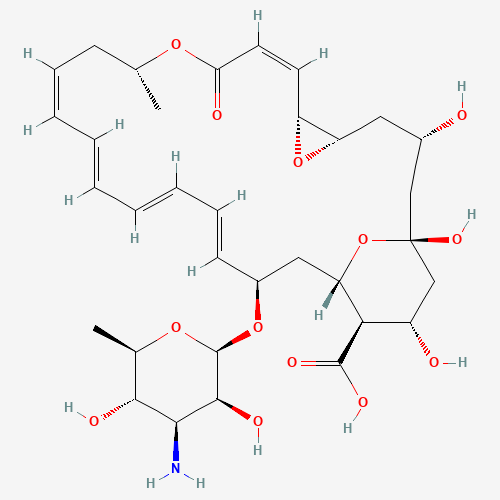
Natamycin is an antifungal used on the surface of cheese and cured sausage, where it stops mould without affecting the bacteria the product needs to ripen. It stays on the surface rather than penetrating.
Where it is and isn’t permitted
| Jurisdiction | Status | Scope and limits | Citation |
|---|---|---|---|
| Australia and New Zealand | Permitted, with conditions | 2 food categories highest permitted level 15 mg/kg Show every food category
| Food Standards Code, Schedule 15, S15—5and 1 further provisionretrieved 2026-10-17 |
| Canada | Permitted, with conditions | highest permitted level 20 mg/kg 4 permitted uses Show every permitted use
| Health Canada, List of Permitted Preservatives (List 11)and 3 further provisionsretrieved 2026-10-17 |
| European Union | Permitted, with conditions | 4 food categories highest permitted level 1 mg/dm² Show every food category
| Regulation (EC) No 1333/2008, Annex IIand 3 further provisionsretrieved 2026-10-18 |
| Great Britain | Permitted, with conditions | 4 food categories highest permitted level 1 mg/kg or mg/l Show every food category
| Assimilated Regulation (EC) No 1333/2008and 3 further provisionsretrieved 2026-10-18 |
| Japan | Permitted, with conditions | Designated additive: Appended Table 1, item 287, ナタマイシン(別名ピマリシン) (“Natamycin (Pimaricin)” in the unofficial English translation). …Designated additive: Appended Table 1, item 287, ナタマイシン(別名ピマリシン) (“Natamycin (Pimaricin)” in the unofficial English translation). Standards for use — Specifications and Standards for Foods, Food Additives, etc. (MHW Notification No. 370 of 1959), Part II (Food Additives), F (Standards for use), entry ナタマイシン: (1) [may be used only in the foods stated] “ナタマイシンは、ナチュラルチーズ(ハード及びセミハードの表面部分に限る。)以外の食品に使用してはならない。” (2) [limits how much may remain in the foods stated] “ナタマイシンは、食品の1kgにつき0.020g以上残存しないように使用しなければならない。” The Japanese is the standard as published. There is no official English translation of the Notification; the English in square brackets is this site’s description of what each sentence does, not a translation of the foods or the levels. Compositional specifications for this additive, in the same Notification, are not imported and are not shown here; nor are the general rules in F 添加物一般, which apply to every additive. | Regulations for Enforcement of the Food Sanitation Act (MHW Ordinance No. 23 of 1948), Appended Table 1retrieved 2026-10-18 |
| South Korea | Permitted, with conditions | Designated food additive: Standards and Specifications for Food Additives, Part III, 1. …Designated food additive: Standards and Specifications for Food Additives, Part III, 1. 일반식품첨가물 (general food additives), 나타마이신 (“Natamycin”, the English the Code prints beside it). Main use (주용도) of 나타마이신: 보존료. Standard for use (사용기준) of 나타마이신: (1) [may be used only for the purpose or in the food the sentence states; sets a limit on the amount used] “나타마이신은 치즈류의 표면에 한하여 사용하여야 한다. 나타마이신의 사용량은 1mg/dm2 이하이어야 하며, 표면으로부터 깊이 5mm이상에서는 검출되어서는 아니 된다” (2) “(0.020g/kg이하).” The Korean is the standard as published. There is no official English translation of the current Code (the English version on MFDS’s website is the 2020 edition and has no legal effect); the English in square brackets is this site’s description of what each sentence does, not a translation of the foods or the levels. Compositional specifications (Part IV) are not imported, nor are the general standards in Part II, which apply to every additive. | Standards and Specifications for Food Additives (식품첨가물의 기준 및 규격), MFDS Notification, Part III (Standards for use, by item)retrieved 2026-10-18 |
| United States | Permitted, with conditions | 21 CFR 172.155retrieved 2026-10-17 | |
| Codex Alimentarius | Permitted, with conditions | 7 food categories highest permitted level 40 mg/kg Show every food category and its notes
| CXS 192-1995 Table One, INS 235and 6 further provisionsretrieved 2026-09-07 |
How much is permitted
A listing usually limits the quantity as well as the food. Only one of the forms that takes is a figure: quantum satis and good manufacturing practice permit the amount the technological effect requires and no more, which is a limit rather than the absence of one. Figures below are the range across every food category this page is listed in, and categories differ between regulators — see how much is permitted.
| Australia and New Zealand | 15 mg/kg | 2 numeric limit |
|---|---|---|
| Canada | 10 mg/kg – 20 mg/kg | 2 numeric limit, 2 GMP |
| European Union | 1 mg/kg | 4 numeric limit |
| Great Britain | 1 mg/kg | 2 numeric limit, 2 no quantity stated |
| Japan | — | 1 no quantity stated |
| South Korea | — | 1 no quantity stated |
| United States | — | 1 no quantity stated |
| Codex Alimentarius | 6 mg/kg – 40 mg/kg | 7 numeric limit |
GRAS notices to the FDA
A GRAS notice is a company’s conclusion that a substance is generally recognised as safe for the use it describes. FDA’s letter responds to that conclusion, for that notifier and that use. It is not a listing in 21 CFR, and it is not counted as a US permission above. The substance and use are as FDA’s inventory words them; this site matched the notice to this page by exact name.
GRN No. 578 · Natamycin · DM Food Specialties B.V
Intended use: For use in ready-to-drink tea beverages, fruit flavored energy drinks, sport and isotonic drinks, and fruit flavored beverages at levels not to exceed 5 parts per million.
FDA’s response (2015-11-06): FDA has no questions
GRN No. 517 · Natamycin · DSM Food Specialties B.V.
Intended use: For use as an inhibitor against yeast and mold growth in yogurt at levels not to exceed 5 ppm in the finished product.
FDA’s response (2014-11-21): FDA has no questions
What it is made from
Produced by fermenting the bacterium Streptomyces natalensis. It is a medical antifungal as well as a food preservative, which is why its food use is tightly limited.
- Vegan
- Vegetarian
Compare other additives on the dietary indexes.
- CAS registry number
- 7681-93-8
- InChIKey
- NCXMLFZGDNKEPB-FFPOYIOWSA-N
- PubChem
- CID 5284447
The two specifications, compared
The European Union sets identity and purity by regulation; JECFA publishes its own through FAO, advisory until a country adopts it. Both documents are below in full. These are the parameters each puts a number on.
| Parameter | European Union | JECFA |
|---|---|---|
| Assay | no less than 95 % | no less than 95 % |
| Loss on drying | no more than 8 % | — |
| Sulphated ash | no more than 0.5 % | no more than 0.5 % |
| Lead | no more than 2 mg/kg | no more than 2 mg/kg |
| Arsenic | no more than 3 mg/kg | no more than 1 mg/kg |
| Mercury | no more than 1 mg/kg | — |
One parameter differs between the two documents. A difference is not a disagreement about safety: the two are revised on their own cycles, and an assay or a drying loss can be measured against a different preparation of the substance, which is why only the contaminant ceilings are marked. Within the EU the EU's figure is the one that binds.
How the EU defines it
The legal specification an additive must meet to be sold as this E number in the EU — what it is, how it may be made, and the purity it must reach. From Commission Regulation (EU) No 231/2012.
E 235 Natamycin
Natamycin is a fungicide of the polyene macrolide group, and is produced by strains of Streptomyces natalensis and other relevant species
Synonyms: Pimaricin
Assay, identification and purity criteria
Description and assay
- Einecs
- 231-683-5
- Chemical name
- A stereoisomer of 22-(3-Amino-3,6-dideoxy-β-D- mannopyranosyloxy)-1,3,26-trihydroxy-12-methyl-10-oxo-6,11,28-trioxatricyclo[22.3.1.05,7]octacosa-8,14,16,18,20-pentaene-25-carboxylic acid.
- Chemical formula
- C₃₃H₄₇O₁₃N
- Molecular weight
- 665,74
- Assay
- Content not less than 95 % on the dried basis
- Description
- White to creamy-white crystalline powder
Identification
- Colour reactions
- On adding a few crystals of natamycin on a spot plate, to a drop of: concentrated hydrochloric acid, a blue colour develops, concentrated phosphoric acid, a green colour develops,which changes into pale red after a few minutes
- Spectrometry
- A 0,0005 % w/v solution in 1 % methanolic acetic acid solution has absorption maxima at about 290 nm, 303 nm and 318 nm, a shoulder at about 280 nm and exhibits minima at about 250 nm, 295,5 nm and 311 nm
- pH
- 5,5-7,5 (1 % w/v solution in previously neutralised mixture of 20 parts dimethylformamide and 80 parts of water)
- Specific rotation
- [α]D ²⁰ + 250° to + 295° (a 1 % w/v solution in glacial acetic acid, at 20 °C and calculated with reference to the dried material)
Purity criteria
- Loss on drying
- Not more than 8 % (over P₂O₅, in vacuum at 60 °C to constant weight)
- Sulphated ash
- Not more than 0,5 %
- Arsenic
- Not more than 3 mg/kg
- Lead
- Not more than 2 mg/kg
- Mercury
- Not more than 1 mg/kg
- Microbiological criteria: Total plate count
- Not more than 100 colonies per gram
How JECFA defines it
The international specification for identity and purity, prepared by the Joint FAO/WHO Expert Committee on Food Additives and published by FAO. It is a different document from any above, written by a different body and revised on its own cycle; it is advisory, and a country adopts it or does not.
INS 235 Natamycin
A fungicidal antimycotic of the polyene macrolide group. It is produced by several species of Streptomyces. The commercial product may contain up to three moles of water.
Synonyms: Pimaricin; INS No. 235
Assay, identification and purity criteria
Description and assay
- Specification history
- Revised specifications prepared at the 99th JECFA (2024) and published in FAO JECFA Monographs 34 (2025) superseding specifications prepared at the 61st JECFA (2003) and published in FNP 52 Add 11 (2003). The Committee reaffirmed the ADI of 0- 0.3 mg/kg bw established at the 20th JECFA (1976).
- Chemical names
- A stereoisomer of 22-(3-Amino-3,6-dideoxy-β-D-mannopyranosyloxy)- 1,3,26-trihydroxy-12-methyl-10-oxo-6,11, 28-trioxatricyclo[22.3.1.0 5,7 ] octacosa-8,14,16,18,20-pentaene-25-carboxylic acid
- C.A.S. number
- 7681-93-8
- Chemical formula
- C 33 H 47 NO 13
- Structural formula
- COOH
- Formula weight
- 665.74
- Assay
- Not less than 95.0% calculated on the dried basis
- DESCRIPTION
- White to creamy-white, almost odourless, crystalline powder
- FUNCTIONAL USES
- Fungicidal preservative
Identification
- Solubility (Vol. 4)
- Practically insoluble in water, in lipid and in mineral oils; slightly soluble in methanol; soluble in glacial acetic acid and dimethylformamide.
- Colour reaction
- On adding a few crystals of the sample, on a spot plate, to a drop of - concentrated hydrochloric acid, a blue colour develops; - concentrated phosphoric acid, a green colour develops, which changes into pale-red after a few minutes
- Infrared absorption
- The infrared spectrum of a potassium bromide dispersion of the sample corresponds with the reference infrared spectrum in Appendix A (Main bands: 3 000-2 500 cm -1 Alcohol/Phenol O-H Stretch, 1716 cm -1 Carboxylic Acid C=O Stretch; 1570 cm -1 N-H bending of a primary amine).
- Ultraviolet absorption (Vol. 4)
- A solution of 5 mg/l of the sample in 0.1% glacial acetic acid in methanol has absorption maxima at about 290, 303 and 318 nm, a shoulder at about 280 nm and exhibits minima at about 250, 295.5 and 311 nm.
Purity criteria
- Loss on drying (Vol. 4) Specific rotation (Vol. 4)
- Not more than 8.0% (60 °C, over P 2 O 5 , pressure less than 5 mm Hg) α 20 D + 250° to + 295° (1% w/v solution in glacial acetic acid)
- pH (Vol. 4)
- 5.0 - 7.5 (1.0% w/v suspension in deionized water)
- Sulfated ash (Vol. 4)
- Not more than 0.5% Test 2 g of the sample (Method I)
- Arsenic (Vol. 4)
- Not more than 1 mg/kg Determine using a method appropriate to the specified level. The selection of sample size and method of sample preparation may be based on the principles of the method described in Volume 4
- Lead (Vol. 4)
- Not more than 2 mg/kg Determine using a method appropriate to the specified level. The selection of sample size and method of sample preparation may be based on the principles of the method described in Volume 4.
- Transglucosidase activity
- The purity of natamycin can be determined both spectrophotometrically and by HPLC. Data must be expressed as percentage on dry basis. If the process can take to the formation of natamycin methyl ester, the HPLC method must be used and the resolution of the two peaks of natamycin and natamycin methyl ester must be guaranteed. (Note: Throughout this Assay , protect from direct light all solutions containing natamycin) REAGENTS Methanol (analytical or spectrophotometric grade, ≥99.9%); Aqueous methanol (mixing methanol and water (2+1 (v/v)); natamycin reference standard (minimum 95%). NATAMYCIN STANDARD SOLUTIONS Immediately before use, dissolve in a 100 ml volumetric flask, containing methanol, a known amount (50 mg) of standard natamycin, make up to the mark (solution A1); In a 50 ml volumetric flask, dilute 5 ml of solution A1 to 50 ml using the methanol-water solution (Solution B1); In a 50 ml volumetric flask, dilute 5 ml of solution B1 to 50 ml using the methanol-water solution to obtain the final standard natamycin (Solution C1): 5 mg/l of natamycin. ASSAY PREPARATION Immediately before use, dissolve in a 100 ml volumetric flask, containing methanol, a known amount (50 mg) of the unknown sample of natamycin (solution A2), proceed as described in Natamycin standard solution to obtain solutions B2 and C2 for the unknown sample. Filter both solutions (standard and assay) through a syringe filter (0.45 μm) to obtain at least 3 ml of filtrate. Discharge the first drops. SPECTROPHOTOMETRIC DETERMINATION y Calibration: Record the spectrum of the Natamycin standard (Solution C1) in the range 300-340 nm, using the methanol-water solution as a blank. The spectrum should show a fingerprint with maxima at: 290, 303 and 318 nm, and minima at: 311 and 329 nm, respectively. Both the maximum and minimum values may vary slightly because of apparatus and solvents. y Sample solution: Analogously to the standard solution, record the spectrum of the Natamycin unknown (Solution C2) in the range 300-340 nm, always using the methanol-water solution as a blank. y Measure the absorbances, of both solutions, at 318 nm and at 311 and 329 nm, respectively. y Read the net absorbances as: Net Abs = Abs318nm - ²/ 3 Abs311nm - 1 / 3 Abs329nm, both for unknown sample and standard of natamycin. y Calculate the concentration of natamycin in the unknown sample (mg/ kg) as: mg V(ml) NetAbs unknown sample mg
- Natamycin
- ( ) = × × natamicin standard ( ) kg Wsample(g) NetAbs natamicin standard kg ALTERNATE METHOD HPLC DETERMINATION: Apparatus: y HPLC equipped with an UV-Vis or Diode Array Detector (DAD); solvents HPLC purity grade. Procedure: y Mobile phase: 30% acetonitrile-70% acidified water (0.1% glacial acetic) v/v y Flow rate: isocratic at 0.8 mi/min y Detector: DAD, ranges 250-360 nm, Quantitative at 305 nm. y Column: RP-18, 250 mmx4.6 mm id, 5μm packed material, complete of guard column. y Expected Retention Time: about 6 minutes. y External HPLC calibration curve and retention time of natamycin: Pipet, into a series of 50 ml volumetric flasks, 1, 2, 4, 6 and 8 ml of standard natamycin (solution C1) and make up to the mark with the methanol-water solution to obtain standard solutions containing: 0.1, 0.2, 0.4, 0.6 and 0.8 mg/l of natamycin, respectively. Filter through a syringe filter (0.45μm) and inject into the HPLC. Establish the retention time of natamycin and build a calibration curve. Express natamycin in mg/kg. y Sample injection: Inject the same aliquot of the sample (solution C2) into the HPLC, measure the area of the corresponding natamycin peak. Substitute it in the calibration curve to obtain the corresponding concentration of natamycin in the unknown sample. y Adjust the injection volumes and dilutions of the samples to ensure that the response remains within the linear response range of the DAD detector. Appendix 1
- 4000 3000
- 2000 1500 1000 600 Wavenuber [cm -1 ]
Every name it appears under
59 recorded names. A label may use any of them.
E number
- E235
INS number
- 235
CAS registry number
- 7681-93-8
As it appears in regulation
- Natamycin
- Natamycin (pimaricin)
Other names
- 0(5,7)]octacosa-8,14,16,18,20-pentaene-25-carboxylic ac
- 73 - Natamycin (pimaricin) in cheese
- 8O0C852CPO
- Antibiotic A-5283
- Delvocid
- Delvolan
- Delvopos
- E 235
- Fermentation product from Streptomyces chattanoogensis
- INS NO.235
- INS-235
- Mycophyt
- Myprozine
- Natacyn
- Natafucin
- Natamicina
- Natamycin
- Natamycin (Standard)
- Natamycin(Pimaricin)
- Natamycin, Pharmaceutical Secondary Standard; Certified Reference Material
- Natamycin, United States Pharmacopeia (USP) Reference Standard
- Natamycin, VETRANAL(TM), analytical standard
- Natamycine
- Natamycinum
- NCXMLFZGDNKEPB-FFPOYIOWSA-N
- NICOTINAMIDE_ADENINE_DINUCLEOTIDE
- Pimafucin
- Pimafugin;
- Pimaracin
- Pimaricin
- Pimaricin 100 |Ig/mL in Water
- Pimaricin preparation, ~2.5%, aqueous suspension
- Pimaricin, from Streptomyces chattanoogensis, >=95% (HPLC)
- Pimaricin; Natamycin
- Pimaricine
- Pimarizin
- Synogil
- Tennecetin
- Tymasil
Systematic names
- (1R,3S,5R,7R,8E,12R,14E,16E,18E,20E,22R,24S,25R,26S)-22-(((2R,3S,4S,5S,6R)-4-amino-3,5-dihydroxy-6-methyltetrahydro-2H-pyran-2-yl)oxy)-1,3,26-trihydroxy-12-methyl-10-oxo-6,11,28-trioxatricyclo[22.3.1.
- (1R,3S,5R,7R,8E,12R,14E,16E,18E,20E,22R,24S,25R,26S)-22-{[(2R,3S,4S,5S,6R)-4-amino-3,5-dihydroxy-6-methyloxan-2-yl]oxy}-1,3,26-trihydroxy-12-methyl-10-oxo-6,11,28-trioxatricyclo[22.3.1.0^{5,7}]octacosa-8,14,16,18,20-pentaene-25-carboxylic acid
- 16-(3-Amino-3,6-didesoxy-beta-D-mannopyranosyloxy)-5,6-epoxy-8,12,14-trihydroxy-26-methyl-2,10-dioxo-1-oxacyclohexacosa-3,17,19,21,23-pentaen-13-carbonsaeure
- Stereoisomer of 22-((3-amino-3,6-dideoxy-beta-D-mannopyranosyl)oxy)-1,3,26-trihydroxy-12-methyl-10-oxo-6,11,28-trioxatricyclo(22.3.1.0(sup 5,7))octacosa-8,14,16,18,20-pentaene-25-carboxylic acid
The EU re-evaluation programme
Every additive authorised in the EU before 20 January 2009 was put back through EFSA by Commission Regulation (EU) No 257/2010, and this one is named in it. What the Regulation required is below; whether the opinion has since been published is not something this site records.
- Already re-evaluated when the programme began. Listed in Annex I as “Natamycin”, against the words “Re-evaluation completed on 26 November 2009”, and therefore not re-evaluated again under it.
Hazard reference values
| Type | Value | Population | Assessed by | Opinion |
|---|---|---|---|---|
| ADI | 0.3 mg/kg bw/day | — | JECFA | 2024 |
Evidence and how bodies read it
What assessing bodies concluded
Each conclusion is paraphrased in the body's own framing, from the published opinion linked beneath it. Where bodies differ, both stand; this site does not adjudicate between them or add a view of its own.
EFSA 2009
The ANS Panel considered the data on natamycin (E 235) not robust enough to derive an ADI, but concluded that, given very poor absorption and an adequate margin of safety, its use only for surface treatment of the rind of semi-hard and semi-soft cheese and of certain sausage casings is not of safety concern. It also found no concern for the induction of antimicrobial resistance.
Common questions
Assembled from what is above, in the words the questions are usually asked in. Each answer is the same statement the relevant section makes, with the same citations behind it.
- What is E 235?
- E 235 is Natamycin (pimaricin). Natamycin is an antifungal used on the surface of cheese and cured sausage, where it stops mould without affecting the bacteria the product needs to ripen. It stays on the surface rather than penetrating.
- What is Natamycin (pimaricin) used for in food?
- It is listed as a preservative — the role Canada and Codex assign it. This page shows every function each regulator records, with the citation for each.
- Where is Natamycin (pimaricin) permitted?
- Of the seven regulators this site reads, Australia and New Zealand, Canada, the EU, Great Britain, Japan, South Korea, the US and the Codex standard permit it. Each permission is for named foods at named levels, not a blanket one; the table on this page gives them with citations.
- Is Natamycin (pimaricin) vegan?
- Yes. Natamycin (pimaricin) is not derived from animals, and is suitable for vegetarians. This page says what it is made from and how.
Sources for this page
- anz retrieved 2026-10-17
- ca retrieved 2026-10-17
- eu retrieved 2026-10-18
- gb retrieved 2026-10-18
- jp retrieved 2026-10-18
- kr retrieved 2026-10-18
- ecfr retrieved 2026-10-17
- gsfa retrieved 2026-09-07
- euspecs retrieved 2026-10-18
- jecfaspecs retrieved 2026-09-23
Full licence terms and publisher details on Sources. How this page is built and updated: Method.
Machine-readable: a JSON record of this additive is given on request —how to ask for access.
Follow changes to Natamycin (pimaricin):Atom feed — regulatory events, and any change the weekly refresh detects in its provisions.