Potassium ferrocyanide
13943-58-3 · E 536 · Ferrate(4-), hexakis(cyano-kappaC)-, potassium (1:4), (OC-6-11)- · Ferrate(4-), hexakis(cyano-kappaC)-, tetrapotassium, (OC-6-11)- · Ferrate(4-a)a, hexakis(cyano-aI masculineC)a-a, potassium (1:4)a, (OC-a6-a11)a- · gelbes Blutlaugensalz · HEXACYANOFERRATE OF POTASSIUM · INS NO.536 · INS-536 · Kaliumhexazyanoferrat(II) · lambda6-iron(6+) ion tetrapotassium hexakis(iminomethanide) · OCPOWIWGGAATRP-UHFFFAOYSA-N · potassium (iii) ferrocyanide · Potassium (Oc-6-11)-Hexakis(Cyano-Kappa-C)Ferrate(4-)(4:1) · Potassium ferrocyanate · Potassium ferrocyanide · POTASSIUM FERROCYANIDE, ACS · Potassium ferrocyanide, solution · potassium hexacyanidoferrate(4-) · potassium hexacyanidoferrate(II) · Potassium Hexacyanoferate II · Potassium hexacyanoferrate · potassium hexacyanoferrate(4-) · Potassium hexacyanoferrate(II) · Tetrapotassium ferrocyanide · tetrapotassium hexacyanidoferrate · Tetrapotassium hexacyanoferrate · Tetrapotassium hexacyanoferrate(4-) · Tetrapotassium hexacyanoferrate(II) · Tetrapotassium hexakis(cyanido-kappaC)ferrate(4-) · tetrapotassium hexakis(cyanido-kappakappaC)ferrate(4-) · Tetrapotassium Hexakis(Cyano-C)Ferrate(4-) · tetrapotassium;iron(2+);hexacyanide · Yellow prussiate of potash · E536 · 536 · Potassium hexacyanoferrate(II) · Tetrapotassium hexacyanoferrate trihydrate; Tetrapotassium hexacyanoferrate(4-) trihydrate · Potassium ferrocyanide · Ferocianură de potasiu · FEROKYANID DRASELNÝ · Ferrocianeto de potássio · Ferrocianuro di potassio · Ferrocianuro potásico · Ferrocyanure de potassium · Ferrokyanid draselný · Ferroċjanur tal-potassju · Hexakyanoželeznatan draselný · Kaaliumferrotsüaniid · KAALIUMHEKSATSÜANOFERRAAT(II) · kalijev ferocianid · Kalijev ferocijanid · Kalio ferocianidas · Kaliumferrocyanid · Kaliumferrosyanidi · Kaliumhexacyanoferraat(II) · KÁLIUM-FERRO-CIANID · Kálium-vas(II)-cianid · Kālija ferocianīds · Potassium ferrocyanide · Żelazocyjanek potasu · Σιδηροκυανιούχο κάλιο · Калиев фероцианидE number E536INS 536CAS 13943-58-3
Listed as an anticaking agent by Canada and Codex.
Listed as anticaking agents (CA, Codex)
- Canada: Anticaking agent — Health Canada, List of Permitted Anticaking Agents (List 1)
- Codex Alimentarius: Anticaking agent — CXS 192-1995 Table One, INS 536
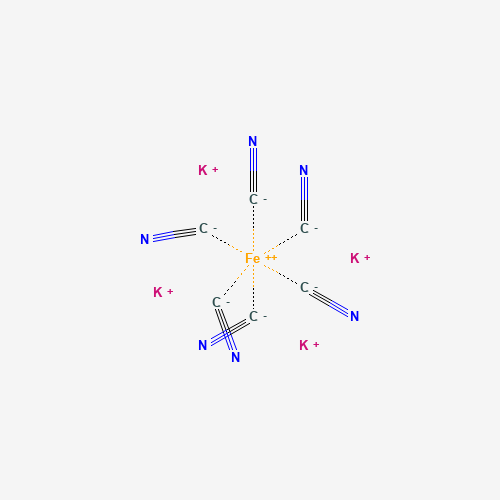
Potassium ferrocyanide is an anticaking agent for table salt, added in tiny amounts to stop it clumping. Despite the name it contains no free cyanide: the cyanide is locked to iron in a complex that does not release it.
Where it is and isn’t permitted
| Jurisdiction | Status | Scope and limits | Citation |
|---|---|---|---|
| Australia and New Zealand | Permitted, with conditions | 1 food category highest permitted level 50 mg/kg total of sodium and potassium ferrocyanide. | Food Standards Code, Schedule 15, S15—5, item 12.1.1, INS 536retrieved 2026-10-17 |
| Canada | Permitted, with conditions | no numerical limit (good manufacturing practice) 3 permitted uses Show every permitted use
| Health Canadaand 2 further provisionsretrieved 2026-10-17 |
| European Union | Permitted, with conditions | 2 food categories highest permitted level 20 mg/kg Permitted as a member of Ferrocyanides. ML = 20 mg/kg. Note 1: The additives may be added individually or in combination. Show every food category
| Regulation (EC) No 1333/2008, Annex II, as amended by (EU) No 1129/2011and 1 further provisionretrieved 2026-10-18 |
| Great Britain | Permitted, with conditions | 2 food categories highest permitted level 20 mg/kg or mg/l Authorised under E 535-538, Ferrocyanides. ML = 20. Note (1): The additives may be added individually or in combination. Note (57): The maximum level is expressed as anhydrous potassium ferrocyanide. Show every food category
| Assimilated Regulation (EC) No 1333/2008, Annex II (as at 28 June 2024), under E 535-538and 1 further provisionretrieved 2026-10-18 |
| Japan | Permitted, with conditions | Designated additive: Appended Table 1, item 356, フェロシアン化物(フェロシアン化カリウム(別名ヘキサシアノ鉄(Ⅱ)酸カリウム)、フェロシアン化カルシウム(別名ヘキサシアノ鉄(Ⅱ)酸カルシウム)及びフェロシアン化ナトリウム(別名ヘキサシアノ鉄(Ⅱ)酸ナトリウム)に限る。) (“Ferrocyanides (li …Designated additive: Appended Table 1, item 356, フェロシアン化物(フェロシアン化カリウム(別名ヘキサシアノ鉄(Ⅱ)酸カリウム)、フェロシアン化カルシウム(別名ヘキサシアノ鉄(Ⅱ)酸カルシウム)及びフェロシアン化ナトリウム(別名ヘキサシアノ鉄(Ⅱ)酸ナトリウム)に限る。) (“Ferrocyanides (limited to Potassium Ferrocyanide (Potassium Hexacyanoferrate(II)), Calcium Ferrocyanide (Calcium Hexacyanoferrate(II)), and Sodium Ferrocyanide (Sodium Hexacyanoferrate(II)))” in the unofficial English translation; listed member: Potassium Ferrocyanide (Potassium Hexacyanoferrate(II))). Standards for use — Specifications and Standards for Foods, Food Additives, etc. (MHW Notification No. 370 of 1959), Part II (Food Additives), F (Standards for use), entry フェロシアン化カリウム: (1) [may be used only in the foods stated] “フェロシアン化カリウムは、食塩及びぶどう酒以外の食品に使用してはならない。” (2) [sets maximum levels of use for the foods stated; sets a combined limit where it is used together with the additives stated; limits how much may remain in the foods stated] “フェロシアン化カリウムの使用量は、無水フェロシアン化ナトリウムとして、食塩1kgにつき0.020g以下でなければならない。ただし、フェロシアン化カルシウム若しくはフェロシアン化ナトリウムの1種又は2種と併用する場合にあっては、それぞれの使用量の和が無水フェロシアン化ナトリウムとして、食塩1kgにつき0.020g以下でなければならない。また、フェロシアン化カリウムは、無水フェロシアン化カリウムとして、ぶどう酒1Lにつき、0.001gを超えて残存しないように使用しなければならない。” The Japanese is the standard as published. There is no official English translation of the Notification; the English in square brackets is this site’s description of what each sentence does, not a translation of the foods or the levels. Compositional specifications for this additive, in the same Notification, are not imported and are not shown here; nor are the general rules in F 添加物一般, which apply to every additive. | Regulations for Enforcement of the Food Sanitation Act (MHW Ordinance No. 23 of 1948), Appended Table 1retrieved 2026-10-18 |
| South Korea | Permitted, with conditions | Designated food additive: Standards and Specifications for Food Additives, Part III, 1. …Designated food additive: Standards and Specifications for Food Additives, Part III, 1. 일반식품첨가물 (general food additives), 페로시안화칼륨 (“Potassium Ferrocyanide”, the English the Code prints beside it). Main use (주용도) of 페로시안화칼륨: 고결방지제. Standard for use (사용기준) of 페로시안화칼륨: (1) [may be used only for the purpose or in the food the sentence states; sets a limit on the amount used] “페로시안화칼륨은 식염(천일염 제외)에 한하여 사용하여야 한다. 페로시안화칼륨의 사용량은 페로시안이온으로서 식염 1kg에 대하여 0.010g 이하(페로시안화칼슘 또는 페로시안화나트륨과 병용할 때에는 각각의 사용량의 합계가 페로시안이온으로서 식염 1kg에 대하여 0.010g 이하)이어야 한다.” The Korean is the standard as published. There is no official English translation of the current Code (the English version on MFDS’s website is the 2020 edition and has no legal effect); the English in square brackets is this site’s description of what each sentence does, not a translation of the foods or the levels. Compositional specifications (Part IV) are not imported, nor are the general standards in Part II, which apply to every additive. | Standards and Specifications for Food Additives (식품첨가물의 기준 및 규격), MFDS Notification, Part III (Standards for use, by item)retrieved 2026-10-18 |
| United States | Not listedDoes not appear on this jurisdiction’s permitted list. That is not the same as being prohibited. | ||
| Codex Alimentarius | Permitted, with conditions | 3 food categories highest permitted level 20 mg/kg Show every food category and its notes
| CXS 192-1995 Table One, INS 536and 2 further provisionsretrieved 2026-09-07 |
How much is permitted
A listing usually limits the quantity as well as the food. Only one of the forms that takes is a figure: quantum satis and good manufacturing practice permit the amount the technological effect requires and no more, which is a limit rather than the absence of one. Figures below are the range across every food category this page is listed in, and categories differ between regulators — see how much is permitted.
| Australia and New Zealand | 50 mg/kg | 1 numeric limit |
|---|---|---|
| Canada | — | 1 GMP, 2 no quantity stated |
| European Union | 20 mg/kg | 2 numeric limit |
| Great Britain | 20 mg/kg | 2 numeric limit |
| Japan | — | 1 no quantity stated |
| South Korea | — | 1 no quantity stated |
| Codex Alimentarius | 14 mg/kg – 20 mg/kg | 3 numeric limit |
What it is made from
Manufactured from hydrogen cyanide, iron salts and potassium hydroxide. The resulting complex is stable and largely passes through the body unchanged.
- Vegan
- Vegetarian
Compare other additives on the dietary indexes.
- CAS registry number
- 13943-58-3
- InChIKey
- XOGGUFAVLNCTRS-UHFFFAOYSA-N
- PubChem
- CID 9605257
How the EU defines it
The legal specification an additive must meet to be sold as this E number in the EU — what it is, how it may be made, and the purity it must reach. From Commission Regulation (EU) No 231/2012.
E 536 Potassium ferrocyanide
Synonyms: Yellow prussiate of potash; Potassium hexacyanoferrate
Assay, identification and purity criteria
Description and assay
- Einecs
- 237-722-2
- Chemical name
- Potassium ferrocyanide
- Chemical formula
- K₄Fe(CN)₆ · 3 H₂O
- Molecular weight
- 422,4
- Assay
- Content not less than 99,0 %
- Description
- Lemon yellow crystals
Identification
- Test for potassium
- Passes test
- Test for ferrocyanide
- Passes test
Purity criteria
- Free moisture
- Not more than 1,0 %
- Water insoluble matter
- Not more than 0,03 %
- Chloride
- Not more than 0,2 %
- Sulphate
- Not more than 0,1 %
- Free cyanide
- Not detectable
- Ferricyanide
- Not detectable
- Lead
- Not more than 5 mg/kg
Every name it appears under
63 recorded names. A label may use any of them.
E number
- E536
INS number
- 536
CAS registry number
- 13943-58-3
As it appears in regulation
- Potassium ferrocyanide
Other names
- E 536
- Ferrate(4-), hexakis(cyano-kappaC)-, potassium (1:4), (OC-6-11)-
- Ferrate(4-), hexakis(cyano-kappaC)-, tetrapotassium, (OC-6-11)-
- Ferrate(4-a)a, hexakis(cyano-aI masculineC)a-a, potassium (1:4)a, (OC-a6-a11)a-
- gelbes Blutlaugensalz
- HEXACYANOFERRATE OF POTASSIUM
- INS NO.536
- INS-536
- Kaliumhexazyanoferrat(II)
- lambda6-iron(6+) ion tetrapotassium hexakis(iminomethanide)
- OCPOWIWGGAATRP-UHFFFAOYSA-N
- potassium (iii) ferrocyanide
- Potassium (Oc-6-11)-Hexakis(Cyano-Kappa-C)Ferrate(4-)(4:1)
- Potassium ferrocyanate
- Potassium ferrocyanide
- POTASSIUM FERROCYANIDE, ACS
- Potassium ferrocyanide, solution
- potassium hexacyanidoferrate(4-)
- potassium hexacyanidoferrate(II)
- Potassium Hexacyanoferate II
- Potassium hexacyanoferrate
- potassium hexacyanoferrate(4-)
- Potassium hexacyanoferrate(II)
- Tetrapotassium ferrocyanide
- tetrapotassium hexacyanidoferrate
- Tetrapotassium hexacyanoferrate
- Tetrapotassium hexacyanoferrate(4-)
- Tetrapotassium hexacyanoferrate(II)
- Tetrapotassium hexakis(cyanido-kappaC)ferrate(4-)
- tetrapotassium hexakis(cyanido-kappakappaC)ferrate(4-)
- Tetrapotassium Hexakis(Cyano-C)Ferrate(4-)
- tetrapotassium;iron(2+);hexacyanide
- Yellow prussiate of potash
Systematic names
- Potassium hexacyanoferrate(II)
- Tetrapotassium hexacyanoferrate trihydrate; Tetrapotassium hexacyanoferrate(4-) trihydrate
Hazard reference values
The two committees set different figures. EFSA's acceptable daily intake is 0.03 mg/kg bw/day; JECFA's is 0.025 mg/kg bw/day (1974). An acceptable daily intake is a reference value set by a committee, not a threshold above which harm begins. The lower figure is not a finding that the other body was wrong: the two work to different terms of reference, on their own timetables, and sometimes from different data. This site states both and chooses between them nowhere. See where the two committees differ.
| Type | Value | Population | Assessed by | Opinion |
|---|---|---|---|---|
| ADI | 0.025 mg/kg bw/day | — | JECFA | 1974 |
| ADI | 0.03 mg/kg bw/day | consumers | EFSA | not identified in the dataset |
Evidence and how bodies read it
What assessing bodies concluded
Each conclusion is paraphrased in the body's own framing, from the published opinion linked beneath it. Where bodies differ, both stand; this site does not adjudicate between them or add a view of its own.
EFSA 2018
The ANS Panel found no concern for genotoxicity or carcinogenicity for sodium, potassium and calcium ferrocyanide (E 535–E 538) and, based on kidney effects in a two-year rat study, established a group ADI of 0.03 mg/kg bw/day expressed as ferrocyanide ion. It concluded they are of no safety concern at the current authorised use as salt substitutes and use levels.
Common questions
Assembled from what is above, in the words the questions are usually asked in. Each answer is the same statement the relevant section makes, with the same citations behind it.
- What is E 536?
- E 536 is Potassium ferrocyanide. Potassium ferrocyanide is an anticaking agent for table salt, added in tiny amounts to stop it clumping. Despite the name it contains no free cyanide: the cyanide is locked to iron in a complex that does not release it.
- What is Potassium ferrocyanide used for in food?
- It is listed as an anticaking agent — the role Canada and Codex assign it. This page shows every function each regulator records, with the citation for each.
- Where is Potassium ferrocyanide permitted?
- Of the seven regulators this site reads, Australia and New Zealand, Canada, the EU, Great Britain, Japan, South Korea and the Codex standard permit it. Each permission is for named foods at named levels, not a blanket one; the table on this page gives them with citations.
- Is Potassium ferrocyanide vegan?
- Yes. Potassium ferrocyanide is not derived from animals, and is suitable for vegetarians. This page says what it is made from and how.
Sources for this page
- anz retrieved 2026-10-17
- ca retrieved 2026-10-17
- eu retrieved 2026-10-18
- gb retrieved 2026-10-18
- jp retrieved 2026-10-18
- kr retrieved 2026-10-18
- gsfa retrieved 2026-09-07
- euspecs retrieved 2026-10-18
Full licence terms and publisher details on Sources. How this page is built and updated: Method.
Machine-readable: a JSON record of this additive is given on request —how to ask for access.
Follow changes to Potassium ferrocyanide:Atom feed — regulatory events, and any change the weekly refresh detects in its provisions.