Potassium nitrate
7757-79-1 · Attitude Adult Fluoride-free-Sensitive-Spearmint · Caswell No. 697 · CCRIS 3667 · Collo-Bo · Dr. Sheffield Sensitive Care · E 252 · EPA Pesticide Chemical Code 076103 · European Pharmacopoeia Reagent Conc. · HSDB 1227 · INS NO.252 · INS-252 · Jason Total Protection Sensitive · Kali nitricum · Kalii nitras · Kaliumnitrat · Kiss My Face Sensitive · Kiss My Face Sensitive Fluoride-Free Whitening-Citrus Mint · KNO3 · Niter · Nitrate of potash · Nitre · Nitric acid potassium salt (1:1) · Nitric acid, potassium salt · Nitrogen and oxygen isotopes in nitrate, NIST(R) RM 8568 · Potassium nitrate · Potassium nitrate (JAN/USP) · Potassium nitrate (KNO3) · Potassium Nitrate ACS grade · Potassium Nitrate Standard Solution · Potassium nitrate(DOT) · Potassium nitrate, 99.99% trace metals basis · Potassium nitrate, 99.999% trace metals basis · Potassium nitrate, ACS reagent, >=99.0% · Potassium nitrate, anhydrous, 99.99% trace metals basis · Potassium nitrate, AR, >=99.5% · Potassium nitrate, BioUltra, >=99.5% (T) · Potassium nitrate, BioXtra, >=99.0% · Potassium nitrate, cell culture tested · Potassium nitrate, JIS special grade, >=99.0% · Potassium nitrate, LR, >=99.5% · Potassium nitrate, NIST(R) SRM(R) 193 · Potassium nitrate, p.a., 99% · Potassium nitrate, Puratronic(R) · Potassium nitrate, ReagentPlus(R), >=99.0% · Potassium nitrate, SAJ first grade, >=99.0% · Potassium Nitrate, Trace metals grade 99.99% · Potassium standard for AAS, ready-to-use, in nitric acid · Potassium-nitrate · Salt peter · Salt peter (VAN) · Saltpeter · saltpetre · Schmidts · Schmidts WONDERMINT TOOTH AND MOUTH · Sensitive Teeth · Sensitive Tooth Paste · Sensodyne (TN) · SprinJene Natural Sensitivity and Gum · Vicknite · E252 · 252 · potassium nitrate · Potassium nitrate · Azotan potasu · Dusičnan draselný · Kaaliumnitraat · Kalijev nitrat · Kalio nitratas · Kaliumnitraat · Kaliumnitraatti · Kaliumnitrat · Kálium-nitrát · Kālija nitrāts · Nitrat de potasiu · Nitrat tal-potassju · Nitrate de potassium · Nitrato de potássio · Nitrato di potassio · Nitrato potásico · Potassium nitrate · Νιτρικό κάλιο · Калиев нитратE number E252INS 252CAS 7757-79-1
Listed as a preservative by Canada, Codex and the US.
Listed as preservatives (CA, US, Codex) · colours (US) · flavour enhancers (US) · colour retention agents (Codex) · flavouring agents and adjuvants (US)
- Canada: Preservative — Health Canada, List of Permitted Preservatives (List 11)
- United States: Antimicrobial agent — FDA, Substances Added to Food: POTASSIUM NITRATE
- Codex Alimentarius: Preservative — CXS 192-1995 Table One, INS 252
- United States: Color or coloring adjunct — FDA, Substances Added to Food: POTASSIUM NITRATE
- United States: Flavor enhancer — FDA, Substances Added to Food: POTASSIUM NITRATE
- Codex Alimentarius: Colour retention agent — CXS 192-1995 Table One, INS 252
- United States: Flavoring agent or adjuvant — FDA, Substances Added to Food: POTASSIUM NITRATE
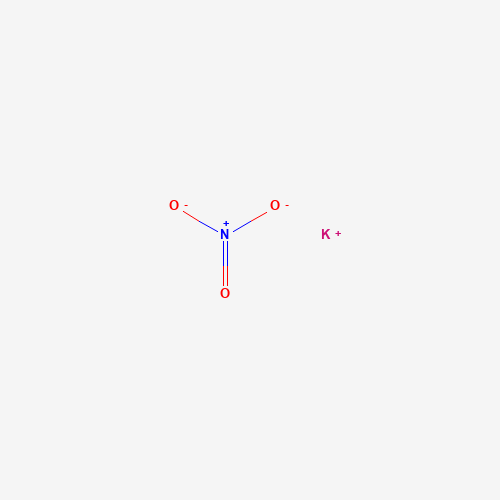
Potassium nitrate, historically called saltpetre, is used in slow-cured meats and some cheeses, where it is gradually reduced to nitrite.
Where it is and isn’t permitted
| Jurisdiction | Status | Scope and limits | Citation |
|---|---|---|---|
| Australia and New Zealand | Permitted, with conditions | 3 food categories highest permitted level 500 mg/kg Show every food category
| Food Standards Code, Schedule 15, S15—5and 2 further provisionsretrieved 2026-10-17 |
| Canada | Permitted, with conditions | no numerical limit (good manufacturing practice) 5 permitted uses Show every permitted use
| Health Canada, List of Permitted Preservatives (List 11)and 4 further provisionsretrieved 2026-10-17 |
| European Union | Permitted, with conditions | 18 food categories highest permitted level 270 mg/kg Show every food category
| Regulation (EC) No 1333/2008, Annex IIand 17 further provisionsretrieved 2026-10-18 |
| Great Britain | Permitted, with conditions | 9 food categories highest permitted level 500 mg/kg or mg/l Show every food category
| Assimilated Regulation (EC) No 1333/2008, Annex II (as at 28 June 2024)and 8 further provisionsretrieved 2026-10-18 |
| Japan | Permitted, with conditions | Designated additive: Appended Table 1, item 214, 硝酸カリウム (“Potassium Nitrate” in the unofficial English translation). …Designated additive: Appended Table 1, item 214, 硝酸カリウム (“Potassium Nitrate” in the unofficial English translation). Standards for use — Specifications and Standards for Foods, Food Additives, etc. (MHW Notification No. 370 of 1959), Part II (Food Additives), F (Standards for use), entry 硝酸カリウム: (1) [may be used only in the foods stated] “硝酸カリウムは、チーズ、清酒、食肉製品及び鯨肉ベーコン以外の食品に使用してはならない。” (2) [sets maximum levels of use for the foods stated; limits how much may remain in the foods stated] “硝酸カリウムの使用量は、硝酸カリウムとして、チーズにあっては原料に供する乳1Lにつき0.20g以下、清酒にあっては酒母1Lにつき0.10g以下でなければならない。また、硝酸カリウムは、亜硝酸根として、食肉製品及び鯨肉ベーコンにあってはその1kgにつき0.070g以上残存しないように使用しなければならない。” The Japanese is the standard as published. There is no official English translation of the Notification; the English in square brackets is this site’s description of what each sentence does, not a translation of the foods or the levels. Compositional specifications for this additive, in the same Notification, are not imported and are not shown here; nor are the general rules in F 添加物一般, which apply to every additive. | Regulations for Enforcement of the Food Sanitation Act (MHW Ordinance No. 23 of 1948), Appended Table 1retrieved 2026-10-18 |
| South Korea | Permitted, with conditions | Designated food additive: Standards and Specifications for Food Additives, Part III, 1. …Designated food additive: Standards and Specifications for Food Additives, Part III, 1. 일반식품첨가물 (general food additives), 질산칼륨 (“Potassium Nitrate”, the English the Code prints beside it). Main use (주용도) of 질산칼륨: 발색제, 보존료. Standard for use (사용기준) of 질산칼륨: (1) [may be used only in the foods listed; sets a limit on the amount used] “질산칼륨은 아래의 식품에 한하여 사용하여야 한다. 질산칼륨의 사용량은 아질산이온으로서 아래의 기준 이상 남지 아니하도록 사용하여야 한다. 1. 식육가공품(식육추출가공품 제외), 기타 동물성가공식품(기타식육이 함유된 제품에 한함):0.07g/kg 2. 치즈류 : 0.05g/kg 3. 대구알염장품:0.2g/kg” The Korean is the standard as published. There is no official English translation of the current Code (the English version on MFDS’s website is the 2020 edition and has no legal effect); the English in square brackets is this site’s description of what each sentence does, not a translation of the foods or the levels. Compositional specifications (Part IV) are not imported, nor are the general standards in Part II, which apply to every additive. | Standards and Specifications for Food Additives (식품첨가물의 기준 및 규격), MFDS Notification, Part III (Standards for use, by item)retrieved 2026-10-18 |
| United States | Permitted, with conditions | 21 CFR 172.160retrieved 2026-10-17 | |
| Codex Alimentarius | Permitted, with conditions | 1 food category highest permitted level 35 mg/kg Note 30 As residual NO3 ion. Note 464 For use in products conforming to the Standards for Cheddar (CXS 263-1966), Danbo (CXS 264-1966) Edam (CXS 265-1966), Gouda (CXS 266-1966), Havarti (CXS 267-1966), Samsø (CXS 268-1966), Emmental (CXS 269-1967), Tilsiter (CXS 270-1968), Saint-Paulin (CXS 271-1968) and Provolone (CXS 272-1968) only as preservatives. Note XS208 Excluding products conforming to the Standard for Cheese in Brine (CODEX STAN 208-1999). Note XS274 Excluding products conforming to the Standard for Coulommiers (CXS 274-1969). Note XS276 Excluding products conforming to the Standard for Camembert (CXS 276-1973). Note XS277 Excluding products conforming to the Standard for Brie (CXS 277-1973). Note XS278 Excluding products conforming to the Standard for Extra Hard Grating Cheese (CXS 278-1978). | CXS 192-1995 Table One, INS 252, food category 01.6.2retrieved 2026-09-07 |
How much is permitted
A listing usually limits the quantity as well as the food. Only one of the forms that takes is a figure: quantum satis and good manufacturing practice permit the amount the technological effect requires and no more, which is a limit rather than the absence of one. Figures below are the range across every food category this page is listed in, and categories differ between regulators — see how much is permitted.
| Australia and New Zealand | 50 mg/kg – 500 mg/kg | 3 numeric limit |
|---|---|---|
| Canada | — | 2 GMP, 3 no quantity stated |
| European Union | 7 mg/kg – 270 mg/kg | 18 numeric limit |
| Great Britain | 150 mg/kg – 500 mg/kg | 7 numeric limit, 2 several limits |
| Japan | — | 1 no quantity stated |
| South Korea | — | 1 no quantity stated |
| United States | — | 1 no quantity stated |
| Codex Alimentarius | 35 mg/kg | 1 numeric limit |
Regulatory changes
What the weekly comparison of the imported lists has seen move. No dated act has been written up for this additive; the status panel above shows where the rules stand now.
Differences the refresh found
Each import is compared with the one before. These are the differences seen, dated by when the comparison ran — not by when they took legal effect, which the lists do not say. Nothing here is interpreted; the provisions and their citations are in the panel above.
· European Union
European Union: 6 provisions added, 3 provisions removed.
- Removed 1.7.2 ripened cheese — 150 mg/kg
- 1.7.4 whey cheese: 150 mg/kg → 75 mg/kg
- 1.7.6 cheese products (excluding products falling in category 16): 150 mg/kg → 75 mg/kg
- Added 1.7.2 ripened cheese — 110 mg/kg
- Added 1.7.2 ripened cheese — 110 mg/kg
- Added 1.7.2 ripened cheese — 110 mg/kg
- Added 1.7.2 ripened cheese — 75 mg/kg
What it is made from
Mined or manufactured by neutralising nitric acid with a potassium base.
- Vegan
- Vegetarian
Compare other additives on the dietary indexes.
- CAS registry number
- 7757-79-1
- InChIKey
- FGIUAXJPYTZDNR-UHFFFAOYSA-N
- PubChem
- CID 24434
The two specifications, compared
The European Union sets identity and purity by regulation; JECFA publishes its own through FAO, advisory until a country adopts it. Both documents are below in full. These are the parameters each puts a number on.
| Parameter | European Union | JECFA |
|---|---|---|
| Assay | no less than 99 % | no less than 99 % |
| Loss on drying | no more than 1 % | no more than 1 % |
| Lead | no more than 0.1 mg/kg | no more than 2 mg/kg |
| Arsenic | no more than 0.1 mg/kg | — |
| Mercury | no more than 0.1 mg/kg | — |
One parameter differs between the two documents. A difference is not a disagreement about safety: the two are revised on their own cycles, and an assay or a drying loss can be measured against a different preparation of the substance, which is why only the contaminant ceilings are marked. Within the EU the EU's figure is the one that binds.
How the EU defines it
The legal specification an additive must meet to be sold as this E number in the EU — what it is, how it may be made, and the purity it must reach. From Commission Regulation (EU) No 231/2012.
E 252 Potassium nitrate
Synonyms: Chile saltpetre; Cubic or soda nitre
Assay, identification and purity criteria
Description and assay
- Einecs
- 231-818-8
- Chemical name
- Potassium nitrate
- Chemical formula
- KNO₃
- Molecular weight
- 101,11
- Assay
- Content not less than 99 % on the anhydrous basis
- Description
- White crystalline powder or transparent prisms having a cooling, saline, pungent taste
Identification
- Test for nitrate
- Passes test
- Test for potassium
- Passes test
- pH
- 4,5-8,5 (5 % solution)
Purity criteria
- Loss on drying
- Not more than 1 % (105 °C, 4 hours)
- Nitrites
- Not more than 20 mg/kg expressed as KNO₂
- Arsenic
- Not more than 0,1 mg/kg
- Lead
- Not more than 0,1 mg/kg
- Mercury
- Not more than 0,1 mg/kg
How JECFA defines it
The international specification for identity and purity, prepared by the Joint FAO/WHO Expert Committee on Food Additives and published by FAO. It is a different document from any above, written by a different body and revised on its own cycle; it is advisory, and a country adopts it or does not.
INS 252 Potassium Nitrate
Synonyms: INS No. 252
Assay, identification and purity criteria
Description and assay
- Specification history
- Prepared at the 44th JECFA (1995), published in FNP 52 Add 3 (1995) superseding specifications prepared at the 27th JECFA (1983), published in FNP 28 (1983) and in FNP 52 (1992). Metals and arsenic specifications revised at the 63rd JECFA (2004). An ADI of 0-3.7 mg/kg bw was established at the 44th JECFA (1995). Nitrate should not be used for infants below 3 months.
- Chemical names
- Potassium nitrate
- C.A.S. number
- 7757-79-1
- Chemical formula
- KNO 3
- Formula weight
- 101.11
- Assay
- Not less than 99.0% on the dried basis Colourless, odourless, transparent prisms, or white granular or crystalline powder
- FUNCTIONAL USES
- Antimicrobial preservative, colour fixative
- METHOD OF ASSAY
- Weigh accurately about 0.4 g of the sample previously dried at 105º for 4 h and dissolve in about 300 ml of water in a 500 ml round flask. Add 3 g of a f f ( ) powder of Devarda's alloy and 15 ml of sodium hydroxide solution (2 in 5), and connect with a spray-preventing device and condenser to the flask. Allow to stand for 2 h. Transfer 50 ml of 0.1N sulfuric acid to a receptacle, and use this to collect 250 ml of the distillate, and titrate the excess sulfuric acid with 0.1N sodium hydroxide, using 3 drops of methyl red/methylene blue TS as the indicator. Perform a blank test in the same manner as the sample to make any necessary correction. Each ml of 0.1N sulfuric acid is equivalent to 10.11 mg of KNO 3 .
Identification
- Solubility (Vol. 4)
- Soluble in water; slightly soluble in ethanol
- Test for potassium (Vol. 4)
- Passes test
- Test for nitrate (Vol. 4)
- Passes test
Purity criteria
- Loss on drying (Vol. 4)
- Not more than 1% (105 o , 4 h)
- Nitrite
- Not more than 20 mg/kg See description under TESTS
- Lead (Vol. 4)
- Not more than 2 mg/kg Determine using an atomic absorption technique appropriate to the specified level. The selection of sample size and method of sample preparation may be based on the principles of the method described in Volume 4, “Instrumental Methods.”
- Test: Nitrite
- Principle: A spectrophotometric determination using a reaction between nitrite, sufanilamide and N-(1-naphthyl) ethylenediamine dihydrochloride to produce a pink coloured complex which is measured by its absorbance at 540 nm. Reagents - Sulfanilamide Solution: Dissolve 2 g of sulfanilamide in 1000 ml dilute hydrochloric acid TS. - Coupling reagent: Dissolve 0.2 g of N-(1-naphthyl)-ethylene- diamine dihydrochloride in water and dilute to 100 ml. Keep the reagent in a brown bottle in a refrigerator. - Nitrite standard: Dissolve 0.750 g of sodium nitrite (previously dried for 4 h over silica gel) in water and dilute to 1000 ml (500 μg nitrite/ml). Dilute 10 ml of this stock solution to 100 ml with water (50 μg nitrite/ml). Finally dilute 10 ml of this preparation to 1000 ml with water (0.5 μg nitrite/ml). Procedure Standard curve: Pipette into 100 ml volumetric flasks 0, 5, 10, 20 and 50 ml of nitrite standard (corresponding to 0, 2.5, 5, 10 and 25 μg of nitrite) and dilute to about 80 ml with water. Add to each of the flasks 10 ml of sulfanilamide solution and mix. After 3 min add 1 ml of coupling reagent, dilute to mark with water, mix and let stand for 15 min. Measure the absorbance of the solutions against water at 540 nm using 10 mm cuvettes. Draw a standard curve with the absorbance as a function of amount of nitrite (it shall be a straight line). Sample: Accurately weigh about 1 g of the sample to the nearest 0.001 g. Dissolve in water and dilute to 100 ml. Pipette 20 ml into a 100 ml volumetric flask and dilute to about 80 ml with water. Add 10 ml of sulfanilamide solution and mix. After 3 min add 1 ml of coupling reagent, dilute to mark with water, mix and let stand for 15 min. Measure the absorbance of the solution against water at 540 nm using 10 mm cuvettes. Read on the standard curve the amount of nitrite corresponding to the actual absorbance. Calculation where A = Amount of nitrite read from the standard curve (μg) W = Weight of sample (g)
Every name it appears under
83 recorded names. A label may use any of them.
E number
- E252
INS number
- 252
CAS registry number
- 7757-79-1
As it appears in regulation
- Potassium nitrate
Other names
- Attitude Adult Fluoride-free-Sensitive-Spearmint
- Caswell No. 697
- CCRIS 3667
- Collo-Bo
- Dr. Sheffield Sensitive Care
- E 252
- EPA Pesticide Chemical Code 076103
- European Pharmacopoeia Reagent Conc.
- HSDB 1227
- INS NO.252
- INS-252
- Jason Total Protection Sensitive
- Kali nitricum
- Kalii nitras
- Kaliumnitrat
- Kiss My Face Sensitive
- Kiss My Face Sensitive Fluoride-Free Whitening-Citrus Mint
- KNO3
- Niter
- Nitrate of potash
- Nitre
- Nitric acid potassium salt (1:1)
- Nitric acid, potassium salt
- Nitrogen and oxygen isotopes in nitrate, NIST(R) RM 8568
- Potassium nitrate
- Potassium nitrate (JAN/USP)
- Potassium nitrate (KNO3)
- Potassium Nitrate ACS grade
- Potassium Nitrate Standard Solution
- Potassium nitrate(DOT)
- Potassium nitrate, 99.99% trace metals basis
- Potassium nitrate, 99.999% trace metals basis
- Potassium nitrate, ACS reagent, >=99.0%
- Potassium nitrate, anhydrous, 99.99% trace metals basis
- Potassium nitrate, AR, >=99.5%
- Potassium nitrate, BioUltra, >=99.5% (T)
- Potassium nitrate, BioXtra, >=99.0%
- Potassium nitrate, cell culture tested
- Potassium nitrate, JIS special grade, >=99.0%
- Potassium nitrate, LR, >=99.5%
- Potassium nitrate, NIST(R) SRM(R) 193
- Potassium nitrate, p.a., 99%
- Potassium nitrate, Puratronic(R)
- Potassium nitrate, ReagentPlus(R), >=99.0%
- Potassium nitrate, SAJ first grade, >=99.0%
- Potassium Nitrate, Trace metals grade 99.99%
- Potassium standard for AAS, ready-to-use, in nitric acid
- Potassium-nitrate
- Salt peter
- Salt peter (VAN)
- Saltpeter
- saltpetre
- Schmidts
- Schmidts WONDERMINT TOOTH AND MOUTH
- Sensitive Teeth
- Sensitive Tooth Paste
- Sensodyne (TN)
- SprinJene Natural Sensitivity and Gum
- Vicknite
Systematic names
- potassium nitrate
The EU re-evaluation programme
Every additive authorised in the EU before 20 January 2009 was put back through EFSA by Commission Regulation (EU) No 257/2010, and this one is named in it. What the Regulation required is below; whether the opinion has since been published is not something this site records.
- To be evaluated by 31 December 2015. Named in Annex II, Part II, point 1 as “Potassium nitrate”, among the additives given priority within its class.
Hazard reference values
EFSA and JECFA have both set an acceptable daily intake for Potassium nitrate, and they agree: 3.7 mg/kg bw/day. An acceptable daily intake is a reference value set by a committee, not a threshold above which harm begins. See where the two committees differ.
Evidence and how bodies read it
What assessing bodies concluded
Each conclusion is paraphrased in the body's own framing, from the published opinion linked beneath it. Where bodies differ, both stand; this site does not adjudicate between them or add a view of its own.
EFSA 2017
The ANS Panel found no genotoxicity or carcinogenicity for sodium and potassium nitrate (E 251, E 252) and, despite uncertainty, concluded there was insufficient evidence to withdraw the SCF's ADI of 3.7 mg/kg bw/day. Additive use contributed less than 5% of total nitrate exposure and did not exceed the ADI, but exposure from all dietary sources combined would exceed it in all age groups.
Common questions
Assembled from what is above, in the words the questions are usually asked in. Each answer is the same statement the relevant section makes, with the same citations behind it.
- What is E 252?
- E 252 is Potassium nitrate. Potassium nitrate, historically called saltpetre, is used in slow-cured meats and some cheeses, where it is gradually reduced to nitrite.
- What is Potassium nitrate used for in food?
- It is listed as a preservative — the role Canada, Codex and the US assign it. This page shows every function each regulator records, with the citation for each.
- Where is Potassium nitrate permitted?
- Of the seven regulators this site reads, Australia and New Zealand, Canada, the EU, Great Britain, Japan, South Korea, the US and the Codex standard permit it. Each permission is for named foods at named levels, not a blanket one; the table on this page gives them with citations.
- Is Potassium nitrate vegan?
- Yes. Potassium nitrate is not derived from animals, and is suitable for vegetarians. This page says what it is made from and how.
Sources for this page
- anz retrieved 2026-10-17
- ca retrieved 2026-10-17
- eu retrieved 2026-10-18
- gb retrieved 2026-10-18
- jp retrieved 2026-10-18
- kr retrieved 2026-10-18
- ecfr retrieved 2026-10-17
- gsfa retrieved 2026-09-07
- euspecs retrieved 2026-10-18
- jecfaspecs retrieved 2026-09-23
Full licence terms and publisher details on Sources. How this page is built and updated: Method.
Machine-readable: a JSON record of this additive is given on request —how to ask for access.
Follow changes to Potassium nitrate:Atom feed — regulatory events, and any change the weekly refresh detects in its provisions.