Propionic acid
79-09-4 · 1-propanoic acid · 2-methylacetic acid · Acid C3 · acide propanoique · Acide propionique · Adofeed · Antischim B · BRN 0506071 · C2H5COOH · C3 acid · Carboxyethane · Caswell No. 707 · CCRIS 6096 · CH3-CH2-COOH · E 280 · EPA Pesticide Chemical Code 077702 · Epitope ID:139981 · EtCO2H · Ethanecarboxylic acid · ethylformic acid · FEMA No. 2924 · FEMA Number 2924 · HSDB 1192 · INS NO.280 · INS-280 · JHU490RVYR · Kyselina propionova · Luprisol · Luprosil · Metacetonic acid · Methyl acetic acid · methylacetic acid · Monoprop · n-propionic acid · Propanoic acid · Propanoic acid (9CI) · Propanyl acid · Propcorn · Propioic acid · Propionic acid · Propionic acid (6CI,8CI) · Propionic acid (natural) · Propionic acid (NF) · Propionic acid grain preserver · Propionic acid, 99% · Propionic acid, 99.5% · Propionic acid, >=99% · Propionic acid, >=99.5% · Propionoic acid · Propionsaeure · Propkorn · propoic acid · proponic acid · proprionic acid · Prozoin · Pseudoacetic acid · Sentry grain preserver · Tenox P grain preservative · Toxi-Check · ultra-long-chain fatty acid · E280 · 280 · Propanoic acid · Propionic acid · Acid propionic · Acide propionique · Aċidu propjoniku · Kwas propionowy · Kyselina propionová · Propionic acid · Propionihappo · Propiono rūgštis · Propionsav · Propionska kiselina · propionska kislina · Propionskābe · Propionsyra · Propionsyre · Propionsäure · Propionzuur · Propioonhape · Ácido propiónico · Προπιονικό οξύ · Пропионова киселинаE number E280INS 280CAS 79-09-4
Listed as a preservative by Canada, Codex and the US.
Listed as preservatives (CA, US, Codex) · acidity regulators (US) · flavouring agents and adjuvants (US)
- Canada: Preservative — Health Canada, List of Permitted Preservatives (List 11)
- United States: Antimicrobial agent — FDA, Substances Added to Food: PROPIONIC ACID
- United States: Antimicrobial agents — 21 CFR 184.1081, citing 21 CFR 170.3(o)(2)
- Codex Alimentarius: Preservative — CXS 192-1995 Table One, INS 280
- United States: pH control agent — FDA, Substances Added to Food: PROPIONIC ACID
- United States: Flavoring agent or adjuvant — FDA, Substances Added to Food: PROPIONIC ACID
- United States: Flavoring agents and adjuvants — 21 CFR 184.1081, citing 21 CFR 170.3(o)(12)
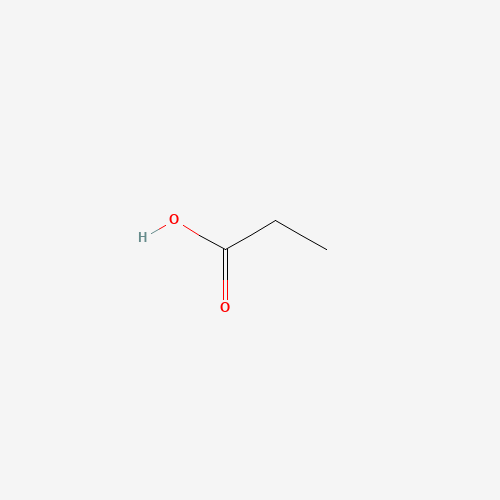
Propionic acid is a mould inhibitor used in bread and other baked goods, often in the form of its calcium or sodium salts. It occurs naturally in Swiss-type cheeses, produced by the bacteria that form the holes.
Where it is and isn’t permitted
| Jurisdiction | Status | Scope and limits | Citation |
|---|---|---|---|
| Australia and New Zealand | Permitted, with conditions | 5 food categories highest permitted level 4,000 mg/kg Show every food category
| Food Standards Code, Schedule 15, S15—5and 4 further provisionsretrieved 2026-10-17 |
| Canada | Permitted, with conditions | 4 permitted uses Show every permitted use
| Health Canada, List of Permitted Preservatives (List 11)and 3 further provisionsretrieved 2026-10-17 |
| European Union | Permitted, with conditions | 6 food categories highest permitted level 3,000 mg/kg Show every food category
| Regulation (EC) No 1333/2008, Annex IIand 5 further provisionsretrieved 2026-10-18 |
| Great Britain | Permitted, with conditions | 6 food categories highest permitted level 2,000 mg/kg or mg/l Show every food category
| Assimilated Regulation (EC) No 1333/2008, Annex II (as at 28 June 2024)and 5 further provisionsretrieved 2026-10-18 |
| Japan | Permitted, with conditions | Designated additive: Appended Table 1, item 369, プロピオン酸 (“Propionic Acid” in the unofficial English translation). …Designated additive: Appended Table 1, item 369, プロピオン酸 (“Propionic Acid” in the unofficial English translation). Standards for use — Specifications and Standards for Foods, Food Additives, etc. (MHW Notification No. 370 of 1959), Part II (Food Additives), F (Standards for use), entry プロピオン酸: (1) [may be used only in the foods stated; states an exception to the preceding sentence] “プロピオン酸は、チーズ、パン及び洋菓子以外の食品に使用してはならない。ただし、着香の目的で使用する場合は、この限りでない。” (2) [sets maximum levels of use for the foods stated] “プロピオン酸の使用量は、プロピオン酸として、チーズにあってはその1kgにつき3.0g(ソルビン酸、ソルビン酸カリウム又はソルビン酸カルシウムを併用する場合には、プロピオン酸としての使用量及びソルビン酸としての使用量の合計量が3.0g)以下、パン及び洋菓子にあってはその1kgにつき2.5g以下でなければならない。” The Japanese is the standard as published. There is no official English translation of the Notification; the English in square brackets is this site’s description of what each sentence does, not a translation of the foods or the levels. Compositional specifications for this additive, in the same Notification, are not imported and are not shown here; nor are the general rules in F 添加物一般, which apply to every additive. | Regulations for Enforcement of the Food Sanitation Act (MHW Ordinance No. 23 of 1948), Appended Table 1retrieved 2026-10-18 |
| South Korea | Permitted, with conditions | Designated food additive: Standards and Specifications for Food Additives, Part III, 1. …Designated food additive: Standards and Specifications for Food Additives, Part III, 1. 일반식품첨가물 (general food additives), 프로피온산 (“Propionic Acid”, the English the Code prints beside it). Main use (주용도) of 프로피온산: 보존료, 향료. Standard for use (사용기준) of 프로피온산: (1) [may be used only in the foods or uses listed; sets a limit on the amount used] “프로피온산은 아래의 식품 또는 용도에 한하여 사용하여야 한다. 프로피온산의 사용량은 1. 빵류 : 2.5g/kg 이하 2. 치즈류:3.0g/kg 이하(소브산, 소브산칼슘 또는 소브산칼륨과 병용할 때에는 프로피온산으로서 사용량과 소브산으로서 사용량의 합계가 3.0g/kg 이하) 3. 잼류:1.0g/kg 이하(소브산, 소브산칼륨, 소브산칼슘, 안식향산, 안식향산칼륨, 안식향산칼슘, 안식향산나트륨, 파라옥시안식향산메틸 또는 파라옥시안식향산에틸과 병용할 때에는 프로피온산으로서 사용량, 소브산으로서 사용량, 안식향산으로서 사용량, 파라옥시안식향산으로서 사용량의 합계가 1.0g/kg 이하) 4. 착향의 목적” The Korean is the standard as published. There is no official English translation of the current Code (the English version on MFDS’s website is the 2020 edition and has no legal effect); the English in square brackets is this site’s description of what each sentence does, not a translation of the foods or the levels. Compositional specifications (Part IV) are not imported, nor are the general standards in Part II, which apply to every additive. | Standards and Specifications for Food Additives (식품첨가물의 기준 및 규격), MFDS Notification, Part III (Standards for use, by item)retrieved 2026-10-18 |
| United States | Permitted | 21 CFR 184.1081retrieved 2026-10-17 | |
| Codex Alimentarius | Permitted, with conditions | 2 food categories highest permitted level 3,000 mg/kg Show every food category and its notes
| CXS 192-1995 Table Three, INS 280and 2 further provisionsretrieved 2026-09-07 |
How much is permitted
A listing usually limits the quantity as well as the food. Only one of the forms that takes is a figure: quantum satis and good manufacturing practice permit the amount the technological effect requires and no more, which is a limit rather than the absence of one. Figures below are the range across every food category this page is listed in, and categories differ between regulators — see how much is permitted.
| Australia and New Zealand | 400 mg/kg – 4,000 mg/kg | 3 numeric limit, 2 GMP |
|---|---|---|
| Canada | — | 4 no quantity stated |
| European Union | 1,000 mg/kg – 3,000 mg/kg | 3 numeric limit, 3 quantum satis |
| Great Britain | 1,000 mg/kg – 2,000 mg/kg | 2 numeric limit, 1 several limits, 3 quantum satis |
| Japan | — | 1 no quantity stated |
| South Korea | — | 1 no quantity stated |
| United States | — | 1 no quantity stated |
| Codex Alimentarius | 3,000 mg/kg | 1 numeric limit, 2 GMP |
What it is made from
Produced industrially from petroleum-derived ethylene, and by fermentation where a natural label is wanted.
- Vegan
- Vegetarian
Compare other additives on the dietary indexes.
- CAS registry number
- 79-09-4
- InChIKey
- XBDQKXXYIPTUBI-UHFFFAOYSA-N
- PubChem
- CID 1032
The two specifications, compared
The European Union sets identity and purity by regulation; JECFA publishes its own through FAO, advisory until a country adopts it. Both documents are below in full. These are the parameters each puts a number on.
| Parameter | European Union | JECFA |
|---|---|---|
| Assay | no less than 99.5 % | no less than 99.5 % |
| Lead | no more than 2 mg/kg | no more than 2 mg/kg |
| Arsenic | no more than 3 mg/kg | — |
| Mercury | no more than 1 mg/kg | — |
The two documents state the same figures for every parameter compared here.
How the EU defines it
The legal specification an additive must meet to be sold as this E number in the EU — what it is, how it may be made, and the purity it must reach. From Commission Regulation (EU) No 231/2012.
E 280 Propionic acid
Assay, identification and purity criteria
Description and assay
- Einecs
- 201-176-3
- Chemical name
- Propionic acid; Propanoic acid
- Chemical formula
- C₃H₆O₂
- Molecular weight
- 74,08
- Assay
- Content not less than 99,5 %
- Description
- Colourless or slightly yellowish, oily liquid with a slightly pungent odour
Identification
- Melting point
- – 22 °C
- Distillation range
- 138,5 °C to 142,5 °C
Purity criteria
- Non-volatile residue
- Not more than 0,01 % when dried at 140 °C to constant weight
- Aldehydes
- Not more than 0,1 % expressed as formaldehyde
- Arsenic
- Not more than 3 mg/kg
- Lead
- Not more than 2 mg/kg
- Mercury
- Not more than 1 mg/kg
How JECFA defines it
The international specification for identity and purity, prepared by the Joint FAO/WHO Expert Committee on Food Additives and published by FAO. It is a different document from any above, written by a different body and revised on its own cycle; it is advisory, and a country adopts it or does not.
INS 280 Propionic Acid
Synonyms: Propanoic acid, ethylformic acid, methylacetic acid, INS No. 280 Ethylformic acid; Methylacetic acid; Propanoic acid
Assay, identification and purity criteria
Description and assay
- Specification history
- Prepared at the 51st JECFA (1998), published in FNP 52 Add 6 (1998) superseding specifications prepared at the 49th JECFA (1997), published in FNP 52 Add 5 (1997). ADI "not limited" established at the 17th JECFA in 1973.
- Chemical names
- Propionic acid
- C.A.S. number
- 79-09-4
- Chemical formula
- C 3 H 6 O 2
- Formula weight
- 74.08
- Assay
- Not less than 99.5% on dried basis
- DESCRIPTION
- An oily liquid with a slightly pungent odour
- FUNCTIONAL USES
- Preservative, antimould, antirope agent, flavouring agent (see "Flavouring agents" monograph JECFA no. 84)
- METHOD OF ASSAY
- Mix 3 g of the sample, weighed to the nearest 0.1 mg, with 50 ml of water in a 250-ml flask. Add phenolphthalein TS, and titrate with 1N sodium hydroxide to the first appearance of a faint pink end-point which persists for at least 30 sec. Each ml of 1N sodium hydroxide is equivalent to 74.08 mg of C 3 H 6 O 2 .
Identification
- Solubility (Vol. 4)
- Miscible with water and ethanol
- Specific gravity (Vol. 4)
- d 20 : 0.993-0.997
Purity criteria
- Distillation range (Vol. 4)
- 138.5 - 142.5 o
- Non-volatile residue (Vol. 4)
- Not more than 0.01% when dried at 140 o to constant weight
- Formic acid
- Not more than 0.1% See description under TESTS
- Aldehydes
- Not more than 0.2% (as propionaldehyde) See description under TESTS
- Lead (Vol. 4)
- Not more than 2 mg/kg Determine using an atomic absorption technique appropriate to the specified level. The selection of sample size and method of sample preparation may be based on the principles of the method described in Volume 4, “Instrumental Methods.”
- Test: Formic acid
- Dissolve 15 g of sodium hydroxide in 50 ml of water, cool, add 6 ml of bromine, stirring to effect complete solution, and dilute to 2,000 ml with water. Transfer 25.0 ml of this solution, into a 250 ml, glass-stoppered Erlenmeyer flask containing 100 ml of water, and add 10 ml of a 1 in 5 solution of sodium acetate and 10.0 ml of the sample. Allow to stand for 15 min, add 5 ml of a 1 in 4 solution of potassium iodide and 10 ml of hydrochloric acid, and titrate with 0.1 N sodium thiosulfate just to the disappearance of the brown colour. Perform a blank determination. The difference between the volume of 0.1 N sodium thiosulfate required for the blank and that required for the sample is not more than 4.4 ml.
- Test: Aldehydes
- Transfer 10.0 ml of the sample into a 250-ml glass-stoppered conical flask containing 50 ml of water and 10.0 ml of a 1 in 8 solution of sodium bisulfite. Stopper the flask, and shake vigorously. Allow the mixture to stand for 30 min, then titrate with 0.1N iodine to the same brownish yellow end-point obtained with a blank treated with the same quantities of the same reagents. The difference between the volume of 0.1N iodine required for the blank and that required for the sample is not more than 7 ml.
Every name it appears under
85 recorded names. A label may use any of them.
E number
- E280
INS number
- 280
CAS registry number
- 79-09-4
As it appears in regulation
- Propionic acid
Other names
- 1-propanoic acid
- 2-methylacetic acid
- Acid C3
- acide propanoique
- Acide propionique
- Adofeed
- Antischim B
- BRN 0506071
- C2H5COOH
- C3 acid
- Carboxyethane
- Caswell No. 707
- CCRIS 6096
- CH3-CH2-COOH
- E 280
- EPA Pesticide Chemical Code 077702
- Epitope ID:139981
- EtCO2H
- Ethanecarboxylic acid
- ethylformic acid
- FEMA No. 2924
- FEMA Number 2924
- HSDB 1192
- INS NO.280
- INS-280
- JHU490RVYR
- Kyselina propionova
- Luprisol
- Luprosil
- Metacetonic acid
- Methyl acetic acid
- methylacetic acid
- Monoprop
- n-propionic acid
- Propanoic acid
- Propanoic acid (9CI)
- Propanyl acid
- Propcorn
- Propioic acid
- Propionic acid
- Propionic acid (6CI,8CI)
- Propionic acid (natural)
- Propionic acid (NF)
- Propionic acid grain preserver
- Propionic acid, 99%
- Propionic acid, 99.5%
- Propionic acid, >=99%
- Propionic acid, >=99.5%
- Propionoic acid
- Propionsaeure
- Propkorn
- propoic acid
- proponic acid
- proprionic acid
- Prozoin
- Pseudoacetic acid
- Sentry grain preserver
- Tenox P grain preservative
- Toxi-Check
- ultra-long-chain fatty acid
Systematic names
- Propanoic acid
Hazard reference values
| Type | Value | Population | Assessed by | Opinion |
|---|---|---|---|---|
| ADI | not limited | — | JECFA | 1997 |
Evidence and how bodies read it
What assessing bodies concluded
Each conclusion is paraphrased in the body's own framing, from the published opinion linked beneath it. Where bodies differ, both stand; this site does not adjudicate between them or add a view of its own.
EFSA 2014
The ANS Panel found no concern for genotoxicity or carcinogenicity for propionic acid and its salts (E 280–E 283), but concluded the database did not allow an ADI to be allocated. It concluded there would not be a safety concern from the maximum concentrations at the currently authorised uses and use levels.
Common questions
Assembled from what is above, in the words the questions are usually asked in. Each answer is the same statement the relevant section makes, with the same citations behind it.
- What is E 280?
- E 280 is Propionic acid. Propionic acid is a mould inhibitor used in bread and other baked goods, often in the form of its calcium or sodium salts. It occurs naturally in Swiss-type cheeses, produced by the bacteria that form the holes.
- What is Propionic acid used for in food?
- It is listed as a preservative — the role Canada, Codex and the US assign it. This page shows every function each regulator records, with the citation for each.
- Where is Propionic acid permitted?
- Of the seven regulators this site reads, Australia and New Zealand, Canada, the EU, Great Britain, Japan, South Korea, the US and the Codex standard permit it. Each permission is for named foods at named levels, not a blanket one; the table on this page gives them with citations.
- Is Propionic acid vegan?
- Yes. Propionic acid is not derived from animals, and is suitable for vegetarians. This page says what it is made from and how.
Sources for this page
- anz retrieved 2026-10-17
- ca retrieved 2026-10-17
- eu retrieved 2026-10-18
- gb retrieved 2026-10-18
- jp retrieved 2026-10-18
- kr retrieved 2026-10-18
- ecfr retrieved 2026-10-17
- gsfa retrieved 2026-09-07
- euspecs retrieved 2026-10-18
- jecfaspecs retrieved 2026-09-23
Full licence terms and publisher details on Sources. How this page is built and updated: Method.
Machine-readable: a JSON record of this additive is given on request —how to ask for access.
Follow changes to Propionic acid:Atom feed — regulatory events, and any change the weekly refresh detects in its provisions.