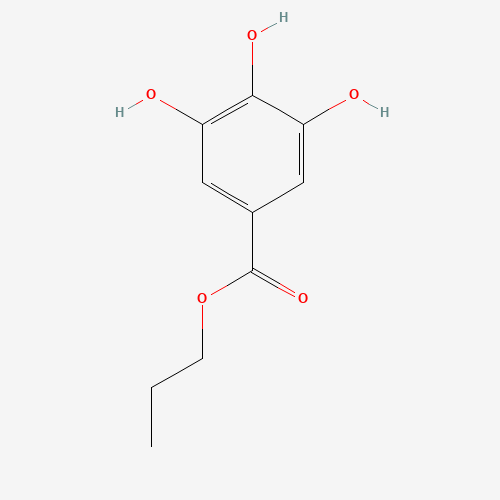
Propyl gallate

E number E310INS 310CAS 121-79-9

Listed as an antioxidant by Codex and the US.

Listed as antioxidants (US, Codex) · preservatives (CA) · flavouring agents and adjuvants (US)
Chemical structure of Propyl gallate, from PubChem compound 4947
Structure from PubChem CID 4947 (National Library of Medicine, public domain). A depiction of one compound: where a listing covers a family, or a substance has no single structure, this page shows none.

Propyl gallate is a synthetic antioxidant used in oils, fats, chewing gum and snack foods, often combined with BHA or BHT because the three work better together than separately.

Where it is and isn’t permitted

Status of Propyl gallate by jurisdiction. Every jurisdiction this site covers is listed, including those where the substance does not appear.
JurisdictionStatusScope and limitsCitation
Australia and New ZealandFood Standards Australia New ZealandPermitted, with conditions

3 food categories

highest permitted level 200 mg/kg

Show every food category
  • 0 Preparations of food additives — 100 mg/kg
  • 2 Edible oils and oil emulsions — 100 mg/kg
  • 5.2.1 Bubble gum and chewing gum — 200 mg/kg
Food Standards Code, Schedule 15, S15—5and 2 further provisionsretrieved 2026-10-17
CanadaHealth CanadaPermitted, with conditions

8 permitted uses

Show every permitted use
  • In: Calorie-reduced margarine; Margarine. Purpose: Preservative. Limit: If used singly, the amount not to exceed 0.01% of the fat content. If used in combination with butylated hydroxyanisole or butylated hydroxytoluene, or both, the total combined amount not to exceed 0.01% of the fat content. — Health Canada, List of Permitted Preservatives (List 11), item P.11(a)
  • In: Chewing gum. Purpose: Preservative. Limit: If used singly, the amount not to exceed 200 ppm. If used in combination with butylated hydroxyanisole or butylated hydroxytoluene, or both, the total combined amount not to exceed 200 ppm. — Health Canada, List of Permitted Preservatives (List 11), item P.11(b)
  • In: Citrus oil flavours; Dry flavours; Essential oils. Purpose: Preservative. Limit: If used singly, the amount not to exceed 1,250 ppm. If used in combination with butylated hydroxyanisole or butylated hydroxytoluene, or both, the total combined amount not to exceed 1,250 ppm. — Health Canada, List of Permitted Preservatives (List 11), item P.11(c)
  • In: Citrus oils. Purpose: Preservative. Limit: If used singly, the amount not to exceed 5,000 ppm. If used in combination with butylated hydroxyanisole or butylated hydroxytoluene, or both, the total combined amount not to exceed 5,000 ppm. — Health Canada, List of Permitted Preservatives (List 11), item P.11(d)
  • In: Dehydrated potato products; Dried breakfast cereals. Purpose: Preservative. Limit: If used singly, the amount not to exceed 50 ppm. If used in combination with butylated hydroxyanisole or butylated hydroxytoluene, or both, the total combined amount not to exceed 50 ppm. — Health Canada, List of Permitted Preservatives (List 11), item P.11(e)
  • In: Dried cooked poultry meat. Purpose: Preservative. Limit: If used singly, the amount not to exceed 0.015% of the fat content. If used in combination with citric acid or butylated hydroxyanisole, or both, the total combined amount not to exceed 0.015% of the fat content. — Health Canada, List of Permitted Preservatives (List 11), item P.11(f)
  • In: Fats and oils, except milk fat, olive oil and suet; Lard; Shortening. Purpose: Preservative. Limit: If used singly, the amount not to exceed 200 ppm. If used in any combination with butylated hydroxyanisole, butylated hydroxytoluene or tertiary butyl hydroquinone, the total combined amount not to exceed 200 ppm. — Health Canada, List of Permitted Preservatives (List 11), item P.11(g)
  • In: Unstandardized foods, except unstandardized preparations of meat or meat by-product, fish or meat (as defined in section B.21.002 of the Food and Drug Regulations) or poultry meat or poultry meat by-product and those unstandardized foods set out in paragraphs (b), (c), (d) and (e) of this item. Purpose: Preservative. Limit: If used singly, the amount not to exceed 0.02% of the fat content. If used in combination with butylated hydroxyanisole or butylated hydroxytoluene, or both, the total combined amount not to exceed 0.02% of the fat content. Amendment notices: NOM/ADM-0122. — Health Canada, List of Permitted Preservatives (List 11), item P.11(h)
Health Canada, List of Permitted Preservatives (List 11)and 7 further provisionsretrieved 2026-10-17
European UnionEuropean Commission / EFSAPermitted, with conditions

18 food categories

highest permitted level 400 mg/kg

Show every food category
  • 1.5 dehydrated milk as defined by directive 2001/114/ec — 200 mg/kgPermitted as a member of Propyl gallate, TBHQ and BHA. ML = 200 mg/kg. only milk powder for vending machines. Note 1: The additives may be added individually or in combination.
  • 12.2.2 Seasonings and condiments — 200 mg/kgPermitted as a member of Propyl gallate, TBHQ, BHA and BHT. ML = 200 mg/kg. Note 1: The additives may be added individually or in combination.
  • 12.5 Soups and broths — 200 mg/kgPermitted as a member of Propyl gallate, TBHQ and BHA. ML = 200 mg/kg. only dehydrated soups and broths. Note 1: The additives may be added individually or in combination.
  • 12.6 Sauces — 200 mg/kgPermitted as a member of Propyl gallate, TBHQ and BHA. ML = 200 mg/kg. Note 1: The additives may be added individually or in combination.
  • 15.1 Potato- cereal- flour- or starch-based snacks — 200 mg/kgPermitted as a member of Propyl gallate, TBHQ and BHA. ML = 200 mg/kg. only cereal-based snack foods. Note 1: The additives may be added individually or in combination.
  • 15.2 Processed nuts — 200 mg/kgPermitted as a member of Propyl gallate, TBHQ and BHA. ML = 200 mg/kg. Note 1: The additives may be added individually or in combination.
  • 17.1 food supplements supplied in a solid form excluding food supplements for infants and young children’, — 400 mg/kgPermitted as a member of Propyl gallate, TBHQ, BHA and BHT. ML = 400 mg/kg. Note 1: The additives may be added individually or in combination.
  • 17.2 food supplements supplied in a liquid form excluding food supplements for Infants and young children — 400 mg/lPermitted as a member of Propyl gallate, TBHQ, BHA and BHT. ML = 400 mg/l. Note 1: The additives may be added individually or in combination.
  • 2.1 fats and oils essentially free from water (excluding anhydrous milk fat) — 200 mg/kgPermitted as a member of Propyl gallate, TBHQ and BHA. ML = 200 mg/kg. Only fats and oils for the professional manufacture of heat-treated foods; frying oil and frying fat (excluding olive pomace oil) and lard, fish oil, beef, poultry and sheep fat. Note 1: The additives may be added individually or in combination.
  • 2.2.2 Other fat and oil emulsions including spreads as defined by Regulation (EC) No 1234/2007 and liquid emulsions — 200 mg/kgPermitted as a member of Propyl gallate, TBHQ and BHA. ML = 200 mg/kg. only frying fat. Note 1: The additives may be added individually or in combination.
  • 4.2.5.4 nut butters and nut spreads — 200 mg/kgPermitted as a member of Propyl gallate, TBHQ and BHA. ML = 200 mg/kg. only processed nuts. Note 1: The additives may be added individually or in combination.
  • 4.2.6 processed potato products — 25 mg/kgPermitted as a member of Propyl gallate, TBHQ and BHA. ML = 25 mg/kg. only dehydrated potatoes. Note 1: The additives may be added individually or in combination.
  • 5.3 chewing gum — 400 mg/kgPermitted as a member of Propyl gallate, TBHQ, BHA and BHT. ML = 400 mg/kg. Note 1: The additives may be added individually or in combination.
  • 6.3 breakfast cereals — 200 mg/kgPermitted as a member of Propyl gallate, TBHQ and BHA. ML = 200 mg/kg. Only pre-cooked cereals. Note 1: The additives may be added individually or in combination.
  • 6.7 pre-cooked or processed cereals — 200 mg/kgPermitted as a member of Propyl gallate, TBHQ and BHA. ML = 200 mg/kg. only pre-cooked cereals. Note 1: The additives may be added individually or in combination.
  • 7.2 Fine bakery wares — 200 mg/kgPermitted as a member of Propyl gallate, TBHQ and BHA. ML = 200 mg/kg. only cake mixes. Note 1: The additives may be added individually or in combination.
  • 8.3.1 Non-heat-treated processed meat — 200 mg/kgPermitted as a member of Propyl gallate, TBHQ and BHA. ML = 200 mg/kg. only dehydtated meat. Note 1: The additives may be added individually or in combination.
  • 8.3.2 Heat-treated meat products — 200 mg/kgPermitted as a member of Propyl gallate, TBHQ and BHA. ML = 200 mg/kg. only dehydrated meat. Note 1: The additives may be added individually or in combination.
Regulation (EC) No 1333/2008, Annex II, as amended by (EU) No 2018/1481, via Propyl gallateand 17 further provisionsretrieved 2026-10-18
Great BritainFood Standards Agency / Food Standards ScotlandPermitted, with conditions

18 food categories

highest permitted level 400 mg/kg or mg/l

Show every food category
  • 1.5 Dehydrated milk as defined by Directive 2001/114/EC — 200 mg/kg or mg/lPermitted as a member of E 310–320: Propyl gallate, TBHQ and BHA. ML = 200. only milk powder for vending machines. Note (1): The additives may be added individually or in combination.
  • 12.2.2 Seasonings and condiments — 200 mg/kg or mg/lAuthorised under E 310-321, Propyl gallate, TBHQ, BHA and BHT. ML = 200. Note (1): The additives may be added individually or in combination. Note (13): Maximum limit expressed on fat.
  • 12.5 Soups and broths — 200 mg/kg or mg/lPermitted as a member of E 310–320: Propyl gallate, TBHQ and BHA. ML = 200. only dehydrated soups and broths. Note (1): The additives may be added individually or in combination. Note (13): Maximum limit expressed on fat.
  • 12.6 Sauces — 200 mg/kg or mg/lPermitted as a member of E 310–320: Propyl gallate, TBHQ and BHA. ML = 200. Note (1): The additives may be added individually or in combination. Note (13): Maximum limit expressed on fat.
  • 15.1 Potato-, cereal-, flour- or starch-based snacks — 200 mg/kg or mg/lPermitted as a member of E 310–320: Propyl gallate, TBHQ and BHA. ML = 200. only cereal-based snack foods. Note (1): The additives may be added individually or in combination.
  • 15.2 Processed nuts — 200 mg/kg or mg/lPermitted as a member of E 310–320: Propyl gallate, TBHQ and BHA. ML = 200. Note (1): The additives may be added individually or in combination. Note (13): Maximum limit expressed on fat.
  • 17.1 Food supplements supplied in a solid form, excluding food supplements for infants and young children — 400 mg/kg or mg/lAuthorised under E 310-321, Propyl gallate, TBHQ, BHA and BHT. ML = 400. Note (1): The additives may be added individually or in combination.
  • 17.2 Food supplements supplied in a liquid form, excluding food supplements for infants and young children — 400 mg/kg or mg/lAuthorised under E 310-321, Propyl gallate, TBHQ, BHA and BHT. ML = 400. Note (1): The additives may be added individually or in combination.
  • 2.1 Fats and oils essentially free from water (excluding anhydrous milkfat) — 200 mg/kg or mg/lPermitted as a member of E 310–320: Propyl gallate, TBHQ and BHA. ML = 200. only fats and oils for the professional manufacture of heat- treated foods; frying oil and frying fat (excluding olive pomace oil) and lard, fish oil, beef, poultry and sheep fat. Note (1): The additives may be added individually or in combination. Note (41): Expressed on fat basis.
  • 2.2.2 Other fat and oil emulsions including spreads as defined by Regulation (EC) No 1234/2007 and liquid emulsions — 200 mg/kg or mg/lPermitted as a member of E 310–320: Propyl gallate, TBHQ and BHA. ML = 200. only frying fat. Note (1): The additives may be added individually or in combination. Note (2): The maximum level is applicable to the sum and the levels are expressed as the free acid.
  • 4.2.5.4 Nut butters and nut spreads — 200 mg/kg or mg/lPermitted as a member of E 310–320: Propyl gallate, TBHQ and BHA. ML = 200. only processed nuts. Note (1): The additives may be added individually or in combination. Note (41): Expressed on fat basis.
  • 4.2.6 Processed potato products — 25 mg/kg or mg/lPermitted as a member of E 310–320: Propyl gallate, TBHQ and BHA. ML = 25. only dehydrated potatoes. Note (1): The additives may be added individually or in combination.
  • 5.3 Chewing gum — 400 mg/kg or mg/lAuthorised under E 310-321, Propyl gallate, TBHQ, BHA and BHT. ML = 400. Note (1): The additives may be added individually or in combination.
  • 6.3 Breakfast cereals — 200 mg/kg or mg/lPermitted as a member of E 310–320: Propyl gallate, TBHQ and BHA. ML = 200. only precooked cereals. Note (1): The additives may be added individually or in combination. Note (13): Maximum limit expressed on fat.
  • 6.7 Pre-cooked or processed cereals — 200 mg/kg or mg/lPermitted as a member of E 310–320: Propyl gallate, TBHQ and BHA. ML = 200. only pre-cooked cereals. Note (1): The additives may be added individually or in combination.
  • 7.2 Fine bakery wares — 200 mg/kg or mg/lPermitted as a member of E 310–320: Propyl gallate, TBHQ and BHA. ML = 200. only cake mixes. Note (1): The additives may be added individually or in combination.
  • 8.3.1 Non-heat-treated meat products — 200 mg/kg or mg/lPermitted as a member of E 310–320: Propyl gallate, TBHQ and BHA. ML = 200. only dehydrated meat. Note (1): The additives may be added individually or in combination. Note (13): Maximum limit expressed on fat.
  • 8.3.2 Heat-treated meat products — 200 mg/kg or mg/lPermitted as a member of E 310–320: Propyl gallate, TBHQ and BHA. ML = 200. only dehydrated meat. Note (1): The additives may be added individually or in combination. Note (13): Maximum limit expressed on fat.
Assimilated Regulation (EC) No 1333/2008, Annex II (as at 28 June 2024)and 17 further provisionsretrieved 2026-10-18
JapanConsumer Affairs AgencyPermitted, with conditions
Designated additive: Appended Table 1, item 393, 没食子酸プロピル (“Propyl Gallate” in the unofficial English translation). …

Designated additive: Appended Table 1, item 393, 没食子酸プロピル (“Propyl Gallate” in the unofficial English translation). Standards for use — Specifications and Standards for Foods, Food Additives, etc. (MHW Notification No. 370 of 1959), Part II (Food Additives), F (Standards for use), entry 没食子酸プロピル: (1) [may be used only in the foods stated] “没食子酸プロピルは、バター及び油脂以外の食品に使用してはならない。” (2) [sets maximum levels of use for the foods stated] “没食子酸プロピルの使用量は、没食子酸プロピルとして、油脂にあってはその1kgにつき0.20g以下、バターにあってはその1kgにつき0.10g以下でなければならない。” The Japanese is the standard as published. There is no official English translation of the Notification; the English in square brackets is this site’s description of what each sentence does, not a translation of the foods or the levels. Compositional specifications for this additive, in the same Notification, are not imported and are not shown here; nor are the general rules in F 添加物一般, which apply to every additive.

Regulations for Enforcement of the Food Sanitation Act (MHW Ordinance No. 23 of 1948), Appended Table 1retrieved 2026-10-18
South KoreaMinistry of Food and Drug SafetyPermitted, with conditions
Designated food additive: Standards and Specifications for Food Additives, Part III, 1. …

Designated food additive: Standards and Specifications for Food Additives, Part III, 1. 일반식품첨가물 (general food additives), 몰식자산프로필 (“Propyl Gallate”, the English the Code prints beside it). Main use (주용도) of 몰식자산프로필: 산화방지제. Standard for use (사용기준) of 몰식자산프로필: (1) [may be used only in the foods listed] “몰식자산프로필은 아래의 식품에 한하여 사용하여야 한다.” (2) [sets a limit on the amount used] “몰식자산프로필의 사용량은 1. 식용유지류(모조치즈, 식물성크림 제외), 버터류∶0.1g/kg 이하” The Korean is the standard as published. There is no official English translation of the current Code (the English version on MFDS’s website is the 2020 edition and has no legal effect); the English in square brackets is this site’s description of what each sentence does, not a translation of the foods or the levels. Compositional specifications (Part IV) are not imported, nor are the general standards in Part II, which apply to every additive.

Standards and Specifications for Food Additives (식품첨가물의 기준 및 규격), MFDS Notification, Part III (Standards for use, by item)retrieved 2026-10-18
United StatesFood and Drug AdministrationPermitted21 CFR 184.1660retrieved 2026-10-17
Codex AlimentariusCodex Alimentarius Commission / JECFAPermitted, with conditions

31 food categories

highest permitted level 1,000 mg/kg

Show every food category and its notes
  • 01.5.1 Milk powder and cream powder (plain) — 200 mg/kg
    • Note 15 On the fat or oil basis.
    • Note 75 For use in milk powder for vending machines only.
    • Note 196 Singly or in combination: butylated hydroxyanisole (BHA, INS 320), butylated hydroxytoluene (BHT, INS 321) and propyl gallate (INS 310).
    • Note XS207 Excluding products conforming to the Standard for Standard for Milk Powders and Cream Powder (CXS 207-1999)
    • Note XS290 Excluding products conforming to the Standard for Standard for Edible Casein Products (CXS 290-1995).
  • 01.7 Dairy-based desserts (e.g. pudding, fruit or flavoured yoghurt) — 90 mg/kg
    • Note 2 On the dry ingredient, dry weight, dry mix or concentrate basis.
    • Note 15 On the fat or oil basis.
    • Note XS243 Excluding products conforming to the Standard for Fermented Milks (CXS 243-2003).
  • 02.1.1 Butter oil, anhydrous milkfat, ghee — 100 mg/kg
    • Note 15 On the fat or oil basis.
    • Note 133 Any combination of butylated hydroxyanisole (INS 320), butylated hydroxytoluene (INS 321), and propyl gallate (INS 310) at 200 mg/kg, provided that single use limits are not exceeded.
    • Note 171 Excluding anhydrous milkfat.
    • Note 514 Except for use in products conforming to the Standard for Edible Fats and Oils not Covered by Individual Standards (CXS 19-1981): butylated hydroxyanisole (INS 320) at 175 mg/kg, butylated hydroxytoluene (INS 321) at 75 mg/kg, propyl gallate (INS 310) at 100 mg/kg, and tertiary butylhydroquinone (INS 319) at 120 mg/kg; as well, any combination of INS 320, INS 321, INS 310 and INS 319 at up to 200 mg/kg, provided the single use limits are not exceeded.
  • 02.1.2 Vegetable oils and fats — 200 mg/kg
    • Note 15 On the fat or oil basis.
    • Note 130 Singly or in combination: butylated hydroxyanisole (INS 320), butylated hydroxytoluene (INS 321), tertiary butylated hydroquinone (INS 319), and propyl gallate (INS 310).
    • Note 511 Excluding virgin and cold pressed oils in products conforming to the Standard for Edible Fats and Oils not Covered by Individual Standards (CXS 19-1981) and the Standard for Named Vegetable Oils (CXS 210-1999).
    • Note 515 Except for use in products conforming to the Standard for Edible Fats and Oils not Covered by Individual Standards (CXS 19-1981) and the Standard for Named Vegetable Oils (CXS 210-1999): butylated hydroxyanisole (INS 320) at 175 mg/kg, butylated hydroxytoluene (INS 321) at 75 mg/kg, propyl gallate (INS 310) at 100 mg/kg, and tertiary butylhydroquinone (INS 319) at 120 mg/kg; as well, any combination of INS 320, INS 321, INS 310 and INS 319 at up to 200 mg/kg, provided the single use limits are not exceeded.
    • Note XS33 Excluding products conforming to the Standard for Olive Oils and Olive Pomace Oils (CODEX STAN 33-1981).
    • Note XS325R Excluding products conforming to the Regional Standard for Unrefined Shea Butter (CXS 325R-2017).
  • 02.1.3 Lard, tallow, fish oil, and other animal fats — 200 mg/kg
    • Note 15 On the fat or oil basis.
    • Note 130 Singly or in combination: butylated hydroxyanisole (INS 320), butylated hydroxytoluene (INS 321), tertiary butylated hydroquinone (INS 319), and propyl gallate (INS 310).
    • Note 516 Except for use in products conforming to the Standard for Edible Fats and Oils not Covered by Individual Standards (CXS 19-1981) and the Standard for Named Animal Fats (CXS 211-1999) ): butylated hydroxyanisole (INS 320) at 175 mg/kg, butylated hydroxytoluene (INS 321) at 75 mg/kg, propyl gallate (INS 310) at 100 mg/kg, and tertiary butylhydroquinone (INS 319) at 120 mg/kg; as well, any combination of INS 320, INS 321, INS 310 and INS 319 at up to 200 mg/kg, provided the single use limits are not exceeded.
  • 02.2.2 Fat spreads, dairy fat spreads and blended spreads — 200 mg/kg
    • Note 15 On the fat or oil basis.
    • Note 552 Except for use in products conforming to the Standard for Dairy Fat Spreads (CXS 253-2006), only intended for cooking purposes: propyl gallate (INS 310) at 200 mg/kg, butylated hydroxyanisole (INS 320) at 200 mg/kg or butylated hydroxytoluene (INS 321) at 75 mg/kg, singly or in combination at 200 mg/kg.
    • Note 559 For use in products conforming to the Standard for Fat Spreads and Blended Spreads (CXS 256-2007): propyl gallate (INS 310), tertiary butylhydroquinone (INS 319), butylated hydroxyanisole (INS 320) and butylated hydroxytoluene (INS 321), singly or in combination at 200 mg/kg.
  • 02.3 Fat emulsions mainly of type oil-in-water, including mixed and/or flavoured products based on fat emulsions — 200 mg/kg
    • Note 15 On the fat or oil basis.
    • Note 130 Singly or in combination: butylated hydroxyanisole (INS 320), butylated hydroxytoluene (INS 321), tertiary butylated hydroquinone (INS 319), and propyl gallate (INS 310).
  • 02.4 Fat-based desserts excluding dairy-based dessert products of food category 01.7 — 200 mg/kg
    • Note 15 On the fat or oil basis.
    • Note 130 Singly or in combination: butylated hydroxyanisole (INS 320), butylated hydroxytoluene (INS 321), tertiary butylated hydroquinone (INS 319), and propyl gallate (INS 310).
  • 04.1.2.9 Fruit-based desserts, incl. fruit-flavoured water-based desserts — 90 mg/kg
    • Note 2 On the dry ingredient, dry weight, dry mix or concentrate basis.
    • Note 15 On the fat or oil basis.
  • 04.2.2.2 Dried vegetables (including mushrooms and fungi, roots and tubers, pulses and legumes, and aloe vera), seaweeds, and nuts and seeds — 50 mg/kg
    • Note 15 On the fat or oil basis.
    • Note 76 For use in potatoes.
    • Note 196 Singly or in combination: butylated hydroxyanisole (BHA, INS 320), butylated hydroxytoluene (BHT, INS 321) and propyl gallate (INS 310).
    • Note 613 Except for products conforming to the Regional Standard for Laver Products (CXS 323R-2017), only for use in Seasoned Laver Products.
    • Note XS336R Excluding products conforming to the Regional Standard for kava products for use as a beverage when mixed with water (North America and South West Pacific) (CXS 336R-2020).
  • 05.1 Cocoa products and chocolate products including imitations and chocolate substitutes — 200 mg/kg
    • Note 15 On the fat or oil basis.
    • Note 130 Singly or in combination: butylated hydroxyanisole (INS 320), butylated hydroxytoluene (INS 321), tertiary butylated hydroquinone (INS 319), and propyl gallate (INS 310).
    • Note 303 Excluding products (other than white chocolate) conforming to the Standard for Chocolate and Chocolate Products (CODEX STAN 87-1981).
    • Note XS86 Excluding products conforming to the Standard for Cocoa Butter (CODEX STAN 86-1981).
    • Note XS105 Excluding products conforming to the Standard for Cocoa Powders (Cocoas) and Dry Mixtures of Cocoa and Sugars (CODEX STAN 105-1981).
    • Note XS141 Excluding products conforming to the Standard for Cocoa (Cacao) Mass (Cocoa/chocolate liquor) and Cocoa Cake (CODEX STAN 141-1983).
  • 05.2 Confectionery including hard and soft candy, nougats, etc. other than food categories 05.1, 05.3, and 05.4 — 200 mg/kg
    • Note 15 On the fat or oil basis.
    • Note 130 Singly or in combination: butylated hydroxyanisole (INS 320), butylated hydroxytoluene (INS 321), tertiary butylated hydroquinone (INS 319), and propyl gallate (INS 310).
    • Note XS309R Excluding products conforming to the Codex Regional Standard for Halawa Tehenia (CODEX STAN 309R-211).
  • 05.3 Chewing gum — 1,000 mg/kg
    • Note 130 Singly or in combination: butylated hydroxyanisole (INS 320), butylated hydroxytoluene (INS 321), tertiary butylated hydroquinone (INS 319), and propyl gallate (INS 310).
  • 05.4 Decorations (e.g. for fine bakery wares), toppings (non-fruit), and sweet sauces — 200 mg/kg
    • Note 15 On the fat or oil basis.
    • Note 130 Singly or in combination: butylated hydroxyanisole (INS 320), butylated hydroxytoluene (INS 321), tertiary butylated hydroquinone (INS 319), and propyl gallate (INS 310).
  • 06.1 Whole, broken, or flaked grain, including rice — 100 mg/kg
    • Note 15 On the fat or oil basis.
    • Note XS198 Excluding products conforming to the Standard for Rice (CXS 198-1995).
    • Note XS202 Excluding products conforming to the Standard for Couscous (CXS 202-1995).
  • 06.3 Breakfast cereals, including rolled oats — 200 mg/kg
    • Note 15 On the fat or oil basis.
    • Note 196 Singly or in combination: butylated hydroxyanisole (BHA, INS 320), butylated hydroxytoluene (BHT, INS 321) and propyl gallate (INS 310).
  • 06.4.3 Pre-cooked pastas and noodles and like products — 200 mg/kg
    • Note 15 On the fat or oil basis.
    • Note 130 Singly or in combination: butylated hydroxyanisole (INS 320), butylated hydroxytoluene (INS 321), tertiary butylated hydroquinone (INS 319), and propyl gallate (INS 310).
    • Note 211 For use in noodles only.
    • Note XS364R Excluding use in products conforming to the Regional standard for quick-frozen dumplings (CXS 364R-2026).
  • 06.5 Cereal and starch based desserts (e.g. rice pudding, tapioca pudding) — 90 mg/kg
    • Note 2 On the dry ingredient, dry weight, dry mix or concentrate basis.
    • Note 15 On the fat or oil basis.
  • 07.1.3 Other ordinary bakery products (e.g. bagels, pita, English muffins) — 100 mg/kg
    • Note 15 On the fat or oil basis.
    • Note 130 Singly or in combination: butylated hydroxyanisole (INS 320), butylated hydroxytoluene (INS 321), tertiary butylated hydroquinone (INS 319), and propyl gallate (INS 310).
  • 07.2.3 Mixes for fine bakery wares (e.g. cakes, pancakes) — 200 mg/kg
    • Note 15 On the fat or oil basis.
    • Note 196 Singly or in combination: butylated hydroxyanisole (BHA, INS 320), butylated hydroxytoluene (BHT, INS 321) and propyl gallate (INS 310).
  • 08.2 Processed meat, poultry, and game products in whole pieces or cuts — 200 mg/kg
    • Note 15 On the fat or oil basis.
    • Note 130 Singly or in combination: butylated hydroxyanisole (INS 320), butylated hydroxytoluene (INS 321), tertiary butylated hydroquinone (INS 319), and propyl gallate (INS 310).
    • Note XS96 Excluding products conforming to the Standard for Cooked Cured Ham (CODEX STAN 96-1981).
    • Note XS97 Excluding products conforming to the Standard for Cooked Cured Pork Shoulder (CODEX STAN 97-1981).
  • 08.3 Processed comminuted meat, poultry, and game products — 200 mg/kg
    • Note 15 On the fat or oil basis.
    • Note 130 Singly or in combination: butylated hydroxyanisole (INS 320), butylated hydroxytoluene (INS 321), tertiary butylated hydroquinone (INS 319), and propyl gallate (INS 310).
    • Note XS88 Excluding products conforming to the Standard for Corned Beef (CODEX STAN 88-1981).
    • Note XS89 Excluding products conforming to Standard for Luncheon Meat (CODEX STAN 89-1981).
    • Note XS98 Excluding products conforming to the Standard for Cooked Cured Chopped Meat (CODEX STAN 98-1981).
  • 09.2.5 Smoked, dried, fermented, and/or salted fish and fish products, including molluscs, crustaceans, and echinoderms — 100 mg/kg
    • Note 15 On the fat or oil basis.
    • Note 196 Singly or in combination: butylated hydroxyanisole (BHA, INS 320), butylated hydroxytoluene (BHT, INS 321) and propyl gallate (INS 310).
    • Note XS167 Excluding products conforming to the Standard for Salted Fish and Dried Salted Fish of the Gadidae Family of Fishes (CODEX STAN 167-1989).
    • Note XS189 Excluding products conforming to the Standard for Dried Shark Fins (CODEX STAN 189-1993).
    • Note XS222 Excluding products conforming to the Standard for Crackers from Marine and Freshwater Fish, Crustaceans and Molluscan Shellfish (CODEX STAN 222-2001).
    • Note XS236 Excluding products conforming to the Standard for Boiled Dried Salted Anchovies (CODEX STAN 236-2003).
    • Note XS244 Excluding products conforming to the Standard for Salted Atlantic Herring and Salted Sprat (CODEX STAN 244-2004).
    • Note XS311 Excluding products conforming to the Standard for Smoked Fish, Smoked-flavoured Fish and Smoke-dried Fish (CODEX STAN 311-2013).
  • 10.4 Egg-based desserts (e.g. custard) — 90 mg/kg
    • Note 2 On the dry ingredient, dry weight, dry mix or concentrate basis.
    • Note 15 On the fat or oil basis.
  • 12.2 Herbs, spices, seasonings, and condiments (e.g. seasoning for instant noodles) — 200 mg/kg
    • Note 15 On the fat or oil basis.
    • Note 130 Singly or in combination: butylated hydroxyanisole (INS 320), butylated hydroxytoluene (INS 321), tertiary butylated hydroquinone (INS 319), and propyl gallate (INS 310).
    • Note XS326 Excluding products conforming to the Standard for Black, White and Green Peppers (CODEX STAN 326-2017).
    • Note XS327 Excluding products conforming to the Standard for Cumin (CODEX STAN 327-2017).
    • Note XS328 Excluding products conforming to the Standard for Dried Thyme (CODEX STAN 328-2017).
    • Note XS342 Excluding products conforming to the Standard for Dried Oregano (CXS 342-2021).
    • Note XS343 Excluding products conforming to the Standard for dried roots, rhizomes and bulbs: Dried or dehydrated ginger (CXS 343-2021).
    • Note XS344 Excluding products conforming to the Standard for dried floral parts: Cloves (CXS 344-2021).
    • Note XS345 Excluding products conforming to the Standard for Dried Basil (CXS 345-2021).
    • Note XS347 Excluding products conforming to the Standard for dried or dehydrated garlic (CXS 347-2019).
    • Note XS351 Excluding products conforming to the Standard for Dried Floral Parts - Saffron (CXS 351-2022).
    • Note XS352 Excluding products conforming to the Standard for Dried Seeds – Nutmeg (CXS 352-2022).
    • Note XS353 Excluding products conforming to the Standard for Dried or Dehydrated Chilli Pepper and Paprika (CXS 353-2022).
  • 12.5 Soups and broths — 200 mg/kg
    • Note 15 On the fat or oil basis.
    • Note 127 On the served to the consumer basis.
    • Note 130 Singly or in combination: butylated hydroxyanisole (INS 320), butylated hydroxytoluene (INS 321), tertiary butylated hydroquinone (INS 319), and propyl gallate (INS 310).
  • 12.6 Sauces and like products — 200 mg/kg
    • Note 15 On the fat or oil basis.
    • Note 130 Singly or in combination: butylated hydroxyanisole (INS 320), butylated hydroxytoluene (INS 321), tertiary butylated hydroquinone (INS 319), and propyl gallate (INS 310).
    • Note XS302 Excluding products conforming to the Standard for Fish Sauce (CODEX STAN 302-2011).
    • Note XS306 Excluding products conforming to the Standard for Chilli Sauce (CXS 306-2011).
  • 13.6 Food supplements — 400 mg/kg
    • Note 15 On the fat or oil basis.
    • Note 196 Singly or in combination: butylated hydroxyanisole (BHA, INS 320), butylated hydroxytoluene (BHT, INS 321) and propyl gallate (INS 310).
  • 14.1.4 Water-based flavoured drinks, including "sport," “energy,” or "electrolyte" drinks and particulated drinks — 1,000 mg/kg
    • Note 15 On the fat or oil basis.
  • 15.1 Snacks - potato, cereal, flour or starch based (from roots and tubers, pulses and legumes) — 200 mg/kg
    • Note 15 On the fat or oil basis.
    • Note 130 Singly or in combination: butylated hydroxyanisole (INS 320), butylated hydroxytoluene (INS 321), tertiary butylated hydroquinone (INS 319), and propyl gallate (INS 310).
  • 15.2 Processed nuts, including coated nuts and nut mixtures (with e.g. dried fruit) — 200 mg/kg
    • Note 15 On the fat or oil basis.
    • Note 130 Singly or in combination: butylated hydroxyanisole (INS 320), butylated hydroxytoluene (INS 321), tertiary butylated hydroquinone (INS 319), and propyl gallate (INS 310).
CXS 192-1995 Table One, INS 310and 30 further provisionsretrieved 2026-09-07

How much is permitted

A listing usually limits the quantity as well as the food. Only one of the forms that takes is a figure: quantum satis and good manufacturing practice permit the amount the technological effect requires and no more, which is a limit rather than the absence of one. Figures below are the range across every food category this page is listed in, and categories differ between regulators — see how much is permitted.

Australia and New Zealand100 mg/kg – 200 mg/kg3 numeric limit
Canada—8 no quantity stated
European Union25 mg/kg – 400 mg/kg18 numeric limit
Great Britain25 mg/kg – 400 mg/kg18 numeric limit
Japan—1 no quantity stated
South Korea—1 no quantity stated
United States—1 no quantity stated
Codex Alimentarius50 mg/kg – 1,000 mg/kg31 numeric limit

What it is made from

Made by esterifying gallic acid, obtained from plant tannins, with propanol.

  • Vegan
  • Vegetarian

Compare other additives on the dietary indexes.

CAS registry number
121-79-9
InChIKey
ZTHYODDOHIVTJV-UHFFFAOYSA-N
PubChem
CID 4947

The two specifications, compared

The European Union sets identity and purity by regulation; JECFA publishes its own through FAO, advisory until a country adopts it. Both documents are below in full. These are the parameters each puts a number on.

ParameterEuropean UnionJECFA
Assayno less than 98 %no less than 98 %
Loss on dryingno more than 0.5 %no more than 0.5 %
Sulphated ashno more than 0.1 %no more than 0.1 %
Leadno more than 0.3 mg/kgno more than 2 mg/kg
Arsenicno more than 0.1 mg/kg—
Mercuryno more than 0.1 mg/kg—

One parameter differs between the two documents. A difference is not a disagreement about safety: the two are revised on their own cycles, and an assay or a drying loss can be measured against a different preparation of the substance, which is why only the contaminant ceilings are marked. Within the EU the EU's figure is the one that binds.

How the EU defines it

The legal specification an additive must meet to be sold as this E number in the EU — what it is, how it may be made, and the purity it must reach. From Commission Regulation (EU) No 231/2012.

E 310 Propyl gallate

Propyl gallate is produced by the esterification of gallic acid with propanol. The reaction is catalysed by sulphuric acid.

Assay, identification and purity criteria

Description and assay

Einecs
204-498-2
Chemical name
Propyl gallate; Propyl ester of gallic acid; n-propyl ester of 3,4,5-trihydroxybenzoic acid
Chemical formula
C₁₀H₁₂O₅
Molecular weight
212,20
Assay
Content not less than 98 % on the anhydrous basis
Description
White to creamy-white, crystalline, odourless solid

Identification

Solubility
Slightly soluble in water, freely soluble in ethanol, ether and propane-1,2-diol
Melting range
Between 146 °C and 150 °C after drying at 110 °C for four hours

Purity criteria

Loss on drying
Not more than 0,5 % (110 °C, 4 hours)
Sulphated ash
Not more than 0,1 %
Free acid
Not more than 0,5 % (as gallic acid)
Specific absorption in ethanol
[image] (275 nm) not less than 485 and not more than 520
Arsenic
Not more than 0,1 mg/kg
Lead
Not more than 0,3 mg/kg
Mercury
Not more than 0,1 mg/kg

Commission Regulation (EU) No 231/2012, Annex, E 310

How JECFA defines it

The international specification for identity and purity, prepared by the Joint FAO/WHO Expert Committee on Food Additives and published by FAO. It is a different document from any above, written by a different body and revised on its own cycle; it is advisory, and a country adopts it or does not.

INS 310 Propyl Gallate

Synonyms: INS No. 310

Assay, identification and purity criteria

Description and assay

Specification history
Prepared at the 46th JECFA (1996), published in FNP 52 Add 4 (1996) superseding specifications prepared at the 41st JECFA (1993), published in FNP 52 Add 2 (1993). Metals and arsenic specifications revised at the 61st JECFA (2003). An ADI of 0-1.4 mg/kg bw was established at the 46th JECFA (1996)
Chemical names
Propyl gallate, propyl ester of gallic acid, n-propyl ester of 3,4,5-trihydroxybenzoic acid, propyl 3,4,5-trihydroxybenzoate
C.A.S. number
121-79-9
Chemical formula
C 10 H 12 O 5
Formula weight
212.20
Assay
Not less than 98.0% and not more than 102.0% on the dried basis
DESCRIPTION
White or creamy-white, crystalline odourless solid
FUNCTIONAL USES
Antioxidant
METHOD OF ASSAY
Weigh accurately about 0.2 g of the dried sample into a 400-ml beaker. Add 150 ml of water and heat to boiling. Then with constant and vigorous stirring add 50 ml of bismuth nitrate TS (II). Continue stirring for a few min more until precipitation is complete, then allow the solution to cool to room temperature. Filter the yellow precipitate onto a weighed sintered-glass crucible, wash first with cold 0.05N nitric acid and then with ice-cold water, until free from acid. Dry at 110 o to constant weight. Proceed as directed in the specifications for dodecyl gallate. Calculate the propyl gallate content by the formula:

Identification

Solubility (Vol. 4)
Slightly soluble in water; freely soluble in ethanol, ether and propane-1,2-diol
Melting range (Vol. 4)
146 - 150 o after drying
Gallic acid
Dissolve about 0.5 g of the sample in 10 ml of sodium hydroxide TS and boil for 30 min under nitrogen. Maintaining a stream of nitrogen, cool the mixture and acidify to pH 2-3 with sulfuric acid TS. Filter the precipitate through a sintered glass crucible, wash with a minimum amount of water and then dry at 110ºfor 2 h. The melting point of the gallic acid so obtained is about 240º, with decomposition.
TLC-separation of gallate esters
Use a thin-layer plate prepared with silica gel G. Prepare a sample solution by dissolving 10 mg of sample in 10 ml ethanol. Prepare control solution A by dissolving 10 mg of propyl gallate in 10 ml ethanol and control solution B by dissolving 10 mg of propyl gallate and 10 mg of octyl gallate in 10 ml ethanol. Place 5 μl of each solution on the plate. Develop the chromatogram to about 15 cm from the starting point using a developing solvent containing glacial acetic acid, petroleum ether and toluene (1:2:2). Dry the plate in air. Spray the plate with an indicator solution, containing 20% w/v phosphomolybdic acid in ethanol until a yellow colouration persists. Examine in daylight. After a few min there is a progressive change to blue colouration. After 5 to 10 min expose the plate to ammonia vapours until the background is white. Examine in daylight. The principal spot of the sample solution corresponds with that for propyl gallate in the control solutions. Suitable resolution of propyl and octyl gallate spots is determined from control solution B.

Purity criteria

Loss on drying (Vol. 4)
Not more than 0.5% (110 o , 4 h) Note: Ventilation during drying is advisable
Sulfated ash (Vol. 4)
Not more than 0.1% Test 2 g of the sample (Method I)
Chlorinated organic compounds
Not more than 100 mg/kg as chlorine Dissolve 1 g of the sample in 10 ml of 0.1N sodium hydroxide. Acidify with nitric acid TS and filter off the precipitate. Mix the precipitate with 2 g of calcium carbonate, dry the mixture and then ignite. Take up the ignition residue in 20 ml of dilute nitric acid TS and filter. Mix the solution with 0.5 ml of 0.1 N silver nitrate. The turbidity should not be more than that obtained in 20 ml of dilute nitric acid TS containing 0.5 ml of 0.1N silver nitrate and 0.3 ml of 0.01N hydrochloric acid.
Free acid
Not more than 0.5% as gallic acid To a mixture of 50 ml of carbon dioxide-free water and 50 ml of acetone, add 5 drops of bromocresol green TS and titrate with 0.005N hydrochloric acid to match a buffer (pH 5) TS containing the same amount of indicator. Dissolve 0.4 g of the sample in 50 ml of acetone and add 50 ml of carbon dioxide-free water, 5 drops of bromocresol green TS and the amount of 0.005N hydrochloric acid found in the preliminary test to bring the solvent to pH 5. Titrate the solution back to pH 5 with 0.05N sodium hydroxide, matching against the buffer (pH 5) TS. Each ml of 0.05N sodium hydroxide is equivalent to 8.506 mg of gallic acid.
Lead (Vol. 4)
Not more than 2 mg/kg Determine using an atomic absorption technique appropriate to the specified level. The selection of sample size and method of sample preparation may be based on the principles of the method described in Volume 4, “Instrumental Methods.”

FAO JECFA Monograph 1 (2006)

Authorised in other additives, enzymes, flavourings and nutrients

These authorisations are not for use in food. They let this substance be used inside another additive, a food enzyme, a flavouring or a nutrient preparation — often as a carrier — and it reaches food only as part of that product. Annex III to Regulation (EC) No 1333/2008.

PartMay be used inMaximum levelCitation
Annex III, Part 4: Food additives including carriers in food flavouringsEssential oils1 000 mg/kg (propyl gallate, TBHQ and BHA, individually or in combination) in the essential oilsRegulation (EC) No 1333/2008, Annex III, Part 4

Every name it appears under

84 recorded names. A label may use any of them.

E number

  • E310

INS number

  • 310

CAS registry number

  • 121-79-9
  • 56274-95-4

As it appears in regulation

  • Propyl gallate

Other names

  • 3,4,5-Trihydroxy-benzoic acid propyl ester
  • 3,4,5-Trihydroxybenzene-1-propylcarboxylate
  • 3,4,5-Trihydroxybenzoic acid n-propyl ester
  • 3,4,5-Trihydroxybenzoic acid, propyl ester
  • 3,5-Trihydroxybenzene-1-propylcarboxylate
  • 3,5-Trihydroxybenzoic acid, propyl ester
  • 8D4SNN7V92
  • Anhydrous propyl gallate (e 310)
  • Benzoic acid, 3,4,5-trihydroxy-, propyl ester
  • Benzoic acid,4,5-trihydroxy-, propyl ester
  • CAS-121-79-9
  • CCRIS 541
  • E 310
  • FEMA 2947
  • FEMA No. 2947
  • Gallate, Propyl
  • Gallic acid n-propyl ester
  • Gallic acid propyl ester , PG
  • Gallic acid, propyl ester
  • Gallic acid-propyl ester
  • HSDB 591
  • INS NO.310
  • INS-310
  • n-Propyl 3,4,5-trihydroxybenzoate
  • n-Propyl 3,5-trihydroxybenzoate
  • N-PROPYL ESTER OF 3,4,5- TRIHYDROXYBENZOIC ACID
  • n-Propyl ester of 3,4,5-trihydroxybenzoic acid
  • n-Propyl ester of 3,5-trihydroxybenzoic acid
  • n-Propyl gallate
  • n-Propyl-3,4,5-Trihydroxybenzoate
  • n-propyl-gallate
  • NIPA 49
  • Nipagallin P
  • Nipanox S 1
  • Pro gallin P
  • Progallin P
  • Propyl 3,4,5-trihydroxybenzoate
  • Propyl 3,5-trihydroxybenzoate
  • Propyl galiate
  • Propyl gallate
  • Propyl gallate (e 310)
  • Propyl gallate (NF)
  • Propyl gallate (Standard)
  • Propyl gallate, 98%
  • Propyl gallate, >=98%, FCC
  • Propyl gallate, antioxidant, >=98.0% (HPLC)
  • Propyl gallate, European Pharmacopoeia (EP) Reference Standard
  • Propyl gallate, for microscopy, >=98.0% (HPLC)
  • Propyl gallate, Pharmaceutical Secondary Standard; Certified Reference Material
  • Propyl gallate, powder
  • Propyl gallate, United States Pharmacopeia (USP) Reference Standard
  • Propyl gallate, USP, 98.0-102.0%
  • propyl-gallate
  • Propylester kyseliny gallove
  • Propylgallate
  • Sustane PG
  • Tenox PG
  • WLN: QR BQ CQ EVO3

Systematic names

  • Propyl 3,4,5-trihydroxybenzoate

Hazard reference values

The two committees set different figures. EFSA's acceptable daily intake is 0.5 mg/kg bw/day; JECFA's is 1.4 mg/kg bw/day (1996). An acceptable daily intake is a reference value set by a committee, not a threshold above which harm begins. The lower figure is not a finding that the other body was wrong: the two work to different terms of reference, on their own timetables, and sometimes from different data. This site states both and chooses between them nowhere. See where the two committees differ.

Values set by assessing bodies. A body that has not set a value is not listed here.
TypeValuePopulationAssessed byOpinion
ADI1.4 mg/kg bw/day—JECFA1996
ADI0.5 mg/kg bw/dayconsumersEFSAnot identified in the dataset

Evidence and how bodies read it

What assessing bodies concluded

Each conclusion is paraphrased in the body's own framing, from the published opinion linked beneath it. Where bodies differ, both stand; this site does not adjudicate between them or add a view of its own.

  1. EFSA 2014

    The ANS Panel derived an ADI of 0.5 mg/kg bw/day for propyl gallate (E 310) and concluded that the SCF group ADI for propyl, octyl and dodecyl gallates should be withdrawn and the three evaluated separately. Although high-level exposure exceeded the ADI in adults and the elderly, it concluded, given the conservative exposure assessment, that use at current uses and use levels is not of safety concern.

    Source document

Common questions

Assembled from what is above, in the words the questions are usually asked in. Each answer is the same statement the relevant section makes, with the same citations behind it.

What is E 310?
E 310 is Propyl gallate. Propyl gallate is a synthetic antioxidant used in oils, fats, chewing gum and snack foods, often combined with BHA or BHT because the three work better together than separately.
What is Propyl gallate used for in food?
It is listed as an antioxidant — the role Codex and the US assign it. This page shows every function each regulator records, with the citation for each.
Where is Propyl gallate permitted?
Of the seven regulators this site reads, Australia and New Zealand, Canada, the EU, Great Britain, Japan, South Korea, the US and the Codex standard permit it. Each permission is for named foods at named levels, not a blanket one; the table on this page gives them with citations.
Is Propyl gallate vegan?
Yes. Propyl gallate is not derived from animals, and is suitable for vegetarians. This page says what it is made from and how.

Sources for this page

  • anz retrieved 2026-10-17
  • ca retrieved 2026-10-17
  • eu retrieved 2026-10-18
  • gb retrieved 2026-10-18
  • jp retrieved 2026-10-18
  • kr retrieved 2026-10-18
  • ecfr retrieved 2026-10-17
  • gsfa retrieved 2026-09-07
  • euspecs retrieved 2026-10-18
  • jecfaspecs retrieved 2026-09-23

Full licence terms and publisher details on Sources. How this page is built and updated: Method.

Machine-readable: a JSON record of this additive is given on request —how to ask for access.

Follow changes to Propyl gallate:Atom feed — regulatory events, and any change the weekly refresh detects in its provisions.