Sodium aluminosilicate
12003-51-9 · Aluminium sodium orthosilicate (1/1/1) · Aluminium sodium silicate · Aluminum sodium silicate (1:1:1) · E 554 · OKSRBEMKUSZPOX-UHFFFAOYSA-N · Silicic acid (H4SiO4), aluminum sodium salt (1:1:1) · Sodium aluminium silicate · Sodium aluminium silicate(1:1:1) · Sodium aluminosilicate · Sodium silicoaluminate · E554 · 554 · Aluminum sodium silicate · Sodium aluminium silicate · Sodium aluminosilicate · Kremičitan hlinitosodný · Krzemian glinowo-sodowy · Křemičitan sodno-hlinitý · Naatriumalumiiniumsilikaat · Natrij aluminijev silikat · NATRIJEV ALUMINIJEV SILIKAT · Natrio aliuminio silikatas · Natriumalumiinisilikaatti · Natriumaluminiumsilicaat · Natriumaluminiumsilicat · Natriumaluminiumsilikat · Nátrium-alumínium-szilikát · Nātrija alumīnija silikāts · Silicat de aluminiu și sodiu · Silicate alumino-sodique · Silicato de alumínio e sódio · Silicato de sodio y aluminio · Silicato di sodio e alluminio · Silikat tas-sodju tal-aluminju · SILIKAT TAS-SODJU U TAL-ALUMINJU · Sodium aluminium silicate · Πυριτικό αργιλιονάτριο · Натриевоалуминиев силикатE number E554INS 554CAS 12003-51-9
Listed as an anticaking agent by Canada, Codex and the US.
Listed as anticaking agents (CA, US, Codex) · humectants (US) · formulation aids (US)
- Canada: Anticaking agent — Health Canada, List of Permitted Anticaking Agents (List 1)
- United States: Anticaking agent or free-flow agent — FDA, Substances Added to Food: SODIUM ALUMINUM SILICATE
- Codex Alimentarius: Anticaking agent — CXS 192-1995 Table One, INS 554
- United States: Humectant — FDA, Substances Added to Food: SODIUM ALUMINUM SILICATE
- United States: Formulation aid — FDA, Substances Added to Food: SODIUM ALUMINUM SILICATE
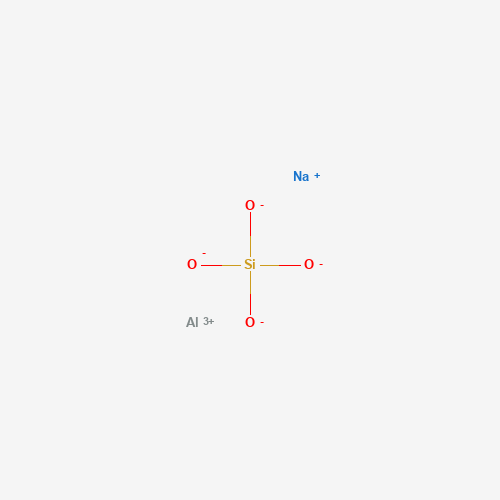
Sodium aluminosilicate is an anticaking agent used in powdered products and table salt. It is a source of dietary aluminium.
Where it is and isn’t permitted
| Jurisdiction | Status | Scope and limits | Citation |
|---|---|---|---|
| Australia and New Zealand | Permitted, with conditions | 55 food categories no numerical limit (good manufacturing practice) Show every food category
| Food Standards Code, Schedule 15, S15—5and 54 further provisionsretrieved 2026-10-17 |
| Canada | Permitted, with conditions | highest permitted level 2 % 5 permitted uses Show every permitted use
| Health Canada, List of Permitted Anticaking Agents (List 1)and 4 further provisionsretrieved 2026-10-17 |
| European Union | Permitted, with conditions | 1 food category ML = 20 mg/kg carry over in cheese mg/kg. Only for salt intended for surface treatment of ripened cheese, food category 01.7.2 Period of application: from 1 February 2014. Note 38: Expressed as aluminium. | Regulation (EC) No 1333/2008, Annex II, as amended by (EU) No 380/2012retrieved 2026-10-18 |
| Great Britain | Permitted, with conditions | 1 food category Maximum level: 20 mg/kg carry over in cheese. Only for salt intended for surface treatment of ripened cheese, food category 01.7.2 Period of application: from 1 February 2014. Note (38): Expressed as aluminium. | Assimilated Regulation (EC) No 1333/2008, Annex II (as at 28 June 2024)retrieved 2026-10-18 |
| Japan | No listing matchedThis site imports only Japan’s list of designated additives (Appended Table 1 to the Regulations for Enforcement of the Food Sanitation Act), matched by English name. Existing additives, natural flavouring agents and ordinary foods used as additives are permitted outside that list and are not imported, so an empty row does not show that Japan does not permit the substance. | ||
| South Korea | Permitted, with conditions | Designated food additive: Standards and Specifications for Food Additives, Part III, 1. …Designated food additive: Standards and Specifications for Food Additives, Part III, 1. 일반식품첨가물 (general food additives), 실리코알루민산나트륨 (“Sodium Silicoaluminate”, the English the Code prints beside it). Main use (주용도) of 실리코알루민산나트륨: 고결방지제. Standard for use (사용기준) of 실리코알루민산나트륨: (1) [may be used only in the foods listed; sets a limit on the amount used] “실리코알루민산나트륨은 아래의 식품에 한하여 사용하여야 한다. 실리코알루민산나트륨의 사용량은 알루미늄으로서 1. 가공소금 : 1.0g/kg 이하 2. 기타음료 : 0.4g/kg 이하 3. 식물성크림 : 0.6g/kg 이하 4. 기타코코아가공품 : 0.5g/kg 이하 5. 복합조미식품 : 1.0g/kg 이하” The Korean is the standard as published. There is no official English translation of the current Code (the English version on MFDS’s website is the 2020 edition and has no legal effect); the English in square brackets is this site’s description of what each sentence does, not a translation of the foods or the levels. Compositional specifications (Part IV) are not imported, nor are the general standards in Part II, which apply to every additive. | Standards and Specifications for Food Additives (식품첨가물의 기준 및 규격), MFDS Notification, Part III (Standards for use, by item)retrieved 2026-10-18 |
| United States | Permitted | 21 CFR 182.2727retrieved 2026-10-17 | |
| Codex Alimentarius | Permitted, with conditions | 9 food categories highest permitted level 1,140 mg/kg Show every food category and its notes
| CXS 192-1995 Table One, INS 554and 8 further provisionsretrieved 2026-09-07 |
How much is permitted
A listing usually limits the quantity as well as the food. Only one of the forms that takes is a figure: quantum satis and good manufacturing practice permit the amount the technological effect requires and no more, which is a limit rather than the absence of one. Figures below are the range across every food category this page is listed in, and categories differ between regulators — see how much is permitted.
| Australia and New Zealand | — | 55 GMP |
|---|---|---|
| Canada | 20,000 mg/kg | 2 numeric limit, 3 no quantity stated |
| European Union | — | 1 no quantity stated |
| Great Britain | — | 1 no quantity stated |
| South Korea | — | 1 no quantity stated |
| United States | — | 1 no quantity stated |
| Codex Alimentarius | 100 mg/kg – 1,140 mg/kg | 9 numeric limit |
What it is made from
Produced synthetically by precipitating sodium silicate with an aluminium salt.
- Vegan
- Vegetarian
Compare other additives on the dietary indexes.
- CAS registry number
- 12003-51-9
- InChIKey
- OKSRBEMKUSZPOX-UHFFFAOYSA-N
- PubChem
- CID 61537
The two specifications, compared
The European Union sets identity and purity by regulation; JECFA publishes its own through FAO, advisory until a country adopts it. Both documents are below in full. These are the parameters each puts a number on.
| Parameter | European Union | JECFA |
|---|---|---|
| Assay | stated in prose | no less than 66 % |
| Loss on drying | no more than 8 % | no more than 8 % |
| Lead | no more than 5 mg/kg | — |
| Arsenic | no more than 3 mg/kg | — |
| Mercury | no more than 1 mg/kg | — |
The two documents state the same figures for every parameter compared here.
How the EU defines it
The legal specification an additive must meet to be sold as this E number in the EU — what it is, how it may be made, and the purity it must reach. From Commission Regulation (EU) No 231/2012.
E 554 Sodium aluminium silicate
Synonyms: Sodium silicoaluminate; Sodium aluminosilicate; Aluminium sodium silicate
Assay, identification and purity criteria
Description and assay
- Chemical name
- Sodium aluminium silicate
- Assay
- Content on the anhydrous basis: — as SiO₂ not less than 66,0 % and not more than 88,0 % — as Al₂O₃ not less than 5,0 % and not more than 15,0 %
- Description
- Fine white amorphous powder or beads
Identification
- Test for sodium
- Passes test
- Test for aluminium
- Passes test
- Test for silicate
- Passes test
- pH
- Between 6,5 and 11,5 (5 % slurry)
Purity criteria
- Loss on drying
- Not more than 8,0 % (105 °C, 2 hours)
- Loss on ignition
- Not less than 5,0 % and not more than 11,0 % on the anhydrous basis (1 000 °C to constant weight)
- Sodium
- Not less than 5 % and not more than 8,5 % (as Na₂O) on the anhydrous basis
- Arsenic
- Not more than 3 mg/kg
- Lead
- Not more than 5 mg/kg
- Mercury
- Not more than 1 mg/kg
How JECFA defines it
The international specification for identity and purity, prepared by the Joint FAO/WHO Expert Committee on Food Additives and published by FAO. It is a different document from any above, written by a different body and revised on its own cycle; it is advisory, and a country adopts it or does not.
INS 554 Sodium Aluminium Silicate
Sodium aluminium silicate is a series of amorphous hydrated sodium aluminium silicates with varying proportions of Na 2 O, Al 2 O 3 and SiO 2 . It is manufactured by reacting aluminium sulphate and sodium silicate followed by precipitation.
Synonyms: Sodium silicoaluminate; sodium aluminosilicate; aluminium sodium silicate; silicic acid, aluminium sodium salt; INS No. 554
Assay, identification and purity criteria
Description and assay
- Specification history
- 1 out of 3 Prepared at the 84th JECFA and published in FAO JECFA Monograph 20 (2017), superseding tentative specifications prepared at the 80th JECFA (2015) and published in FAO JECFA Monographs 17 (2015). An ADI 'not specified' for silicon dioxide and certain silicates was established at the 29th JECFA (1985). A PTWI of 2 mg/kg bw for total aluminium was established at the 74th JECFA (2011). The PTWI applies to all aluminium compounds in food, including food additives.
- Chemical names
- Aluminium sodium silicate
- C.A.S. number
- 1344-00-9
- Chemical formula
- xSiO 2 · yAl 2 O 3 · zNa 2 O
- Assay
- Silicon dioxide (SiO 2 ): Not less than 66% and not more than 88%. Aluminium oxide (Al 2 O 3 ): Not less than 5% and not more than 15%. Sodium oxide (Na 2 O): Not less than 5% and not more than 8.5%. All values expressed on ignited basis.
- DESCRIPTION
- Odourless, fine, white amorphous powder, or as beads
- FUNCTIONAL USES
- Anticaking agent 2 out of 3
- METHOD OF ASSAY
- Weigh about 0.5 g of the sample to the nearest 0.1 mg, in a platinum or nickel crucible, add 5 g potassium hydroxide and 2 g boric acid, mix and melt completely using a torch burner and allow to stand at room temperature. Place the reaction product along with crucible into 150 mL hot deionized water in a 250-mL PTFE beaker and dissolve residue by agitation. Wash the crucible with hot deionized water and remove it. Add 50 mL hydrochloric acid and transfer the contents into a 250-mL polypropylene volumetric flask. Wash the beaker three times with hot deionized water, transfer the washings to the volumetric flask and make up to volume. Dilute with 2% hydrochloric acid and prepare the test solution. Analyse aluminium, sodium, and silica in the test solution by ICP-AES technique (Vol. 4). Set instrument parameters as specified by the instrument manufacturer. Use analytical lines for Al (396.152 nm), Na (589.52 nm) and Si (251.611 nm). Construct standard curve using standard solutions 0.2 – 5.0 μg/mL each. Read the concentration of Al, Na and Si, in sample solution (as μg/mL). Conduct as a blank determination following the above procedure. Calculate the content of aluminium oxide, sodium oxide and silicon dioxide in the sample using the formulas: 1.889 × ( 𝐶𝐶 − 𝐵𝐵 ) × 250 × 𝐷𝐷𝐷𝐷 𝐴𝐴𝐴𝐴 2 𝑂𝑂 3 (%) = 6 × 100 𝑊𝑊 × 10 1.348 × ( 𝐶𝐶 − 𝐵𝐵 ) × 250 × 𝐷𝐷𝐷𝐷 𝑁𝑁𝑁𝑁 2 𝑂𝑂 (%) = 6 × 100 𝑊𝑊 × 10 2.139 × ( 𝐶𝐶 − 𝐵𝐵 ) × 250 × 𝐷𝐷𝐷𝐷 𝑆𝑆𝑆𝑆 𝑂𝑂 2 (%) = 6 × 100 𝑊𝑊 × 10 Where: - C (μg/mL) is concentration of Al or Na or Si in the test solution, - B (μg/mL) is concentration of Al or Na or Si in the blank solution, - W is weight of sample on the ignited basis, - DF is dilution factor
Identification
- Solubility (Vol. 4)
- Insoluble in water.
- Test for sodium
- Passes test See description under TESTS
- Test for aluminium
- Passes test See description under TESTS
- Test for silicon
- Passes test See description under TESTS
- Test for aluminium, sodium and silicon
- Prepare the test solution as shown under method of assay. Analyse aluminium, sodium and silica in the test solution by ICP-AES technique (Vol. 4). Set instrument parameters as specified by the instrument manufacturer, use analytical lines for Al (396.15 nm), Na (589.52 nm) and Si (251.611 nm).
Purity criteria
- pH (Vol. 4)
- 6.5 – 11.5 (5% slurry)
- Loss on drying (Vol. 4)
- Not more than 8.0% (105°, 2 h).
- Loss on ignition (Vol. 4)
- Not less than 5.0% and not more than 11.0% on the dried basis (1000°, constant weight).
- Impurities soluble in 0.5 M hydrochloric acid
- Lead: Not more than 5 mg/kg Arsenic: Not more than 3 mg/kg Mercury: Not more than 1 mg/kg See description under TESTS
- Test: Impurities soluble in 0.5 M hydrochloric acid
- Extract a known quantity of finely ground sample using closed system digestion (to prevent loss of arsenic and mercury) with 0.5 M hydrochloric acid (spectroscopic grade) for 30 min. Let solution cool, then filter through a 0.1 μm membrane filter. Wash the filter twice with 0.5 M hydrochloric acid. Combine the filtrate and wash solution and make up to a known volume with 3 out of 3 0.5 M hydrochloric acid. Determine using a method appropriate to the specified level
Authorised in other additives, enzymes, flavourings and nutrients
These authorisations are not for use in food. They let this substance be used inside another additive, a food enzyme, a flavouring or a nutrient preparation — often as a carrier — and it reaches food only as part of that product. Annex III to Regulation (EC) No 1333/2008.
| Part | May be used in | Maximum level | Citation |
|---|---|---|---|
| Annex III, Part 5, Section A: Food additives added in nutrients except in nutrients intended to be used in foodstuffs listed in Part E, point 01.10, of Annex II and foodstuffs for infants and young children listed in Part E, point 13.1, of Annex II | In fat soluble vitamin preparations | 15 000 mg/kg in the preparation | Regulation (EC) No 1333/2008, Annex III, Part 5, Section A |
Every name it appears under
39 recorded names. A label may use any of them.
E number
- E554
INS number
- 554
CAS registry number
- 12003-51-9
As it appears in regulation
- Sodium aluminium silicate
- Sodium aluminosilicate
Other names
- Aluminium sodium orthosilicate (1/1/1)
- Aluminium sodium silicate
- Aluminum sodium silicate (1:1:1)
- E 554
- OKSRBEMKUSZPOX-UHFFFAOYSA-N
- Silicic acid (H4SiO4), aluminum sodium salt (1:1:1)
- Sodium aluminium silicate
- Sodium aluminium silicate(1:1:1)
- Sodium aluminosilicate
- Sodium silicoaluminate
Systematic names
- Aluminum sodium silicate
Hazard reference values
| Type | Value | Population | Assessed by | Opinion |
|---|---|---|---|---|
| ADI | not specified | — | JECFA | 2017 |
Evidence and how bodies read it
What assessing bodies concluded
Each conclusion is paraphrased in the body's own framing, from the published opinion linked beneath it. Where bodies differ, both stand; this site does not adjudicate between them or add a view of its own.
EFSA 2020
The FAF Panel concluded that the safety of sodium aluminium silicate (E 554) and potassium aluminium silicate (E 555) could not be assessed because toxicological data and physicochemical characterisation were very limited. It noted that aluminium exposure from these uses could exceed EFSA's tolerable weekly intake for aluminium.
Common questions
Assembled from what is above, in the words the questions are usually asked in. Each answer is the same statement the relevant section makes, with the same citations behind it.
- What is E 554?
- E 554 is Sodium aluminosilicate. Sodium aluminosilicate is an anticaking agent used in powdered products and table salt. It is a source of dietary aluminium.
- What is Sodium aluminosilicate used for in food?
- It is listed as an anticaking agent — the role Canada, Codex and the US assign it. This page shows every function each regulator records, with the citation for each.
- Where is Sodium aluminosilicate permitted?
- Of the seven regulators this site reads, Australia and New Zealand, Canada, the EU, Great Britain, South Korea, the US and the Codex standard permit it. Each permission is for named foods at named levels, not a blanket one; the table on this page gives them with citations.
- Is Sodium aluminosilicate vegan?
- Yes. Sodium aluminosilicate is not derived from animals, and is suitable for vegetarians. This page says what it is made from and how.
Sources for this page
- anz retrieved 2026-10-17
- ca retrieved 2026-10-17
- eu retrieved 2026-10-18
- gb retrieved 2026-10-18
- kr retrieved 2026-10-18
- ecfr retrieved 2026-10-17
- gsfa retrieved 2026-09-07
- euspecs retrieved 2026-10-18
- jecfaspecs retrieved 2026-09-23
Full licence terms and publisher details on Sources. How this page is built and updated: Method.
Machine-readable: a JSON record of this additive is given on request —how to ask for access.
Follow changes to Sodium aluminosilicate:Atom feed — regulatory events, and any change the weekly refresh detects in its provisions.