Sodium dichloroisocyanurate
51580-86-0 · 1,3,5-Triazine-2,4,6(1H,3H,5H)-trione, 1,3-dichloro-, sodium salt, dihydrate · 1,3,5Triazine2,4,6(1H,3H,5H)trione, 1,3dichloro, sodium salt, dihydrate · 1,3Dichloro1,3,5triazine2,4,6(1H,3H,5H)trione, sodium salt, dihydrate · Anhydrous NaDCC · C3H4Cl2N3NaO5 · Dichloroisocyanuric acid sodium salt dihydrate · NaDCC dihydrate · PYILKOIEIHHYGD-UHFFFAOYSA-M · Sodium dichloro-s-triazinetrione dihydrate · Sodium Dichlorodi-Isocyanurate, Dihydrate · Sodium dichloroisocyanurate · Sodium Dichloroisocyanurate (Anhydrous and Dihydrate) · Sodium dichloroisocyanurate dihydrat · Sodium dichloroisocyanurate dihydrate · Sodium dichloroisocyanurate dihydrate, >=98.0% (AT) · Sodium dichlorostriazinetrione dihydrate · sodium;1,5-dichloro-4,6-dioxo-1,3,5-triazin-2-olate;dihydrate · Triazine, 2,4,6(1H,3H,5H)trione, 1,3dichloro, sodium salt, dihydrate · Troclosene sodium dihydrateCAS 51580-86-0
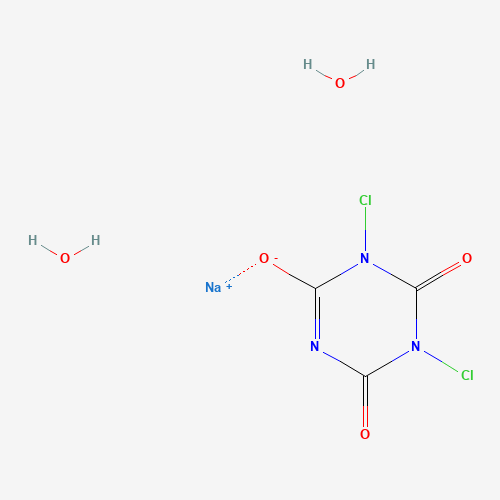
A chlorine-releasing antimicrobial, specified by JECFA for use in drinking water systems rather than as an ingredient of a food. It comes as a hygroscopic white powder with a slight chlorine odour.
Where it is and isn’t permitted
| Jurisdiction | Status | Scope and limits | Citation |
|---|---|---|---|
| Australia and New Zealand | No listed food uses foundThis site has not matched this substance to any food use on this jurisdiction’s list of authorised food additives. A food additive may be used only in foods that list names. Flavourings, enzymes, processing aids and added nutrients are regulated separately and do not appear on it. | ||
| Canada | No listing matchedHealth Canada’s lists name additives without E or INS numbers, so this site matches them by exact name. A substance listed there under a name this site does not recognise has no row here. | ||
| European Union | No listed food uses foundThis site has not matched this substance to any food use on this jurisdiction’s list of authorised food additives. A food additive may be used only in foods that list names. Flavourings, enzymes, processing aids and added nutrients are regulated separately and do not appear on it. | ||
| Great Britain | No listed food uses foundThis site has not matched this substance to any food use on this jurisdiction’s list of authorised food additives. A food additive may be used only in foods that list names. Flavourings, enzymes, processing aids and added nutrients are regulated separately and do not appear on it. | ||
| Japan | No listing matchedThis site imports only Japan’s list of designated additives (Appended Table 1 to the Regulations for Enforcement of the Food Sanitation Act), matched by English name. Existing additives, natural flavouring agents and ordinary foods used as additives are permitted outside that list and are not imported, so an empty row does not show that Japan does not permit the substance. | ||
| South Korea | No listing matchedThis site imports Part III of South Korea’s Standards and Specifications for Food Additives, matched by CAS number, then INS number, then exact name. Mixed preparations and sanitisers are not imported, and an entry whose identifiers disagreed with a page’s is held for review, so an empty row does not show that South Korea does not permit the substance. | ||
| United States | Not listedDoes not appear on this jurisdiction’s permitted list. That is not the same as being prohibited. | ||
| Codex Alimentarius | Not listedDoes not appear on this jurisdiction’s permitted list. That is not the same as being prohibited. |
What it is made from
Made by reacting chlorine with cyanuric acid in alkaline slurry, then converting the dichloroisocyanuric acid to the sodium salt; heating gives the anhydrous form.
- Vegan
- Vegetarian
Compare other additives on the dietary indexes.
- CAS registry number
- 51580-86-0
- InChIKey
- PYILKOIEIHHYGD-UHFFFAOYSA-M
- PubChem
- CID 23667638
How JECFA defines it
The international specification for identity and purity, prepared by the Joint FAO/WHO Expert Committee on Food Additives and published by FAO. It is a different document from any above, written by a different body and revised on its own cycle; it is advisory, and a country adopts it or does not.
Sodium Dichloroisocyanurate (Anhydrous and Dihydrate)
NaDCC (anhydrous/dihydrate) is prepared by first reacting elemental chlorine with cyanuric acid in aqueous alkaline slurry to produce dichloroisocyanuric acid monohydrate. The latter is converted to the dihydrate of NaDCC, which may be heated to yield the anhydrous material. Both the dihydrate and the anhydrous material are produced as dry powders that can be granulated and packaged.
Synonyms: Anhydrous: NaDCC; sodium dichloro- s -triazinetrione Dihydrate: NaDCC dihydrate; sodium dichloro- s -triazinetrione dihydrate NaDCC dihydrate; Sodium dichloro-s-triazinetrione dihydrate
Assay, identification and purity criteria
Description and assay
- Specification history
- SODIUM DICHLOROISOCYANURATE (ANHYDROUS and DIHYDRATE) New specifications prepared at the 61st JECFA (2003), published in FNP 52 Add 11 (2003). An ADI of 2.0 mg/kg bw for the anhydrous form was established at the 61 st JECFA (2003).
- Chemical names
- 1,3-dichloro-1,3,5-triazine-2,4,6(1H,3H,5H)-trione, sodium salt Triazine, 2,4,6(1H,3H,5H)-trione, 1,3-dichloro-, sodium salt 1,3-dichloro-1,3,5-triazine-2,4,6(1H,3H,5H)-trione, sodium salt, dihydrate Triazine, 2,4,6(1H,3H,5H)-trione, 1,3-dichloro-, sodium salt, dihydrate
- C.A.S. number
- Anhydrous: 2893-78-9 Dihydrate: 51580-86-0
- Chemical formula
- Anhydrous: NaC3N3O3Cl2 Dihydrate: NaC3N3O3Cl2•2H2O
- Structural formula
- (anhydrous form)
- Formula weight
- Anhydrous: 219.95 Dihydrate: 255.98
- Assay
- Available chlorine: not less than 62.0% (anhydrous) and 55.0% - 57.0% (dihydrate) Not less than 98% of NaDCC on the dried basis for both anhydrous and the dihydrate
- DESCRIPTION
- Hygroscopic white crystalline powder or granules with a slight chlorine odour
- FUNCTIONAL USES
- Antimicrobial agent for use in drinking water systems
- METHOD OF ASSAY
- Principle: The sample is dissolved in a solution of potassium iodide. The chlorine of the sample oxidizes iodide to free iodine, which is titrated against sodium thiosulfate. “Available chlorine” is calculated from the titration result. The sample purity on the dried basis is calculated from the available chlorine and the loss on drying. Procedure : Add 200 ml of freshly boiled and cooled distilled water to a 500 ml iodine flask with stirring bar. Add 25 ml of potassium iodide TS. Accurately weigh about 0.23 g - 0.26 g of sample. Transfer to the flask; stir until dissolved. Add either 10 ml of a 1:3 sulfuric acid solution or 10 ml of glacial acetic acid. Titrate with standardized 0.1 N sodium thiosulfate solution (FNP 5) until the solution turns yellow. Add 1 ml of starch TS and continue with the titration until the blue colour just disappears. Record the volume (ml) of titrant used (V). The percent available chlorine (%AvCl) is: %AvCl = 100 × V × N × 0.03546 / W. where N = normality of the titrant W = weight of the sample (g) 0.03546 = molecular weight of chlorine divided by 1000 (Note: For the dihydrate, to ensure the absence of free water, the material is normally dried to slightly less than the theoretical water content, i.e., to < 2:1 water:NaDCC. In this case, the %AvCl can be slightly higher than the theoretical available chlorine, TAC, of 55.40 %.) The content of sodium dichloroisocyanurate is: % NaDCC (dried basis) = 100 × [ %AvCl /64.47] × [100 /(100 - LOD] where 64.47 = percent TAC for anhydrous NaDCC LOD is the percent loss on drying previously determined. IR Spectrum of NaDCC in Diamond Cell
Identification
- Solubility (Vol. 4)
- Soluble in water, slightly soluble in acetone
- Melting range (Vol. 4)
- 240 o (decomposes)
- Infrared spectrum
- The infrared spectra of anhydrous NaDCC and NaDCC dihydrate obtained using a diamond anvil compression cell are given in the Appendix.
- Sodium (Vol. 4)
- Passes test
Purity criteria
- pH (FNP 5)
- 6.0 - 7.0 (1 % soln)
- Sodium chloride
- Not more than 2 % See description under TESTS
- Loss on drying (Vol. 4)
- Anhydrous: not more than 3.0% (127 o , 1.5 h) Dihydrate: between 11.0% and 14.0% (127 o , 1.5 h)
- Lead (Vol. 4)
- Not more than 2 mg/kg Determine using an atomic absorption technique appropriate to the specified level. The selection of sample size and method of sample preparation may be based on the principles of the methods described in Volume 4, “Instrumental Methods.”
- Test: Sodium chloride
- Principle: Chloride ion is determined using a chloride-specific electrode. Apparatus: − Ion-selective electrode meter − Chloride ion electrode − Reference electrode Reagents: (Note: Use only distilled water. Do not use de-ionized water.) Sodium nitrate, 5 M: Dissolve 42.5 g of reagent-grade material in 100 ml of water. Chloride standards for calibration of the ion-selective electrode meter: − Stock solution (1000 mg/l): Transfer 1.650 g of reagent grade sodium chloride to a 1-litre volumetric flask. Add ca. 500 ml of water to dissolve the salt and dilute to volume. Mix well. − Chloride standard (20 mg/l): Pipette 10 ml of the stock solution into a 500-ml volumetric flask, dilute to volume and mix. − Chloride standard (2 mg/l): Pipette 10 ml of the 20 mg/l chloride standard into a 100-ml volumetric flask, dilute to volume and mix. Procedure: Calibrate the ion-selective electrode meter according to the manufacturer’s instructions. Weigh 0.30 g of the sample. Quantitatively transfer the sample to a 500-ml volumetric flask. Add about 300 ml of water and shake the flask until the sample has completely dissolved. Dilute to volume and mix. Transfer 100 ml of the solution to a 150-ml beaker and, via pipette, add 2 ml of 5 M sodium nitrate. Stir the solution slowly. Introduce the electrodes into the solution. Record the concentration of chloride ion, C (mg/l), directly from the meter display. (Note: If the concentration reading is above 20 mg/l (i.e., 20 ppm), repeat the analysis, decreasing the sample weight as necessary.) Remove the electrodes from the solution, rinse them with water and blot dry. Store the electrodes in a beaker of water until needed. Calculations: % sodium chloride = C × 0.0824/W where W = sample weight (g) 0.0824 = 500/(10000 × FWCl/FWNaCl), and FWCl/FWNaCl is the ratio of the formula weight of chlorine to that of sodium chloride
- Test: 4000
- 3500 3000 2500 2000 1500 1000 500 cm-1 IR Spectrum of NaDCC Dihydrate in Diamond Cell:
- Test: 4000
- 3500 3000 2500 2000 1500 1000 500 cm-1
Every name it appears under
20 recorded names. A label may use any of them.
CAS registry number
- 51580-86-0
Other names
- 1,3,5-Triazine-2,4,6(1H,3H,5H)-trione, 1,3-dichloro-, sodium salt, dihydrate
- 1,3,5Triazine2,4,6(1H,3H,5H)trione, 1,3dichloro, sodium salt, dihydrate
- 1,3Dichloro1,3,5triazine2,4,6(1H,3H,5H)trione, sodium salt, dihydrate
- Anhydrous NaDCC
- C3H4Cl2N3NaO5
- Dichloroisocyanuric acid sodium salt dihydrate
- NaDCC dihydrate
- PYILKOIEIHHYGD-UHFFFAOYSA-M
- Sodium dichloro-s-triazinetrione dihydrate
- Sodium Dichlorodi-Isocyanurate, Dihydrate
- Sodium dichloroisocyanurate
- Sodium Dichloroisocyanurate (Anhydrous and Dihydrate)
- Sodium dichloroisocyanurate dihydrat
- Sodium dichloroisocyanurate dihydrate
- Sodium dichloroisocyanurate dihydrate, >=98.0% (AT)
- Sodium dichlorostriazinetrione dihydrate
- sodium;1,5-dichloro-4,6-dioxo-1,3,5-triazin-2-olate;dihydrate
- Triazine, 2,4,6(1H,3H,5H)trione, 1,3dichloro, sodium salt, dihydrate
- Troclosene sodium dihydrate
Hazard reference values
No reference value for this substance in the sources we hold.
Evidence and how bodies read it
Studies, and the differing conclusions regulators drew from them, are curated rather than machine-read, and none has been written for this substance yet.
Common questions
Assembled from what is above, in the words the questions are usually asked in. Each answer is the same statement the relevant section makes, with the same citations behind it.
- What is Sodium dichloroisocyanurate?
- A chlorine-releasing antimicrobial, specified by JECFA for use in drinking water systems rather than as an ingredient of a food. It comes as a hygroscopic white powder with a slight chlorine odour.
- Is Sodium dichloroisocyanurate vegan?
- Yes. Sodium dichloroisocyanurate is not derived from animals, and is suitable for vegetarians. This page says what it is made from and how.
Sources for this page
- jecfaspecs retrieved 2026-09-23
Full licence terms and publisher details on Sources. How this page is built and updated: Method.
Machine-readable: a JSON record of this additive is given on request —how to ask for access.
Follow changes to Sodium dichloroisocyanurate:Atom feed — regulatory events, and any change the weekly refresh detects in its provisions.