Sodium iron (III) ethylenediaminetetraacetate, trihydrate
149022-26-4 · 157009-77-3 · 15708-41-5 · 18154-32-0 · (Ethylenedinitrilo)tetraacetic acid, monosodium iron salt · 403J23EMFA · 9,12-Octadecadienoic acid (9Z,12Z)-, dimer, diisoeicosyl ester · C10H12FeN2NaO8 · Edathamil monosodium ferric salt · Edetic acid sodium iron salt · EDTA (iron sodium) · EDTA ferric sodium salt · edta ferric-sodium salt · EDTA iron(III) sodium salt · EDTA, IRON (III) SODIUM · EDTA, SODIUM FERRIC SALT · EDTA,iron sodium salt(food grade) · Ethylenediaminetetraacetic acid ferric sodium salt · Ethylenediaminetetraacetic acid iron(III) sodium salt · Ethylenediaminetetraacetic Acid Monosodium Ferric Salt · Ethylenediaminetetraacetic acid, iron(III) monosodium salt · Fe(III)-EDTA, sodium salt · Feredato sodico · Feredetate de sodium · Feredetato de sodio · Ferrazone · Ferric sodium edetate · Ferric sodium EDTA · Ferric sodium ethylenediaminetetraacetate · Ferrostrane · Ferrostrene · Iron chelate of the monosodium salt of (ethylenedinitrilo)tetraacetic acid · Iron sodium ethylenediaminetetraacetate (1:1:1) · Iron(III) sodium 2,2',2'',2'''-(ethane-1,2-diylbis(azanetriyl))tetraacetate · Iron(III) Sodium Ethylenediaminetetraacetate · Linezolid Impurity 17 · MKWYFZFMAMBPQK-UHFFFAOYSA-J · Monosodium ferric EDTA · NaFeEDTA · Natrii feredetas · Sequestrene Na Fe iron chelate · Sequestrene NaFe · Sodium ((ethylenedinitrilo)tetraacetatato)ferrate(III) · Sodium ((ethylenedinitrilo)tetraacetato)ferrate(1-) · Sodium (N,N,N',N'-ethylenediaminetetraacetato)ferrate(1-) · Sodium feredetate · Sodium feredetate (INN) · Sodium ferric EDTA · Sodium ferric ethylenediaminetetraacetate · Sodium iron (III) ethylenediaminetetraacetate, trihydrate · sodium iron edetate · Sodium iron EDTA · SODIUM IRON ETHYLENEDIAMINE TETRAACETIC ACID · Sodium iron(III) ethylenediaminetetraacetate · Sodium ironedetate · sybron · Sytron · Sytron (TN) · E0092 · Ferrate(1-),[[N,N'-1,2-ethanediylbis[N-[(carboxy-kO)methyl]glycinato-kN,kO]](4-)]-,sodium, (OC-6-21)- · sodium;2-[2-[bis(carboxylatomethyl)amino]ethyl-(carboxylatomethyl)amino]acetate;iron(3+)CAS 15708-41-5
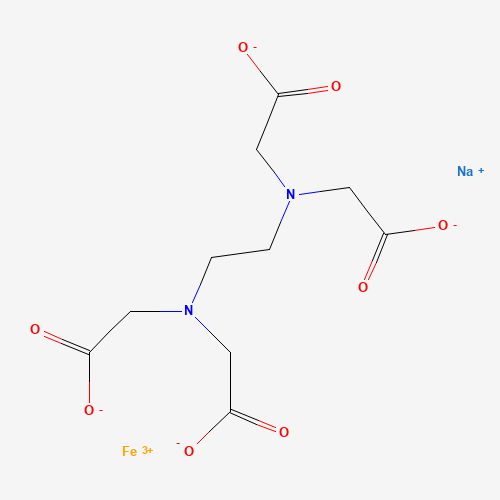
Sodium iron EDTA is an iron chelate used to fortify foods, particularly condiments such as fish and soy sauce, where ordinary iron salts would darken the product or be blocked from absorption by phytate.
Where it is and isn’t permitted
| Jurisdiction | Status | Scope and limits | Citation |
|---|---|---|---|
| Australia and New Zealand | No listed food uses foundThis site has not matched this substance to any food use on this jurisdiction’s list of authorised food additives. A food additive may be used only in foods that list names. Flavourings, enzymes, processing aids and added nutrients are regulated separately and do not appear on it. | ||
| Canada | No listing matchedHealth Canada’s lists name additives without E or INS numbers, so this site matches them by exact name. A substance listed there under a name this site does not recognise has no row here. | ||
| European Union | No listed food uses foundThis site has not matched this substance to any food use on this jurisdiction’s list of authorised food additives. A food additive may be used only in foods that list names. Flavourings, enzymes, processing aids and added nutrients are regulated separately and do not appear on it. | ||
| Great Britain | No listed food uses foundThis site has not matched this substance to any food use on this jurisdiction’s list of authorised food additives. A food additive may be used only in foods that list names. Flavourings, enzymes, processing aids and added nutrients are regulated separately and do not appear on it. | ||
| Japan | No listing matchedThis site imports only Japan’s list of designated additives (Appended Table 1 to the Regulations for Enforcement of the Food Sanitation Act), matched by English name. Existing additives, natural flavouring agents and ordinary foods used as additives are permitted outside that list and are not imported, so an empty row does not show that Japan does not permit the substance. | ||
| South Korea | No listing matchedThis site imports Part III of South Korea’s Standards and Specifications for Food Additives, matched by CAS number, then INS number, then exact name. Mixed preparations and sanitisers are not imported, and an entry whose identifiers disagreed with a page’s is held for review, so an empty row does not show that South Korea does not permit the substance. | ||
| United States | Not listedDoes not appear on this jurisdiction’s permitted list. That is not the same as being prohibited. | ||
| Codex Alimentarius | Not listedDoes not appear on this jurisdiction’s permitted list. That is not the same as being prohibited. |
GRAS notices to the FDA
A GRAS notice is a company’s conclusion that a substance is generally recognised as safe for the use it describes. FDA’s letter responds to that conclusion, for that notifier and that use. It is not a listing in 21 CFR, and it is not counted as a US permission above. The substance and use are as FDA’s inventory words them; this site matched the notice to this page by exact name.
GRN No. 178 · Sodium iron EDTA · Akzo Nobel Chemicals
Intended use: Iron fortification of soy, fish, hoisin and teriyaki sauces at an iron level of 0.024 percent; and of sweet and sour sauce at an iron level of 0.012 percent
FDA’s response (2006-01-11): FDA has no questions
GRN No. 152 · Sodium iron EDTA · Kraft Foods Global
Intended use: Use in iron fortification of powdered soft drinks in areas of the world with a high prevalence of iron deficiency at a level of 2.5 milligram iron/200 milliliter of reconstituted beverage
FDA’s response (2004-12-09): FDA has no questions
What it is made from
Made by chelating iron (III) with EDTA and isolating the sodium salt as a light yellow powder.
- Vegan
- Vegetarian
Compare other additives on the dietary indexes.
- CAS registry number
- 15708-41-5
- InChIKey
- MKWYFZFMAMBPQK-UHFFFAOYSA-J
- PubChem
- CID 27461
How JECFA defines it
The international specification for identity and purity, prepared by the Joint FAO/WHO Expert Committee on Food Additives and published by FAO. It is a different document from any above, written by a different body and revised on its own cycle; it is advisory, and a country adopts it or does not.
Sodium Iron (III) Ethylenediaminetetraacetate, Trihydrate
Synonyms: Ferric sodium edetate, sodium iron EDTA, sodium feredetate Ferric sodium edetate; Sodium feredetate; Sodium iron EDTA
Assay, identification and purity criteria
Description and assay
- Specification history
- Prepared at the 53rd JECFA (1999) and published in FNP 52 Add 7 (1999), superseding specifications prepared at the 41st JECFA (1993), published in FNP 52 Add 2 (1993). Evaluated as safe for use in supervised food fortification programmes at the 53rd JECFA (1999)
- Chemical names
- Sodium [[N,N'-ethanediylbis[N-(carboxymethyl) glycinato]] (4-)] ferrate(1-); sodium [(ethylenedinitrilo) tetraacetato]ferrate(1-); Sodium iron (III) ethylenediaminetetraacetate
- C.A.S. number
- 15708-41-5
- Chemical formula
- C 10 H 12 FeN 2 NaO 8 · 3H 2 O
- Formula weight
- 421.09 (trihydrate)
- Assay
- Not less than 12.5% and not more than 13.5% iron, calculated on the basis of the trihydrate. Not less than 65.5% and not more than 70.5% EDTA, calculated on the basis of the trihydrate.
- DESCRIPTION
- Light yellow coloured powder that is relatively stable and unaffected by storage
- FUNCTIONAL USES
- Nutrient supplement
- METHOD OF ASSAY
- I ron Dissolve the sample (approx. 0.5 g accurately weighed) in distilled water (40 ml) in an iodine flask. Add concentrated hydrochloric acid (20 ml) mix, add potassium iodide (3 g) and then allow to stand for 5 min. Titrate the liberated iodine with standardised 0.1 M sodium thiosulfate, using starch solution as indicator. Avoid vigorous mixing during the titration. Perform a blank, omitting the sample. where Ts = sample titre in ml Tb = blank titre in ml 0.05585 = atomic weight of iron × 10 -3 M = molarity of sodium thiosulfate W = sample weight (g) EDTA Reagents (1) 0.25 M calcium acetate solution, standardized - Weigh and transfer 44.0 g reagent grade calcium acetate monohydrate to a 1 L volumetric flask; add water to dissolve and fill to the mark. Weigh accurately 2.0 to 2.1 g of reagent grade EDTA acid into each of three 250-ml conical flasks. Add 150 ml water and adjust to pH 11-12 (pH paper may be used) with 50% sodium hydroxide solution. Add about 30 mg of hydroxynaphthol blue indicator and titrate with calcium acetate to a sharp red endpoint. (2) Triethanolamine, reagent grade. (3) Hydroxynaphthol Blue indicator. (4) 50 % sodium hydroxide solution. Procedure Accurately weigh 0.8 - 1.0 g of sample into a 250-ml beaker. Add 75 ml of distilled water to dissolve. Adjust the pH to 9.0 by dropwise addition of triethanolamine. Then adjust to pH 12.5 - 13.0 by addition of 50% aqueous NaOH. The solution should be clear and colourless. Add about 30 mg hydroxynaphthol blue indicator and titrate with 0.25 M calcium acetate solution to a red endpoint.
Identification
- Solubility (Vol. 4)
- Soluble in water
- Test for iron (Vol. 4)
- Passes test
- Test for sodium (Vol. 4)
- Passes test
Purity criteria
- pH (Vol. 4)
- 3.5 - 5.5 (1 in 100 soln)
- Water-insoluble matter
- Not more than 0.1% Weigh accurately 5 g of sample and transfer into 100 ml water. Stir until dissolved. Place a filter paper (1 μm porosity, maximum) in a Gooch crucible (3.5-4.0 cm) and seat the paper by applying vacuum while washing with water. Dry the crucible at 175 o for 15 min, cool in a desiccator, and weigh. Pour sample solution through the crucible and wash with three successive 10 ml portions of water. Dry the crucible at 110 o for one hour. Cool in a desiccator and weigh the crucible. Calculate as percentage.
- Nitrilotriacetic acid
- Not more than 0.1% See description under TESTS
- Arsenic (Vol. 4)
- Not more than 1 mg/kg Test 3 g of the sample as directed in the Limit test (Method II)
- Lead (Vol. 4)
- Not more than 1 mg/kg Determine using an atomic absorption technique appropriate to the specified level. The selection of sample size and method of sample preparation may be based on the principles of the method described in Volume 4, “Instrumental Methods.”
- Test: Nitrilotriacetic acid
- Mobile Phase Add 10 ml of a 1 in 4 solution of tetrabutylammonium hydroxide in methanol to 200 ml of water, and adjust with 1 M phosphoric acid to a pH of 7.5 ± 0.1. Transfer the solution to a 1000-ml volumetric flask, add 90 ml of methanol, dilute with water to volume, mix, filter through a membrane filter (0.5-μg or finer porosity), and degas. Ammonium hydroxide blank solution Add 0.5 ml of ammonium hydroxide to a 10 ml volumetric flask. Dilute with water to volume. Stock Standard Solution Transfer about 100 mg of nitrilotriacetic acid, accurately weighed, to a 10-ml volumetric flask, and add 0.5 ml of ammonium hydroxide, and mix. Dilute to volume, and mix. Standard Preparation Transfer 1.0 g of the sample to a 100-ml volumetric flask. Add 100 μl of the Stock Standard Solution, dilute with water to volume, and mix. Sonicate, if necessary, to achieve a complete solution. Test Preparation Transfer 1.0 g of the sample to a 100-ml volumetric flask. Add 100 μl of Ammonium hydroxide blank solution and dilute with water to volume, and mix. Sonicate, if necessary, to achieve complete solution. Chromatographic System (see High-Pressure Liquid Chromatography, in General Methods (Guide to JECFA Specifications), FNP 5/Rev. 2 (1991)). The chromatograph is equipped with a 254-nm detector and a 4.6-nm × 15-cm column that contains 5- 10-μm porous microparticles of silica to which is bonded octylsilane (Zorbax 8 or equivalent). The flow rate is about 2 ml/min. Chromatograph three replicate injections of the Standard Preparation, and record the peak responses as directed under Procedure. The relative standard deviation is not more than 2.0%, and the resolution factor between nitrilotriacetic acid and sodium iron EDTA is not less than 4.0. Procedure Separately inject equal volumes (about 50 μl) of the Standard Preparation and the Test Preparation into the chromatograph, record the chromatograms, and measure the responses for the major peaks. The retention times are about 3.5 min for nitrilotriacetic acid and 11.9 min for sodium iron EDTA. The response of the nitrilotriacetic acid peak of the Test Preparation does not exceed the difference between the nitrilotriacetic acid peak responses obtained from the Standard Preparation and the Test Preparation.
Every name it appears under
61 recorded names. A label may use any of them.
E number
- E0092
CAS registry number
- 149022-26-4
- 157009-77-3
- 15708-41-5
- 18154-32-0
Other names
- (Ethylenedinitrilo)tetraacetic acid, monosodium iron salt
- 403J23EMFA
- 9,12-Octadecadienoic acid (9Z,12Z)-, dimer, diisoeicosyl ester
- C10H12FeN2NaO8
- Edathamil monosodium ferric salt
- Edetic acid sodium iron salt
- EDTA (iron sodium)
- EDTA ferric sodium salt
- edta ferric-sodium salt
- EDTA iron(III) sodium salt
- EDTA, IRON (III) SODIUM
- EDTA, SODIUM FERRIC SALT
- EDTA,iron sodium salt(food grade)
- Ethylenediaminetetraacetic acid ferric sodium salt
- Ethylenediaminetetraacetic acid iron(III) sodium salt
- Ethylenediaminetetraacetic Acid Monosodium Ferric Salt
- Ethylenediaminetetraacetic acid, iron(III) monosodium salt
- Fe(III)-EDTA, sodium salt
- Feredato sodico
- Feredetate de sodium
- Feredetato de sodio
- Ferrazone
- Ferric sodium edetate
- Ferric sodium EDTA
- Ferric sodium ethylenediaminetetraacetate
- Ferrostrane
- Ferrostrene
- Iron chelate of the monosodium salt of (ethylenedinitrilo)tetraacetic acid
- Iron sodium ethylenediaminetetraacetate (1:1:1)
- Iron(III) sodium 2,2',2'',2'''-(ethane-1,2-diylbis(azanetriyl))tetraacetate
- Iron(III) Sodium Ethylenediaminetetraacetate
- Linezolid Impurity 17
- MKWYFZFMAMBPQK-UHFFFAOYSA-J
- Monosodium ferric EDTA
- NaFeEDTA
- Natrii feredetas
- Sequestrene Na Fe iron chelate
- Sequestrene NaFe
- Sodium ((ethylenedinitrilo)tetraacetatato)ferrate(III)
- Sodium ((ethylenedinitrilo)tetraacetato)ferrate(1-)
- Sodium (N,N,N',N'-ethylenediaminetetraacetato)ferrate(1-)
- Sodium feredetate
- Sodium feredetate (INN)
- Sodium ferric EDTA
- Sodium ferric ethylenediaminetetraacetate
- Sodium iron (III) ethylenediaminetetraacetate, trihydrate
- sodium iron edetate
- Sodium iron EDTA
- SODIUM IRON ETHYLENEDIAMINE TETRAACETIC ACID
- Sodium iron(III) ethylenediaminetetraacetate
- Sodium ironedetate
- sybron
- Sytron
- Sytron (TN)
Systematic names
- Ferrate(1-),[[N,N'-1,2-ethanediylbis[N-[(carboxy-kO)methyl]glycinato-kN,kO]](4-)]-,sodium, (OC-6-21)-
- sodium;2-[2-[bis(carboxylatomethyl)amino]ethyl-(carboxylatomethyl)amino]acetate;iron(3+)
Hazard reference values
No reference value for this substance in the sources we hold.
Evidence and how bodies read it
Studies, and the differing conclusions regulators drew from them, are curated rather than machine-read, and none has been written for this substance yet.
Common questions
Assembled from what is above, in the words the questions are usually asked in. Each answer is the same statement the relevant section makes, with the same citations behind it.
- What is Sodium iron (III) ethylenediaminetetraacetate, trihydrate?
- Sodium iron EDTA is an iron chelate used to fortify foods, particularly condiments such as fish and soy sauce, where ordinary iron salts would darken the product or be blocked from absorption by phytate.
- Is Sodium iron (III) ethylenediaminetetraacetate, trihydrate vegan?
- Yes. Sodium iron (III) ethylenediaminetetraacetate, trihydrate is not derived from animals, and is suitable for vegetarians. This page says what it is made from and how.
Sources for this page
- jecfaspecs retrieved 2026-09-23
Full licence terms and publisher details on Sources. How this page is built and updated: Method.
Machine-readable: a JSON record of this additive is given on request —how to ask for access.
Follow changes to Sodium iron (III) ethylenediaminetetraacetate, trihydrate:Atom feed — regulatory events, and any change the weekly refresh detects in its provisions.