Trehalose
6138-23-4 · .ALPHA., .ALPHA.-TREHALOSE DIHYDRATE · .alpha.-D-Glucopyranoside, .alpha.-D-glucopyranosyl, dihydrate · .ALPHA.-D-GLUCOPYRANOSYL-.ALPHA.-D-GLUCOPYRANOSIDE DIHYDRATE · 7YIN7J07X4 · ?-D-Glucopyranosyl ?-D-glucopyranoside dihydrate · a,a-D-Trehalose dihydrate · a,a-D-Trehalose dihydrate - high purity · a,a-D-Trehalose dihydrate endotoxin free · a,a-Trehalose · a-d-glucopyranosyl-a-d-glucopyranoside · a-D-Glucopyranosyl-a-D-glucopyranoside dihydrate · alpha,alpha-trehalose · alpha,alpha-Trehalose dihydrate · alpha-D-Glucopyranoside, alpha-D-glucopyranosyl, dihydrate · alpha-D-Glucopyranosyl alpha-D-glucopyranoside--water (1/2) · alpha-D-Glucopyranosyl-alpha-D-glucopyranoside dihydrate · D(+)-Trehalose dihydrate · D-(+)-Trehalose dihydrate · D-(+)-Trehalose dihydrate (D-Trehalose dihydrate; alpha,alpha-Trehalose dihydrate) · D-(+)-Trehalose dihydrate, FCC grade · D-(+)-Trehalose dihydrate, for microbiology, >=99.0% · D-(+)-Trehalose dihydrate, from Saccharomyces cerevisiae, >=98.5% (HPLC) · D-(+)-Trehalose dihydrate, from Saccharomyces cerevisiae, >=99% · D-(+)-Trehalose dihydrate, from Saccharomyces cerevisiae, BioReagent, plant cell culture tested · D-(+)-Trehalose dihydrate, from Saccharomyces cerevisiae, powder, BioReagent, suitable for cell culture, suitable for insect cell culture, >=99% · D-(+)-Trehalose dihydrate, SAJ special grade, >=99.0% · D-(+)-Trehalose dihydrate, Vetec(TM) reagent grade, >=99% · D-Trehalose dihydrate · D-Trehalose dihydrate 1000 microg/mL in Water · D-Trehalose dihydrate; ,-Trehalose dihydrate · D-Trehalose; ,-Trehalose · DPVHGFAJLZWD · FEMA NO. 4600 · MYCOSE DIHYDRATE · Trehalose · Trehalose (for injection) (sterile) · Trehalose dihydrate CRS · Trehalose dihydrate, European Pharmacopoeia (EP) Reference Standard · Trehalose dihydrate; a-d-Glucopyranosyl a-d-glucopyranoside dihydrate (a,a-trehalose dihydrate) · TREHALOSE, DIHYDRATE · Trehalose, Pharmaceutical Secondary Standard; Certified Reference Material · Trehalose, United States Pharmacopeia (USP) Reference Standard · (2R,2'R,3S,3'S,4S,4'S,5R,5'R,6R,6'R)-6,6'-Oxybis(2-(hydroxymethyl)tetrahydro-2H-pyran-3,4,5-triol) dihydrate · (2R,3S,4S,5R,6R)-2-(hydroxymethyl)-6-[(2R,3R,4S,5S,6R)-3,4,5-trihydroxy-6-(hydroxymethyl)oxan-2-yl]oxyoxane-3,4,5-triol;dihydrateCAS 6138-23-4
Listed as a flavouring agent by the US.
Listed as flavouring agents and adjuvants (US)
- United States: Flavoring agent or adjuvant — FDA, Substances Added to Food: TREHALOSE, DIHYDRATE
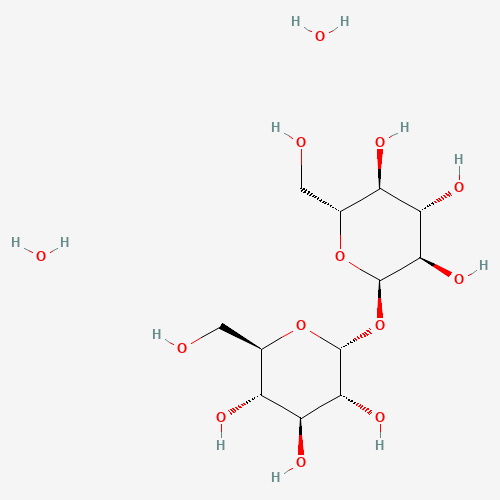
Trehalose is a sugar made of two glucose units, about half as sweet as sucrose, used as a texturiser, stabiliser, humectant and sweetener. It is unusually good at protecting proteins and cell membranes during freezing and drying.
Where it is and isn’t permitted
| Jurisdiction | Status | Scope and limits | Citation |
|---|---|---|---|
| Australia and New Zealand | No listed food uses foundThis site has not matched this substance to any food use on this jurisdiction’s list of authorised food additives. A food additive may be used only in foods that list names. Flavourings, enzymes, processing aids and added nutrients are regulated separately and do not appear on it. | ||
| Canada | No listing matchedHealth Canada’s lists name additives without E or INS numbers, so this site matches them by exact name. A substance listed there under a name this site does not recognise has no row here. | ||
| European Union | No listed food uses foundThis site has not matched this substance to any food use on this jurisdiction’s list of authorised food additives. A food additive may be used only in foods that list names. Flavourings, enzymes, processing aids and added nutrients are regulated separately and do not appear on it. | ||
| Great Britain | No listed food uses foundThis site has not matched this substance to any food use on this jurisdiction’s list of authorised food additives. A food additive may be used only in foods that list names. Flavourings, enzymes, processing aids and added nutrients are regulated separately and do not appear on it. | ||
| Japan | No listing matchedThis site imports only Japan’s list of designated additives (Appended Table 1 to the Regulations for Enforcement of the Food Sanitation Act), matched by English name. Existing additives, natural flavouring agents and ordinary foods used as additives are permitted outside that list and are not imported, so an empty row does not show that Japan does not permit the substance. | ||
| South Korea | No listing matchedThis site imports Part III of South Korea’s Standards and Specifications for Food Additives, matched by CAS number, then INS number, then exact name. Mixed preparations and sanitisers are not imported, and an entry whose identifiers disagreed with a page’s is held for review, so an empty row does not show that South Korea does not permit the substance. | ||
| United States | Not listedDoes not appear on this jurisdiction’s permitted list. That is not the same as being prohibited. | ||
| Codex Alimentarius | Not listedDoes not appear on this jurisdiction’s permitted list. That is not the same as being prohibited. |
What FDA’s inventory records
This page holds no listing for Trehalose in the parts of 21 CFR this site reads. FDA’s Substances Added to Food inventory does carry it, as TREHALOSE, DIHYDRATE, pointing at a flavour industry number, with no 21 CFR citation, and FEMA number 4600.
Technical effects FDA records: flavoring agent or adjuvant.
The inventory is an information resource: a row means FDA holds information about the substance’s use in food, not that the substance is listed for that use. It is shown apart from the permissions above and is not counted as a US permission anywhere on this site.
GRAS notices to the FDA
A GRAS notice is a company’s conclusion that a substance is generally recognised as safe for the use it describes. FDA’s letter responds to that conclusion, for that notifier and that use. It is not a listing in 21 CFR, and it is not counted as a US permission above. The substance and use are as FDA’s inventory words them; this site matched the notice to this page by exact name.
GRN No. 912 · Trehalose · c-LEcta GmbH
Intended use: Intended for use in foods as a sweetener, flavor enhancer, texturizer, and humectant in foods generally, excluding infant formulas.
FDA’s response (2021-10-01): At the notifier's request, FDA ceased to evaluate this notice
GRN No. 45 · Trehalose · Hayashibara International Inc.
Intended use: Use in foods in general, including meat products, for multiple technical effects at levels in accordance with good manufacturing practice
FDA’s response (2000-10-05): FDA has no questions
What it is made from
Made from liquefied starch by a multi-step enzymatic process; the commercial product is the dihydrate.
- Vegan
- Vegetarian
Compare other additives on the dietary indexes.
- CAS registry number
- 6138-23-4
- InChIKey
- DPVHGFAJLZWDOC-PVXXTIHASA-N
- PubChem
- CID 181978
How JECFA defines it
The international specification for identity and purity, prepared by the Joint FAO/WHO Expert Committee on Food Additives and published by FAO. It is a different document from any above, written by a different body and revised on its own cycle; it is advisory, and a country adopts it or does not.
Trehalose
A non-reducing disaccharide consisting of two glucose moieties joined together by an alpha-1,1 glucosidic bond. It is made from liquefied starch by a multistep enzymatic process. The commercial product is the dihydrate.
Synonyms: alpha,alpha-trehalose
Assay, identification and purity criteria
Description and assay
- Specification history
- New specifications prepared at the 55th JECFA (2000) and published in FNP 52 Add 8 (2000). An ADI "not specified" was established at the 55th JECFA (2000).
- Chemical names
- alpha-D-glucopyranosyl-alpha-D-glucopyranoside, dihydrate
- C.A.S. number
- 6138-23-4
- Chemical formula
- C 12 H 22 O 11 · 2H 2 O
- Formula weight
- 378.33
- Assay
- Not less than 98% on the dry basis
- DESCRIPTION
- White or almost white crystals
- FUNCTIONAL USES
- Texturizer, stabilizer, humectant, sweetener
- METHOD OF ASSAY
- Determine by liquid chromatography using the following conditions. Sample preparation Weigh accurately about 3g of dry sample into a 100ml volumetric flask and add about 80 ml of deionized water. Bring sample to complete dissolution and dilute to mark with deionized water. Filter through a 0.45 micron filter. Preparation of standard solution Dissolve accurately weighed quantities of dry standard reference trehalose (available from Hayashibara Co., Ltd, 2-3 Shimoishii 1-chome, Okayama 700, Japan) in water to obtain a solution having known concentration of about 30 mg of trehalose per ml. Apparatus Liquid chromatograph equipped with a refractive index detector and an integrating recorder. Conditions Column and packing : Shodex Ionpack KS-801 or equivalent -length : 300mm -diameter : 10mm -temperature : 50°C Mobile phase : water Flow rate : 0.4 ml/min Injection volume : 8μl Procedure Separately inject equal volumes of the sample solution and the standard solution into the chromatograph. Record the chromatograms and measure the response of the trehalose peak. Calculate the quantity in mg of trehalose in 1 ml of the sample solution by the following formula: % trehalose = 100 x (R U /R S ) (Ws/W U ) where R S = Peak area of trehalose in the standard preparation R U = Peak area of trehalose in the sample preparation W S = Weight in mg of trehalose in the standard preparation WU = Weight of dry sample in mg
Identification
- Solubility (Vol. 4)
- Soluble in water, slightly soluble in ethanol
- Specific rotation (Vol. 4)
- alpha (20, D): +199° (5% aqueous solution)
- Melting point (Vol. 4)
- 97°
Purity criteria
- Loss on drying (Vol. 4)
- Not more than1.5% (60°, 5h)
- Total ash (Vol. 4)
- Not more than 0.05%
- Lead (Vol. 4)
- Not more than 1mg/kg Determine using an atomic absorption technique appropriate to the specified level. The selection of sample size and method of sample preparation may be based on the principles of the method described in Volume 4, “Instrumental Methods.”
Every name it appears under
45 recorded names. A label may use any of them.
CAS registry number
- 6138-23-4
Other names
- .ALPHA., .ALPHA.-TREHALOSE DIHYDRATE
- .alpha.-D-Glucopyranoside, .alpha.-D-glucopyranosyl, dihydrate
- .ALPHA.-D-GLUCOPYRANOSYL-.ALPHA.-D-GLUCOPYRANOSIDE DIHYDRATE
- 7YIN7J07X4
- ?-D-Glucopyranosyl ?-D-glucopyranoside dihydrate
- a,a-D-Trehalose dihydrate
- a,a-D-Trehalose dihydrate - high purity
- a,a-D-Trehalose dihydrate endotoxin free
- a,a-Trehalose
- a-d-glucopyranosyl-a-d-glucopyranoside
- a-D-Glucopyranosyl-a-D-glucopyranoside dihydrate
- alpha,alpha-trehalose
- alpha,alpha-Trehalose dihydrate
- alpha-D-Glucopyranoside, alpha-D-glucopyranosyl, dihydrate
- alpha-D-Glucopyranosyl alpha-D-glucopyranoside--water (1/2)
- alpha-D-Glucopyranosyl-alpha-D-glucopyranoside dihydrate
- D(+)-Trehalose dihydrate
- D-(+)-Trehalose dihydrate
- D-(+)-Trehalose dihydrate (D-Trehalose dihydrate; alpha,alpha-Trehalose dihydrate)
- D-(+)-Trehalose dihydrate, FCC grade
- D-(+)-Trehalose dihydrate, for microbiology, >=99.0%
- D-(+)-Trehalose dihydrate, from Saccharomyces cerevisiae, >=98.5% (HPLC)
- D-(+)-Trehalose dihydrate, from Saccharomyces cerevisiae, >=99%
- D-(+)-Trehalose dihydrate, from Saccharomyces cerevisiae, BioReagent, plant cell culture tested
- D-(+)-Trehalose dihydrate, from Saccharomyces cerevisiae, powder, BioReagent, suitable for cell culture, suitable for insect cell culture, >=99%
- D-(+)-Trehalose dihydrate, SAJ special grade, >=99.0%
- D-(+)-Trehalose dihydrate, Vetec(TM) reagent grade, >=99%
- D-Trehalose dihydrate
- D-Trehalose dihydrate 1000 microg/mL in Water
- D-Trehalose dihydrate; ,-Trehalose dihydrate
- D-Trehalose; ,-Trehalose
- DPVHGFAJLZWD
- FEMA NO. 4600
- MYCOSE DIHYDRATE
- Trehalose
- Trehalose (for injection) (sterile)
- Trehalose dihydrate CRS
- Trehalose dihydrate, European Pharmacopoeia (EP) Reference Standard
- Trehalose dihydrate; a-d-Glucopyranosyl a-d-glucopyranoside dihydrate (a,a-trehalose dihydrate)
- TREHALOSE, DIHYDRATE
- Trehalose, Pharmaceutical Secondary Standard; Certified Reference Material
- Trehalose, United States Pharmacopeia (USP) Reference Standard
Systematic names
- (2R,2'R,3S,3'S,4S,4'S,5R,5'R,6R,6'R)-6,6'-Oxybis(2-(hydroxymethyl)tetrahydro-2H-pyran-3,4,5-triol) dihydrate
- (2R,3S,4S,5R,6R)-2-(hydroxymethyl)-6-[(2R,3R,4S,5S,6R)-3,4,5-trihydroxy-6-(hydroxymethyl)oxan-2-yl]oxyoxane-3,4,5-triol;dihydrate
Hazard reference values
No reference value for this substance in the sources we hold.
Evidence and how bodies read it
Studies, and the differing conclusions regulators drew from them, are curated rather than machine-read, and none has been written for this substance yet.
Common questions
Assembled from what is above, in the words the questions are usually asked in. Each answer is the same statement the relevant section makes, with the same citations behind it.
- What is Trehalose?
- Trehalose is a sugar made of two glucose units, about half as sweet as sucrose, used as a texturiser, stabiliser, humectant and sweetener. It is unusually good at protecting proteins and cell membranes during freezing and drying.
- What is Trehalose used for in food?
- It is listed as a flavouring agent — the role the US assigns it. This page shows every function each regulator records, with the citation for each.
- Is Trehalose vegan?
- Yes. Trehalose is not derived from animals, and is suitable for vegetarians. This page says what it is made from and how.
Sources for this page
- jecfaspecs retrieved 2026-09-23
Full licence terms and publisher details on Sources. How this page is built and updated: Method.
Machine-readable: a JSON record of this additive is given on request —how to ask for access.
Follow changes to Trehalose:Atom feed — regulatory events, and any change the weekly refresh detects in its provisions.