Trimagnesium dicitrate
3344-18-1 · 7779-25-1 · 1,2,3-Propanetricarboxylic acid, 2-hydroxy-, magnesium salt (2:3) · 1,2,3-Propanetricarboxylic acid, hydroxy-, magnesium salt (2:3) · Be Health Magnesium Citrate Oral Solution-Cherry · Be Health Magnesium Citrate Oral Solution-Grape · Be Health Magnesium Citrate Oral Solution-Lemon · CITRAMAG · Citrate of Magnesia · Citrate of Magnesium · Citric acid, magnesium salt (2:3) · Citroma · CitroMag · CVS Magnesium Citrate Oral Solution-Cherry · CVS Magnesium Citrate Oral Solution-Grape · CVS Magnesium Citrate Oral Solution-Lemon · E 345(i) · EZ2Go Magnesium Citrate Saline Laxative Lemon Flavor · Freskaro Magnesium Citrate Oral Solution-Cherry · Freskaro Magnesium Citrate Oral Solution-Grape · Freskaro Magnesium Citrate Oral Solution-Lemon · Gadavyt · Harris Teeter Magnesium Citrate Oral Solution-Lemon · Leader Magnesium Citrate Oral Solution-Cherry · Leader Magnesium Citrate Oral Solution-Grape · Leader Magnesium Citrate Oral Solution-Lemon · Mag cit · Mag diasporal 300 · Magcit · Magesium Citrate · magnesium 2-hydroxypropane-1,2,3-tricarboxylate · magnesium 2-hydroxypropane-1,2,3-tricarboxylate (3/2) · MAGNESIUM CITRATE · Magnesium citrate (3:2) · Magnesium citrate (JAN/USP) · Magnesium citrate (VAN) · Magnesium citrate , Mg 16 % · Magnesium Citrate Anhydrous · Magnesium Citrate Saline Laxative · MAGNESIUM CITRATE TRIBASIC ANHYDROUS · Magnesium citrate, Mg3(C6H5O7)2 · MAGNESIUM di CITRATE · magnesium dicitrate · MAGNESIUMCI · MAGNESIUMCITRATE · Major Magnesium Citrate Oral Solution-Lemon · Mg citrate · OneLAX · OneLAX Saline Laxative · oxy powder digestive cleanse · PEN Prep · RHO26O1T9V · Saline Laxative · Tectlol (TN) · Tri Magnesium Citrate · Trimagnesium citrate · Trimagnesium dicitrate · Trimagnesium dicitrate anhydrous · trimagnesium;2-hydroxypropane-1,2,3-tricarboxylate · Trimagnesiumdicitrat · E345 · E345(i) · Trimagnesium;2-hydroxypropane-1,2,3-tricarboxylate · Trimagnesium dicitrate · Dicitrat de trimagneziu · Dicitrate de trimagnesium · Dicitrato de trimagnesio · Dicitrato di trimagnesio · Dicitronan trihořečnatý · Dicytrynian trimagnezu · Diċitrat tat-trimanjeżju · Tri-magnezijev dicitrat · Trimagneesiumditsitraat · Trimagnesium dicitrate · Trimagnesiumdicitraat · Trimagnesiumdicitrat · Trimagnesiumdisitraatti · trimagnezijev dicitrat · TRIMAGNIJA DICITRĀTS · Trimagnio dicitratas · Trimagnézium-dicitrát · Δικιτρικό τριμαγνήσιο · Тримагнезиев дицитратE number E345(i)CAS 3344-18-1
Listed as an acidity regulator by Canada.
Listed as acidity regulators (CA)
- Canada: Acidity regulator — Health Canada, List of Permitted Acidity Regulators and Acid-Reacting Materials (List 10)
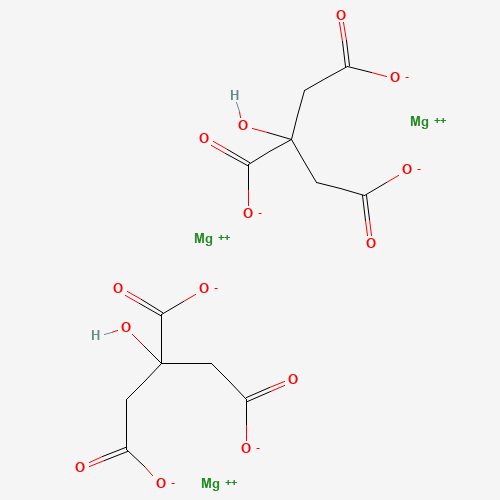
Trimagnesium dicitrate is a magnesium salt of citric acid, used in solid food supplements as a magnesium source and acidity regulator.
Where it is and isn’t permitted
| Jurisdiction | Status | Scope and limits | Citation |
|---|---|---|---|
| Australia and New Zealand | No listed food uses foundThis site has not matched this substance to any food use on this jurisdiction’s list of authorised food additives. A food additive may be used only in foods that list names. Flavourings, enzymes, processing aids and added nutrients are regulated separately and do not appear on it. | ||
| Canada | Permitted | no numerical limit (good manufacturing practice) In: Soft drinks. Purpose: Acidity regulator. Limit: Good Manufacturing Practice. | Health Canada, List of Permitted Acidity Regulators and Acid-Reacting Materials (List 10), item M.2retrieved 2026-10-17 |
| European Union | Permitted, with conditions | 1 food category highest permitted level 100,000 mg/kg ML = 100000 mg/kg. | Regulation (EC) No 1333/2008, Annex II, as amended by 2024/346retrieved 2026-10-18 |
| Great Britain | No listed food uses foundThis site has not matched this substance to any food use on this jurisdiction’s list of authorised food additives. A food additive may be used only in foods that list names. Flavourings, enzymes, processing aids and added nutrients are regulated separately and do not appear on it. | ||
| Japan | No listing matchedThis site imports only Japan’s list of designated additives (Appended Table 1 to the Regulations for Enforcement of the Food Sanitation Act), matched by English name. Existing additives, natural flavouring agents and ordinary foods used as additives are permitted outside that list and are not imported, so an empty row does not show that Japan does not permit the substance. | ||
| South Korea | No listing matchedThis site imports Part III of South Korea’s Standards and Specifications for Food Additives, matched by CAS number, then INS number, then exact name. Mixed preparations and sanitisers are not imported, and an entry whose identifiers disagreed with a page’s is held for review, so an empty row does not show that South Korea does not permit the substance. | ||
| United States | Not listedDoes not appear on this jurisdiction’s permitted list. That is not the same as being prohibited. | ||
| Codex Alimentarius | Not listedDoes not appear on this jurisdiction’s permitted list. That is not the same as being prohibited. |
How much is permitted
A listing usually limits the quantity as well as the food. Only one of the forms that takes is a figure: quantum satis and good manufacturing practice permit the amount the technological effect requires and no more, which is a limit rather than the absence of one. Figures below are the range across every food category this page is listed in, and categories differ between regulators — see how much is permitted.
| Canada | — | 1 GMP |
|---|---|---|
| European Union | 100,000 mg/kg | 1 numeric limit |
What it is made from
Made by reacting a magnesium source with citric acid, which is produced by fermentation, and drying the salt to its anhydrous form.
- Vegan
- Vegetarian
Compare other additives on the dietary indexes.
- CAS registry number
- 3344-18-1
- InChIKey
- PLSARIKBYIPYPF-UHFFFAOYSA-H
- PubChem
- CID 6099959
How the EU defines it
The legal specification an additive must meet to be sold as this E number in the EU — what it is, how it may be made, and the purity it must reach. From Commission Regulation (EU) No 231/2012.
E 345(i) Trimagnesium dicitrate
Synonyms: Magnesium citrate; trimagnesium citrate Definition
Assay, identification and purity criteria
Description and assay
- Einecs
- 222-093-9
- Chemical name
- Trimagnesium bis (2-hydroxypropane-1,2,3- tricarboxylate), anhydrous
- Chemical formula
- (C₆H₅O₇)₂ Mg₃
- Molecular weight
- 451,12 (anhydrous)
- Assay
- 15,0-16,5 % Mg on dry substance/matter equal to 92,8-102,1 % trimagnesium dicitrate anhydrous
- Description
- White or almost white, fine, slightly hygroscopic powder
- Appearance of a solution
- Not more opalescent than ref. susp. III and not more intensely coloured than ref. sol. Y7 or BY6 Identification
- Test for citrate
- Positive
- Test for magnesium
- Positive
- pH (5 % solution)
- 6,0-8,5
- Solubility
- Soluble in water, practically insoluble in ethanol (96 %), it dissolves in diluted hydrochloric acid.
- Particle size
- by STEM method – Median (D₅₀) particle size (number-based) not below 130 nm by laser diffraction method – Median (D₅₀) particle size (mass-based) not below 50 μm Purity
- Loss on drying
- Maximum 3,5 %, determined on 1 000 g by drying in an oven at 180 ± 10 °C for 5 h
- Oxalic/oxalate
- ≤ 280 mg/kg (0,028 %) as oxalic acid
- Sulfates
- ≤ 2 000 mg/kg (0,2 %)
- Calcium
- ≤ 2 000 mg/kg (0,2 %)
- Iron
- ≤ 100 mg/kg
- Mercury
- ≤ 0,1 mg/kg
- Lead
- ≤ 1 mg/kg
- Cadmium
- ≤ 0,1 mg/kg
- Arsenic
- ≤ 1 mg/kg
- Not identified material
- No process or product related impurities. The unintended presence of hydrated forms of trimagnesium dicitrate such as the nonahydrate cannot be excluded.
Every name it appears under
83 recorded names. A label may use any of them.
E number
- E345
- E345(i)
CAS registry number
- 3344-18-1
- 7779-25-1
As it appears in regulation
- Trimagnesium dicitrate
Other names
- 1,2,3-Propanetricarboxylic acid, 2-hydroxy-, magnesium salt (2:3)
- 1,2,3-Propanetricarboxylic acid, hydroxy-, magnesium salt (2:3)
- Be Health Magnesium Citrate Oral Solution-Cherry
- Be Health Magnesium Citrate Oral Solution-Grape
- Be Health Magnesium Citrate Oral Solution-Lemon
- CITRAMAG
- Citrate of Magnesia
- Citrate of Magnesium
- Citric acid, magnesium salt (2:3)
- Citroma
- CitroMag
- CVS Magnesium Citrate Oral Solution-Cherry
- CVS Magnesium Citrate Oral Solution-Grape
- CVS Magnesium Citrate Oral Solution-Lemon
- E 345(i)
- EZ2Go Magnesium Citrate Saline Laxative Lemon Flavor
- Freskaro Magnesium Citrate Oral Solution-Cherry
- Freskaro Magnesium Citrate Oral Solution-Grape
- Freskaro Magnesium Citrate Oral Solution-Lemon
- Gadavyt
- Harris Teeter Magnesium Citrate Oral Solution-Lemon
- Leader Magnesium Citrate Oral Solution-Cherry
- Leader Magnesium Citrate Oral Solution-Grape
- Leader Magnesium Citrate Oral Solution-Lemon
- Mag cit
- Mag diasporal 300
- Magcit
- Magesium Citrate
- magnesium 2-hydroxypropane-1,2,3-tricarboxylate
- magnesium 2-hydroxypropane-1,2,3-tricarboxylate (3/2)
- MAGNESIUM CITRATE
- Magnesium citrate (3:2)
- Magnesium citrate (JAN/USP)
- Magnesium citrate (VAN)
- Magnesium citrate , Mg 16 %
- Magnesium Citrate Anhydrous
- Magnesium Citrate Saline Laxative
- MAGNESIUM CITRATE TRIBASIC ANHYDROUS
- Magnesium citrate, Mg3(C6H5O7)2
- MAGNESIUM di CITRATE
- magnesium dicitrate
- MAGNESIUMCI
- MAGNESIUMCITRATE
- Major Magnesium Citrate Oral Solution-Lemon
- Mg citrate
- OneLAX
- OneLAX Saline Laxative
- oxy powder digestive cleanse
- PEN Prep
- RHO26O1T9V
- Saline Laxative
- Tectlol (TN)
- Tri Magnesium Citrate
- Trimagnesium citrate
- Trimagnesium dicitrate
- Trimagnesium dicitrate anhydrous
- trimagnesium;2-hydroxypropane-1,2,3-tricarboxylate
- Trimagnesiumdicitrat
Systematic names
- Trimagnesium;2-hydroxypropane-1,2,3-tricarboxylate
Hazard reference values
| Type | Value | Population | Assessed by | Opinion |
|---|---|---|---|---|
| ADI | not allocated | — | JECFA | 1985 |
Evidence and how bodies read it
Studies, and the differing conclusions regulators drew from them, are curated rather than machine-read, and none has been written for this substance yet.
Common questions
Assembled from what is above, in the words the questions are usually asked in. Each answer is the same statement the relevant section makes, with the same citations behind it.
- What is E 345(i)?
- E 345(i) is Trimagnesium dicitrate. Trimagnesium dicitrate is a magnesium salt of citric acid, used in solid food supplements as a magnesium source and acidity regulator.
- What is Trimagnesium dicitrate used for in food?
- It is listed as an acidity regulator — the role Canada assigns it. This page shows every function each regulator records, with the citation for each.
- Where is Trimagnesium dicitrate permitted?
- Of the seven regulators this site reads, Canada and the EU permit it. Each permission is for named foods at named levels, not a blanket one; the table on this page gives them with citations.
- Is Trimagnesium dicitrate vegan?
- Yes. Trimagnesium dicitrate is not derived from animals, and is suitable for vegetarians. This page says what it is made from and how.
Sources for this page
- ca retrieved 2026-10-17
- eu retrieved 2026-10-18
- euspecs retrieved 2026-10-18
Full licence terms and publisher details on Sources. How this page is built and updated: Method.
Machine-readable: a JSON record of this additive is given on request —how to ask for access.
Follow changes to Trimagnesium dicitrate:Atom feed — regulatory events, and any change the weekly refresh detects in its provisions.