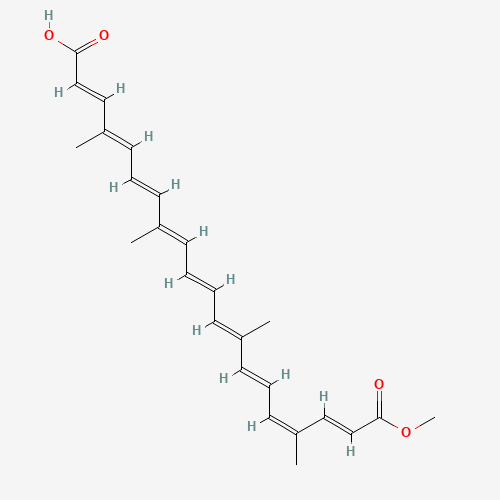
Annatto extracts, bixin-based

E number E160b(i)INS 160b(i)CAS 6983-79-5

Listed as a colour by Codex and the EU.

Listed as colours (EU, Codex)
Chemical structure of Annatto extracts, bixin-based, from PubChem compound 5281226
Structure from PubChem CID 5281226 (National Library of Medicine, public domain). A depiction of one compound: where a listing covers a family, or a substance has no single structure, this page shows none.

Bixin is the oil-soluble form of annatto, an orange-yellow colour from the seed coat of the achiote tree. It is the colour of many hard cheeses, including Red Leicester and some cheddars, and of butter and margarine.

Where it is and isn’t permitted

Status of Annatto extracts, bixin-based by jurisdiction. Every jurisdiction this site covers is listed, including those where the substance does not appear.
JurisdictionStatusScope and limitsCitation
Australia and New ZealandFood Standards Australia New ZealandNo listed food uses foundThis site has not matched this substance to any food use on this jurisdiction’s list of authorised food additives. A food additive may be used only in foods that list names. Flavourings, enzymes, processing aids and added nutrients are regulated separately and do not appear on it.
CanadaHealth CanadaNo listing matchedHealth Canada’s lists name additives without E or INS numbers, so this site matches them by exact name. A substance listed there under a name this site does not recognise has no row here.
European UnionEuropean Commission / EFSAPermitted, with conditions

26 food categories

highest permitted level 80 mg/l

Show every food category
  • 1.4 flavoured fermented milk products including heat-treated products — 15 mg/lML = 15 mg/l. Note 94: When E 160b(i) (Annatto bixin) and E 160b(ii) (Annatto norbixin) are added in combination, the higher individual maximum level applies to the sum, but the individual maximum levels shall not be exceeded.
  • 1.7.2 ripened cheese — 15 mg/kgML = 15 mg/kg. only ripened orange, yellow and broken-white cheese and red and green pesto cheese. Note 94: When E 160b(i) (Annatto bixin) and E 160b(ii) (Annatto norbixin) are added in combination, the higher individual maximum level applies to the sum, but the individual maximum levels shall not be exceeded.
  • 1.7.3 edible cheese rind — 20 mg/kgML = 20 mg/kg. Note 94: When E 160b(i) (Annatto bixin) and E 160b(ii) (Annatto norbixin) are added in combination, the higher individual maximum level applies to the sum, but the individual maximum levels shall not be exceeded.
  • 1.7.5 processed cheese — 15 mg/kgML = 15 mg/kg. Note 94: When E 160b(i) (Annatto bixin) and E 160b(ii) (Annatto norbixin) are added in combination, the higher individual maximum level applies to the sum, but the individual maximum levels shall not be exceeded.
  • 12.5 Soups and broths — 15 mg/kgML = 15 mg/kg. Note 94: When E 160b(i) (Annatto bixin) and E 160b(ii) (Annatto norbixin) are added in combination, the higher individual maximum level applies to the sum, but the individual maximum levels shall not be exceeded.
  • 12.6 Sauces — 30 mg/kgML = 30 mg/kg. including pickles, relishes, chutney and piccalilli; excluding tomato-based sauces. Note 94: When E 160b(i) (Annatto bixin) and E 160b(ii) (Annatto norbixin) are added in combination, the higher individual maximum level applies to the sum, but the individual maximum levels shall not be exceeded.
  • 14.1.4 Flavoured_drinks — 20 mg/lML = 20 mg/l.
  • 14.2.6 Spirit drinks as defined in Regulation (EU) 2019/787 — 10 mg/lML = 10 mg/l. only liqueurs’.
  • 15.1 Potato- cereal- flour- or starch-based snacks — 20 mg/kgML = 20 mg/kg. Note 94: When E 160b(i) (Annatto bixin) and E 160b(ii) (Annatto norbixin) are added in combination, the higher individual maximum level applies to the sum, but the individual maximum levels shall not be exceeded.
  • 15.2 Processed nuts — 10 mg/kgML = 10 mg/kg. Note 94: When E 160b(i) (Annatto bixin) and E 160b(ii) (Annatto norbixin) are added in combination, the higher individual maximum level applies to the sum, but the individual maximum levels shall not be exceeded.
  • 16 Desserts excluding products covered in category 1 3 and 4 — 15 mg/kgML = 15 mg/kg. Note 94: When E 160b(i) (Annatto bixin) and E 160b(ii) (Annatto norbixin) are added in combination, the higher individual maximum level applies to the sum, but the individual maximum levels shall not be exceeded.
  • 2.1 fats and oils essentially free from water (excluding anhydrous milk fat) — 10 mg/kgML = 10 mg/kg. only fats.
  • 2.2.2 Other fat and oil emulsions including spreads as defined by Regulation (EC) No 1234/2007 and liquid emulsions — 10 mg/kgML = 10 mg/kg. excluding reduced fat butter’.
  • 4.2.5 jam jellies and marmalades and similar products — 20 mg/kgML = 20 mg/kg. except chestnut purée. Note 94: When E 160b(i) (Annatto bixin) and E 160b(ii) (Annatto norbixin) are added in combination, the higher individual maximum level applies to the sum, but the individual maximum levels shall not be exceeded.
  • 4.2.5.2 Jam, jellies and marmalades and sweetened chestnut puree as defined by Directive 2001/113/EC — 20 mg/kgML = 20 mg/kg. except chestnut purée.
  • 4.2.5.3 other similar fruit or vegetable spreads — 20 mg/kgML = 20 mg/kg. except crème de pruneaux. Note 94: When E 160b(i) (Annatto bixin) and E 160b(ii) (Annatto norbixin) are added in combination, the higher individual maximum level applies to the sum, but the individual maximum levels shall not be exceeded.
  • 4.2.6 processed potato products — 10 mg/kgML = 10 mg/kg. only dried potato granules and flakes. Note 94: When E 160b(i) (Annatto bixin) and E 160b(ii) (Annatto norbixin) are added in combination, the higher individual maximum level applies to the sum, but the individual maximum levels shall not be exceeded.
  • 5.2 Other confectionery including breath freshening micro-sweets — 30 mg/kgML = 30 mg/kg. Note 94: When E 160b(i) (Annatto bixin) and E 160b(ii) (Annatto norbixin) are added in combination, the higher individual maximum level applies to the sum, but the individual maximum levels shall not be exceeded.
  • 5.4 Decorations, coatings and fillings, except fruit-based fillings covered by category 4.2.4 — 80 mg/kgML = 80 mg/kg. only decorations and coatings. Note 94: When E 160b(i) (Annatto bixin) and E 160b(ii) (Annatto norbixin) are added in combination, the higher individual maximum level applies to the sum, but the individual maximum levels shall not be exceeded.
  • 6.5 Noodles — 20 mg/kgML = 20 mg/kg. Note 94: When E 160b(i) (Annatto bixin) and E 160b(ii) (Annatto norbixin) are added in combination, the higher individual maximum level applies to the sum, but the individual maximum levels shall not be exceeded.
  • 6.6 Batters — 50 mg/kgML = 50 mg/kg. only batters for coating. Note 94: When E 160b(i) (Annatto bixin) and E 160b(ii) (Annatto norbixin) are added in combination, the higher individual maximum level applies to the sum, but the individual maximum levels shall not be exceeded.
  • 8.2 Meat preparations as defined by Regulation (EC) No 853/2004 — 20 mg/kgML = 20 mg/kg. only breakfast sausages with a minimum cereal content of 6 % and burger meat with a minimum vegetable and/or cereal content of 4 % mixed within the meat; In these products, the meat is minced in such a way so that the muscle and fat tissue are completely dispersed, so that fibre makes an emulsion with the fat, giving those products their typical appearance. Note 94: When E 160b(i) (Annatto bixin) and E 160b(ii) (Annatto norbixin) are added in combination, the higher individual maximum level applies to the sum, but the individual maximum levels shall not be exceeded.
  • 8.3.1 Non-heat-treated processed meat — 20 mg/kgML = 20 mg/kg. only chorizo sausage, salchichon, pasturmas and sobrasada. Note 94: When E 160b(i) (Annatto bixin) and E 160b(ii) (Annatto norbixin) are added in combination, the higher individual maximum level applies to the sum, but the individual maximum levels shall not be exceeded.
  • 8.3.2 Heat-treated meat products — 20 mg/kgML = 20 mg/kg. only sausages, pâtés, terrines and luncheon meat. Note 94: When E 160b(i) (Annatto bixin) and E 160b(ii) (Annatto norbixin) are added in combination, the higher individual maximum level applies to the sum, but the individual maximum levels shall not be exceeded.
  • 8.3.3 Casings and coatings and decorations for meat — 50 mg/kgML = 50 mg/kg. Note 94: When E 160b(i) (Annatto bixin) and E 160b(ii) (Annatto norbixin) are added in combination, the higher individual maximum level applies to the sum, but the individual maximum levels shall not be exceeded.
  • 9.2 Processed fish and fishery products including molluscs and crustaceans — 10 mg/kgML = 10 mg/kg. only smoked fish. Note 94: When E 160b(i) (Annatto bixin) and E 160b(ii) (Annatto norbixin) are added in combination, the higher individual maximum level applies to the sum, but the individual maximum levels shall not be exceeded.
Regulation (EC) No 1333/2008and 25 further provisionsretrieved 2026-10-18
Great BritainFood Standards Agency / Food Standards ScotlandPermitted, with conditions

25 food categories

highest permitted level 80 mg/kg or mg/l

Show every food category
  • 1.4 Flavoured fermented milk products including heat-treated products — 15 mg/kg or mg/lML = 15. Note (94): When E 160b(i) (Annatto bixin) and E 160b(ii) (Annatto norbixin) are added in combination, the higher individual maximum level applies to the sum, but the individual maximum levels shall not be exceeded.
  • 1.7.2 Ripened cheese — 15 mg/kg or mg/lML = 15. only ripened orange, yellow and broken-white cheese and red and green pesto cheese. Note (94): When E 160b(i) (Annatto bixin) and E 160b(ii) (Annatto norbixin) are added in combination, the higher individual maximum level applies to the sum, but the individual maximum levels shall not be exceeded.
  • 1.7.3 Edible cheese rind — 20 mg/kg or mg/lML = 20. Note (94): When E 160b(i) (Annatto bixin) and E 160b(ii) (Annatto norbixin) are added in combination, the higher individual maximum level applies to the sum, but the individual maximum levels shall not be exceeded.
  • 1.7.5 Processed cheese — 15 mg/kg or mg/lML = 15. Note (94): When E 160b(i) (Annatto bixin) and E 160b(ii) (Annatto norbixin) are added in combination, the higher individual maximum level applies to the sum, but the individual maximum levels shall not be exceeded.
  • 12.5 Soups and broths — 15 mg/kg or mg/lML = 15. Note (94): When E 160b(i) (Annatto bixin) and E 160b(ii) (Annatto norbixin) are added in combination, the higher individual maximum level applies to the sum, but the individual maximum levels shall not be exceeded.
  • 12.6 Sauces — 30 mg/kg or mg/lML = 30. including pickles, relishes, chutney and piccalilli; excluding tomato-based sauces. Note (94): When E 160b(i) (Annatto bixin) and E 160b(ii) (Annatto norbixin) are added in combination, the higher individual maximum level applies to the sum, but the individual maximum levels shall not be exceeded.
  • 14.1.4 Flavoured drinks — 20 mg/kg or mg/lML = 20.
  • 14.2.6 Spirit drinks as defined in Regulation (EC) No 110/2008 — 10 mg/kg or mg/lML = 10. only liqueurs.
  • 15.1 Potato-, cereal-, flour- or starch-based snacks — 20 mg/kg or mg/lML = 20. Note (94): When E 160b(i) (Annatto bixin) and E 160b(ii) (Annatto norbixin) are added in combination, the higher individual maximum level applies to the sum, but the individual maximum levels shall not be exceeded.
  • 15.2 Processed nuts — 10 mg/kg or mg/lML = 10. Note (94): When E 160b(i) (Annatto bixin) and E 160b(ii) (Annatto norbixin) are added in combination, the higher individual maximum level applies to the sum, but the individual maximum levels shall not be exceeded.
  • 16 Desserts excluding products covered in categories 1, 3 and 4 — 15 mg/kg or mg/lML = 15. Note (94): When E 160b(i) (Annatto bixin) and E 160b(ii) (Annatto norbixin) are added in combination, the higher individual maximum level applies to the sum, but the individual maximum levels shall not be exceeded.
  • 2.1 Fats and oils essentially free from water (excluding anhydrous milkfat) — 10 mg/kg or mg/lML = 10. only fats.
  • 2.2.2 Other fat and oil emulsions including spreads as defined by Regulation (EC) No 1234/2007 and liquid emulsions — 10 mg/kg or mg/lML = 10. excluding reduced fat butter.
  • 4.2.5.2 Jam, jellies and marmalades and sweetened chestnut puree as defined by Directive 2001/113/EC — 20 mg/kg or mg/lML = 20. except chestnut purée. Note (94): When E 160b(i) (Annatto bixin) and E 160b(ii) (Annatto norbixin) are added in combination, the higher individual maximum level applies to the sum, but the individual maximum levels shall not be exceeded.
  • 4.2.5.3 Other similar fruit or vegetable spreads — 20 mg/kg or mg/lML = 20. except crème de pruneaux. Note (94): When E 160b(i) (Annatto bixin) and E 160b(ii) (Annatto norbixin) are added in combination, the higher individual maximum level applies to the sum, but the individual maximum levels shall not be exceeded.
  • 4.2.6 Processed potato products — 10 mg/kg or mg/lML = 10. only dried potato granules and flakes. Note (94): When E 160b(i) (Annatto bixin) and E 160b(ii) (Annatto norbixin) are added in combination, the higher individual maximum level applies to the sum, but the individual maximum levels shall not be exceeded.
  • 5.2 Other confectionery including breath refreshening microsweets — 30 mg/kg or mg/lML = 30. Note (94): When E 160b(i) (Annatto bixin) and E 160b(ii) (Annatto norbixin) are added in combination, the higher individual maximum level applies to the sum, but the individual maximum levels shall not be exceeded.
  • 5.4 Decorations, coatings and fillings, except fruit based fillings covered by category 4.2.4 — 80 mg/kg or mg/lML = 80. only decorations and coatings. Note (94): When E 160b(i) (Annatto bixin) and E 160b(ii) (Annatto norbixin) are added in combination, the higher individual maximum level applies to the sum, but the individual maximum levels shall not be exceeded.
  • 6.5 Noodles — 20 mg/kg or mg/lML = 20. Note (94): When E 160b(i) (Annatto bixin) and E 160b(ii) (Annatto norbixin) are added in combination, the higher individual maximum level applies to the sum, but the individual maximum levels shall not be exceeded.
  • 6.6 Batters — 50 mg/kg or mg/lML = 50. only batters for coating. Note (94): When E 160b(i) (Annatto bixin) and E 160b(ii) (Annatto norbixin) are added in combination, the higher individual maximum level applies to the sum, but the individual maximum levels shall not be exceeded.
  • 8.2 Meat preparations as defined by Regulation (EC) No 853/2004 — 20 mg/kg or mg/lML = 20. only breakfast sausages with a minimum cereal content of 6 % and burger meat with a minimum vegetable and/or cereal content of 4 % mixed within the meat; In these products, the meat is minced in such a way so that the muscle and fat tissue are completely dispersed, so that fibre makes an emulsion with the fat, giving those products their typical appearance. Note (94): When E 160b(i) (Annatto bixin) and E 160b(ii) (Annatto norbixin) are added in combination, the higher individual maximum level applies to the sum, but the individual maximum levels shall not be exceeded.
  • 8.3.1 Non-heat-treated meat products — 20 mg/kg or mg/lML = 20. only chorizo sausage , salchichon , pasturmas and sobrasada. Note (94): When E 160b(i) (Annatto bixin) and E 160b(ii) (Annatto norbixin) are added in combination, the higher individual maximum level applies to the sum, but the individual maximum levels shall not be exceeded.
  • 8.3.2 Heat-treated meat products — 20 mg/kg or mg/lML = 20. only sausages, pâtés, terrines and luncheon meat. Note (94): When E 160b(i) (Annatto bixin) and E 160b(ii) (Annatto norbixin) are added in combination, the higher individual maximum level applies to the sum, but the individual maximum levels shall not be exceeded.
  • 8.3.3 Casings and coatings and decorations for meat — 50 mg/kg or mg/lML = 50. Note (94): When E 160b(i) (Annatto bixin) and E 160b(ii) (Annatto norbixin) are added in combination, the higher individual maximum level applies to the sum, but the individual maximum levels shall not be exceeded.
  • 9.2 Processed fish and fishery products including mollusks and crustaceans — several limits(1) ML 10: only smoked fish; (2) ML 30: only surimi and similar products and salmon substitutes. Note (94): When E 160b(i) (Annatto bixin) and E 160b(ii) (Annatto norbixin) are added in combination, the higher individual maximum level applies to the sum, but the individual maximum levels shall not be exceeded.
Assimilated Regulation (EC) No 1333/2008and 24 further provisionsretrieved 2026-10-18
JapanConsumer Affairs AgencyNo listing matchedThis site imports only Japan’s list of designated additives (Appended Table 1 to the Regulations for Enforcement of the Food Sanitation Act), matched by English name. Existing additives, natural flavouring agents and ordinary foods used as additives are permitted outside that list and are not imported, so an empty row does not show that Japan does not permit the substance.
South KoreaMinistry of Food and Drug SafetyNo listing matchedThis site imports Part III of South Korea’s Standards and Specifications for Food Additives, matched by CAS number, then INS number, then exact name. Mixed preparations and sanitisers are not imported, and an entry whose identifiers disagreed with a page’s is held for review, so an empty row does not show that South Korea does not permit the substance.Related listing with permitted uses here: Annatto extracts, norbixin-based (E160b(ii)). This site cannot tell whether that listing covers this exact form.
United StatesFood and Drug AdministrationNot listedDoes not appear on this jurisdiction’s permitted list. That is not the same as being prohibited.
Codex AlimentariusCodex Alimentarius Commission / JECFAPermitted, with conditions

75 food categories

highest permitted level 10,000 mg/kg

Show every food category and its notes
  • 01.1.4 Flavoured Fluid Milk Drinks — 20 mg/kg
    • Note 8 As bixin.
    • Note 52 Excluding chocolate milk.
  • 01.3.2 Beverage whiteners — 50 mg/kg
    • Note 8 As bixin.
    • Note XS250 Excluding products conforming to the Standard for a Blend of Evaporated Skimmed Milk and Vegetable Fat (CODEX STAN 250-2006).
    • Note XS252 Excluding products conforming to the Standard for a Blend of Sweetened Condensed Skimmed Milk and Vegetable Fat (CODEX STAN 252-2006).
  • 01.4.4 Cream analogues — 100 mg/kg
    • Note 8 As bixin.
  • 01.5.2 Milk and cream powder analogues — 100 mg/kg
    • Note 8 As bixin.
    • Note XS251 Excluding products conforming to the Standard for a Blend of Skimmed Milk and Vegetable Fat in Powdered Form (CODEX STAN 251-2006).
  • 01.6.2.2 Rind of ripened cheese — 100 mg/kg
    • Note 8 As bixin.
  • 01.6.2.3 Cheese powder (for reconstitution; e.g. for cheese sauces) — 50 mg/kg
    • Note 8 As bixin.
  • 01.6.4.1 Plain processed cheese — 60 mg/kg
    • Note 8 As bixin.
    • Note 145 Except for use at 100 mg/kg in sliced processed cheeses.
  • 01.6.4.2 Flavoured processed cheese, including containing fruit, vegetables, meat, etc. — 15 mg/kg
    • Note 8 As bixin.
    • Note 239 Except for use at 100 mg/kg in sliced processed cheese.
  • 01.6.5 Cheese analogues — 100 mg/kg
    • Note 8 As bixin.
  • 01.7 Dairy-based desserts (e.g. pudding, fruit or flavoured yoghurt) — 100 mg/kg
    • Note 8 As bixin.
    • Note 146 Except for use in non-plain products conforming to the Standard for Fermented Milks (CXS 243-2003) at 20 mg/kg.
  • 02.1.1 Butter oil, anhydrous milkfat, ghee — 100 mg/kg
    • Note 8 As bixin.
    • Note 240 Except for use in products conforming to the Standard for Edible Fats and Oils not covered by Individual Standards (CXS 19-1981) for the purposes of natural colour lost in processing, or standardizing colour only at 10 mg/kg.
  • 02.1.2 Vegetable oils and fats — 10 mg/kg
    • Note 8 As bixin.
    • Note 508 For use in products, excluding virgin or cold pressed oils and vegetable oils, conforming to the Standard for Edible Fats and Oils not Covered by Individual Standards (CXS 19-1981) only, for the purposes of restoring natural colour lost in processing, or standardising colour.
    • Note XS33 Excluding products conforming to the Standard for Olive Oils and Olive Pomace Oils (CODEX STAN 33-1981).
    • Note XS210 Excluding products conforming to the Standard for Named Vegetable Oils (CXS 210-1999).
    • Note XS325R Excluding products conforming to the Regional Standard for Unrefined Shea Butter (CXS 325R-2017).
  • 02.1.3 Lard, tallow, fish oil, and other animal fats — 10 mg/kg
    • Note 8 As bixin.
    • Note 512 For use in products conforming to the Standard for Edible fats and oils not Covered by Individual Standards (CXS 19-1981) and the Standard for Named Animal Fats (CXS 211-1999) for the purposes of restoring natural colour lost in processing, or standardizing colour only.
    • Note XS329 Excluding products conforming to the Standard for Fish Oils (CXS 329-2017).
  • 02.2.1 Butter — 20 mg/kg
    • Note 8 As bixin.
  • 02.2.2 Fat spreads, dairy fat spreads and blended spreads — 100 mg/kg
    • Note 8 As bixin.
    • Note 215 Except for use in products conforming to the Standard for Dairy Fat Spreads (CODEX STAN 253-2006) at 20 mg/kg.
  • 02.3 Fat emulsions mainly of type oil-in-water, including mixed and/or flavoured products based on fat emulsions — 25 mg/kg
    • Note 8 As bixin.
  • 02.4 Fat-based desserts excluding dairy-based dessert products of food category 01.7 — 15 mg/kg
    • Note 8 As bixin.
  • 03.0 Edible ices, including sherbet and sorbet — 20 mg/kg
    • Note 8 As bixin.
  • 04.1.2.11 Fruit fillings for pastries — 50 mg/kg
    • Note 8 As bixin.
  • 04.1.2.5 — 20 mg/kg
    • Note 8 As bixin.
    • Note XS296 Excluding products conforming to the Standard for Jams, Jellies and Marmalades (CODEX STAN 296-2009).
  • 04.1.2.6 Fruit-based spreads (e.g. chutney) excluding products of food category — 20 mg/kg
    • Note 8 As bixin.
    • Note XS160 Excluding products conforming to the Standard for Mango Chutney (CODEX STAN 160-1987).
  • 04.1.2.7 Candied fruit — 20 mg/kg
    • Note 8 As bixin.
  • 04.1.2.8 Fruit preparations, including pulp, purees, fruit toppings and coconut milk — 100 mg/kg
    • Note 8 As bixin.
    • Note XS240 Excluding products conforming to the Standard for Aqueous Coconut Products (CODEX STAN 240-2003).
    • Note XS314R Excluding products conforming to the Standard for Date Paste (CODEX STAN 314R-2013).
  • 04.1.2.9 Fruit-based desserts, incl. fruit-flavoured water-based desserts — 30 mg/kg
    • Note 8 As bixin.
    • Note 657 Except for use at 100 mg/kg in jelly desserts and fruit-flavoured jelly.
  • 04.2.2.3 Vegetables (including mushrooms and fungi, roots and tubers, pulses and legumes, and aloe vera), and seaweeds in vinegar, oil, brine, or soybean sauce — 10 mg/kg
    • Note 8 As bixin.
    • Note XS38 Excluding products conforming to the General Standard for Edible Fungi and Fungus Products (CODEX STAN 38-1981).
    • Note XS66 Excluding products conforming to the Standard for Table Olives (CODEX STAN 66-1981).
    • Note XS260 Excluding products conforming to the Standard for Pickled Fruits and Vegetables (CODEX STAN 260-2007).
    • Note 658 Except for use at 300 mg/kg in products conforming to the Standard for Pickled Cucumbers (Cucumber Pickles) (CXS 115-1981), singly or in combination, with other colours permitted in CXS 115-1981.
  • 04.2.2.5 Vegetable (including mushrooms and fungi, roots and tubers, pulses and legumes, and aloe vera), seaweed, and nut and seed purees and spreads (e.g. peanut butter) — 20 mg/kg
    • Note 8 As bixin.
    • Note XS57 Excluding products conforming to the Standard for Processed Tomato Concentrates (CODEX STAN 57-1981).
  • 04.2.2.6 Vegetable (including mushrooms and fungi, roots and tubers, pulses and legumes, and aloe vera), seaweed, and nut and seed pulps and preparations (e.g. vegetable desserts and sauces, candied vegetables) other than food category 04.2.2.5 — 10 mg/kg
    • Note 8 As bixin.
    • Note 92 Excluding tomato-based sauces.
    • Note XS38 Excluding products conforming to the General Standard for Edible Fungi and Fungus Products (CODEX STAN 38-1981).
    • Note XS57 Excluding products conforming to the Standard for Processed Tomato Concentrates (CODEX STAN 57-1981).
    • Note XS259R Excluding products conforming to the Codex Regional Standard for Tehena (CODEX STAN 259R-2007).
    • Note XS308R Excluding products conforming to the Regional Standard for Harissa (Red Hot Pepper Paste) (CXS 308R-2011).
    • Note XS321 Excluding products conforming to the Standard for Ginseng Products (CXS 321-2015).
  • 04.2.2.7 Fermented vegetable (including mushrooms and fungi, roots and tubers, pulses and legumes, and aloe vera) and seaweed products, excluding fermented soybean products of food categories 06.8.6, 06.8.7, 12.9.1, — 10 mg/kg
    • Note 8 As bixin.
    • Note XS38 Excluding products conforming to the General Standard for Edible Fungi and Fungus Products (CODEX STAN 38-1981).
    • Note XS151 Excluding products conforming to the Standard for Gari (CXS 151-1985).
    • Note XS223 Excluding products conforming to the Standard for Kimchi (CXS 223-2001).
    • Note XS294 Excluding products conforming to the Standard for Gochujang (CXS 294-2009).
  • 05.1.3 Cocoa-based spreads, incl. fillings — 50 mg/kg
    • Note 8 As bixin.
    • Note XS86 Excluding products conforming to the Standard for Cocoa Butter (CODEX STAN 86-1981).
  • 05.1.4 Cocoa and chocolate products — 50 mg/kg
    • Note 8 As bixin.
    • Note 183 For use in surface decoration only.
  • 05.1.5 Imitation chocolate, chocolate substitute products — 50 mg/kg
    • Note 8 As bixin.
  • 05.2 Confectionery including hard and soft candy, nougats, etc. other than food categories 05.1, 05.3, and 05.4 — 200 mg/kg
    • Note 8 As bixin.
  • 05.3 Chewing gum — 300 mg/kg
    • Note 8 As bixin.
  • 05.4 Decorations (e.g. for fine bakery wares), toppings (non-fruit), and sweet sauces — 80 mg/kg
    • Note 8 As bixin.
  • 06.3 Breakfast cereals, including rolled oats — 75 mg/kg
    • Note 8 As bixin.
    • Note 663 Except for use at 100 mg/kg in extruded and/or puffed cereal products.
  • 06.4.2 Dried pastas and noodles and like products — 10 mg/kg
    • Note 8 As bixin.
    • Note 676 Some Codex Members allow the use of additives with colour function in this food category while others limit these additives to certain products.
  • 06.4.3 Pre-cooked pastas and noodles and like products — 20 mg/kg
    • Note 8 As bixin.
    • Note 676 Some Codex Members allow the use of additives with colour function in this food category while others limit these additives to certain products.
  • 06.5 Cereal and starch based desserts (e.g. rice pudding, tapioca pudding) — 10 mg/kg
    • Note 8 As bixin.
  • 06.6 Batters (e.g. for breading or batters for fish or poultry) — 80 mg/kg
    • Note 8 As bixin.
  • 06.8.1 Soybean-based beverages — 10 mg/kg
    • Note 8 As bixin.
    • Note 666 Except for use in composite/flavoured soybean beverages and soybean-based beverages conforming to the Regional Standard for Non-Fermented Soybean Products (Asia) (CXS 322R-2015) at 5 mg/kg, as bixin.
  • 07.1.2 Crackers, excluding sweet crackers — 100 mg/kg
    • Note 8 As bixin.
  • 07.1.4 Bread-type products, including bread stuffing and bread crumbs — 200 mg/kg
    • Note 8 As bixin.
    • Note 398 Some Codex Members allow the use of additives with sweetener and colour functions in this food category while others limit this food category to products without these additives.
  • 07.1.5 Steamed breads and buns — 200 mg/kg
    • Note 8 As bixin.
    • Note 201 For use in flavoured products only.
    • Note 398 Some Codex Members allow the use of additives with sweetener and colour functions in this food category while others limit this food category to products without these additives.
  • 07.1.6 Mixes for bread and ordinary bakery wares — 200 mg/kg
    • Note 8 As bixin.
    • Note 398 Some Codex Members allow the use of additives with sweetener and colour functions in this food category while others limit this food category to products without these additives.
  • 07.2 Fine bakery wares (sweet, salty, savoury) and mixes — 100 mg/kg
    • Note 8 As bixin.
  • 08.1.2 Fresh meat, poultry and game, comminuted — 20 mg/kg
    • Note 8 As bixin.
    • Note 669 For use only in breakfast sausages, merguez type products, salsicha fresca, butifarra fresca, longaniza fresca and chorizo fresco and mici.
  • 08.2.2 Heat-treated processed meat, poultry, and game products in whole pieces or cuts — 20 mg/kg
    • Note 8 As bixin.
    • Note XS96 Excluding products conforming to the Standard for Cooked Cured Ham (CODEX STAN 96-1981).
    • Note XS97 Excluding products conforming to the Standard for Cooked Cured Pork Shoulder (CODEX STAN 97-1981).
    • Note XS350R Excluding products conforming to the Regional Standard for dried meat (Africa) (CXS 350R-2022).
    • Note 670 Except for use in cooked ham and cooked chicken at 100 mg/kg to restore faded colour and improve the frying colour.
  • 08.3.1.1 Cured (including salted) non-heat treated processed comminuted meat, poultry, and game products — 100 mg/kg
    • Note 8 As bixin.
  • 08.3.1.2 Cured (including salted) and dried non-heat treated processed comminuted meat, poultry, and game products — 100 mg/kg
    • Note 8 As bixin.
  • 08.3.1.3 Fermented non-heat treated processed comminuted meat, poultry, and game products — 100 mg/kg
    • Note 8 As bixin.
  • 08.3.2 Heat-treated processed comminuted meat, poultry, and game products — 100 mg/kg
    • Note 8 As bixin.
    • Note XS88 Excluding products conforming to the Standard for Corned Beef (CODEX STAN 88-1981).
    • Note XS89 Excluding products conforming to Standard for Luncheon Meat (CODEX STAN 89-1981).
    • Note XS98 Excluding products conforming to the Standard for Cooked Cured Chopped Meat (CODEX STAN 98-1981).
  • 08.3.3 Frozen processed comminuted meat, poultry, and game products — 20 mg/kg
    • Note 8 As bixin.
    • Note 16 For use in glaze, coatings or decorations for fruit, vegetables, meat or fish only.
  • 08.4 Edible casings (e.g. sausage casings) — 10,000 mg/kg
    • Note 8 As bixin.
    • Note 365 On a casings basis.
  • 09.2.2 Frozen battered fish, fish fillets and fish products, including molluscs, crustaceans, and echinoderms — 80 mg/kg
    • Note 8 As bixin.
    • Note 41 For use in breading or batter coatings only.
    • Note 257 Except for use in breading or batter coatings in products conforming to the Standard for Quick Frozen Fish Sticks (Fish Fingers), Fish Portions and Fish Fillets – Breaded or in Batter (CODEX STAN 166-1989) only at 25 mg/kg as bixin.
  • 09.2.4.1 Cooked fish and fish products — 30 mg/kg
    • Note 8 As bixin.
    • Note 95 For non-standardized foods: for use in surimi and fish roe products only.
  • 09.2.5 Smoked, dried, fermented, and/or salted fish and fish products, including molluscs, crustaceans, and echinoderms — 10 mg/kg
    • Note 8 As bixin.
    • Note 382 For use only in smoked fish and smoke-flavoured fish products conforming to the Standard for Smoked Fish, Smoked-flavoured fish, and Smoke-dried fish (CODEX STAN 311-2013).
    • Note XS167 Excluding products conforming to the Standard for Salted Fish and Dried Salted Fish of the Gadidae Family of Fishes (CODEX STAN 167-1989).
    • Note XS189 Excluding products conforming to the Standard for Dried Shark Fins (CODEX STAN 189-1993).
    • Note XS222 Excluding products conforming to the Standard for Crackers from Marine and Freshwater Fish, Crustaceans and Molluscan Shellfish (CODEX STAN 222-2001).
    • Note XS236 Excluding products conforming to the Standard for Boiled Dried Salted Anchovies (CODEX STAN 236-2003).
    • Note XS244 Excluding products conforming to the Standard for Salted Atlantic Herring and Salted Sprat (CODEX STAN 244-2004).
  • 09.3.1 Fish and fish products, including molluscs, crustaceans, and echinoderms, marinated and/or in jelly — 10 mg/kg
    • Note 8 As bixin.
    • Note 16 For use in glaze, coatings or decorations for fruit, vegetables, meat or fish only.
  • 09.3.3 Salmon substitutes, caviar and other fish roe products — 10 mg/kg
    • Note 8 As bixin.
    • Note XS291 Excluding products conforming to the Standard for Sturgeon Caviar (CODEX STAN 291-2010).
  • 09.3.4 Semi-preserved fish and fish products, including molluscs, crustaceans and echinoderms (e.g. fish paste), excluding products of food categories 09.3.1 - 09.3.3 — 10 mg/kg
    • Note 8 As bixin.
  • 12.2.2 Seasonings and condiments — 600 mg/kg
    • Note 8 As bixin.
  • 12.4 Mustards — 100 mg/kg
    • Note 8 As bixin.
  • 12.5 Soups and broths — 50 mg/kg
    • Note 8 As bixin.
    • Note 501 Except for use at 300 mg/kg in carrot and pumpkin flavoured soup.
  • 12.6.1 Emulsified sauces and dips (e.g. mayonnaise, salad dressing, onion dips) — 30 mg/kg
    • Note 8 As bixin.
    • Note 593 Except for use at 100 mg/kg in cheese dips and flavoured mayonnaise.
  • 12.6.2 Non-emulsified sauces (e.g. ketchup, cheese sauce, cream sauce, brown gravy) — 100 mg/kg
    • Note 8 As bixin.
    • Note 577 Except for use at 50 mg/kg in products conforming to the Standard for Chili Sauce (CXS 306-2011).
  • 12.6.3 Mixes for sauces and gravies — 100 mg/kg
    • Note 8 As bixin.
    • Note 127 On the served to the consumer basis.
  • 12.6.4 Clear sauces (e.g. fish sauce) — 400 mg/kg
    • Note 8 As bixin.
    • Note XS302 Excluding products conforming to the Standard for Fish Sauce (CODEX STAN 302-2011).
  • 12.7 Salads (e.g. macaroni salad, potato salad) and sandwich spreads excluding cocoa-and nut-based spreads of food categories 04.2.2.5 and 05.1.3 — 10 mg/kg
    • Note 8 As bixin.
  • 13.3 Dietetic foods intended for special medical purposes (excluding products of food category 13.1) — 50 mg/kg
    • Note 8 As bixin.
    • Note 566 Excluding products conforming to the Guidelines for Ready to Use Therapeutic Foods (CXG 95-2022).
  • 13.6 Food supplements — 200 mg/kg
    • Note 8 As bixin.
    • Note 539 For use in solid forms as sold to the consumer only.
  • 14.1.4 Water-based flavoured drinks, including "sport," “energy,” or "electrolyte" drinks and particulated drinks — 30 mg/kg
    • Note 8 As bixin.
    • Note 127 On the served to the consumer basis.
  • 14.2.4 Wines (other than grape) — 20 mg/kg
    • Note 8 As bixin.
  • 14.2.6 Distilled spirituous beverages containing more than 15% alcohol — 30 mg/kg
    • Note 8 As bixin.
  • 14.2.7 Aromatized alcoholic beverages (e.g. beer, wine and spirituous cooler-type beverages, low-alcoholic refreshers) — 30 mg/kg
    • Note 8 As bixin.
  • 15.1 Snacks - potato, cereal, flour or starch based (from roots and tubers, pulses and legumes) — 20 mg/kg
    • Note 8 As bixin.
    • Note 603 For use at 100 mg/kg in flavoured crackers (e.g. barbecue, cheese, hot/spicy) and tortillas/nachos/chips only.
  • 15.2 Processed nuts, including coated nuts and nut mixtures (with e.g. dried fruit) — 10 mg/kg
    • Note 8 As bixin.
CXS 192-1995 Table One, INS 160b(i)and 74 further provisionsretrieved 2026-09-07

How much is permitted

A listing usually limits the quantity as well as the food. Only one of the forms that takes is a figure: quantum satis and good manufacturing practice permit the amount the technological effect requires and no more, which is a limit rather than the absence of one. Figures below are the range across every food category this page is listed in, and categories differ between regulators — see how much is permitted.

European Union10 mg/kg – 80 mg/kg26 numeric limit
Great Britain10 mg/kg – 80 mg/kg24 numeric limit, 1 several limits
Codex Alimentarius10 mg/kg – 10,000 mg/kg75 numeric limit

What it is made from

Extracted from the seed coat of Bixa orellana using vegetable oil or an organic solvent. Bixin is fat-soluble, which is why this form is used for fatty foods; the water-soluble norbixin form is listed separately.

  • Vegan
  • Vegetarian

Compare other additives on the dietary indexes.

CAS registry number
6983-79-5
InChIKey
RAFGELQLHMBRHD-SLEZCNMESA-N
PubChem
CID 5281226

The two specifications, compared

The European Union sets identity and purity by regulation; JECFA publishes its own through FAO, advisory until a country adopts it. Both documents are below in full. These are the parameters each puts a number on.

ParameterEuropean UnionJECFA
Assayno less than 85 %no less than 25 %
Leadno more than 1 mg/kgno more than 2 mg/kg
Arsenicno more than 2 mg/kgno more than 3 mg/kg
Mercuryno more than 1 mg/kgno more than 1 mg/kg
Cadmiumno more than 0.5 mg/kg—

3 parameters differ between the two documents. A difference is not a disagreement about safety: the two are revised on their own cycles, and an assay or a drying loss can be measured against a different preparation of the substance, which is why only the contaminant ceilings are marked. Within the EU the EU's figure is the one that binds.

How the EU defines it

The legal specification an additive must meet to be sold as this E number in the EU — what it is, how it may be made, and the purity it must reach. From Commission Regulation (EU) No 231/2012.

E 160b(i) Annatto bixin

Solvent-extracted bixin is obtained by the extraction of the outer coating of the seeds of the annatto tree (Bixa orellana L.) with one or more of the following food grade solvents: acetone, methanol, hexane, ethanol, isopropyl alcohol, ethyl acetate, alkaline alcohol or supercritical carbon dioxide. The resulting preparation may be acidified, followed by the removal of the solvent, drying and milling. Solvent-extracted bixin contains several coloured components; the major colouring principle is cis-bixin, a minor colouring principle is trans-bixin; thermal degradation products of bixin may also be present as a result of processing.

Synonyms: Annatto B, Orlean, Terre orellana, L. Orange, CI Natural Orange 4

Assay, identification and purity criteria

Description and assay

Colour Index No
75120
Einecs
230-248-7
Chemical name
cis-Bixin: Methyl (9-cis)-hydrogen-6,6'-diapo-Ψ,Ψ-carotenedioate
Chemical formula
cis-Bixin: C₂₅H₃₀O₄
Molecular weight
394,5
Assay
Not less than 85 % colouring matter (expressed as bixin) E1 % 1cm 3090 at ca. 487 nm in tetrahydrofuran and acetone
Description
Dark red-brown to red-purple powder

Identification

Solubility
Insoluble in water, slightly soluble in ethanol
Spectrometry
The sample in acetone shows absorbance maxima at about 425, 457 and 487 nm
Solubility
Insoluble in water, slightly soluble in ethanol
Spectrometry
The sample in acetone shows absorbance maxima at about 425, 457 and 487 nm

Purity criteria

Norbixin
Not more than 5 % of total colouring matters
Residual Solvents
Acetone: Not more than 30 mg/kg Methanol: Not more than 50 mg/kg Hexane: Not more than 25 mg/kg
Ethanol: Isopropyl alcohol: Ethyl acetate:
not more than 50 mg/kg, singly or in combination
Arsenic
Not more than 2 mg/kg
Lead
Not more than 1 mg/kg
Mercury
Not more than 1 mg/kg
Cadmium
Not more than 0,5 mg/kg
Colour Index No
75120
Einecs
230-248-7
Chemical name
cis-Bixin: Methyl (9-cis)-hydrogen-6,6'-diapo-Ψ,Ψ-carotenedioate
Chemical formula
cis-Bixin: C₂₅H₃₀O₄
Molecular weight
394,5
Assay
Not less than 25 % colouring matter (expressed as bixin) E1 % 1cm 3090 at ca. 487 nm in tetrahydrofuran and acetone
Description
Dark red-brown to red-purple powder
Norbixin
Not more than 7 % of total colouring matters
Arsenic
Not more than 2 mg/kg
Lead
Not more than 1 mg/kg
Mercury
Not more than 1 mg/kg
Cadmium
Not more than 0,5 mg/kg

Commission Regulation (EU) No 231/2012, Annex, E 160b(i)

How JECFA defines it

The international specification for identity and purity, prepared by the Joint FAO/WHO Expert Committee on Food Additives and published by FAO. It is a different document from any above, written by a different body and revised on its own cycle; it is advisory, and a country adopts it or does not.

INS 160b(i) Annatto Extract (Aqueous-Processed Bixin)

Aqueous-processed bixin is prepared by removal of the outer coating of the seeds of the annatto tree ( Bixa orellana L) by abrading the seeds in the presence of cold, mildly-alkaline water. The resultant preparation is acidified to precipitate bixin which is then filtered, dried and milled. Aqueous-processed bixin contains several coloured components; the major colouring principle is cis -bixin, a minor colouring principle is trans - bixin; thermal degradation products of bixin may also be present as a result of processing. Products supplied to the food industry may be formulated with appropriate carriers of food grade quality.

Synonyms: Annatto E, Orlean, Terre orellana, L. Orange, CI (1975) 75120 (Natural Orange 4), INS 160b(i) Annatto E; CI (1975) 75120 (Natural Orange 4); L. Orange; Orlean; Terre orellana

Assay, identification and purity criteria

Description and assay

Specification history
ANNATTO EXTRACTS (AQUEOUS-PROCESSED BIXIN) Prepared at the 67 th JECFA (2006) and published in FAO JECFA Monographs 3 (2006), superseding specifications prepared at the 61 st JECFA (2003) and published in FNP 52 Add 11 (2003) and in the Combined Compendium of Food Additive Specifications, FAO JECFA Monographs 1 (2005). An ADI for bixin of 0 – 12 mg/kg bw and a group ADI for norbixin and its disodium and dipotassium salts of 0 – 0.6 mg/kg bw expressed as norbixin were established at the 67 th JECFA (2006). The colouring matters bixin and norbixin derived from annatto extracts (solvent-extracted bixin; solvent-extracted norbixin; aqueous-processed bixin; alkali-processed norbixin, acid-precipitated; and alkali-processed norbixin, not acid-precipitated) are included in the ADIs for bixin and norbixin. All previous ADIs for annatto extracts were withdrawn.
Chemical name
cis- Bixin: Methyl (9- cis )-hydrogen-6,6'-diapo- Ψ , Ψ -carotenedioate
C.A.S. number
cis- Bixin: 6983-79-5
Chemical formula
C25H30O4
Structural formula
COOCH3 COOH cis -Bixin
Formula weight
394.5
Assay
Not less than 25% colouring matter (expressed as bixin)
DESCRIPTION
Dark red-brown to red-purple powder
FUNCTIONAL USES
Colour
METHOD OF ASSAY
Proceed as directed in Food Colours, Colouring Matters Content by Spectrophotometry (Vol. 4), procedure 2, using 10 ml tetrahydrofuran to dissolve the sample and acetone in place of cyclohexane. Measure the absorbance at the Amax of about 487 nm. The specific absorbance (A 1% 1 cm) is 3090.

Identification

Solubility (Vol. 4)
Insoluble in water, slightly soluble in ethanol
UV/VIS absorption (Vol. 4)
The sample in acetone shows absorbance maxima at about 425, 457 and 487 nm
Thin Layer Chromatography
Activate a TLC plate (e.g. LK6D SILICA GEL 60 A (layer thickness: 250 μ m, size: 5 x 20 cm)) for 1 h at 110 ˚ . Prepare a 5% solution of the sample in 95% ethanol and apply 10 μl to the plate. Allow to dry and develop using a mixture of n-butanol, methyl ethyl ketone and 10% aqueous ammonia (3:2:2 by volume) until the solvent front has ascended about 10 cm. Allow to dry. Bixin and norbixin appear as yellow spots with Rf values of about 0.50 to 0.45, respectively. Spray with 5% sodium nitrite solution and then with 0.5 mol/l sulfuric acid and the spots immediately decolourise.

Purity criteria

Norbixin (Vol. 4)
Not more than 7 % of total colouring matters
Arsenic (Vol. 4)
Not more than 3 mg/kg Determine using an ICP-AES/AAS-Hydride technique. Alternatively, determine arsenic using Method II of the Arsenic Limit Test. The selection of sample size and method of sample preparation may be based on the principles of the methods described in Volume 4.
Lead (Vol. 4)
Not more than 2 mg/kg Determine using an AAS ICP-AES technique appropriate to the specified level. The selection of the sample size and method of sample preparation may be based on the principles of the method described in Volume 4.
Mercury (Vol. 4)
Not more than 1 mg/kg Determine using cold vapour atomic absorption technique. Select sample size appropriate to the specified level.

FAO JECFA Monograph 4 (2007)

INS 160b(i) Annatto extract (solvent-extracted bixin)

Solvent-extracted bixin is obtained by the removal of the outer coating of the seeds of the annatto tree ( Bixa orellana L) with one or more of the following food grade solvents: acetone, methanol, hexane, ethanol, isopropyl alcohol, ethyl acetate, alkaline alcohol or supercritical carbon dioxide. The resulting preparation may be acidified, followed by the removal of the solvent, drying and milling. Solvent-extracted bixin contains several coloured components; the major colouring principle is cis -bixin, a minor colouring principle is trans -bixin; thermal degradation products of bixin may also be present as a result of processing. Products supplied to the food industry may be formulated with appropriate carriers of food grade quality.

Synonyms: Annatto B, Orlean, Terre orellana, L. Orange, CI (1975) 75120 (Natural Orange 4), INS 160b(i) Annatto B; CI (1975) 75120 (Natural Orange 4); L. Orange; Orlean; Terre orellana

Assay, identification and purity criteria

Description and assay

Specification history
ANNATTO EXTRACTS (SOLVENT-EXTRACTED BIXIN) Prepared at the 80 th JECFA and published in FAO JECFA Monographs 17 (2015) superseding specifications prepared at the 67 th JECFA (2006) published in FAO JECFA Monographs 3 (2006). An ADI for bixin of 0 – 12 mg/kg bw was established at the 67 th JECFA (2006).
Chemical name
cis- Bixin: Methyl (9- cis )-hydrogen-6,6'-diapo-Ψ,Ψ-carotenedioate
C.A.S. number
cis- Bixin: 6983-79-5
Chemical formula
cis- Bixin: C25H30O4
Structural formula
COOCH3 COOH cis -Bixin
Formula weight
394.5
Assay
Not less than 85 % colouring matter (expressed as bixin)
DESCRIPTION
Dark red-brown to red-purple powder
FUNCTIONAL USES
Colour
METHOD OF ASSAY
Proceed as directed in Food Colours, Colouring Matters Content by Spectrophotometry (Vol. 4), procedure 2, using 10 ml tetrahydrofuran to dissolve the sample and acetone in place of cyclohexane. Measure the absorbance at the Amax of about 487 nm. The specific absorbance (A 1% 1 cm) is 3090.

Identification

Solubility (Vol. 4)
Insoluble in water, slightly soluble in ethanol
UV/VIS absorption (Vol. 4)
The sample in acetone shows absorbance maxima at about 425, 457 and 487 nm
Thin Layer Chromatography
Activate a TLC plate (e.g. LK6D SILICA GEL 60 A (layer thickness: 250  m, size: 5 x 20 cm)) for 1 h at 110 ˚ . Prepare a 5% solution of the sample in 95% ethanol and apply 10 μl to the plate. Allow to dry and develop using a mixture of n-butanol, methyl ethyl ketone and 10% aqueous ammonia (3:2:2 by volume) until the solvent front has ascended about 10 cm. Allow to dry. Bixin and norbixin appear as yellow spots with Rf values of about 0.50 to 0.45, respectively. Spray with 5% sodium nitrite solution and then with 0.5 mol/l sulphuric acid and the spots immediately decolourise.

Purity criteria

Norbixin (Vol. 4)
Not more than 2.5 % of total colouring matters.
Residual Solvents
Acetone: Not more than 30 mg/kg Methanol: Not more than 50 mg/kg Hexane: Not more than 25 mg/kg Ethanol: Isopropyl alcohol: Not more than 50 mg/kg, singly or in combination Ethyl acetate: See description under TESTS
Arsenic (Vol. 4)
Not more than 3 mg/kg Determine using an AAS (Hydride generation technique) appropriate to the specified level. The selection of sample size and method of sample preparation may be based on principles of methods described in Volume 4 (under “General Methods, Metallic Impurities”).
Lead (Vol. 4)
Not more than 2 mg/kg Determine using an AAS (Electrothermal atomization technique) appropriate to the specified level. The selection of sample size and method of sample preparation may be based on principles of methods described in Volume 4 (under “General Methods, Metallic Impurities”).
Mercury (Vol. 4)
Not more than 1 mg/kg Determine using AAS (Cold vapour generation technique). The selection of sample size and method of sample preparation may be based on principles of methods described in Volume 4 (under “General Methods, Metallic Impurities”).
Residual solvents
Proceed as directed in Residual Solvents by Headspace Gas Chromatography (Vol. 4) using the following: Stock standard solutions Add 10 ml dimethylformamide to a 20 ml volumetric flask. Accurately weigh, to within 0.01 mg, each flask. Pipet 250 μ l each of chromatography grade methanol, ethanol, isopropanol, and ethyl acetate, and 150 μ l each of acetone and hexane into each of the flask. Reweigh accurately and then fill the flask with dimethylformamide. Mix well. Standard mixture solution A: Pipet each 3.0 ml of stock standard solution into a 20 ml volumetric flask and fill the flask with dimethylformamide. Standard mixture solution B: Pipet 4.0 ml solution A into a 10 ml volumetric flask and fill the flask with dimethylformamide. Standard mixture solution C: Pipet 2.0 ml solution A into a 20 ml volumetric flask and fill the flask with dimethylformamide. Standard mixture solution D: Pipet 1.0 ml solution A into a 20 ml volumetric flask and fill the flask with dimethylformamide. Samples Weigh accurately 0.2 g sample into a 20 ml injection vial. Add 2.5 ml dimethylformamide and seal. Standard solutions Introduce 0.1 ml of the each standard mixture solution (A, B, C and D) into each 20 ml injection vial. Add 2.4 ml dimethylformamide and seal. Standard curves Place the four standard solutions in the sample tray on head-space gas chromatography. Heat vials at 60° for 20 min with continuous agitation. Analyze using the analytical condition as described above. Measure the peak area for each solvent. Construct the standard curves by plotting the ratios of the peak areas of each solvent against the concentrations of each solvent (mg/ml) in the standards solutions. Procedure Place the sample solution in the sample tray on head-space gas chromatograph. Heat vials at 60° for 20 min with continuous agitation. Analyze using the analytical conditions for Residual Solvents by Headspace Gas Chromatography as described in Vol. 4. Measure the peak area for each solvent and obtain the concentration of each solvent (C, mg/ml) from the standard curves. Calculation Calculate the concentration of each residual solvent in samples from; Residual solvent (mg/kg) = C × 2.5/W × 1000 where: W is weight of sample (g).

FAO JECFA Monograph 17 (2015)

Every name it appears under

50 recorded names. A label may use any of them.

E number

  • E160B
  • E160b(i)

INS number

  • 160b(i)

CAS registry number

  • 6983-79-5

As it appears in regulation

  • Annatto bixin

Other names

  • (9-cis)-6,6'-diapo-?,?-carotenedioic acid 6-methyl ester; a-Bixin; Bixinol
  • .ALPHA.-BIXIN
  • 6'-methyl hydrogen 9'-cis-6,6'-diapocarotene-6,6'-dioate
  • 6'-methyl hydrogen 9'-Z-6,6'-diapocarotene-6,6'-dioate
  • 6,6'-DIAPO-.PSI.,.PSI.-CAROTENEDIOIC ACID, 6-METHYL ESTER, 9-CIS-
  • 6-Methyl hydrogen (9Z)-6,6'-diapocarotene-6,6'-dioate
  • a-Bixin
  • alpha-Bixin
  • Annatto (E 160b)
  • Annatto bixin
  • ANNATTO EXTRACTS, BIXIN-BASED
  • Bixin
  • Bixin, >=95.0% (HPLC)
  • Bixinol
  • BIXINS CIS-FORM
  • CCRIS 9384
  • cis-Bixin
  • E 160b(i)
  • Isobixin
  • Methyl (9-cis)-hydrogen-6,6'-diapo-psi,psi-carotenedioate
  • Stable bixin

Systematic names

  • (2E,4E,6E,8E,10E,12E,14E,16E,18E)-20-methoxy-4,8,13,17-tetramethyl-20-oxoicosa-2,4,6,8,10,12,14,16,18-nonaenoic acid
  • (2E,4E,6E,8E,10E,12E,14E,16Z,18E)-20-methoxy-4,8,13,17-tetramethyl-20-oxo-icosa-2,4,6,8,10,12,14,16,18-nonaenoic acid
  • (2E,4E,6E,8E,10E,12E,14E,16Z,18E)-20-methoxy-4,8,13,17-tetramethyl-20-oxoicosa-2,4,6,8,10,12,14,16,18-nonaenoic acid
  • 2,4,6,8,10,12,14,16,18-EICOSANONAENEDIOIC ACID, 4,8,13,17-TETRAMETHYL-, 1-METHYL ESTER, (2E,4Z,6E,8E,10E,12E,14E,16E,18E)-
  • 2,4,6,8,10,12,14,16,18-Eicosanonaenedioic acid, 4,8,13,17-tetramethyl-, monomethyl ester, (2E,4Z,6E,8E,10E,12E,14E,16E,18E)-
  • 20-methoxy-4,8,13,17-tetramethyl-20-oxoicosa-2,4,6,8,10,12,14,16,18-nonaenoic acid

Hazard reference values

Values set by assessing bodies. A body that has not set a value is not listed here.
TypeValuePopulationAssessed byOpinion
ADI6 mg/kg bw/dayconsumersEFSA2017

Evidence and how bodies read it

What assessing bodies concluded

Each conclusion is paraphrased in the body's own framing, from the published opinion linked beneath it. Where bodies differ, both stand; this site does not adjudicate between them or add a view of its own.

  1. EFSA 2019

    The FAF Panel concluded that annatto E does not raise concern for genotoxicity, so the 2016 ADIs for bixin (6 mg/kg bw/day) and norbixin (0.3 mg/kg bw/day) also apply to it. Bixin exposure did not exceed its ADI; norbixin reached its ADI for high-consuming toddlers in one country, which, given likely overestimation, the Panel concluded does not raise a health concern.

    Source document

  2. EFSA 2016

    The ANS Panel concluded that the safety of the currently authorised annatto extracts (E 160b) could not be assessed for lack of identity and toxicity data, and recommended specifications for newly defined extracts. For those, it derived ADIs of 6 mg bixin/kg bw/day and 0.3 mg norbixin/kg bw/day; bixin exposure was below its ADI, while norbixin exposure exceeded its ADI at high percentiles for some groups under the proposed extension of use.

    Source document

Common questions

Assembled from what is above, in the words the questions are usually asked in. Each answer is the same statement the relevant section makes, with the same citations behind it.

What is E 160b(i)?
E 160b(i) is Annatto extracts, bixin-based. Bixin is the oil-soluble form of annatto, an orange-yellow colour from the seed coat of the achiote tree. It is the colour of many hard cheeses, including Red Leicester and some cheddars, and of butter and margarine.
What is Annatto extracts, bixin-based used for in food?
It is listed as a colour — the role Codex and the EU assign it. This page shows every function each regulator records, with the citation for each.
Where is Annatto extracts, bixin-based permitted?
Of the seven regulators this site reads, the EU, Great Britain and the Codex standard permit it. Each permission is for named foods at named levels, not a blanket one; the table on this page gives them with citations.
Is Annatto extracts, bixin-based vegan?
Yes. Annatto extracts, bixin-based is not derived from animals, and is suitable for vegetarians. This page says what it is made from and how.

Sources for this page

  • eu retrieved 2026-10-18
  • gb retrieved 2026-10-18
  • gsfa retrieved 2026-09-07
  • euspecs retrieved 2026-10-18
  • jecfaspecs retrieved 2026-09-23

Full licence terms and publisher details on Sources. How this page is built and updated: Method.

Machine-readable: a JSON record of this additive is given on request —how to ask for access.

Follow changes to Annatto extracts, bixin-based:Atom feed — regulatory events, and any change the weekly refresh detects in its provisions.