Cyclodextrin, beta-
37331-89-8 · 7585-39-9 · -Cyclodextrin(Discontinued,See C4X-25742) · .beta.-Cyclodextrin · 1dmb · 2zyn · ALFADEX IMPURITY A [EP IMPURITY] · b-Cyclodextrin · BETA BYCLODEXTRIN · Beta cyclodextrin · beta-CD · beta-cyclo-dextrin · beta-Cycloamylose · Beta-cyclodextrin · beta-Cyclodextrin, >=97% · beta-Cyclodextrin, produced by Wacker Chemie AG, Burghausen, Germany · beta-cyclodextrine · beta-Cyclodextrins · beta-Cycloheptaamylose · beta-Dextrin · Beta-schardinger dextrin · Betacd · betacyclodextrin · Betadex · Betadex (NF/INN) · Betadex CRS · Betadex, European Pharmacopoeia (EP) Reference Standard · Betadex;Alfadex EP Impurity A · betadexum · CAVAMAX W7 · CCRIS 651 · cyclo-epta-amylose · Cyclodextrin B · CYCLODEXTRIN, BETA- · Cycloheptaamylose · Cycloheptaglucan · Cycloheptaglucosan · CYCLOHEPTAKIS-(1->4)-(.ALPHA.-D-GLUCOPYRANOSYL) · Cycloheptapentylose · Cyclomaltoheptaose · Dextrin, beta-cyclo · E 459 · heptakis(hydroxymethyl)[?]tetradecol · INS NO.459 · INS-459 · JV039JZZ3A · Kleptose · Kleptose B · Maltodecaose DP10 · Oristar bcd · Rhodocap N · Ringdex B · Ringdex BL · Ringdex-b · Schardinger A-Dextrin · Schardinger beta-dextrin · ss-Cyclodextrin · SULFOBUTYLBETADEX SODIUM IMPURITY A [EP IMPURITY] · yena-Cyclodextrin · E459 · 459 · (1S,3R,5R,6S,8R,10R,11S,13R,15R,16S,18R,20R,21S,23R,25R,26S,28R,30R,31S,33R,35R,36R,37R,38R,39R,40R,41R,42R,43R,44R,45R,46R,47R,48R,49R)-5,10,15,20,25,30,35-heptakis(hydroxymethyl)-2,4,7,9,12,14,17,19,22,24,27,29,32,34-tetradecaoxaoctacyclo[31.2.2.2~3,6~. · Betadex; Cycloheptakis-(1?4)-(a-d-glucopyranosyl) (cyclomaltoheptaose); Cycloheptakis-(1?4)-(a-d-glucopyranosyl) ss-cyclodextrin · Beta-cyclodextrin · BEETATSÜKLODEKSTRIIN · beta ciklodekstrin · Beta ciklodekstrinas · Beta cyklodextrín · Beta-ciclodestrina · Beta-ciclodextrina · Beta-ciklodekstrin · Beta-ciklodekstrīns · BETA-CILODEXTRINĂ · Beta-cyclodextrin · Beta-cyklodekstryna · Beta-cyklodextrin · BETA-SYKLODEKSTRIINI · BETA-ĊIKLODESTRINA · BETACICLODEXTRINA · Betasyklodekstriini · Betaċiklodestrin · béta-Ciklodextrin · Bêta-cyclodextrine · β-tsüklodekstriin · β-κυκλοδεξτρίνη · Бета-циклодекстринE number E459INS 459CAS 7585-39-9
Listed as a thickener, a stabiliser and a flavouring agent by Codex and the US.
Listed as thickeners (Codex) · stabilisers (Codex) · flavouring agents and adjuvants (US) · carriers (Codex) · formulation aids (US)
- Codex Alimentarius: Thickener — CXS 192-1995 Table One, INS 459
- Codex Alimentarius: Stabilizer — CXS 192-1995 Table One, INS 459
- United States: Flavoring agent or adjuvant — FDA, Substances Added to Food: BETA-CYCLODEXTRIN
- Codex Alimentarius: Carrier — CXS 192-1995 Table One, INS 459
- United States: Formulation aid — FDA, Substances Added to Food: BETA-CYCLODEXTRIN
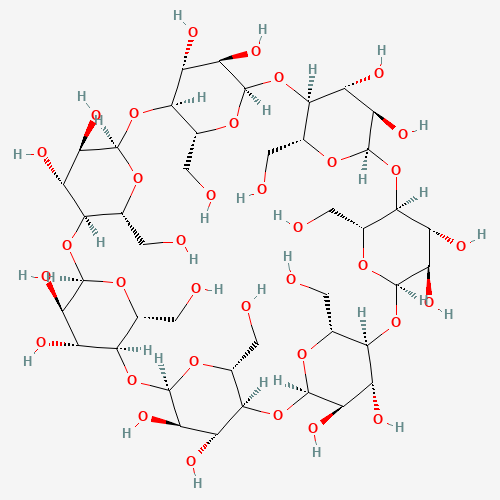
Beta-cyclodextrin is a ring-shaped sugar with a hollow centre, used to trap and protect flavours, to mask bitterness, and to remove cholesterol from dairy products.
Where it is and isn’t permitted
| Jurisdiction | Status | Scope and limits | Citation |
|---|---|---|---|
| Australia and New Zealand | No listed food uses foundThis site has not matched this substance to any food use on this jurisdiction’s list of authorised food additives. A food additive may be used only in foods that list names. Flavourings, enzymes, processing aids and added nutrients are regulated separately and do not appear on it. | ||
| Canada | No listing matchedHealth Canada’s lists name additives without E or INS numbers, so this site matches them by exact name. A substance listed there under a name this site does not recognise has no row here. | ||
| European Union | Permitted, with conditions | 3 food categories highest permitted level 500 mg/l Show every food category
| Regulation (EC) No 1333/2008and 2 further provisionsretrieved 2026-10-18 |
| Great Britain | Permitted, with conditions | 4 food categories highest permitted level 500 mg/kg or mg/l Show every food category
| Assimilated Regulation (EC) No 1333/2008and 3 further provisionsretrieved 2026-10-18 |
| Japan | No listing matchedThis site imports only Japan’s list of designated additives (Appended Table 1 to the Regulations for Enforcement of the Food Sanitation Act), matched by English name. Existing additives, natural flavouring agents and ordinary foods used as additives are permitted outside that list and are not imported, so an empty row does not show that Japan does not permit the substance. | ||
| South Korea | No listing matchedThis site imports Part III of South Korea’s Standards and Specifications for Food Additives, matched by CAS number, then INS number, then exact name. Mixed preparations and sanitisers are not imported, and an entry whose identifiers disagreed with a page’s is held for review, so an empty row does not show that South Korea does not permit the substance. | ||
| United States | Not listedDoes not appear on this jurisdiction’s permitted list. That is not the same as being prohibited. | ||
| Codex Alimentarius | Permitted, with conditions | 8 food categories highest permitted level 20,000 mg/kg Show every food category and its notes
| CXS 192-1995 Table One, INS 459and 7 further provisionsretrieved 2026-09-07 |
How much is permitted
A listing usually limits the quantity as well as the food. Only one of the forms that takes is a figure: quantum satis and good manufacturing practice permit the amount the technological effect requires and no more, which is a limit rather than the absence of one. Figures below are the range across every food category this page is listed in, and categories differ between regulators — see how much is permitted.
| European Union | 500 mg/kg | 1 numeric limit, 2 quantum satis |
|---|---|---|
| Great Britain | 500 mg/kg | 1 numeric limit, 3 quantum satis |
| Codex Alimentarius | 5 mg/kg – 20,000 mg/kg | 8 numeric limit |
What FDA’s inventory records
This page holds no listing for Cyclodextrin, beta- in the parts of 21 CFR this site reads. FDA’s Substances Added to Food inventory does carry it, as BETA-CYCLODEXTRIN, pointing at a flavour industry number, with no 21 CFR citation, and FEMA number 4028.
Technical effects FDA records: flavoring agent or adjuvant, formulation aid.
The inventory is an information resource: a row means FDA holds information about the substance’s use in food, not that the substance is listed for that use. It is shown apart from the permissions above and is not counted as a US permission anywhere on this site.
GRAS notices to the FDA
A GRAS notice is a company’s conclusion that a substance is generally recognised as safe for the use it describes. FDA’s letter responds to that conclusion, for that notifier and that use. It is not a listing in 21 CFR, and it is not counted as a US permission above. The substance and use are as FDA’s inventory words them; this site matched the notice to this page by exact name.
GRN No. 74 · Beta-cyclodextrin · Wacker Biochem Corp.
Intended use: Use in baked goods prepared from dry mixes, breakfast cereal, chewing gum, gelatins and puddings, dry mix for soups, flavored coffee and tea, compressed candies, processed cheese products, flavored savory snacks and crackers, dry mix for beverages as a flavor carrier or protectant at varying levels
FDA’s response (2001-10-25): FDA has no questions
What it is made from
Produced by treating starch with cyclodextrin glycosyltransferase, an enzyme that closes chains of seven glucose units into a ring. The ring's interior is water-repelling, which is what lets it hold a guest molecule.
- Vegan
- Vegetarian
Compare other additives on the dietary indexes.
- CAS registry number
- 7585-39-9
- InChIKey
- WHGYBXFWUBPSRW-FOUAGVGXSA-N
- PubChem
- CID 444041
The two specifications, compared
The European Union sets identity and purity by regulation; JECFA publishes its own through FAO, advisory until a country adopts it. Both documents are below in full. These are the parameters each puts a number on.
| Parameter | European Union | JECFA |
|---|---|---|
| Assay | no less than 98 % | no less than 98 % |
| Sulphated ash | no more than 0.1 % | no more than 0.1 % |
| Lead | no more than 1 mg/kg | no more than 1 mg/kg |
| Arsenic | no more than 1 mg/kg | — |
The two documents state the same figures for every parameter compared here.
How the EU defines it
The legal specification an additive must meet to be sold as this E number in the EU — what it is, how it may be made, and the purity it must reach. From Commission Regulation (EU) No 231/2012.
E 459 Beta-cyclodextrin
Beta-cyclodextrin is a non-reducing cyclic saccharide consisting of seven α-1,4-linked D-glucopyranosyl units. The product is manufactured by the action of the enzyme cycloglycosyltransferase (CGTase) obtained from Bacillus circulans, Paenibacillus macerans or recombinant Bacillus licheniformis strain SJ1608 on partially hydrolysed starch
Assay, identification and purity criteria
Description and assay
- Einecs
- 231-493-2
- Chemical name
- Cycloheptaamylose
- Chemical formula
- (C₆H₁₀O₅)₇
- Molecular weight
- 1 135
- Assay
- Content not less than 98,0 % of (C₆H₁₀O₅)₇ on an anhydrous basis
- Description
- Virtually odourless white or almost white crystalline solid
- Appearance of the aqueous solution
- Clear and colourless
Identification
- Solubility
- Sparingly soluble in water; freely soluble in hot water; slightly soluble in ethanol
- Specific rotation
- [α]D ²⁵ + 160° to + 164° (1 % solution)
- pH value:
- 5,0-8,0 (1 % solution)
Purity criteria
- Water content
- Not more than 14 % (Karl Fischer method)
- Other cyclodextrins
- Not more than 2 % on an anhydrous basis
- Solvent residues
- Not more than 1 mg/kg of each of toluene and trichloroethylene
- Sulphated ash
- Not more than 0,1 %
- Arsenic
- Not more than 1 mg/kg
- Lead
- Not more than 1 mg/kg
How JECFA defines it
The international specification for identity and purity, prepared by the Joint FAO/WHO Expert Committee on Food Additives and published by FAO. It is a different document from any above, written by a different body and revised on its own cycle; it is advisory, and a country adopts it or does not.
INS 459 beta-Cyclodextrin
A non-reducing cyclic saccharide consisting of seven alpha-1,4-linked D-glucopyranosyl units manufactured by the action of cyclodextrin transglycolase on hydrolysed starch followed by purification of the ß- cyclodextrin; purification is by preparation of a ß-cyclodextrin/solvent inclusion compound followed by steam-stripping of the solvent before final purification.
Synonyms: Beta-cyclodextrin, ßCD, BCD, ß-Schardinger dextrin, cyclodextrin B, INS No. 459 BCD; beta-Cyclodextrin; beta-Schardinger dextrin; Cyclodextrin B
Assay, identification and purity criteria
Description and assay
- Specification history
- ß-CYCLODEXTRIN Prepared at the 44th JECFA (1995), published in FNP 52 Add 3 (1995) superseding specifications prepared at the 41st JECFA (1993), published in FNP 52 Add 2 (1993). Metals and arsenic specifications revised at the 63rd JECFA (2004). An ADI of 0-5 mg/kg bw was established at the 44th JECFA (1995)
- Chemical names
- Cycloheptaamylose
- C.A.S. number
- 7585-39-9
- Chemical formula
- (C 6 H 10 O 5 ) 7
- Formula weight
- 1135.00
- Assay
- Not less than 98.0% of (C 6 H 10 O 5 ) 7 on an anhydrous basis
- DESCRIPTION
- Virtually odourless, slightly sweet tasting white or almost white crystalline solid
- FUNCTIONAL USES
- Encapsulation agent for food additives, flavouring and vitamins
- METHOD OF ASSAY
- Principle ß-Cyclodextrin is identified by liquid chromatography and quantified by comparison to reference standards containing standard cyclodextrins. Preparation of sample solution Weigh accurately about 500 mg of sample. Add 50 ml of twice-distilled water. Heat and stir until the sample has completely dissolved. Cool, adjust the total volume to 100 ml. Filter on a Millex HA 0.45 μm filter. Preparation of standard solutions Use USP grade alpha- and ß-cyclodextrin. Samples of gamma-cyclodextrin can be obtained from commercial suppliers such as Aldrich Chemical Co. or Sigma Chemical Co. Prepare three standard solutions (S 1 , S 2 and S 3 ) containing increasing amounts (mg/kg) of alpha-cyclodextrin, ß-cyclodextrin and gamma-cyclodextrin as follows: S 1 : 2.0 mg/kg A + 3.0 mg/kg B + 2.0 mg/kg G S 2 : 3.5 mg/kg A + 5.0 mg/kg B + 3.5 mg/kg G S 3 : 5.0 mg/kg A + 8.0 mg/kg B + 5.0 mg/kg G where A = alpha- cyclodextrin B = ß-cyclodextrin G = gamma-cyclodextrin Apparatus Liquid chromatograph maintained at a constant temperature of 25 o and equipped with a refractive index detector. Conditions Column - length: 25 cm - diameter: 4.6 mm - packing: 5 μm octadecylsilane bonded to silica (Silica Cl8) with a guard column containing the same packing Solvent: Water: methanol (94:6) Flow rate: 0.7 ml/min Procedure Inject 10 μl of each of the 3 standard solutions. For each cyclodextrin draw a graph by plotting on the x axis the concentration in g/l and on the y axis the areas of the peaks. Inject 10 μl of the sample solution and determine the area of the eluted ß-cyclodextrin peak. The concentration of ß- cyclodextrin (L g/l) in the sample solution is then read from the graphs. Calculation Calculate the content of ß-cyclodextrin in the sample using the formula: where B = percentage of ß-cyclodextrin in the sample L = the concentration of ß-cyclodextrin in the sample solution as determined under "Procedure" C = the concentration of sample in the sample solution in g/l.
Identification
- Solubility ( Vol. 4)
- Sparingly soluble in water; freely soluble in hot water; slightly soluble in ethanol
- Specific rotation (Vol. 4)
- [alpha] 25, D: Between +160 and +164 o (1% solution)
- Infrared absorption
- The infrared spectrum of the sample corresponds with that of a reference standard.
- Chromatography
- The retention time for the major peak in the liquid chromatogram of the sample solution corresponds to that for ß-cyclodextrin in the chromatograms of the standard solutions prepared as directed in the Method of Assay.
Purity criteria
- Water (Vol. 4)
- Not more than 14% (Karl Fischer Method)
- Other cyclodextrins
- Not more than 2% on an anhydrous basis See description under TESTS
- Residual solvents
- Not more than 1 mg/kg of each of toluene and trichloroethylene See description under TESTS
- Reducing substances (Vol. 4)
- Not more than 1% (as glucose)
- Sulfated ash (Vol. 4)
- Not more than 0.1%
- Lead (Vol. 4)
- Not more than 1 mg/kg Determine using an atomic absorption technique appropriate to the specified level. The selection of sample size and method of sample preparation may be based on the principles of the method described in Volume 4, “Instrumental Methods.” .
- Test: Other cyclodextrins
- Analyses of alpha- and gamma-cyclodextrins are included in the Method of Assay. Adjust the attenuation of the instrument or adjust sample size to obtain a chromatogram in which the ß-cyclodextrin peak height nearly reaches the top of the recording chart. Measure peak heights or peak areas of the alpha-, ß- and gamma-cyclodextrin responses. Calculate % other cyclodextrins (CX) using the formula:
- Test: Residual solvents
- A dynamic-headspace gas chromatographic technique is used for the following procedure. The organic volatile impurities are trapped on an absorbent trap and the purge gas is vented. The trapped organic volatile impurities are desorbed from the trap by heating the trap, and carried into the gas chromatograph by back flushing the trap with the carrier gas. Quantitate each solvent by the technique of standard additions. Purge and Trap Apparatus (The apparatus is based on that described in the US Environmental Protection Agency Test Method for Purgeable Halocarbons - Method 601): The apparatus consists of three separate sections: the sample purge; the trap; and the desorber. The sample purge is designed to accept 5 ml samples with a water column at least 3 cm deep. The gaseous headspace between the water column and the trap has a total volume of less than 15 ml. The purge gas is passed through the water column as finely-divided bubbles with a diameter of less than 3 mm at the origin. The purge gas is introduced not more than 5 mm from the base of the water column. The trap is not less than 25 cm long and has an inside diameter of not less than 2.67 mm. The trap is packed to contain the indicated minimum lengths of adsorbents in the following order, beginning at the trap inlet: 7.7 cm of 2,6-diphenylene oxide polymer (the 2,6-diphenylene oxide polymer is commercially available as TENAX TA), 7.7 cm of silica gel, and 7.7 cm of coconut charcoal. The desorber is capable of rapidly heating the trap at 2500. The trap should not be heated higher than 2500. Condition the assembled trap, prior to initial use, at 2250 overnight with an inert gas at a flow rate of not less than 20 ml per min. Prior to use daily, condition the trap for 15 min at 225º. Standard Solution Accurately weigh 50 mg of trichloroethylene and 50 mg of toluene in a 50 ml volumetric flask. Dilute with methanol. Calibration Solutions Into five 50 ml volumetric flasks, accurately add 0.5, 1.0, 2.0, 3.0, and 5.0 ml of the Standard Solution and dilute with water. These calibration solutions correspond to the concentrations 10.2, 20.4, 40.8, 61.2 and 102 ng per for each solvent. Chromatographic system The purge and trap apparatus is connected to a gas chromatograph with a flame-ionisation detector. Column: capillary column, 30 m, 0.32 mm diameter, 1 micron film thickness of dimethylpolysiloxane oil (such as DB-1, OV-1). Temperature programme: 40º for 3 min, then raise to 220º at 40 per min. Detector: 280º Carrier gas: Helium Purge gas: Nitrogen Flow rate: 40 ml/min Calibration Introduce precisely 20 μl of each calibration solution on the wall (inner side) of the sample purge. Desorb according to equipment instructions. Record the peak areas. Prepare calibration graphs of peak areas versus weight of each solvent introduced into the purge. Procedure Introduce on the fritted sparger of the sample purge an accurately weighed amount of sample (W), about 250 mg. Purge and desorb according to equipment instructions. Record the peak area of each solvent and read the corresponding weight (X) from the respective calibration curve. Calculation Calculate the amount of each residual solvent by the formula:
Authorised in other additives, enzymes, flavourings and nutrients
These authorisations are not for use in food. They let this substance be used inside another additive, a food enzyme, a flavouring or a nutrient preparation — often as a carrier — and it reaches food only as part of that product. Annex III to Regulation (EC) No 1333/2008.
| Part | May be used in | Maximum level | Citation |
|---|---|---|---|
| Annex III, Part 1: Carriers in food additives | All food additives | 1 000 mg/kg in final food | Regulation (EC) No 1333/2008, Annex III, Part 1 |
| Annex III, Part 4: Food additives including carriers in food flavourings | Encapsulated flavourings in: flavoured snacks | 1 000 mg/kg in foodstuffs as consumed or as reconstituted according to the instructions of the manufacturer | Regulation (EC) No 1333/2008, Annex III, Part 4 |
| Annex III, Part 4: Food additives including carriers in food flavourings | Encapsulated flavourings in: flavoured teas and flavoured powdered instant drinks | 500 mg/l in final food | Regulation (EC) No 1333/2008, Annex III, Part 4 |
| Annex III, Part 5, Section A: Food additives added in nutrients except in nutrients intended to be used in foodstuffs listed in Part E, point 01.10, of Annex II and foodstuffs for infants and young children listed in Part E, point 13.1, of Annex II | All nutrientsCan be used as a carrier: Yes | 100 000 mg/kg in the preparation and 1 000 mg/kg in final food | Regulation (EC) No 1333/2008, Annex III, Part 5, Section A |
Every name it appears under
86 recorded names. A label may use any of them.
E number
- E459
INS number
- 459
CAS registry number
- 37331-89-8
- 7585-39-9
As it appears in regulation
- Beta-cyclodextrin
Other names
- -Cyclodextrin(Discontinued,See C4X-25742)
- .beta.-Cyclodextrin
- 1dmb
- 2zyn
- ALFADEX IMPURITY A [EP IMPURITY]
- b-Cyclodextrin
- BETA BYCLODEXTRIN
- Beta cyclodextrin
- beta-CD
- beta-cyclo-dextrin
- beta-Cycloamylose
- Beta-cyclodextrin
- beta-Cyclodextrin, >=97%
- beta-Cyclodextrin, produced by Wacker Chemie AG, Burghausen, Germany
- beta-cyclodextrine
- beta-Cyclodextrins
- beta-Cycloheptaamylose
- beta-Dextrin
- Beta-schardinger dextrin
- Betacd
- betacyclodextrin
- Betadex
- Betadex (NF/INN)
- Betadex CRS
- Betadex, European Pharmacopoeia (EP) Reference Standard
- Betadex;Alfadex EP Impurity A
- betadexum
- CAVAMAX W7
- CCRIS 651
- cyclo-epta-amylose
- Cyclodextrin B
- CYCLODEXTRIN, BETA-
- Cycloheptaamylose
- Cycloheptaglucan
- Cycloheptaglucosan
- CYCLOHEPTAKIS-(1->4)-(.ALPHA.-D-GLUCOPYRANOSYL)
- Cycloheptapentylose
- Cyclomaltoheptaose
- Dextrin, beta-cyclo
- E 459
- heptakis(hydroxymethyl)[?]tetradecol
- INS NO.459
- INS-459
- JV039JZZ3A
- Kleptose
- Kleptose B
- Maltodecaose DP10
- Oristar bcd
- Rhodocap N
- Ringdex B
- Ringdex BL
- Ringdex-b
- Schardinger A-Dextrin
- Schardinger beta-dextrin
- ss-Cyclodextrin
- SULFOBUTYLBETADEX SODIUM IMPURITY A [EP IMPURITY]
- yena-Cyclodextrin
Systematic names
- (1S,3R,5R,6S,8R,10R,11S,13R,15R,16S,18R,20R,21S,23R,25R,26S,28R,30R,31S,33R,35R,36R,37R,38R,39R,40R,41R,42R,43R,44R,45R,46R,47R,48R,49R)-5,10,15,20,25,30,35-heptakis(hydroxymethyl)-2,4,7,9,12,14,17,19,22,24,27,29,32,34-tetradecaoxaoctacyclo[31.2.2.2~3,6~.
- Betadex; Cycloheptakis-(1?4)-(a-d-glucopyranosyl) (cyclomaltoheptaose); Cycloheptakis-(1?4)-(a-d-glucopyranosyl) ss-cyclodextrin
Hazard reference values
EFSA and JECFA have both set an acceptable daily intake for Cyclodextrin, beta-, and they agree: 5 mg/kg bw/day. An acceptable daily intake is a reference value set by a committee, not a threshold above which harm begins. See where the two committees differ.
Evidence and how bodies read it
What assessing bodies concluded
Each conclusion is paraphrased in the body's own framing, from the published opinion linked beneath it. Where bodies differ, both stand; this site does not adjudicate between them or add a view of its own.
EFSA 2016
The ANS Panel found no indication of genotoxicity or carcinogenicity for β-cyclodextrin (E 459) and saw no reason to revise the ADI of 5 mg/kg bw/day. It concluded, however, that the ADI was exceeded in the refined brand-loyal exposure scenario in most population groups.
Common questions
Assembled from what is above, in the words the questions are usually asked in. Each answer is the same statement the relevant section makes, with the same citations behind it.
- What is E 459?
- E 459 is Cyclodextrin, beta-. Beta-cyclodextrin is a ring-shaped sugar with a hollow centre, used to trap and protect flavours, to mask bitterness, and to remove cholesterol from dairy products.
- What is Cyclodextrin, beta- used for in food?
- It is listed as a thickener, a stabiliser and a flavouring agent — the role Codex and the US assign it. This page shows every function each regulator records, with the citation for each.
- Where is Cyclodextrin, beta- permitted?
- Of the seven regulators this site reads, the EU, Great Britain and the Codex standard permit it. Each permission is for named foods at named levels, not a blanket one; the table on this page gives them with citations.
- Is Cyclodextrin, beta- vegan?
- Yes. Cyclodextrin, beta- is not derived from animals, and is suitable for vegetarians. This page says what it is made from and how.
Sources for this page
- eu retrieved 2026-10-18
- gb retrieved 2026-10-18
- gsfa retrieved 2026-09-07
- euspecs retrieved 2026-10-18
- jecfaspecs retrieved 2026-09-23
Full licence terms and publisher details on Sources. How this page is built and updated: Method.
Machine-readable: a JSON record of this additive is given on request —how to ask for access.
Follow changes to Cyclodextrin, beta-:Atom feed — regulatory events, and any change the weekly refresh detects in its provisions.