Magnesium silicate
1343-88-0 · 14987-04-3 · Ambosol · Avibest · Britesorb · Britesorb 90 · Britesorb No. 40 · Caswell No. 533 · Celkate T 21 · Chooz · E 553a(i) · E 553a(ii) · EPA Pesticide Chemical Code 072601 · Florisil · Gastomag · Haiburaito 1250 · Haiburaito 325 · HS-T (silicate) · HSDB 5823 · INS NO.553(I) · INS-553(I) · Kyowaad 600S · Macrosorb M 15 · Magmasil · Magnesium hydrosilicate · Magnesium silicate · Magnesium silicate (talc) · Magnesium silicate, synthetic · Magnesium trisilicate · Magnesol · Magnesol XL · Magsorbent · Mizuka Life P 1G · Mizupearl M 302 · Naisuton · Nikkagel M · Novasorb · Salisil · Sep-Pak Florisil · Shimugon M · Silicic acid, magnesium salt · Silton SS 1 · Tri-Sil · Trinesium · Trisomin · E553a · 553(i) · dimagnesium tetraoxidosilane · Dimagnesium trisilicon octaoxide · Magnesium silicate · Krzemian magnezu · Křemičitan hořečnatý · Magneesiumsilikaat · Magnesium silicate · Magnesiumsilicaat · Magnesiumsilicat · Magnesiumsilicate · Magnesiumsilikaatti · Magnesiumsilikat · Magnezijev silikat · magnezijevi silikati · Magnija silikāts · Magnio silikatas · Magnézium-szilikát · Silicat de magneziu · Silicate de magnésium · Silicato de magnésio · Silicato di magnesio · Silicato magnésico · Silikat tal-manjeżju · Πυριτικό μαγνήσιο · Магнезиев силикатE number E553aINS 553(i)CAS 1343-88-0
Listed as an anticaking agent by Canada, Codex and the US.
Listed as anticaking agents (CA, US, Codex) · glazing and surface-finishing agents (CA) · formulation aids (US) · lubricants and release agents (CA)
- Canada: Anticaking agent — Health Canada, List of Permitted Anticaking Agents (List 1)
- United States: Anticaking agent or free-flow agent — FDA, Substances Added to Food: MAGNESIUM SILICATE
- Codex Alimentarius: Anticaking agent — CXS 192-1995 Table One, INS 553(i)
- Canada: Glazing agent — Health Canada, List of Permitted Glazing Agents (List 7)
- United States: Formulation aid — FDA, Substances Added to Food: MAGNESIUM SILICATE
- Canada: Release agent — Health Canada, List of Permitted Food Additives with Other Purposes of Use (List 8)
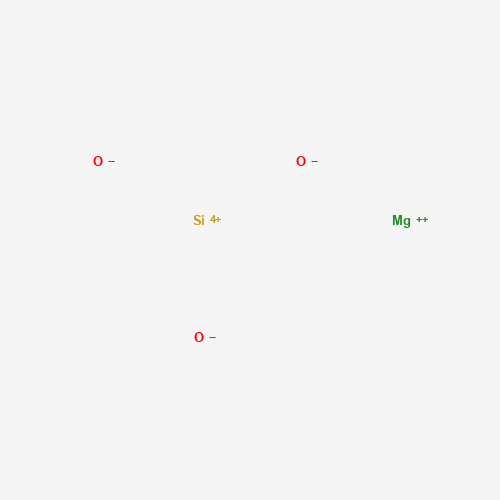
Magnesium silicate is an anticaking agent used in powdered foods, table salt and confectionery.
Where it is and isn’t permitted
| Jurisdiction | Status | Scope and limits | Citation |
|---|---|---|---|
| Australia and New Zealand | Permitted, with conditions | 54 food categories no numerical limit (good manufacturing practice) Show every food category
| Food Standards Code, Schedule 15, S15—5and 53 further provisionsretrieved 2026-10-17 |
| Canada | Permitted, with conditions | highest permitted level 4,000 mg/kg 8 permitted uses Show every permitted use
| Health Canadaand 7 further provisionsretrieved 2026-10-17 |
| European Union | Permitted, with conditions | 17 food categories highest permitted level 30,000 mg/kg Show every food category
| Regulation (EC) No 1333/2008, Annex IIand 16 further provisionsretrieved 2026-10-18 |
| Great Britain | Permitted, with conditions | 18 food categories highest permitted level 30,000 mg/kg or mg/l Show every food category
| Assimilated Regulation (EC) No 1333/2008and 17 further provisionsretrieved 2026-10-18 |
| Japan | Permitted, with conditions | Designated additive: Appended Table 1, item 141, ケイ酸マグネシウム (“Magnesium Silicate” in the unofficial English translation). …Designated additive: Appended Table 1, item 141, ケイ酸マグネシウム (“Magnesium Silicate” in the unofficial English translation). Standards for use — Specifications and Standards for Foods, Food Additives, etc. (MHW Notification No. 370 of 1959), Part II (Food Additives), F (Standards for use), entry ケイ酸マグネシウム: (1) [may be used only for the uses stated; must be removed or broken down before the food is finished] “ケイ酸マグネシウムは、油脂のろ過助剤以外の用途に使用してはならない。また、使用したケイ酸マグネシウムは、最終食品の完成前に除去しなければならない。” The Japanese is the standard as published. There is no official English translation of the Notification; the English in square brackets is this site’s description of what each sentence does, not a translation of the foods or the levels. Compositional specifications for this additive, in the same Notification, are not imported and are not shown here; nor are the general rules in F 添加物一般, which apply to every additive. | Regulations for Enforcement of the Food Sanitation Act (MHW Ordinance No. 23 of 1948), Appended Table 1retrieved 2026-10-18 |
| South Korea | Permitted, with conditions | Designated food additive: Standards and Specifications for Food Additives, Part III, 1. …Designated food additive: Standards and Specifications for Food Additives, Part III, 1. 일반식품첨가물 (general food additives), 규산마그네슘 (“Magnesium Silicate”, the English the Code prints beside it); the Code marks it as also usable as a processing aid; 2. 가공보조제 (processing aids), 규산마그네슘 (“Magnesium Silicate”, the English the Code prints beside it); the Code marks it as also usable as a general food additive. Main use (주용도) of 규산마그네슘: 고결방지제. Standard for use (사용기준) of 규산마그네슘: (1) [may be used only in the foods listed; sets a limit on the amount used] “규산마그네슘은 아래의 식품에 한하여 사용하여야 한다. 규산마그네슘의 사용량은 1. 가공유크림(자동판매기용 분말 제품에 한함):1% 이하(이산화규소 또는 규산칼슘과 병용할 때에는 각각의 사용량의 합계가 1% 이하) 2. 분유류(자동판매기용에 한함):1% 이하(이산화규소 또는 규산칼슘과 병용할 때에는 각각의 사용량의 합계가 1% 이하) 3. 식염:2% 이하(이산화규소 또는 규산칼슘과 병용할 때에는 각각의 사용량의 합계가 2% 이하)” Main use (주용도) of 규산마그네슘: 여과보조제. Standard for use (사용기준) of 규산마그네슘: (1) [must be removed before the final food is complete] “규산마그네슘은 최종식품의 완성 전에 제거하여야 한다.” The Korean is the standard as published. There is no official English translation of the current Code (the English version on MFDS’s website is the 2020 edition and has no legal effect); the English in square brackets is this site’s description of what each sentence does, not a translation of the foods or the levels. Compositional specifications (Part IV) are not imported, nor are the general standards in Part II, which apply to every additive. | Standards and Specifications for Food Additives (식품첨가물의 기준 및 규격), MFDS Notification, Part III (Standards for use, by item)retrieved 2026-10-18 |
| United States | Permitted | 21 CFR 182.2437retrieved 2026-10-17 | |
| Codex Alimentarius | Permitted, with conditions | 8 food categories highest permitted level 15,000 mg/kg Show every food category and its notes
| CXS 192-1995 Table Three, INS 553(i)and 8 further provisionsretrieved 2026-09-07 |
How much is permitted
A listing usually limits the quantity as well as the food. Only one of the forms that takes is a figure: quantum satis and good manufacturing practice permit the amount the technological effect requires and no more, which is a limit rather than the absence of one. Figures below are the range across every food category this page is listed in, and categories differ between regulators — see how much is permitted.
| Australia and New Zealand | — | 54 GMP |
|---|---|---|
| Canada | 4,000 mg/kg | 1 numeric limit, 4 GMP, 3 no quantity stated |
| European Union | 10,000 mg/kg – 30,000 mg/kg | 11 numeric limit, 6 quantum satis |
| Great Britain | 10,000 mg/kg – 30,000 mg/kg | 10 numeric limit, 2 several limits, 6 quantum satis |
| Japan | — | 1 no quantity stated |
| South Korea | — | 1 no quantity stated |
| United States | — | 1 no quantity stated |
| Codex Alimentarius | 10,000 mg/kg – 15,000 mg/kg | 2 numeric limit, 7 GMP |
What it is made from
Precipitated by reacting a magnesium salt with sodium silicate.
- Vegan
- Vegetarian
Compare other additives on the dietary indexes.
- CAS registry number
- 1343-88-0
- InChIKey
- ZADYMNAVLSWLEQ-UHFFFAOYSA-N
- PubChem
- CID 72941442
The two specifications, compared
The European Union sets identity and purity by regulation; JECFA publishes its own through FAO, advisory until a country adopts it. Both documents are below in full. These are the parameters each puts a number on.
| Parameter | European Union | JECFA |
|---|---|---|
| Assay | no less than 15 % | no less than 15 % |
| Loss on drying | no more than 15 % | no more than 15 % |
| Lead | no more than 5 mg/kg | no more than 5 mg/kg |
| Arsenic | no more than 3 mg/kg | — |
| Mercury | no more than 1 mg/kg | — |
The two documents state the same figures for every parameter compared here.
How the EU defines it
The legal specification an additive must meet to be sold as this E number in the EU — what it is, how it may be made, and the purity it must reach. From Commission Regulation (EU) No 231/2012.
E 553a(i) Magnesium silicate
Magnesium silicate is a synthetic compound of which the molar ratio of magnesium oxide to silicon dioxide is approximately 2:5
Assay, identification and purity criteria
Description and assay
- Assay
- Content not less than 15 % of MgO and not less than 67 % of SiO₂ on the ignited basis
- Description
- Very fine, white, odourless powder, free from grittiness
Identification
- Test for magnesium
- Passes test
- Test for silicate
- Passes test
- pH
- Between 7,0 and 10,8 (10 % slurry)
Purity criteria
- Loss on drying
- Not more than 15 % (105 °C, 2 hours)
- Loss on ignition
- Not more than 15 % after drying (1 000 °C, 20 min)
- Water soluble salts
- Not more than 3 %
- Free alkali
- Not more than 1 % (as NaOH)
- Fluoride
- Not more than 10 mg/kg
- Arsenic
- Not more than 3 mg/kg
- Lead
- Not more than 5 mg/kg
- Mercury
- Not more than 1 mg/kg
How JECFA defines it
The international specification for identity and purity, prepared by the Joint FAO/WHO Expert Committee on Food Additives and published by FAO. It is a different document from any above, written by a different body and revised on its own cycle; it is advisory, and a country adopts it or does not.
INS 553(i) Magnesium Silicate, synthetic
Magnesium silicate (synthetic) is manufactured by the precipitation reaction between sodium silicate and a soluble magnesium salt. The aqueous suspension of the precipitate is filtered and the collected solid washed, dried, classified for particle size and packaged. The finest material is intended for use as an anticaking agent and the coarser particles are for use as a filtering aid. The moisture content of the material meant for use as an anticaking agent is kept to less than 15%. Although magnesium silicate is of variable composition, the molar ratio of MgO to SiO2 is approximately 2:5.
Synonyms: INS No. 553(i)
Assay, identification and purity criteria
Description and assay
- Specification history
- Prepared at the 74 th JECFA (2011) and published in FAO Monographs 11 (2011) superseding specifications prepared at the 61 st JECFA (2003), published in the Combined Compendium of Food Additive Specifications, FAO JECFA Monographs 1 (2005). An ADI ‘not specified’ was established at the 25 th JECFA (1981).
- Chemical name
- Magnesium silicate
- C.A.S. number
- 1343-88-0
- Assay
- Not less than 15% of MgO and not less than 67% of SiO2, calculated on the ignited basis.
- DESCRIPTION
- Very fine, white, odourless powder, free from grittiness
- FUNCTIONAL USES
- Anticaking agent, filtering aid
- METHOD OF ASSAY
- Magnesium oxide and silicon dioxide: Weigh about 0.5 g of the sample to the nearest 0.1 mg, in a platinum or nickel crucible, add 5 g potassium hydroxide and 2 g boric acid, mix and melt completely using a torch burner (alkali fusion) and allow to stand at room temperature. Place the reaction product along with crucible in a 250-ml PTFE beaker, add 150 ml hot deionized water and dissolve residue by agitation. Wash the crucible with hot deionized water and remove it. Add 50 ml hydrochloric acid and transfer the contents into a 250-ml volumetric flask. Wash the beaker three times with hot deionized water, transfer the washings to the volumetric flask and make up to volume (Solution A). Prepare the test solution by diluting Solution A with 2% hydrochloric acid solution. Analyze magnesium and silica in the test solution by ICP-AES technique (Vol. 4). Set instrument parameters as specified by the instrument manufacturer and use the analytical lines for Si (251.611 nm) and Mg (279.553 nm). Read the concentration (as μg/ml) of Mg and Si from respective standard curves. Calculate the magnesium oxide and silicon dioxide content of the sample, on the ignited basis, using the formula: 4.1458 x C x DF %MgO (on the ignited basis) = W x [100 – (%LOD+%LOI)] 5.3504 x C x DF %SiO2 (on the ignited basis) = W x [100 – (%LOD+%LOI)] where C is concentration of Mg or Si in the test solution, μg/ml; DF is dilution factor (dilution of Solution A to get test solution); W is weight of sample, g; %LOD is % loss on drying; and %LOI is % loss on ignition.
Identification
- Solubility (Vol. 4)
- Insoluble in water
- pH (Vol. 4)
- 7.0-11.0 (1 in 10 slurry)
- Magnesium (Vol. 4)
- Mix about 0.5 g of the sample with 10 ml of dilute hydrochloric acid TS, filter, and neutralize the filtrate to litmus paper with ammonia TS. The neutralized filtrate gives a positive test for magnesium.
- Silicate
- Prepare a bead by fusing a few crystals of sodium ammonium phosphate on a platinum loop in the flame of a Bunsen burner. Place the hot, transparent bead in contact with the sample, and again fuse. Silica floats about in the bead, producing, upon cooling, an opaque bead with a web-like structure.
Purity criteria
- Loss on drying (Vol. 4)
- Not more than 15% (for material used as an anticaking agent (105°, 2 h)) Retain the dried sample for determination of loss on ignition.
- Loss on ignition (Vol. 4)
- Not more than 15% on the dried basis Weigh to the nearest 0.1 mg, 1 g of the dried sample in a tared platinum crucible provided with a cover. Gradually apply heat to the crucible at first, then strongly ignite at 900/1000° for 20 min. Cool, weigh and calculate as percentage.
- Free alkali
- Not more than 1% (as NaOH) Add 2 drops of phenolphthalein TS to 20 ml of dilute filtrate prepared in the test for Soluble salts (see below), representing 1 g of the sample. Not more than 2.5 ml of 0.1 N hydrochloric acid should be required to discharge the pink colour produced.
- Soluble salts
- Not more than 3% Boil 10 g of the sample with 150 ml of water for 15 min. Cool to room temperature, and add water to restore the original volume. Allow the mixture to stand for 15 min, and filter until clear. Retain 20 ml of the filtrate for the test Free alkali. Evaporate 75 ml of the filtrate, representing 5 g of the sample in a tared platinum dish on a steam bath to dryness, and ignite gently to constant weight. Cool, weigh and calculate as percentage (the weight of the residue should not exceed 150 mg).
- Fluoride (Vol. 4)
- Not more than 10 mg/kg Weigh 2.5 g of the sample to the nearest mg and proceed as directed in the Fluoride Limit Test (Method I or III).
- Lead (Vol. 4)
- Not more than 5 mg/kg Determine using an AAS/ICP-AES technique appropriate to the specified level. The selection of sample size and method of sample preparation may be based on principles of methods described in Volume 4 (under “General Methods, Metallic Impurities”).
Authorised in other additives, enzymes, flavourings and nutrients
These authorisations are not for use in food. They let this substance be used inside another additive, a food enzyme, a flavouring or a nutrient preparation — often as a carrier — and it reaches food only as part of that product. Annex III to Regulation (EC) No 1333/2008.
| Part | May be used in | Maximum level | Citation |
|---|---|---|---|
| Annex III, Part 2: Food additives other than carriers in food additives | Dry powdered preparations of polyolsNote (1): Except enzymes authorised as food additives. | 10 000 mg/kg in the preparation | Regulation (EC) No 1333/2008, Annex III, Part 2 |
Every name it appears under
72 recorded names. A label may use any of them.
E number
- E553a
INS number
- 553(i)
CAS registry number
- 1343-88-0
- 14987-04-3
As it appears in regulation
- Magnesium silicate
Other names
- Ambosol
- Avibest
- Britesorb
- Britesorb 90
- Britesorb No. 40
- Caswell No. 533
- Celkate T 21
- Chooz
- E 553a(i)
- E 553a(ii)
- EPA Pesticide Chemical Code 072601
- Florisil
- Gastomag
- Haiburaito 1250
- Haiburaito 325
- HS-T (silicate)
- HSDB 5823
- INS NO.553(I)
- INS-553(I)
- Kyowaad 600S
- Macrosorb M 15
- Magmasil
- Magnesium hydrosilicate
- Magnesium silicate
- Magnesium silicate (talc)
- Magnesium silicate, synthetic
- Magnesium trisilicate
- Magnesol
- Magnesol XL
- Magsorbent
- Mizuka Life P 1G
- Mizupearl M 302
- Naisuton
- Nikkagel M
- Novasorb
- Salisil
- Sep-Pak Florisil
- Shimugon M
- Silicic acid, magnesium salt
- Silton SS 1
- Tri-Sil
- Trinesium
- Trisomin
Systematic names
- dimagnesium tetraoxidosilane
- Dimagnesium trisilicon octaoxide
The EU re-evaluation programme
Every additive authorised in the EU before 20 January 2009 was put back through EFSA by Commission Regulation (EU) No 257/2010, and this one is named in it. What the Regulation required is below; whether the opinion has since been published is not something this site records.
- To be evaluated by 31 December 2018. Named in Annex II, Part II, point 4 as “Magnesium silicate and trisilicate”, among the additives given priority within its class.
Hazard reference values
| Type | Value | Population | Assessed by | Opinion |
|---|---|---|---|---|
| ADI | not specified | — | JECFA | 1982 |
Evidence and how bodies read it
What assessing bodies concluded
Each conclusion is paraphrased in the body's own framing, from the published opinion linked beneath it. Where bodies differ, both stand; this site does not adjudicate between them or add a view of its own.
EFSA 2018
The ANS Panel concluded that the safety of calcium silicate (E 552), magnesium silicate and trisilicate (E 553a) and talc (E 553b) as food additives cannot be assessed, citing accumulation of silicon in rat kidney and liver and a lack of reliable longer-term toxicity data. It considered the SCF's group ADI for silicon dioxide and silicates obsolete and recommended revisions to the specifications.
Common questions
Assembled from what is above, in the words the questions are usually asked in. Each answer is the same statement the relevant section makes, with the same citations behind it.
- What is E 553a?
- E 553a is Magnesium silicate. Magnesium silicate is an anticaking agent used in powdered foods, table salt and confectionery.
- What is Magnesium silicate used for in food?
- It is listed as an anticaking agent — the role Canada, Codex and the US assign it. This page shows every function each regulator records, with the citation for each.
- Where is Magnesium silicate permitted?
- Of the seven regulators this site reads, Australia and New Zealand, Canada, the EU, Great Britain, Japan, South Korea, the US and the Codex standard permit it. Each permission is for named foods at named levels, not a blanket one; the table on this page gives them with citations.
- Is Magnesium silicate vegan?
- Yes. Magnesium silicate is not derived from animals, and is suitable for vegetarians. This page says what it is made from and how.
Sources for this page
- anz retrieved 2026-10-17
- ca retrieved 2026-10-17
- eu retrieved 2026-10-18
- gb retrieved 2026-10-18
- jp retrieved 2026-10-18
- kr retrieved 2026-10-18
- ecfr retrieved 2026-10-17
- gsfa retrieved 2026-09-07
- euspecs retrieved 2026-10-18
- jecfaspecs retrieved 2026-09-23
Full licence terms and publisher details on Sources. How this page is built and updated: Method.
Machine-readable: a JSON record of this additive is given on request —how to ask for access.
Follow changes to Magnesium silicate:Atom feed — regulatory events, and any change the weekly refresh detects in its provisions.