Propan-1-ol
62309-51-7 · 71-23-8 · 1 Propanol · 1-Hydroxypropane · 1-propanol · 1-Propanol, anhydrous · 1-Propanol-d3 · 1-PROPONOL · 1-Propyl alcohol · Albacol · Alcohol, propyl · Alcool propilico · Alcool propylique · ASTM Method D7059 Calibration Mixture 1 500-1200 microg/mL in Toluene · ASTM Method D7059 Calibration Mixture 2 500-600 microg/mL in Toluene · ASTM Method D7059 Calibration Mixture 3 300-500 microg/mL in Toluene · ASTM Method D7059 Calibration Mixture 4 150-500 microg/mL in Toluene · ASTM Method D7059 Calibration Mixture 5 100-500 microg/mL in Toluene · ASTM Method D7059 Calibration Mixture 6 25-500 microg/mL in Toluene · ASTM Method D7059 Calibration Mixture 7 5-500 microg/mL in Toluene · BRN 1098242 · Caswell No. 709A · CCRIS 3202 · EPA Pesticide Chemical Code 047502 · Ethyl carbinol · ethyl methanol · ethylcarbinol · FEMA No. 2928 · FEMA Number 2928 · HSDB 115 · Hydroxypropane · n-PrOH · n-Propan-1-ol · n-Propanol · n-Propyl alcohol · n-Propyl alkohol · NPA · optal · osmosol extra · POL · Propan-1-ol · propane-1-ol · propanol · Propanol, 1- · Propanol-1 · PROPANOL-1,1,2,2-D4 · PROPANOL-2,2-D2 · Propanol; Propan-1-ol · Propanole · Propanolen · Propanoli · Propyl alcohol · Propyl alcohol (natural) · Propyl alcohol, n- · Propyl alcohol, normal · Propyl-1,1-d2 alcohol · PROPYL-2-D1 ALCOHOL · propylalcohol · Propylan-propyl alcohol · Propylic alcohol · Propylowy alkoholCAS 71-23-8
Listed as a flavouring agent and a solvent by the US.
Listed as flavouring agents and adjuvants (US) · solvents and vehicles (US)
- United States: Flavoring agent or adjuvant — FDA, Substances Added to Food: PROPYL ALCOHOL
- United States: Solvent or vehicle — FDA, Substances Added to Food: PROPYL ALCOHOL
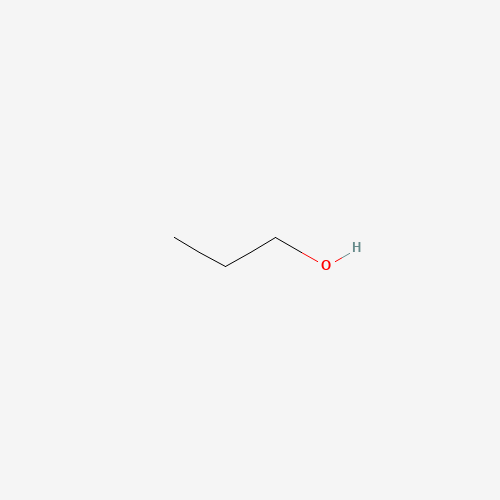
Propan-1-ol, or n-propanol, is used as a carrier solvent, an extraction solvent and a flavouring agent.
Where it is and isn’t permitted
| Jurisdiction | Status | Scope and limits | Citation |
|---|---|---|---|
| Australia and New Zealand | No listed food uses foundThis site has not matched this substance to any food use on this jurisdiction’s list of authorised food additives. A food additive may be used only in foods that list names. Flavourings, enzymes, processing aids and added nutrients are regulated separately and do not appear on it. | ||
| Canada | No listing matchedHealth Canada’s lists name additives without E or INS numbers, so this site matches them by exact name. A substance listed there under a name this site does not recognise has no row here. | ||
| European Union | No listed food uses foundThis site has not matched this substance to any food use on this jurisdiction’s list of authorised food additives. A food additive may be used only in foods that list names. Flavourings, enzymes, processing aids and added nutrients are regulated separately and do not appear on it. | ||
| Great Britain | No listed food uses foundThis site has not matched this substance to any food use on this jurisdiction’s list of authorised food additives. A food additive may be used only in foods that list names. Flavourings, enzymes, processing aids and added nutrients are regulated separately and do not appear on it. | ||
| Japan | Permitted, with conditions | Designated additive: Appended Table 1, item 367, プロパノール (“Propanol” in the unofficial English translation). …Designated additive: Appended Table 1, item 367, プロパノール (“Propanol” in the unofficial English translation). Standards for use — Specifications and Standards for Foods, Food Additives, etc. (MHW Notification No. 370 of 1959), Part II (Food Additives), F (Standards for use), entry プロパノール: (1) [may be used only for the purpose of flavouring] “プロパノールは、着香の目的以外に使用してはならない。” The Japanese is the standard as published. There is no official English translation of the Notification; the English in square brackets is this site’s description of what each sentence does, not a translation of the foods or the levels. Compositional specifications for this additive, in the same Notification, are not imported and are not shown here; nor are the general rules in F 添加物一般, which apply to every additive. | Regulations for Enforcement of the Food Sanitation Act (MHW Ordinance No. 23 of 1948), Appended Table 1retrieved 2026-10-18 |
| South Korea | No listing matchedThis site imports Part III of South Korea’s Standards and Specifications for Food Additives, matched by CAS number, then INS number, then exact name. Mixed preparations and sanitisers are not imported, and an entry whose identifiers disagreed with a page’s is held for review, so an empty row does not show that South Korea does not permit the substance. | ||
| United States | Permitted, with conditions | Named in the list of synthetic flavoring substances and adjuvants in 21 CFR 172.515(b), which may be safely used in food in the minimum quantity required to produce their intended effect. The section is held on this site as the page synthetic-flavoring-substances-and-adjuvants; read it for the conditions. | 21 CFR 172.515retrieved 2026-10-18 |
| Codex Alimentarius | Not listedDoes not appear on this jurisdiction’s permitted list. That is not the same as being prohibited. |
How much is permitted
A listing usually limits the quantity as well as the food. Only one of the forms that takes is a figure: quantum satis and good manufacturing practice permit the amount the technological effect requires and no more, which is a limit rather than the absence of one. Figures below are the range across every food category this page is listed in, and categories differ between regulators — see how much is permitted.
| Japan | — | 1 no quantity stated |
|---|---|---|
| United States | — | 1 no quantity stated |
No regulator sets a figure for Propan-1-ol. That is not an absence of control: where the listing says quantum satis or good manufacturing practice, the quantity is limited to what the effect requires.
What it is made from
Made industrially from propylene, and also formed during alcoholic fermentation as a fusel alcohol.
- Vegan
- Vegetarian
Compare other additives on the dietary indexes.
- CAS registry number
- 71-23-8
- InChIKey
- BDERNNFJNOPAEC-UHFFFAOYSA-N
- PubChem
- CID 1031
How JECFA defines it
The international specification for identity and purity, prepared by the Joint FAO/WHO Expert Committee on Food Additives and published by FAO. It is a different document from any above, written by a different body and revised on its own cycle; it is advisory, and a country adopts it or does not.
Propan-1-ol
Synonyms: n-Propyl alcohol; n-propanol; NPA; 1-hydroxypropane
Assay, identification and purity criteria
Description and assay
- Specification history
- Prepared at the 28th JECFA (1984), published in FNP 31/2 (1984) and in FNP 52 (1992). Metals and arsenic specifications revised at the 63rd JECFA (2004). No ADI was allocated at the 25th JECFA (1981)
- Chemical names
- 1-Propanol, propan-1-ol
- C.A.S. number
- 71-23-8
- Chemical formula
- C 3 H 8 O
- Formula weight
- 60.10
- Assay
- Not less than 99%
- DESCRIPTION
- Clear, colourless liquid with a characteristic odour
- FUNCTIONAL USES
- Carrier solvent, extraction solvent, flavouring agent (see "Flavouring agents" monograph JECFA no. 82)
- METHOD OF ASSAY
- Determine the content of propan-1-ol and volatile impurities using the procedures for gas chromatography under the following conditions: Column - length: 1.8 m - diameter: 6 mm - material: steel - packing: 10% P.E.G. 400 on Chromosorb W (60/80 mesh), or equivalent Carrier gas: Helium Flow rate: 45 ml/min Detector: FID Temperatures - injection port, 150 o - column: 90 o - detector: 150 o Inject 1 to 5 μl of sample, obtain chromatogram, and determine the content of each constituent by the method of area normalization.
Identification
- Solubility (Vol. 4)
- Miscible with water and ethanol
- Specific gravity (Vol. 4)
- 0.803 - 0.805
Purity criteria
- Water (Vol. 4)
- Not more than 0.2% (Karl Fischer Method)
- Distillation range (Vol. 4)
- 95% v/v distils between 96 o and 99 o
- Colour
- Not more than Colour Standard No. 10
- Non-volatile residue (Vol. 4)
- Not more than 2 mg/100 ml
- Acidity
- Not more than 0.002% (as acetic acid) To 60 g of the sample add a few drops of phenolphthalein TS, and titrate with 0.1 N ethanolic potassium hydroxide to a pink end-point which persists for at least 15 sec. Not more than 0.2 ml is required.
- Aldehyde and ketone
- Not more than 0.2% (as propionaldehyde) Accurately weigh about 10 g of the sample and proceed as directed under Aldehyde and Ketone Determination , using 29.04 as the equivalence factor (e) in the calculation.
- Other alcohols, ethers and volatile impurities
- Not more than 0.5% total, with not more than 0.1% of any single ethers See under METHOD OF ASSAY
- Lead (Vol. 4)
- Not more than 2 mg/kg Determine using an atomic absorption technique appropriate to the specified level. The selection of sample size and method of sample preparation may be based on the principles of the method described in Volume 4, “Instrumental Methods.”
Every name it appears under
61 recorded names. A label may use any of them.
CAS registry number
- 62309-51-7
- 71-23-8
Other names
- 1 Propanol
- 1-Hydroxypropane
- 1-propanol
- 1-Propanol, anhydrous
- 1-Propanol-d3
- 1-PROPONOL
- 1-Propyl alcohol
- Albacol
- Alcohol, propyl
- Alcool propilico
- Alcool propylique
- ASTM Method D7059 Calibration Mixture 1 500-1200 microg/mL in Toluene
- ASTM Method D7059 Calibration Mixture 2 500-600 microg/mL in Toluene
- ASTM Method D7059 Calibration Mixture 3 300-500 microg/mL in Toluene
- ASTM Method D7059 Calibration Mixture 4 150-500 microg/mL in Toluene
- ASTM Method D7059 Calibration Mixture 5 100-500 microg/mL in Toluene
- ASTM Method D7059 Calibration Mixture 6 25-500 microg/mL in Toluene
- ASTM Method D7059 Calibration Mixture 7 5-500 microg/mL in Toluene
- BRN 1098242
- Caswell No. 709A
- CCRIS 3202
- EPA Pesticide Chemical Code 047502
- Ethyl carbinol
- ethyl methanol
- ethylcarbinol
- FEMA No. 2928
- FEMA Number 2928
- HSDB 115
- Hydroxypropane
- n-PrOH
- n-Propan-1-ol
- n-Propanol
- n-Propyl alcohol
- n-Propyl alkohol
- NPA
- optal
- osmosol extra
- POL
- Propan-1-ol
- propane-1-ol
- propanol
- Propanol, 1-
- Propanol-1
- PROPANOL-1,1,2,2-D4
- PROPANOL-2,2-D2
- Propanol; Propan-1-ol
- Propanole
- Propanolen
- Propanoli
- Propyl alcohol
- Propyl alcohol (natural)
- Propyl alcohol, n-
- Propyl alcohol, normal
- Propyl-1,1-d2 alcohol
- PROPYL-2-D1 ALCOHOL
- propylalcohol
- Propylan-propyl alcohol
- Propylic alcohol
- Propylowy alkohol
Hazard reference values
No reference value for this substance in the sources we hold.
Evidence and how bodies read it
Studies, and the differing conclusions regulators drew from them, are curated rather than machine-read, and none has been written for this substance yet.
Common questions
Assembled from what is above, in the words the questions are usually asked in. Each answer is the same statement the relevant section makes, with the same citations behind it.
- What is Propan-1-ol?
- Propan-1-ol, or n-propanol, is used as a carrier solvent, an extraction solvent and a flavouring agent.
- What is Propan-1-ol used for in food?
- It is listed as a flavouring agent and a solvent — the role the US assigns it. This page shows every function each regulator records, with the citation for each.
- Is Propan-1-ol banned in Europe?
- No. Propan-1-ol is not on the EU's list of authorised food additives, but it would not be expected to be: every role regulators give it — flavouring agent and solvent — the EU regulates under separate law. Its absence from the additives list says nothing about whether it is permitted in Europe.
- Where is Propan-1-ol permitted?
- Of the seven regulators this site reads, Japan and the US permit it. Each permission is for named foods at named levels, not a blanket one; the table on this page gives them with citations.
- Is Propan-1-ol vegan?
- Yes. Propan-1-ol is not derived from animals, and is suitable for vegetarians. This page says what it is made from and how.
Sources for this page
- jp retrieved 2026-10-18
- us-listings retrieved 2026-10-18
- jecfaspecs retrieved 2026-09-23
Full licence terms and publisher details on Sources. How this page is built and updated: Method.
Machine-readable: a JSON record of this additive is given on request —how to ask for access.
Follow changes to Propan-1-ol:Atom feed — regulatory events, and any change the weekly refresh detects in its provisions.