Dioctyl sodium sulfosuccinate
1639-66-3 · 1,4-Bis(n-octyl) sulfobutanedioate, sodium salt · Adekacol EC 8600 · Aerosol A 501 · Aerosol AOT · Aerosol GPG · Aerosol OT · Aerosol OT 70PG · Aerosol OT 75 · Airrol ct-1 · Alcopol O · Berol 478 · Bloat treatment · Bu-cerumen · Butanedioic acid, sulfo-, 1,4-dioctyl ester, sodium salt · Butyl-cerumen · Caswell No. 392I · Celanol DOS 65 · Celanol DOS 75 · Clestol · Colace · Coloxyl · Comfolax · Coprola · Defilin · DI-N-OCTYL SODIUM SULFOSUCCINATE · Dialose · dicapryl sodium sulfosuccinate · Dioctyl · Dioctyl sodiosulfosuccinate · Dioctyl Sodium Sulfosuccinate · Dioctyl sodium sulphosuccinate · Dioctyl sulfosuccinate sodium · Dioctyl sulfosuccinate, sodium salt · Dioctylal · dioctylsulfosuccinic acid sodium salt · Dioktylester sulfojantaranu sodneho [Czech] · Diotilan · Disonate · Docusate sodique · Docusate sodium · Docusato sodico · Docusatum natricum · Doxinate · Doxol · Dulcivac · Elfanol 883 · Empimin op70 · EPA Pesticide Chemical Code 079027 · Eurowet · HSDB 4086 · Humifen WT 27G · Jamylene · Laxinate 100 · Mackanate dos-70 · Manoxal OT · Mervamine · Modane Soft · Molatoc · Molcer · Molofac · Natrii dioctylsulfosuccinas · Neocol SW 30 · Nevax · Nikkol OTP 70 · Obston · RCIJACVHOIKRAP-UHFFFAOYSA-M · Regutol · Requtol · Sanmorin OT 70 · Sanmorin ot 70n · Silace · SODIUM 1,4-BIS(OCTYLOXY)-1,4-DIOXOBUTANE-2-SULFONATE · Sodium bis(octyl)sulfosuccinate · Sodium di-n-octyl sulfosuccinate · Sodium di-n-octylsulfosuccinate · Sodium dioctyl sulfosuccinate · Sodium O,O-dioctylsulfosuccinic acid · Sodium sulfosuccinic acid dioctyl ester · sodium;1,4-dioctoxy-1,4-dioxobutane-2-sulfonate · Solbaleite · Soliwax · Succinic acid, sulfo-, 1,4-dioctyl ester, sodium salt · Succinic acid, sulfo-, dioctyl ester, sodium salt · Sulfimel DOS · Sulfobutanedioic acid, 1,4-di(n-octyl) ester, sodium salt · Sulfosuccinic acid 1,4-dioctyl ester sodium salt · Texapon DOS · Triton GR 7 · Velmol · Waxsol · Wetaid SR · 480 · Dioctyl sodium sulfosuccinateINS 480CAS 577-11-7
Listed as an emulsifier by Codex and the US.
Listed as emulsifiers (US, Codex) · thickeners (US) · stabilisers (US) · humectants (Codex) · surface-active agents (US) · processing aids (US)
- United States: Emulsifier or emulsifier salt — FDA, Substances Added to Food: DIOCTYL SODIUM SULFOSUCCINATE
- Codex Alimentarius: Emulsifier — CXS 192-1995 Table One, INS 480
- United States: Stabilizer or thickener — FDA, Substances Added to Food: DIOCTYL SODIUM SULFOSUCCINATE
- United States: Stabilizer or thickener — FDA, Substances Added to Food: DIOCTYL SODIUM SULFOSUCCINATE
- Codex Alimentarius: Humectant — CXS 192-1995 Table One, INS 480
- United States: Surface-active agent — FDA, Substances Added to Food: DIOCTYL SODIUM SULFOSUCCINATE
- United States: Processing aid — FDA, Substances Added to Food: DIOCTYL SODIUM SULFOSUCCINATE
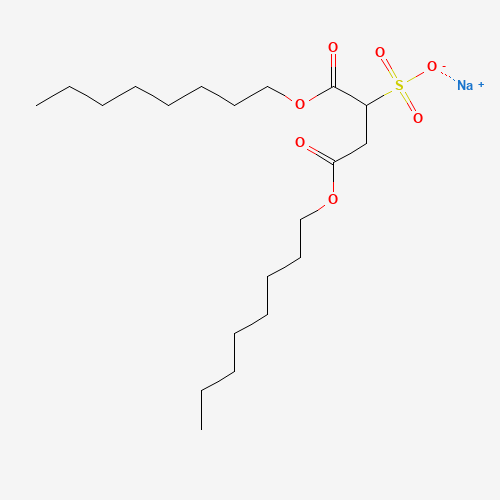
Dioctyl sodium sulfosuccinate is a wetting agent, used to make powders such as cocoa and gum disperse in water instead of floating in lumps.
Where it is and isn’t permitted
| Jurisdiction | Status | Scope and limits | Citation |
|---|---|---|---|
| Australia and New Zealand | Permitted, with conditions | 4 food categories highest permitted level 50 mg/kg Show every food category
| Food Standards Code, Schedule 15, S15—5and 3 further provisionsretrieved 2026-10-17 |
| Canada | Permitted, with conditions | highest permitted level 10 mg/kg 2 permitted uses Show every permitted use
| Health Canada, List of Permitted Food Additives with Other Purposes of Use (List 8)and 1 further provisionretrieved 2026-10-17 |
| European Union | No listed food uses foundThis site has not matched this substance to any food use on this jurisdiction’s list of authorised food additives. A food additive may be used only in foods that list names. Flavourings, enzymes, processing aids and added nutrients are regulated separately and do not appear on it. | ||
| Great Britain | No listed food uses foundThis site has not matched this substance to any food use on this jurisdiction’s list of authorised food additives. A food additive may be used only in foods that list names. Flavourings, enzymes, processing aids and added nutrients are regulated separately and do not appear on it. | ||
| Japan | No listing matchedThis site imports only Japan’s list of designated additives (Appended Table 1 to the Regulations for Enforcement of the Food Sanitation Act), matched by English name. Existing additives, natural flavouring agents and ordinary foods used as additives are permitted outside that list and are not imported, so an empty row does not show that Japan does not permit the substance. | ||
| South Korea | No listing matchedThis site imports Part III of South Korea’s Standards and Specifications for Food Additives, matched by CAS number, then INS number, then exact name. Mixed preparations and sanitisers are not imported, and an entry whose identifiers disagreed with a page’s is held for review, so an empty row does not show that South Korea does not permit the substance. | ||
| United States | Permitted, with conditions | 21 CFR 172.810retrieved 2026-10-17 | |
| Codex Alimentarius | Permitted, with conditions | 1 food category highest permitted level 15 mg/kg Note 383 For use in gelatin powder only. Note 384 On a gelatin powder basis. Note 385 As a humectant for wetting of fumaric acid (INS 297). | CXS 192-1995 Table One, INS 480, food category 04.1.2.9retrieved 2026-09-07 |
How much is permitted
A listing usually limits the quantity as well as the food. Only one of the forms that takes is a figure: quantum satis and good manufacturing practice permit the amount the technological effect requires and no more, which is a limit rather than the absence of one. Figures below are the range across every food category this page is listed in, and categories differ between regulators — see how much is permitted.
| Australia and New Zealand | 10 mg/kg – 50 mg/kg | 4 numeric limit |
|---|---|---|
| Canada | 10 mg/kg | 1 numeric limit, 1 no quantity stated |
| United States | — | 1 no quantity stated |
| Codex Alimentarius | 15 mg/kg | 1 numeric limit |
GRAS notices to the FDA
A GRAS notice is a company’s conclusion that a substance is generally recognised as safe for the use it describes. FDA’s letter responds to that conclusion, for that notifier and that use. It is not a listing in 21 CFR, and it is not counted as a US permission above. The substance and use are as FDA’s inventory words them; this site matched the notice to this page by exact name.
GRN No. 6 · Dioctyl sodium sulfosuccinate · Cytec Industries, Inc.
Intended use: Use in carbonated and non-carbonated soft drinks as a wetting agent or solubilizer for flavor emulsion stabilizers at levels up to 10 parts per million of the finished beverage
FDA’s response (1998-12-28): FDA has no questions
What it is made from
Produced by chemical synthesis from maleic anhydride and octanol.
- Vegan
- Vegetarian
Compare other additives on the dietary indexes.
- CAS registry number
- 577-11-7
- InChIKey
- RCIJACVHOIKRAP-UHFFFAOYSA-M
- PubChem
- CID 517065
How JECFA defines it
The international specification for identity and purity, prepared by the Joint FAO/WHO Expert Committee on Food Additives and published by FAO. It is a different document from any above, written by a different body and revised on its own cycle; it is advisory, and a country adopts it or does not.
INS 480 Dioctyl Sodium Sulfosuccinate
Synonyms: DSS, docusate sodium, INS No. 480 Docusate sodium; DSS
Assay, identification and purity criteria
Description and assay
- Specification history
- Prepared at the 37th JECFA (1990), published in FNP 52 (1992) superseding specifications prepared at the 27th JECFA (1983), published in FNP 28 (1983). Metals and arsenic specifications revised at the 55th JECFA (2000). An ADI of 0-0.1 mg/kg bw was established at the 44th JECFA (1995)
- Chemical names
- Sodium 1,4-bis-(2-ethylhexyl)-sulfosuccinate; butanedioic acid, sulfo-1,4-bis-(2-ethylhexyl) ester sodium salt; dioctyl sodium sulfosuccinate
- C.A.S. number
- 577-11-7
- Chemical formula
- C 20 H 37 NaO 7 S
- Formula weight
- 444.56
- Assay
- Not less than 98.5% on the dried basis
- DESCRIPTION
- White, wax-like, plastic solid, having a characteristic odour suggestive of octanol, but free from odour of other solvents
- FUNCTIONAL USES
- Emulsifying agent, wetting agent
- METHOD OF ASSAY
- Solutions - Sample solution: Transfer about 3.8 g of the sample, previously dried at 105 o for 2 h and accurately weighed, into a 500-ml volumetric flask, dissolve in chloroform. Dilute to volume with the same solvent, and mix. - Tetra-n-butylammonium iodide solution: Transfer 1.250 g of tetra-n-butylammonium iodide to a 500-ml volumetric flask, dilute to volume with water, and mix. - Salt solution: Dissolve 100 g of anhydrous sodium sulfate and 10 g of sodium carbonate in sufficient water to make 1000 ml Procedure Pipet 10.0 ml of the "Sample solution" into a 250-ml flask, and add 40 ml of chloroform, 50 ml of "Salt solution", and 10 drops of bromophenol blue TS. Titrate with "Tetra-n-butylammonium iodide solution" to the first appearance of a blue colour in the chloroform layer after vigorous shaking. Calculate the percentage of C 20 H 37 NaO 7 S by the formula: where V = the volume, in ml of tetra-n-butylammonium iodide solution required 444.6 = formula weight of dioctyl sodium sulfusuccinate W = the weight, in g, of the sample taken 369.4 = formula weight of tetra-n-butylammonium iodide
Identification
- Solubility (Vol. 4)
- Sparingly soluble in water; freely soluble in ethanol and glycerol
- Infrared absorption
- The infrared spectrum of a potassium bromide dispersion of the sample corresponds with that of a reference standard preparation (USP dioctyl sulfosuccinate reference standard obtainable from: United States Pharmacopoeia, 12601 Twinbrook Parkway, Rockville, Md 20852, USA).
- pH (Vol. 4)
- 5.8 - 6.9 (1 in 100 soln)
Purity criteria
- Loss on drying (Vol. 4)
- Not more than 2% (105 o for 2 h)
- Clarity of solution
- Dissolve 25 g of the sample in 94 ml of ethanol. The solution does not develop a haze within 24 h
- Sulfated ash (Vol. 4)
- Between 15.5% and 16.2%. Test 1 g of the sample (Method I)
- Bis-(2-ethylhexyl)- maleate
- Not more than 0.4% See description under TESTS
- Lead (Vol. 4)
- Not more than 2 mg/kg Determine using an atomic absorption technique appropriate to the specified level. The selection of sample size and method of sample preparation may be based on the principles of the method described in Volume 4, “Instrumental Methods.”
- Test: Bis-(2-ethylhexyl)- maleate
- Reagents - Supporting electrolyte: Dissolve 21.2 g of anhydrous lithium perchlorate (LiClO 4 ) in 175 ml of water in a 250-ml beaker. Adjust the pH of this solution to 3.0 by the dropwise addition of glacial acetic acid (usually 1 or 2 drops is sufficient), using a suitable pH meter. Quantitatively transfer the solution into a 200-ml volumetric flask, dilute to volume with water, and mix. - Standard solution: Transfer 100-110 mg of bis-(2-ethyl-hexyl)-maleate (a suitable grade of bis-(2-ethylhexyl)-maleate is available as OT-35 from American Cyanamid Company, Pine Chemicals Department, Pearl River, New York 10965, USA), accurately weighed, into a 100-ml volumetric flask. Record the exact weight, to the nearest 0.1 mg, as W A . Dilute to volume with water, and mix. - Sample stock solution: Transfer 12.5 g of the sample, accurately weighed, into a 150-ml beaker. Record the exact weight, to the nearest 10 mg as W s . Add 80-90 ml of isopropanol, and stir with a glass stirring rod until the sample is dissolved. Quantitatively transfer this solution, with the aid of isopropanol, into a 250-ml volumetric flask. Dilute to volume with isopropanol, and mix. - Test solution A: Pipet 50.0 ml of the "Sample stock solution" and 20.0 ml of the "Supporting electrolyte" into a 100-ml volumetric flask. Dilute to within 15 mm of the graduated volume line with isopropanol, stopper, shake to facilitate solution, and set aside for 2 min. Dilute to volume with isopropanol, and mix. A completely clear solution should be obtained. - Test solution B: Pipet 50.0 ml of the "Sample stock solution", 10.0 ml of the "Standard solution", and 20.0 ml of the "Supporting electrolyte" into a 100 ml volumetric flask, and complete the preparation as described for "Test Solution A". - Blank: Pipet 20.0 ml of the "Supporting electrolyte" into a 100-ml volumetric flask, dilute to volume with isopropanol, and mix. Procedure Rinse a polarographic H-cell several times with small portions of "Test solution A", then fill the cell half-full with the solution, place a paper tissue in the top of the sample side of the cell and pass a moderate stream of nitrogen through the solution for 15 min. (NOTE: The nitrogen should first be saturated by passing it through a suitable scrubber containing isopropanol). After 15 min, divert the nitrogen stream over the surface of the solution, and remove the tissue from the cell. Set the polarizing voltage of a suitable, previously calibrated polarograph (Metrohm Polacord E-261 or equivalent) at -1.3 volts. Adjust the current sensitivity to the lowest range (most sensitive) at which the current oscillations will remain on scale, and record the polarogram, scanning a voltage range of -0.9 to -1.5 volts at this sensitivity and using a saturated calomel electrode as the reference electrode. Record the average oscillations, in mm, at -1.3 volts as A, and those at -1.0 volt as B. (NOTE: If a manual polarograph is used, record the average oscillations of the solutions at -1.3 volts and -1.0 volt respectively). Repeat the entire procedure using Test solution B, recording the average oscillations at -1.3 volts as D, and those at -1.0 volt as E. Similarly, repeat the entire procedure using the "Blank", recording the average oscillations at -1.3 volts as G, and those at -1.0 volt as H. Calculation Make the following preliminary calculations (in mA): where C is net diffusion current of "Test solution A", and S 1 is current sensitivity used for "Test solution A" where F is net diffusion current of "Test solution B", and S 2 is current sensitivity used for "Test solution B" where I is net current introduced by the "Blank", and S 3 is current sensitivity used for the "Blank" where J is diffusion current due to added maleate, added to Test Solution B from the Standard Solution where K is the diffusion current due to maleate present in Test Solution A Finally, calculate the percentage of bis-(2-ethylhexyl)-maleate in the original sample taken by the formula:
Every name it appears under
94 recorded names. A label may use any of them.
INS number
- 480
CAS registry number
- 1639-66-3
As it appears in regulation
- Dioctyl sodium sulfosuccinate
Other names
- 1,4-Bis(n-octyl) sulfobutanedioate, sodium salt
- Adekacol EC 8600
- Aerosol A 501
- Aerosol AOT
- Aerosol GPG
- Aerosol OT
- Aerosol OT 70PG
- Aerosol OT 75
- Airrol ct-1
- Alcopol O
- Berol 478
- Bloat treatment
- Bu-cerumen
- Butanedioic acid, sulfo-, 1,4-dioctyl ester, sodium salt
- Butyl-cerumen
- Caswell No. 392I
- Celanol DOS 65
- Celanol DOS 75
- Clestol
- Colace
- Coloxyl
- Comfolax
- Coprola
- Defilin
- DI-N-OCTYL SODIUM SULFOSUCCINATE
- Dialose
- dicapryl sodium sulfosuccinate
- Dioctyl
- Dioctyl sodiosulfosuccinate
- Dioctyl Sodium Sulfosuccinate
- Dioctyl sodium sulphosuccinate
- Dioctyl sulfosuccinate sodium
- Dioctyl sulfosuccinate, sodium salt
- Dioctylal
- dioctylsulfosuccinic acid sodium salt
- Dioktylester sulfojantaranu sodneho [Czech]
- Diotilan
- Disonate
- Docusate sodique
- Docusate sodium
- Docusato sodico
- Docusatum natricum
- Doxinate
- Doxol
- Dulcivac
- Elfanol 883
- Empimin op70
- EPA Pesticide Chemical Code 079027
- Eurowet
- HSDB 4086
- Humifen WT 27G
- Jamylene
- Laxinate 100
- Mackanate dos-70
- Manoxal OT
- Mervamine
- Modane Soft
- Molatoc
- Molcer
- Molofac
- Natrii dioctylsulfosuccinas
- Neocol SW 30
- Nevax
- Nikkol OTP 70
- Obston
- RCIJACVHOIKRAP-UHFFFAOYSA-M
- Regutol
- Requtol
- Sanmorin OT 70
- Sanmorin ot 70n
- Silace
- SODIUM 1,4-BIS(OCTYLOXY)-1,4-DIOXOBUTANE-2-SULFONATE
- Sodium bis(octyl)sulfosuccinate
- Sodium di-n-octyl sulfosuccinate
- Sodium di-n-octylsulfosuccinate
- Sodium dioctyl sulfosuccinate
- Sodium O,O-dioctylsulfosuccinic acid
- Sodium sulfosuccinic acid dioctyl ester
- sodium;1,4-dioctoxy-1,4-dioxobutane-2-sulfonate
- Solbaleite
- Soliwax
- Succinic acid, sulfo-, 1,4-dioctyl ester, sodium salt
- Succinic acid, sulfo-, dioctyl ester, sodium salt
- Sulfimel DOS
- Sulfobutanedioic acid, 1,4-di(n-octyl) ester, sodium salt
- Sulfosuccinic acid 1,4-dioctyl ester sodium salt
- Texapon DOS
- Triton GR 7
- Velmol
- Waxsol
- Wetaid SR
Hazard reference values
| Type | Value | Population | Assessed by | Opinion |
|---|---|---|---|---|
| ADI | 0.1 mg/kg bw/day | — | JECFA | 2025 |
Evidence and how bodies read it
Studies, and the differing conclusions regulators drew from them, are curated rather than machine-read, and none has been written for this substance yet.
Common questions
Assembled from what is above, in the words the questions are usually asked in. Each answer is the same statement the relevant section makes, with the same citations behind it.
- What is INS 480?
- INS 480 is Dioctyl sodium sulfosuccinate. Dioctyl sodium sulfosuccinate is a wetting agent, used to make powders such as cocoa and gum disperse in water instead of floating in lumps.
- What is Dioctyl sodium sulfosuccinate used for in food?
- It is listed as an emulsifier — the role Codex and the US assign it. This page shows every function each regulator records, with the citation for each.
- Is Dioctyl sodium sulfosuccinate banned in Europe?
- No. Dioctyl sodium sulfosuccinate does not appear on the EU's list of authorised food additives, which is not the same as being banned: the EU permits an additive only where it has authorised it, and usually the reason for an absence is that no one applied. The EU has made no finding against this substance. It does mean it may not be used as a food additive in the EU today.
- Where is Dioctyl sodium sulfosuccinate permitted?
- Of the seven regulators this site reads, Australia and New Zealand, Canada, the US and the Codex standard permit it. Each permission is for named foods at named levels, not a blanket one; the table on this page gives them with citations.
- Is Dioctyl sodium sulfosuccinate vegan?
- Yes. Dioctyl sodium sulfosuccinate is not derived from animals, and is suitable for vegetarians. This page says what it is made from and how.
Sources for this page
- anz retrieved 2026-10-17
- ca retrieved 2026-10-17
- ecfr retrieved 2026-10-17
- gsfa retrieved 2026-09-07
- jecfaspecs retrieved 2026-09-23
Full licence terms and publisher details on Sources. How this page is built and updated: Method.
Machine-readable: a JSON record of this additive is given on request —how to ask for access.
Follow changes to Dioctyl sodium sulfosuccinate:Atom feed — regulatory events, and any change the weekly refresh detects in its provisions.