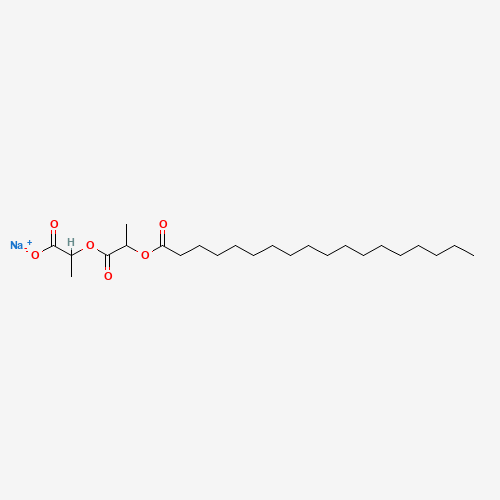
Sodium stearoyl lactylate
25383-99-7 · C24H43NaO6 · E 481 · EMULSILAC SK · INS NO.481(I) · INS-481(I) · Lactic acid, bimol. ester, stearate, sodium salt · Octadecanoic acid, 2-(1-carboxyethoxy)-1-methyl-2-oxoethyl ester, sodium salt · ODFAPIRLUPAQCQ-UHFFFAOYSA-M · Sodium 2-((2-(stearoyloxy)propanoyl)oxy)propanoate · Sodium 2-(1-carboxyethoxy)-1-methyl-2-oxoethyl octadecanoate · Sodium 2-stearoyllactate · Sodium 2-{[2-(octadecanoyloxy)propanoyl]oxy}propanoate · Sodium stearoyl 2-lactylate · sodium stearoyl lactate · Sodium stearoyl lactylate · Sodium stearoyl lactylateSodium stearoyl lactate · Sodium stearoyl-2-lactylate · SODIUM STEAROYL-LACTYLATE (MART.) · SODIUM STEAROYL-LACTYLATE [MART.] · Sodium stearyl-2-lactylate · sodium stelate · sodium;2-(2-octadecanoyloxypropanoyloxy)propanoate · Stearic acid, ester with lactic acid bimol. ester, sodium salt · STEAROYL LACTYLATES · E481 · 481(i) · Octadecanoic acid, 2-(1-carboxyethoxy)-1-methyl-2-oxoethyl ester, sodium salt (1:1) · Sodium;2-(2-octadecanoyloxypropanoyloxy)propanoate · Sodium stearoyl lactylate · Sodium stearoyl-2-lactylate · ESTEAROIL-2-LACTILATO DE SODIO · Estearoil-2-lactilato sódico · Naatriumstearoüül-2-laktülaat · Natrijev stearoil-2-laktilat · Natrio stearoil-2-laktilatas · Natriumstearoyl-2-lactylaat · Natriumstearoyl-2-lactylat · Natriumstearoyl-2-laktylat · Natriumstearoyllactylat · Natriumstearoyyli-2-laktylaatti · Nátrium-sztearoil-2-laktilát · Nātrija stearoil-2-laktilāts · Sodium stearoyl-2-lactylate · Stearoil-2-lactilat de sodiu · Stearoil-2-lattilato di sodio · Stearoilomleczan sodu · Stearojl-2-lattilat tas-sodju · Stearoyl-2-laktylát sodný · Stearoyl-2-mléčnan sodný · Stéaroyl-2-lactylate de sodium · ΣΤΕΑΤΟΫΛΟ-2-ΓΑΛΑΚΤΥΛΙΚΟ ΝΑΤΡΙΟ · Στεαροϋλο-2-γαλακτυλικό νάτριο · НАТРИЕВ СТЕРАОИЛ-2-ЛАКТИЛАТ · Натриев стеароил-2-лактилатE number E481INS 481(i)CAS 25383-99-7
Listed as an emulsifier, a stabiliser and a flour treatment agent by Canada, Codex and the US.
Listed as emulsifiers (CA, US, Codex) · stabilisers (CA, US, Codex) · flour treatment agents (CA, US, Codex) · thickeners (CA, US) · foaming and whipping agents (CA, Codex) · firming agents (US) · dough strengtheners (US) · surface-active agents (US) · oxidising and reducing agents (US)
- Canada: Emulsifying agent — Health Canada, List of Permitted Emulsifying, Gelling, Stabilizing or Thickening Agents (List 4)
- Canada: Emulsifying, stabilizing or thickening agent — Health Canada, List of Permitted Emulsifying, Gelling, Stabilizing or Thickening Agents (List 4)
- United States: Emulsifier or emulsifier salt — FDA, Substances Added to Food: SODIUM STEAROYL-2-LACTYLATE
- Codex Alimentarius: Emulsifier — CXS 192-1995 Table One, INS 481(i)
- Canada: Emulsifying, stabilizing or thickening agent — Health Canada, List of Permitted Emulsifying, Gelling, Stabilizing or Thickening Agents (List 4)
- United States: Stabilizer or thickener — FDA, Substances Added to Food: SODIUM STEAROYL-2-LACTYLATE
- Codex Alimentarius: Stabilizer — CXS 192-1995 Table One, INS 481(i)
- Canada: Flour treatment agent — Health Canada, List of Permitted Flour Treatment Agents (List 2)
- United States: Flour treating agent — FDA, Substances Added to Food: SODIUM STEAROYL-2-LACTYLATE
- Codex Alimentarius: Flour treatment agent — CXS 192-1995 Table One, INS 481(i)
- Canada: Emulsifying, stabilizing or thickening agent — Health Canada, List of Permitted Emulsifying, Gelling, Stabilizing or Thickening Agents (List 4)
- United States: Stabilizer or thickener — FDA, Substances Added to Food: SODIUM STEAROYL-2-LACTYLATE
- Canada: Whipping agent — Health Canada, List of Permitted Food Additives with Other Purposes of Use (List 8)
- Codex Alimentarius: Foaming agent — CXS 192-1995 Table One, INS 481(i)
- United States: Firming agent — FDA, Substances Added to Food: SODIUM STEAROYL-2-LACTYLATE
- United States: Dough strengthener — FDA, Substances Added to Food: SODIUM STEAROYL-2-LACTYLATE
- United States: Surface-active agent — FDA, Substances Added to Food: SODIUM STEAROYL-2-LACTYLATE
- United States: Oxidizing or reducing agent — FDA, Substances Added to Food: SODIUM STEAROYL-2-LACTYLATE
Sodium stearoyl lactylate is a dough strengthener and emulsifier used in bread, buns and tortillas.
Where it is and isn’t permitted
| Jurisdiction | Status | Scope and limits | Citation |
|---|---|---|---|
| Australia and New Zealand | Permitted, with conditions | 54 food categories no numerical limit (good manufacturing practice) Show every food category
| Food Standards Code, Schedule 15, S15—5and 53 further provisionsretrieved 2026-10-17 |
| Canada | Permitted, with conditions | highest permitted level 5,000 mg/kg 19 permitted uses Show every permitted use
| Health Canadaand 18 further provisionsretrieved 2026-10-17 |
| European Union | Permitted, with conditions | 21 food categories highest permitted level 10,000 mg/l Show every food category
| Regulation (EC) No 1333/2008, Annex IIand 20 further provisionsretrieved 2026-10-18 |
| Great Britain | Permitted, with conditions | 20 food categories highest permitted level 10,000 mg/kg or mg/l Show every food category
| Assimilated Regulation (EC) No 1333/2008, Annex II (as at 28 June 2024)and 19 further provisionsretrieved 2026-10-18 |
| Japan | Permitted, with conditions | Designated additive: Appended Table 1, item 240, ステアロイル乳酸ナトリウム (“Sodium Stearoyl Lactylate” in the unofficial English translation). …Designated additive: Appended Table 1, item 240, ステアロイル乳酸ナトリウム (“Sodium Stearoyl Lactylate” in the unofficial English translation). Standards for use — Specifications and Standards for Foods, Food Additives, etc. (MHW Notification No. 370 of 1959), Part II (Food Additives), F (Standards for use), entry ステアロイル乳酸ナトリウム: (1) [may be used only in the foods stated] “ステアロイル乳酸ナトリウムは、菓子(小麦粉を原料としたものに限る。以下この目において同じ。)のうちばい焼したもの若しくは油脂で処理したもの、生菓子(米を原料としたものに限る。以下この目において同じ。)、パン、ミックスパウダー(菓子のうちばい焼したもの若しくは油脂で処理したもの、生菓子、パン、蒸しパン(小麦粉を原料とし、蒸したパンをいう。以下この目において同じ。)又は蒸しまんじゅう(小麦粉を原料とし、蒸したまんじゅうをいう。以下この目において同じ。)の製造に用いるものに限る。)、蒸しパン、蒸しまんじゅう及びめん類(即席めん及びマカロニ類以外の乾めんを除く。以下この目において同じ。)以外の食品に使用してはならない。” (2) [sets maximum levels of use for the foods stated; sets a combined limit where it is used together with the additives stated] “ステアロイル乳酸ナトリウムの使用量は、ステアロイル乳酸カルシウムとして、生菓子の製造に用いるミックスパウダーにあってはその1kgにつき10g以下、スポンジケーキ、バターケーキ又は蒸しパンの製造に用いるミックスパウダーにあってはその1kgにつき8.0g以下、生菓子にあってはその1kgにつき6.0g以下、菓子のうち油脂で処理したもの又はパンの製造に用いるミックスパウダー、スポンジケーキ、バターケーキ及び蒸しパンにあってはその1kgにつき5.5g以下、菓子のうちばい焼したもの(スポンジケーキ及びバターケーキを除く。)の製造に用いるミックスパウダーにあってはその1kgにつき5.0g以下、めん類(マカロニ類を除く。)にあってはゆでめん1kgにつき4.5g以下、菓子のうちばい焼したもの(スポンジケーキ及びバターケーキを除く。)及び油脂で処理したもの、パン並びにマカロニ類にあってはその1kg(マカロニ類にあっては乾めん1kg)につき4.0g以下、蒸しまんじゅうの製造に用いるミックスパウダーにあってはその1kgにつき2.5g以下、蒸しまんじゅうにあってはその1kgにつき2.0g以下でなければならない。また、ステアロイル乳酸カルシウムと併用する場合にあっては、それぞれの使用量の和がステアロイル乳酸カルシウムとしての基準値以下でなければならない。” The Japanese is the standard as published. There is no official English translation of the Notification; the English in square brackets is this site’s description of what each sentence does, not a translation of the foods or the levels. Compositional specifications for this additive, in the same Notification, are not imported and are not shown here; nor are the general rules in F 添加物一般, which apply to every additive. | Regulations for Enforcement of the Food Sanitation Act (MHW Ordinance No. 23 of 1948), Appended Table 1retrieved 2026-10-18 |
| South Korea | Permitted, with conditions | Designated food additive: Standards and Specifications for Food Additives, Part III, 1. …Designated food additive: Standards and Specifications for Food Additives, Part III, 1. 일반식품첨가물 (general food additives), 스테아릴젖산나트륨 (“Sodium Stearoyl Lactylate”, the English the Code prints beside it). Main use (주용도) of 스테아릴젖산나트륨: 유화제. Standard for use (사용기준) of 스테아릴젖산나트륨: (1) [may be used only in the foods listed] “스테아릴젖산나트륨은 아래의 식품에 한하여 사용하여야 한다. 1. 빵류 및 이의 제조용 믹스 2. 면류, 만두피 3. 식물성크림 4. 소스 5. 치즈류 6. 과자(한과류 제외)” The Korean is the standard as published. There is no official English translation of the current Code (the English version on MFDS’s website is the 2020 edition and has no legal effect); the English in square brackets is this site’s description of what each sentence does, not a translation of the foods or the levels. Compositional specifications (Part IV) are not imported, nor are the general standards in Part II, which apply to every additive. | Standards and Specifications for Food Additives (식품첨가물의 기준 및 규격), MFDS Notification, Part III (Standards for use, by item)retrieved 2026-10-18 |
| United States | Permitted, with conditions | 21 CFR 172.846retrieved 2026-10-17 | |
| Codex Alimentarius | Permitted, with conditions | 41 food categories highest permitted level 10,000 mg/kg Show every food category and its notes
| CXS 192-1995 Table One, INS 481(i)and 40 further provisionsretrieved 2026-09-07 |
How much is permitted
A listing usually limits the quantity as well as the food. Only one of the forms that takes is a figure: quantum satis and good manufacturing practice permit the amount the technological effect requires and no more, which is a limit rather than the absence of one. Figures below are the range across every food category this page is listed in, and categories differ between regulators — see how much is permitted.
| Australia and New Zealand | — | 54 GMP |
|---|---|---|
| Canada | 500 mg/kg – 5,000 mg/kg | 8 numeric limit, 11 no quantity stated |
| European Union | 2,000 mg/kg – 10,000 mg/kg | 21 numeric limit |
| Great Britain | 2,000 mg/kg – 10,000 mg/kg | 19 numeric limit, 1 several limits |
| Japan | — | 1 no quantity stated |
| South Korea | — | 1 no quantity stated |
| United States | — | 1 no quantity stated |
| Codex Alimentarius | 300 mg/kg – 10,000 mg/kg | 41 numeric limit |
What it is made from
Made by reacting stearic acid with lactic acid and neutralising with sodium. The stearic acid may come from plant oils or from animal fat, and the label will not say which.
- Vegan status depends on the source
- Vegetarian status depends on the source
- May raise a halal question
- May raise a kosher question
This is not an omission. What this additive is made from is not fixed — depending on the manufacturer it may be plant, animal or microbial in origin, nobody is required to say which, and the same product can change source between production runs. Ask the manufacturer if it matters to you; a label cannot answer it.
Compare other additives on the dietary indexes.
- CAS registry number
- 25383-99-7
- InChIKey
- ODFAPIRLUPAQCQ-UHFFFAOYSA-M
- PubChem
- CID 23671849
The two specifications, compared
The European Union sets identity and purity by regulation; JECFA publishes its own through FAO, advisory until a country adopts it. Both documents are below in full. These are the parameters each puts a number on.
| Parameter | European Union | JECFA |
|---|---|---|
| Lead | no more than 2 mg/kg | no more than 2 mg/kg |
| Arsenic | no more than 3 mg/kg | — |
| Mercury | no more than 1 mg/kg | — |
| Cadmium | no more than 1 mg/kg | — |
The two documents state the same figures for every parameter compared here.
How the EU defines it
The legal specification an additive must meet to be sold as this E number in the EU — what it is, how it may be made, and the purity it must reach. From Commission Regulation (EU) No 231/2012.
E 481 Sodium stearoyl-2-lactylate
A mixture of the sodium salts of stearoyl lactylic acids and its polymers and minor amounts of sodium salts of other related acids, manufactured by the reaction of stearic acid and lactic acid. Other food fatty acids may also be present, free or esterified, due to their presence in the stearic acid used
Synonyms: Sodium stearoyl lactylate; Sodium stearoyl lactate
Assay, identification and purity criteria
Description and assay
- Einecs
- 246-929-7
- Chemical name
- Sodium di-2-stearoyl lactate Sodium di(2-stearoyloxy)propionate
- Chemical formula
- C₂₁H₃₉O₄Na; C₁₉H₃₅O₄Na (major components)
- Description
- White or slightly yellowish powder or brittle solid with a characteristic odour
Identification
- Test for sodium
- Passes test
- Test for fatty acids
- Passes test
- Test for lactic acid
- Passes test
- Solubility
- Insoluble in water. Soluble in ethanol
Purity criteria
- Sodium
- Not less than 2,5 % and not more than 5 %
- Ester value
- Not less than 90 and not more than 190
- Acid value
- Not less than 60 and not more than 130
- Total lactic acid
- Not less than 15 % and not more than 40 %
- Arsenic
- Not more than 3 mg/kg
- Lead
- Not more than 2 mg/kg
- Mercury
- Not more than 1 mg/kg
- Cadmium
- Not more than 1 mg/kg
How JECFA defines it
The international specification for identity and purity, prepared by the Joint FAO/WHO Expert Committee on Food Additives and published by FAO. It is a different document from any above, written by a different body and revised on its own cycle; it is advisory, and a country adopts it or does not.
INS 481(i) Sodium Stearoyl-2-lactylate
A mixture of sodium salts of stearoyl lactylic acids and minor proportions of other salts of related acids, formed by the esterification of commercial stearic acid with lactic acid and neutralized to the sodium salts; may contain unneutralized palmitoyl and stearoyl lactylic acid, free fatty acids (principally palmitic and stearic), free lactic acid and salts of fatty acid esters of lactic acid and polymerized lactic acid.
Synonyms: Sodium stearoyl lactylate, sodium stearoyl lactate; INS No. 481(i) Sodium stearoyl lactate; Sodium stearoyl lactylate
Assay, identification and purity criteria
Description and assay
- Specification history
- Prepared at the 46th JECFA (1996), published in FNP 52 Add 4 (1996) superseding specifications prepared at the 44th JECFA (1995), published in FNP 52 Add 3 (1995). Metals and arsenic specifications revised at the 55th JECFA (2000). An ADI of 0-20 mg/kg bw was established at the 17th JECFA (1973)
- Chemical names
- Sodium di-2-stearoyl lactate, sodium di-(2-stearoyloxy)propionate (major component)
- C.A.S. number
- 25383-99-7
- Chemical formula
- C 21 H 39 O 4 Na; C 19 H 35 O 4 Na (major components)
- Structural formula
- where R is C 17 H 35 or C 15 H 31 and the mean value of n is normally 2
- DESCRIPTION
- White or slightly yellowish powder or brittle solid with a characteristic odour
- FUNCTIONAL USES
- Emulsifier, stabilizer
Identification
- Solubility (Vol. 4)
- Insoluble in water; soluble in ethanol
- Test for sodium
- Add 10 ml of dilute hydrochloric acid TS to 2 g of the sample, heat for 5 min in a water bath, filter and neutralize the filtrate with ammonia TS. Retain the residue from the filter for test C. To the filtrate, add uranyl zinc acetate TS; a yellow crystalline precipitate appears within a few min.
- Test for fatty acids
- Take the residue from the filter in the test for sodium, add 30 ml of sodium hydroxide TS, heat for 30 min on a steam bath and filter. Add 20 ml of dilute hydrochloric acid TS to the filtrate after cooling, extract twice with 30 ml of diethyl ether, wash the ether solution with 20 ml of water, dry with anhydrous sodium sulfate and evaporate the ether. The residue melts between 54 and 69º.
- Test for lactate (Vol. 4)
- Passes test
Purity criteria
- Sodium content
- Not less than 2.5% and not more than 5.0% See description under TESTS
- Total lactic acid
- Not less than 15% and not more than 40% See description under TESTS
- Acid value
- Not less than 60 and not more than 130 See description under TESTS
- Ester value
- Not less than 90 and not more than 190 See description under TESTS
- Lead (Vol. 4)
- Not more than 2 mg/kg Determine using an atomic absorption technique appropriate to the specified level. The selection of sample size and method of sample preparation may be based on the principles of the method described in Volume 4, “Instrumental Methods.”
- Test: Sodium content
- Stock Lanthanum Solution: Transfer 5.86 g of lanthanum oxide, La 2 O 3 , to a 100 ml volumetric flask, wet with a few ml of water, slowly add 25 ml of hydrochloric acid, and swirl until the material is completely dissolved. Dilute to volume with water, and mix. Stock Sodium Solution: Use a solution containing 1 mg of Na in each ml (1000 mg/l Na). The solution may be obtained commercially or be prepared as follows: transfer 1.271 g of sodium chloride, previously dried at 105 o for 2 h and accurately weighed, to a 500 ml volumetric flask, dilute to volume with water, and mix. Standard Sodium Solutions: Transfer 10.0 ml of the Stock Lanthanum Solution to each of three 100 ml volumetric flasks. Using a microlitre syringe, transfer 0.20 ml of the Stock Sodium Solution to the first flask, 0.40 ml to the second flask, and 0.50 ml to the third flask. Dilute each flask to volume with water, and mix. The flasks contain 2.0, 4.0 and 5.0 μg of Na per ml, respectively. Prepare these solutions fresh daily. Sample Preparation: Transfer about 250 mg of the sample, accurately weighed, to a 30 ml beaker, dissolve with heating in 10 ml of alcohol, and quantitatively transfer the solution into a 25 ml volumetric flask. Wash the beaker with two 5 ml portions of alcohol, adding the washings to the flask, dilute to volume with alcohol, and mix. Transfer 2.5 ml of the Stock Lanthanum Solution to a second 25 ml volumetric flask. Using a microlitre syringe, transfer 0.25 ml of the alcoholic solution of the sample to the second flask, dilute to volume with water, and mix. Procedure: Concomitantly determine the absorbance of each Standard Sodium preparation and of the Sample preparation at 589 nm, with a suitable atomic absorption spectrophotometer, following the operating parameters as recommended by the manufacturer of the instrument. Plot the absorbance of the Standard Sodium preparations vs. concentration of Na, in μg per ml, and from the curve so obtained determine the concentration C, in μg per ml, of Na in the Sample preparation. Calculate the quantity, in mg, of Na in the sample taken by the formula 2.5 C.
- Test: Total lactic acid
- Standard curve: Dissolve 1.067 g of lithium lactate in sufficient water to make 1000.0 ml. Transfer 10.0 ml of this solution into a 100 ml volumetric flask, dilute to volume with water, and mix. Transfer 1.0, 2.0, 4.0, 6.0 and 8.0 ml of the diluted standard solution into separate 100 ml volumetric flasks, dilute each flask to volume with water, and mix. These standards represent 1, 2, 4, 6 and 8 μg of lactic acid per ml, respectively. Transfer 1.0 ml of each solution into separate test tubes, and continue as directed in the Procedure, beginning with "Add one drop of cupric sulfate TS ..." After colour development and reading the absorbance values, construct a Standard curve by plotting absorbance versus μg of lactic acid. Test preparation: Transfer about 200 mg of the sample, accurately weighed, into a 125 ml Erlenmeyer flask, add 10 ml of 0.5N ethanolic potassium hydroxide and 10 ml of water, attach an air condenser, and reflux gently for 45 min. Wash the sides of the flask and the condenser with about 40 ml of water, and heat on a steam bath until no odour of alcohol remains. Add 6 ml of dilute sulfuric acid (1 in 2), heat until the fatty acids are melted, then cool to about 600, and add 25 ml of petroleum ether. Swirl the mixture gently, and transfer quantitatively to a separatory funnel. Collect the water layer in a 100 ml volumetric flask, and wash the petroleum ether layer with two 20 ml portions of water, adding the washings to the volumetric flask. Dilute to volume with water, and mix. Transfer 1.0 ml of this solution into a second 100 ml volumetric flask, dilute to volume with water, and mix. Procedure: Transfer 1.0 ml of the Test preparation into a test tube, and transfer 1.0 ml of water to a second test tube to serve as the blank. Treat each tube as follows: Add one drop of cupric sulfate TS, swirl gently, and then add rapidly from a burette 9.0 ml of sulfuric acid. Loosely stopper the tube, and heat in a water bath at 900 for exactly 5 min. Cool immediately to below 200 in an ice bath for 5 min, add 3 drops of p-phenylphenol TS (on the day of use dissolve 750 mg of p-phenylphenol in 50 ml sodium hydroxide TS), shake immediately and heat in a water bath at 300 for 30 min, shaking the tube twice during this time to disperse the reagent. Heat the tube in a water bath at 90º for exactly 90 sec, and then cool immediately to room temperature in an ice water bath. Determine the absorbance of the solution in a 1 cm cell, at 570 nm, with a suitable spectrophotometer, using the blank to set the instrument. Obtain the weight, in μg, of lactic acid in the portion of the Test preparation taken from the Procedure by means of the Standard curve.
- Test: Acid value
- Transfer about 1 g, accurately weighed, to a 100 ml Erlenmeyer flask, add 25 ml of alcohol, previously neutralized to phenolphthalein TS, and heat on a hot plate until the sample is dissolved. Cool, add 5 drops of phenolphthalein TS, and titrate rapidly with 0.1N sodium hydroxide to the first pink colour that persists for at least 30 sec. Calculate the acid value by the formula 56.1 x V x N/W, in which V is the volume, in ml, and N is the normality of the sodium hydroxide solution, and W is the weight, in grams, of the sample taken. Retain the neutralized solution for the determination of Ester value.
- Test: Ester value
- To the neutralized solution retained in the test for acid value add 10.0 ml of alcoholic potassium hydroxide solution prepared by dissolving 11.2 g of potassium hydroxide in 250 ml of alcohol and diluting with 25 ml of water. Add 5 drops of phenolphthalein TS, connect a suitable condenser, and reflux for 2 hours. Cool, add 5 additional drops of phenolphthalein TS and titrate the excess alkali with 0.1N hydrochloric acid. Perform a blank determination using 10.0 ml of the alcoholic potassium hydroxide solution. Calculate the ester value by the formula 56.1 (B - S) x N/W, in which B - S represents the difference between the volumes of 0.1N hydrochloric acid required for the blank and the sample, respectively, N is the normality of the hydrochloric acid, and W is the weight, in grams, of the sample taken.
Every name it appears under
55 recorded names. A label may use any of them.
E number
- E481
INS number
- 481(i)
CAS registry number
- 25383-99-7
As it appears in regulation
- Sodium stearoyl lactylate
- Sodium stearoyl-2-lactylate
Other names
- C24H43NaO6
- E 481
- EMULSILAC SK
- INS NO.481(I)
- INS-481(I)
- Lactic acid, bimol. ester, stearate, sodium salt
- Octadecanoic acid, 2-(1-carboxyethoxy)-1-methyl-2-oxoethyl ester, sodium salt
- ODFAPIRLUPAQCQ-UHFFFAOYSA-M
- Sodium 2-((2-(stearoyloxy)propanoyl)oxy)propanoate
- Sodium 2-(1-carboxyethoxy)-1-methyl-2-oxoethyl octadecanoate
- Sodium 2-stearoyllactate
- Sodium 2-{[2-(octadecanoyloxy)propanoyl]oxy}propanoate
- Sodium stearoyl 2-lactylate
- sodium stearoyl lactate
- Sodium stearoyl lactylate
- Sodium stearoyl lactylateSodium stearoyl lactate
- Sodium stearoyl-2-lactylate
- SODIUM STEAROYL-LACTYLATE (MART.)
- SODIUM STEAROYL-LACTYLATE [MART.]
- Sodium stearyl-2-lactylate
- sodium stelate
- sodium;2-(2-octadecanoyloxypropanoyloxy)propanoate
- Stearic acid, ester with lactic acid bimol. ester, sodium salt
- STEAROYL LACTYLATES
Systematic names
- Octadecanoic acid, 2-(1-carboxyethoxy)-1-methyl-2-oxoethyl ester, sodium salt (1:1)
- Sodium;2-(2-octadecanoyloxypropanoyloxy)propanoate
The EU re-evaluation programme
Every additive authorised in the EU before 20 January 2009 was put back through EFSA by Commission Regulation (EU) No 257/2010, and this one is named in it. What the Regulation required is below; whether the opinion has since been published is not something this site records.
- To be evaluated by 31 December 2016. Named in Annex II, Part II, point 2 as “Sodium stearoyl-2-lactylate”, among the additives given priority within its class.
Hazard reference values
| Type | Value | Population | Assessed by | Opinion |
|---|---|---|---|---|
| ADI | 20 mg/kg bw/day | — | JECFA | 1973 |
Evidence and how bodies read it
What assessing bodies concluded
Each conclusion is paraphrased in the body's own framing, from the published opinion linked beneath it. Where bodies differ, both stand; this site does not adjudicate between them or add a view of its own.
EFSA 2013
The ANS Panel established an ADI of 22 mg/kg bw/day for sodium and calcium stearoyl-2-lactylate (E 481, E 482), singly or combined, based on a one-year rat study, and found no concern for genotoxicity. It estimated that exposure was below the ADI for adults but exceeded it at the mean for other population groups and at high levels for all groups.
Common questions
Assembled from what is above, in the words the questions are usually asked in. Each answer is the same statement the relevant section makes, with the same citations behind it.
- What is E 481?
- E 481 is Sodium stearoyl lactylate. Sodium stearoyl lactylate is a dough strengthener and emulsifier used in bread, buns and tortillas.
- What is Sodium stearoyl lactylate used for in food?
- It is listed as an emulsifier, a stabiliser and a flour treatment agent — the role Canada, Codex and the US assign it. This page shows every function each regulator records, with the citation for each.
- Where is Sodium stearoyl lactylate permitted?
- Of the seven regulators this site reads, Australia and New Zealand, Canada, the EU, Great Britain, Japan, South Korea, the US and the Codex standard permit it. Each permission is for named foods at named levels, not a blanket one; the table on this page gives them with citations.
- Is Sodium stearoyl lactylate vegan?
- It depends on the source, and a label will not tell you. Sodium stearoyl lactylate can be made from plant or animal material, manufacturers are not obliged to say which, and the same product can change between production runs. Anyone who needs to know has to ask the manufacturer.
Sources for this page
- anz retrieved 2026-10-17
- ca retrieved 2026-10-17
- eu retrieved 2026-10-18
- gb retrieved 2026-10-18
- jp retrieved 2026-10-18
- kr retrieved 2026-10-18
- ecfr retrieved 2026-10-17
- gsfa retrieved 2026-09-07
- euspecs retrieved 2026-10-18
- jecfaspecs retrieved 2026-09-23
Full licence terms and publisher details on Sources. How this page is built and updated: Method.
Machine-readable: a JSON record of this additive is given on request —how to ask for access.
Follow changes to Sodium stearoyl lactylate:Atom feed — regulatory events, and any change the weekly refresh detects in its provisions.