Sorbitan monolaurate
1338-39-2 · 8028-02-2 · (R)-2-((2R,3R,4S)-3,4-dihydroxytetrahydrofuran-2-yl)-2-hydroxyethyl dodecanoate · 1,4-anhydro-6-O-dodecanoyl-D-glucitol · 1,4-Anhydro-D-glucitol, 6-dodecanoate · 2-(3,4-dihydroxyoxolan-2-yl)-2-hydroxyethyl dodecanoate · [(2R)-2-[(2R,3R,4S)-3,4-dihydroxyoxolan-2-yl]-2-hydroxyethyl] dodecanoate · Alkamuls S 20 · Alkamuls SML · Anhydrosorbitol monolaurate · Arlacel 20 · Arlacel-20 · Armotan ML · Atmer 100 · CCRIS 709 · Dehymuls SML · Disponil SML 100 · E 493 · Emasol 110 · Emasol L 10 · Emasol L 10(F) · Emasol Super L 10(F) · Emsorb 2515 · FCM no 414 · Glycomul L · Glycomul LC · INS NO.493 · INS-493 · Ionet S 20 · Kemotan S 20 · L 250 (ester) · Laurate de sorbitan · Laurato de sorbitan · Laurato de sorbitano · Lauric acid sorbitan ester · Lonzest SML · Montane 20 · Nissan Nonion LP 20R · Nonion LP 20R · Nonion LR 20R · NRF 201 · Radiasurf 7125 · Rheodol SP-L 10 · Rheodol Super SP-L 10 · Sorbitan laurate · Sorbitan lauric acid monoester · Sorbitan monolaurate · Sorbitan, monododecanoate · Sorbitani lauras · Sorbon S 20 · Sorgen 90 · Span 20 · Texnol SPT · Value SP 20 · E493 · 493 · 1,4-anhydro-6-O-dodecanoyl-D-glucitol · Sorbitan monolaurate · Monolaurat de sorbitan · MONOLAURATE DE SORBITAN · Monolaurate de sorbitane · Monolaurato de sorbitano · Monolaurato di sorbitano · Monolaurynian sorbitolu · Monolawrat tas-sorbitan · Sorbitaanimonolauraatti · Sorbitaanmonolauraat · Sorbitan monolaurat · Sorbitan monolaurate · Sorbitanmonolaurát · Sorbitano monolauratas · Sorbitāna monolaurāts · Szorbitan-monolaurát · Μονολαυρική σορβιτάνη · СОРБИТАН МОНОЛАУАРАТ · Сорбитан монолауратE number E493INS 493CAS 1338-39-2
Listed as an emulsifier and a stabiliser by Codex.
Listed as emulsifiers (Codex) · stabilisers (Codex)
- Codex Alimentarius: Emulsifier — CXS 192-1995 Table One, INS 493
- Codex Alimentarius: Stabilizer — CXS 192-1995 Table One, INS 493
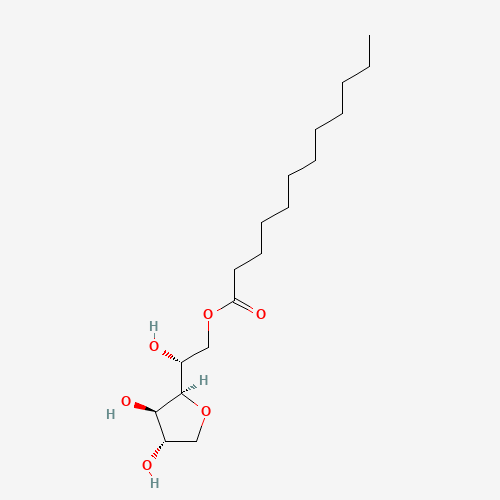
Sorbitan monolaurate is an emulsifier used in cake mixes, icings and beverage bases, usually alongside its polysorbate counterpart.
Where it is and isn’t permitted
| Jurisdiction | Status | Scope and limits | Citation |
|---|---|---|---|
| Australia and New Zealand | No listed food uses foundThis site has not matched this substance to any food use on this jurisdiction’s list of authorised food additives. A food additive may be used only in foods that list names. Flavourings, enzymes, processing aids and added nutrients are regulated separately and do not appear on it. | ||
| Canada | No listing matchedHealth Canada’s lists name additives without E or INS numbers, so this site matches them by exact name. A substance listed there under a name this site does not recognise has no row here. | ||
| European Union | Permitted, with conditions | 19 food categories highest permitted level 10,000 mg/l Show every food category
| Regulation (EC) No 1333/2008and 18 further provisionsretrieved 2026-10-18 |
| Great Britain | Permitted, with conditions | 17 food categories highest permitted level 10,000 mg/kg or mg/l Show every food category
| Assimilated Regulation (EC) No 1333/2008and 16 further provisionsretrieved 2026-10-18 |
| Japan | No listing matchedThis site imports only Japan’s list of designated additives (Appended Table 1 to the Regulations for Enforcement of the Food Sanitation Act), matched by English name. Existing additives, natural flavouring agents and ordinary foods used as additives are permitted outside that list and are not imported, so an empty row does not show that Japan does not permit the substance. | ||
| South Korea | No listing matchedThis site imports Part III of South Korea’s Standards and Specifications for Food Additives, matched by CAS number, then INS number, then exact name. Mixed preparations and sanitisers are not imported, and an entry whose identifiers disagreed with a page’s is held for review, so an empty row does not show that South Korea does not permit the substance. | ||
| United States | Not listedDoes not appear on this jurisdiction’s permitted list. That is not the same as being prohibited. | ||
| Codex Alimentarius | Permitted, with conditions | 53 food categories highest permitted level 20,000 mg/kg Show every food category and its notes
| CXS 192-1995 Table One, INS 493and 52 further provisionsretrieved 2026-09-07 |
How much is permitted
A listing usually limits the quantity as well as the food. Only one of the forms that takes is a figure: quantum satis and good manufacturing practice permit the amount the technological effect requires and no more, which is a limit rather than the absence of one. Figures below are the range across every food category this page is listed in, and categories differ between regulators — see how much is permitted.
| European Union | 25 mg/kg – 10,000 mg/kg | 16 numeric limit, 3 quantum satis |
|---|---|---|
| Great Britain | 25 mg/kg – 10,000 mg/kg | 14 numeric limit, 3 quantum satis |
| Codex Alimentarius | 50 mg/kg – 20,000 mg/kg | 53 numeric limit |
What it is made from
Made by esterifying sorbitol with lauric acid, which comes mainly from coconut and palm kernel oil, though a fat blend is possible.
- Vegan status depends on the source
- Vegetarian status depends on the source
- May raise a halal question
- May raise a kosher question
This is not an omission. What this additive is made from is not fixed — depending on the manufacturer it may be plant, animal or microbial in origin, nobody is required to say which, and the same product can change source between production runs. Ask the manufacturer if it matters to you; a label cannot answer it.
Compare other additives on the dietary indexes.
- CAS registry number
- 1338-39-2
- InChIKey
- LWZFANDGMFTDAV-BURFUSLBSA-N
- PubChem
- CID 11046239
The two specifications, compared
The European Union sets identity and purity by regulation; JECFA publishes its own through FAO, advisory until a country adopts it. Both documents are below in full. These are the parameters each puts a number on.
| Parameter | European Union | JECFA |
|---|---|---|
| Assay | no less than 95 % | no less than 95 % |
| Sulphated ash | no more than 0.5 % | no more than 0.5 % |
| Lead | no more than 2 mg/kg | no more than 2 mg/kg |
| Arsenic | no more than 3 mg/kg | — |
| Mercury | no more than 1 mg/kg | — |
| Cadmium | no more than 1 mg/kg | — |
The two documents state the same figures for every parameter compared here.
How the EU defines it
The legal specification an additive must meet to be sold as this E number in the EU — what it is, how it may be made, and the purity it must reach. From Commission Regulation (EU) No 231/2012.
E 493 Sorbitan monolaurate
A mixture of the partial esters of sorbitol and its anhydrides with edible, commercial lauric acid
Assay, identification and purity criteria
Description and assay
- Einecs
- 215-663-3
- Assay
- Content not less than 95 % of a mixture of sorbitol, sorbitan, and isosorbide esters
- Description
- Amber-coloured oily viscous liquid, light cream to tan-coloured beads or flakes or a hard, waxy solid with a slight odour
Identification
- Solubility
- Dispersible in hot and cold water
- Infrared absorption spectrum
- Characteristic of a partial fatty acid ester of a polyol
Purity criteria
- Water content
- Not more than 2 % (Karl Fischer method)
- Sulphated ash
- Not more than 0,5 %
- Acid value
- Not more than 7
- Saponification value
- Not less than 155 and not more than 170
- Hydroxyl value
- Not less than 330 and not more than 358
- Arsenic
- Not more than 3 mg/kg
- Lead
- Not more than 2 mg/kg
- Mercury
- Not more than 1 mg/kg
- Cadmium
- Not more than 1 mg/kg
How JECFA defines it
The international specification for identity and purity, prepared by the Joint FAO/WHO Expert Committee on Food Additives and published by FAO. It is a different document from any above, written by a different body and revised on its own cycle; it is advisory, and a country adopts it or does not.
INS 493 Sorbitan Monolaurate
A mixture of the partial esters of sorbitol and its mono- and dianhydrides with edible lauric acid
Synonyms: Sorbitan laurate; INS No. 493
Assay, identification and purity criteria
Description and assay
- Specification history
- Prepared at the 55th JECFA (2000) and published in FNP 52 Add 8 (2000), superseding specifications prepared at the 44th JECFA (1995) and published in FNP 52 Add 3 (1995). A group ADI of 0-25 mg/kg bw for sorbitan esters of lauric, oleic, palmitic, and stearic acid was established a t the 26th JECFA (1982).
- C.A.S. number
- 1338-39-2
- Structural formula
- Contains lauric acid esterified with polyols derived from sorbitol including the following types:
- Assay
- Saponification of 100 g of the sample yields not less than 36 g and not more than 49 g of polyols, and not less than 56 g and not more than 68 g of fatty acids. The polyol content shall be not less than 95% of a mixture of sorbitol, 1,4-sorbitan and isosorbide.
- DESCRIPTION
- Amber-coloured oily viscous liquid, light cream to tan beads or flakes or a hard, waxy solid with a slight odour
- FUNCTIONAL USES
- Emulsifier, stabilizer
- METHOD OF ASSAY
- Transfer about 25 g of the sample, accurately weighed, into a 500-ml round-bottom flask, add 250 ml of alcohol and 7.5 g of potassium hydroxide, and mix. Connect a suitable condenser to the flask, reflux the mixture for 1 to 2 h, and then transfer to an 800-ml beaker, rinsing the flask with about 100 ml of water and adding it to the beaker. Heat on a steam bath to evaporate the alcohol, adding water occasionally to replace the alcohol, and evaporate until the odour of alcohol can no longer be detected. Adjust the final volume to about 250 ml with hot water. Neutralize the soap solution with dilute sulfuric acid (1 in 2), add 10% in excess, and heat, while stirring, until the fatty acid layer separates. Transfer the fatty acids to a 500-ml separator, wash with three or four 20-ml portions of hot water to remove polyols, and combine the washings with the original aqueous polyol layer from the saponification. Extract the combined aqueous layer with three 20-ml portions of petroleum ether, add the extracts to the fatty acid layer, evaporate to dryness in a tared dish, cool and weigh. Neutralize the polyol solution with a 1 in 10 solution of potassium hydroxide to pH 7 using a suitable pH meter. Evaporate this solution to a moist residue, and separate the polyols from the salts by several extractions with hot alcohol. Evaporate the alcohol extracts on a steam bath to dryness in a tared dish, cool, and weigh. Avoid excessive drying and heating.
Identification
- Solubility (Vol. 4)
- Dispersible in hot and cold water
Purity criteria
- Water (Vol. 4)
- Not more than 2% (Karl Fischer Method)
- Sulfated ash (Vol. 4)
- Not more than 0.5%
- Acid value (Vol. 4)
- Not more than 7
- Saponification value (Vol. 4)
- Not less than 155 and not more than 170
- Hydroxyl value (Vol. 4)
- Not less than 330 and not more than 358
- Lead (Vol. 4)
- Not more than 2 mg/kg Determine using an atomic absorption technique appropriate to the specified level. The selection of sample size and method of sample preparation may be based on the principles of the method described in Volume 4, “Instrumental Methods.”
Authorised in other additives, enzymes, flavourings and nutrients
These authorisations are not for use in food. They let this substance be used inside another additive, a food enzyme, a flavouring or a nutrient preparation — often as a carrier — and it reaches food only as part of that product. Annex III to Regulation (EC) No 1333/2008.
| Part | May be used in | Maximum level | Citation |
|---|---|---|---|
| Annex III, Part 1: Carriers in food additives | Colours and antifoaming agentsAuthorised as a member of Table 5 of Part 6 (Sorbitan esters), listed as "E 491 – E 495 Sorbitan esters (Table 5 of Part 6)" | quantum satis | Regulation (EC) No 1333/2008, Annex III, Part 1, via Table 5 of Part 6 |
| Annex III, Part 1: Carriers in food additives | Glazing agents for fruitAuthorised as a member of Table 5 of Part 6 (Sorbitan esters), listed as "E 491 – E 495 Sorbitan esters" | quantum satis | Regulation (EC) No 1333/2008, Annex III, Part 1, via Table 5 of Part 6 |
| Annex III, Part 2: Food additives other than carriers in food additives | Preparations of colours, anti-foaming agents and glazing agents for fruitAuthorised as a member of Table 5 of Part 6 (Sorbitan esters), listed as "E 491 – E 495 Sorbitan esters (Table 5 of Part 6)" Note (1): Except enzymes authorised as food additives. | quantum satis | Regulation (EC) No 1333/2008, Annex III, Part 2, via Table 5 of Part 6 |
| Annex III, Part 5, Section A: Food additives added in nutrients except in nutrients intended to be used in foodstuffs listed in Part E, point 01.10, of Annex II and foodstuffs for infants and young children listed in Part E, point 13.1, of Annex II | In beta carotene, lutein, lycopene and vitamin E preparationsAuthorised as a member of Table 5 of Part 6 (Sorbitan esters), listed as "E 491 – E 495 Sorbitan esters (Table 5 of Part 6)" Can be used as a carrier: Yes | quantum satis | Regulation (EC) No 1333/2008, Annex III, Part 5, Section A, via Table 5 of Part 6 |
| Annex III, Part 5, Section A: Food additives added in nutrients except in nutrients intended to be used in foodstuffs listed in Part E, point 01.10, of Annex II and foodstuffs for infants and young children listed in Part E, point 13.1, of Annex II | In vitamin A and D preparationsAuthorised as a member of Table 5 of Part 6 (Sorbitan esters), listed as "E 491 – E 495 Sorbitan esters (Table 5 of Part 6)" Can be used as a carrier: Yes | 2 mg/kg in final food | Regulation (EC) No 1333/2008, Annex III, Part 5, Section A, via Table 5 of Part 6 |
Every name it appears under
76 recorded names. A label may use any of them.
E number
- E493
INS number
- 493
CAS registry number
- 1338-39-2
- 8028-02-2
As it appears in regulation
- Sorbitan monolaurate
Other names
- (R)-2-((2R,3R,4S)-3,4-dihydroxytetrahydrofuran-2-yl)-2-hydroxyethyl dodecanoate
- 1,4-anhydro-6-O-dodecanoyl-D-glucitol
- 1,4-Anhydro-D-glucitol, 6-dodecanoate
- 2-(3,4-dihydroxyoxolan-2-yl)-2-hydroxyethyl dodecanoate
- [(2R)-2-[(2R,3R,4S)-3,4-dihydroxyoxolan-2-yl]-2-hydroxyethyl] dodecanoate
- Alkamuls S 20
- Alkamuls SML
- Anhydrosorbitol monolaurate
- Arlacel 20
- Arlacel-20
- Armotan ML
- Atmer 100
- CCRIS 709
- Dehymuls SML
- Disponil SML 100
- E 493
- Emasol 110
- Emasol L 10
- Emasol L 10(F)
- Emasol Super L 10(F)
- Emsorb 2515
- FCM no 414
- Glycomul L
- Glycomul LC
- INS NO.493
- INS-493
- Ionet S 20
- Kemotan S 20
- L 250 (ester)
- Laurate de sorbitan
- Laurato de sorbitan
- Laurato de sorbitano
- Lauric acid sorbitan ester
- Lonzest SML
- Montane 20
- Nissan Nonion LP 20R
- Nonion LP 20R
- Nonion LR 20R
- NRF 201
- Radiasurf 7125
- Rheodol SP-L 10
- Rheodol Super SP-L 10
- Sorbitan laurate
- Sorbitan lauric acid monoester
- Sorbitan monolaurate
- Sorbitan, monododecanoate
- Sorbitani lauras
- Sorbon S 20
- Sorgen 90
- Span 20
- Texnol SPT
- Value SP 20
Systematic names
- 1,4-anhydro-6-O-dodecanoyl-D-glucitol
Hazard reference values
EFSA and JECFA have both assessed Sorbitan monolaurate and their conclusions are not two comparable figures — EFSA records 21 mg/kg bw, JECFA temporary: 0–25 mg/kg bw/day (as total polyoxyethylene (20) sorbitan esters). An acceptable daily intake is a reference value set by a committee, not a threshold above which harm begins. “Not specified”, “not limited” and “not allocated” are conclusions, not missing data, and they are shown in the words each body used rather than reduced to a number. See where the two committees differ.
| Type | Value | Population | Assessed by | Opinion |
|---|---|---|---|---|
| ADI | 21 mg/kg bw | consumers | EFSA FEEDAP | 2019 |
| group ADI | temporary: 0–25 mg/kg bw/day (as total polyoxyethylene (20) sorbitan esters) | — | JECFA | 2026 |
Evidence and how bodies read it
What assessing bodies concluded
Each conclusion is paraphrased in the body's own framing, from the published opinion linked beneath it. Where bodies differ, both stand; this site does not adjudicate between them or add a view of its own.
EFSA 2017
The ANS Panel found no genotoxicity concern for the sorbitan esters (E 491–E 495) and derived a single group ADI of 10 mg/kg bw/day expressed as sorbitan (equivalent to 26 mg sorbitan monostearate/kg bw/day), replacing two separate SCF group ADIs. Exposure did not exceed this ADI in any population group.
Common questions
Assembled from what is above, in the words the questions are usually asked in. Each answer is the same statement the relevant section makes, with the same citations behind it.
- What is E 493?
- E 493 is Sorbitan monolaurate. Sorbitan monolaurate is an emulsifier used in cake mixes, icings and beverage bases, usually alongside its polysorbate counterpart.
- What is Sorbitan monolaurate used for in food?
- It is listed as an emulsifier and a stabiliser — the role Codex assigns it. This page shows every function each regulator records, with the citation for each.
- Where is Sorbitan monolaurate permitted?
- Of the seven regulators this site reads, the EU, Great Britain and the Codex standard permit it. Each permission is for named foods at named levels, not a blanket one; the table on this page gives them with citations.
- Is Sorbitan monolaurate vegan?
- It depends on the source, and a label will not tell you. Sorbitan monolaurate can be made from plant or animal material, manufacturers are not obliged to say which, and the same product can change between production runs. Anyone who needs to know has to ask the manufacturer.
Sources for this page
- eu retrieved 2026-10-18
- gb retrieved 2026-10-18
- gsfa retrieved 2026-09-07
- euspecs retrieved 2026-10-18
- jecfaspecs retrieved 2026-09-23
Full licence terms and publisher details on Sources. How this page is built and updated: Method.
Machine-readable: a JSON record of this additive is given on request —how to ask for access.
Follow changes to Sorbitan monolaurate:Atom feed — regulatory events, and any change the weekly refresh detects in its provisions.