Stearyl monoglyceridyl citrate
55840-13-6 · 1,2,3-Propanetriol monooctadecanoate 1,2,3-propanetricarboxylate · Acidan · Acidan N 12 · Axol LC · Glycerin monostearate citrate · Glycerol stearate citrate · Monostearin citrate · Poem K 30 · Stearyl monoglyceridyl citrate · Sunsoft 621B · 1,2,3-Propanetricarboxylic acid, 2-hydroxy-, ester with 1,2,3-propanetriol monooctadecanoate · 3-(carboxymethyl)-3-hydroxypentanedioic acid;octadecanoic acid;propane-1,2,3-triol · Stearyl monoglyceridyl citrateCAS 55840-13-6
Listed as a thickener and a stabiliser by Canada and the US.
Listed as thickeners (CA, US) · stabilisers (CA, US) · emulsifiers (CA)
- Canada: Emulsifying, stabilizing or thickening agent — Health Canada, List of Permitted Emulsifying, Gelling, Stabilizing or Thickening Agents (List 4)
- United States: Stabilizer or thickener — FDA, Substances Added to Food: STEARYL MONOGLYCERIDYL CITRATE
- Canada: Emulsifying, stabilizing or thickening agent — Health Canada, List of Permitted Emulsifying, Gelling, Stabilizing or Thickening Agents (List 4)
- United States: Stabilizer or thickener — FDA, Substances Added to Food: STEARYL MONOGLYCERIDYL CITRATE
- Canada: Emulsifying, stabilizing or thickening agent — Health Canada, List of Permitted Emulsifying, Gelling, Stabilizing or Thickening Agents (List 4)
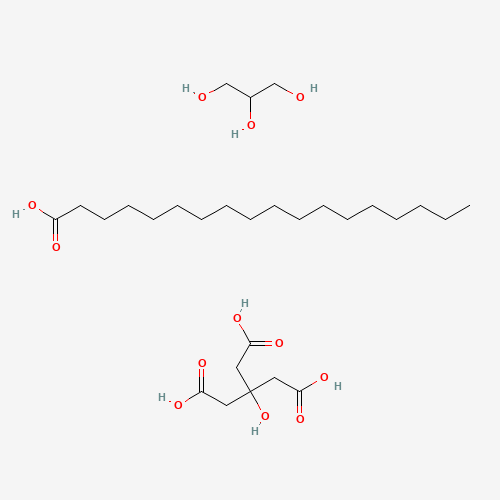
Stearyl monoglyceridyl citrate is a dough conditioner and emulsifier used in baking.
Where it is and isn’t permitted
| Jurisdiction | Status | Scope and limits | Citation |
|---|---|---|---|
| Australia and New Zealand | No listed food uses foundThis site has not matched this substance to any food use on this jurisdiction’s list of authorised food additives. A food additive may be used only in foods that list names. Flavourings, enzymes, processing aids and added nutrients are regulated separately and do not appear on it. | ||
| Canada | Permitted | no numerical limit (good manufacturing practice) In: Shortening. Purpose: Emulsifying, stabilizing or thickening agent. Limit: Good Manufacturing Practice. | Health Canada, List of Permitted Emulsifying, Gelling, Stabilizing or Thickening Agents (List 4), item S.24retrieved 2026-10-17 |
| European Union | No listed food uses foundThis site has not matched this substance to any food use on this jurisdiction’s list of authorised food additives. A food additive may be used only in foods that list names. Flavourings, enzymes, processing aids and added nutrients are regulated separately and do not appear on it. | ||
| Great Britain | No listed food uses foundThis site has not matched this substance to any food use on this jurisdiction’s list of authorised food additives. A food additive may be used only in foods that list names. Flavourings, enzymes, processing aids and added nutrients are regulated separately and do not appear on it. | ||
| Japan | No listing matchedThis site imports only Japan’s list of designated additives (Appended Table 1 to the Regulations for Enforcement of the Food Sanitation Act), matched by English name. Existing additives, natural flavouring agents and ordinary foods used as additives are permitted outside that list and are not imported, so an empty row does not show that Japan does not permit the substance. | ||
| South Korea | No listing matchedThis site imports Part III of South Korea’s Standards and Specifications for Food Additives, matched by CAS number, then INS number, then exact name. Mixed preparations and sanitisers are not imported, and an entry whose identifiers disagreed with a page’s is held for review, so an empty row does not show that South Korea does not permit the substance. | ||
| United States | Permitted, with conditions | 21 CFR 172.755retrieved 2026-10-17 | |
| Codex Alimentarius | Not listedDoes not appear on this jurisdiction’s permitted list. That is not the same as being prohibited. |
How much is permitted
A listing usually limits the quantity as well as the food. Only one of the forms that takes is a figure: quantum satis and good manufacturing practice permit the amount the technological effect requires and no more, which is a limit rather than the absence of one. Figures below are the range across every food category this page is listed in, and categories differ between regulators — see how much is permitted.
| Canada | — | 1 GMP |
|---|---|---|
| United States | — | 1 no quantity stated |
No regulator sets a figure for Stearyl monoglyceridyl citrate. That is not an absence of control: where the listing says quantum satis or good manufacturing practice, the quantity is limited to what the effect requires.
What it is made from
Made by reacting a monoglyceride with citric acid and stearyl alcohol. The fatty components may be plant or animal.
- Vegan status depends on the source
- Vegetarian status depends on the source
- May raise a halal question
- May raise a kosher question
This is not an omission. What this additive is made from is not fixed — depending on the manufacturer it may be plant, animal or microbial in origin, nobody is required to say which, and the same product can change source between production runs. Ask the manufacturer if it matters to you; a label cannot answer it.
Compare other additives on the dietary indexes.
- CAS registry number
- 55840-13-6
- InChIKey
- HFJHNGKIVAKCIW-UHFFFAOYSA-N
- PubChem
- CID 62110
How JECFA defines it
The international specification for identity and purity, prepared by the Joint FAO/WHO Expert Committee on Food Additives and published by FAO. It is a different document from any above, written by a different body and revised on its own cycle; it is advisory, and a country adopts it or does not.
Stearyl Monoglyceridyl Citrate
Prepared by the controlled chemical reaction from citric acid, monoglycerides, and fatty acids (obtained by the glycerolysis of edible fats and oils), and stearyl alcohol.
Synonyms: Stearyl monoglyceride citrate
Assay, identification and purity criteria
Description and assay
- Specification history
- Prepared at the 26th JECFA (1982), published in FNP 25 (1982) and in FNP 52 (1992). Metals and arsenic specifications revised at the 55th JECFA (2000). No ADI was allocated at the 26th JECFA (1982
- DESCRIPTION
- Soft, off-white to tan, waxy solid having a lard-like consistency
- FUNCTIONAL USES
- Emulsifier
Identification
- Solubility (Vol. 4)
- Soluble in chloroform and in ethylene glycol; insoluble in water
Purity criteria
- Water (Vol. 4)
- Not more than 0.25% (Karl Fischer Method)
- Sulfated ash (Vol. 4)
- Not more than 0.1%
- Acid value (Vol. 4)
- Not more than 52
- Acids
- Acids other than citric and fatty acids (such as acetic acid, succinic acid, fumaric acid, tartaric acid, lactic acid) shall not be detectable
- Saponification value
- Not less than 215 and not more than 255 See description under TESTS
- Total citric acid
- Not less than 15% and not more than 18% See description under TESTS
- Lead (Vol. 4)
- Not more than 2 mg/kg Determine using an atomic absorption technique appropriate to the specified level. The selection of sample size and method of sample preparation may be based on the principles of the method described in Volume 4, “Instrumental Methods.”
- Test: Saponification value
- Transfer about 1 g of the sample, accurately weighed, into a 250-ml Erlenmeyer flask, and add 25 ml of ethylene glycol, 35 ml of 0.5 N ethanolic potassium hydroxide, and a few glass beads. Reflux for one h, using a water condenser, then rinse the condenser with water and cool. Add 1 ml of phenolphthalein TS and titrate with 0.5 N hydrochloric acid. Perform a blank determination but do not reflux. The difference between the volumes, in ml of 0.5 N hydrochloric acid consumed in the actual test and in the blank titration, multiplied by 28.05 and divided by the weight, in g, of the sample taken, is the saponification value.
- Test: Total citric acid
- Reagents - Brominating solution: Dissolve 19.84 g of potassium bromide, 5.44 of potassium bromate and 12 g of sodium metavanadate, NaVO 3 in water by warming, and dilute to 1,000 ml with water. Filter if necessary. - Ferrous Sulfate Solution: Dissolve 44 g of ferrous sulfate, FeSO 4 " 7H 2 O, in 1 N sulfuric acid, dilute to 100 ml with 1 N sulfuric acid. Use within 5 days of preparation. - Sulfide Solution: On the day of use, dissolve 4 g of thiourea in 100 ml of a 1 in 50 solution of sodium borate, Na 2 B 4 O 7 " 10H 2 O, and add 2 ml of sodium sulfide TS. Wait 30 min after the addition of the sodium sulfide TS before using. - Standard Solution: Transfer about 50 mg of sodium citrate dihydrate, accurately weighed, into 500 ml volumetric flask, dissolve and dilute to volume with water, and mix. Transfer 15 ml of this solution into a 100 ml volumetric flask, dilute to volume with water, and mix. Calculate the concentration (C), in μg per ml of citric acid in the final solution by the formula (15 x 1,000 x 0.6533W)/(100 x 500), in which W is the weight, in mg of the sodium citrate taken, and 0.6533 is the factor converting sodium citrate dihydrate to citric acid. Sample solution Transfer about 250 mg of the sample, accurately weighed, to a 250-ml extraction flask, and add 15 ml of 0.5 N sodium hydroxide, 5 ml of ethanol and a few glass beads. Connect the flask with a water-cooled condenser, and reflux for 3 h. Immediately cool and neutralize to phenolphthalein TS with 0.5 N hydrochloric acid, then place the flask in an ice-bath and add 5 ml of sulfuric acid TS. Transfer the solution in a 125-ml separator, extract with three 40 ml portions of chloroform, and then extract the combined chloroform extracts in a 250-ml separator with three 10 ml portions of 0.5 N sulfuric acid adding the acid extracts to a second 250-ml separator. Wash the combined acid extracts with two 60 ml portions of chloroform, and discard the chloroform washes. Filter the acid solution into a 500-ml volumetric flask, neutralize slowly with 6 N sodium carbonate, and dilute to volume with water. Transfer 10 ml of this solution into a 100-ml volumetric flask, dilute to volume with water, and mix. Each ml of the final solution contains approximately 10 μg of citric acid. Procedure Pipet 2 ml each of the Standard Solution and of the Sample Solution into separate 40- or 45-ml glass-stoppered centrifuge tubes, and add 3 ml of water to each tube. Place 5 ml of water in a third tube for the reagent blank. Place the tubes in a ice-bath, add 5 ml of sulfuric acid TS, mix thoroughly, and allow to stand for exactly 5 min. Remove the tubes from the ice-bath, and allow them to come to room temperature during the next 5 min. To each tube add 5 ml of the Brominating Solution, then insert the stoppers, invert the tubes once or twice, and heat in a water bath at 30 o for 20 min. Remove the tubes, add 1.5 ml of Ferrous Sulfate Solution, invert, again, and allow to stand for 5 min, shaking occasionally to ensure complete reduction of the excess free bromine in the tubes. Add 6.5 ml of petroleum ether, shake for 2 or 3 min, and remove the water layer with a syringe. Wash the ether solutions with 15 ml of water, then remove the water and filter the ether extracts into the original centrifuge tubes which have been previously rinsed with the Sulfide Solution. Filter each ether extract through a tight plug of glass wool onto which has been placed a sufficient amount of anhydrous sodium sulfate to remove the last traces of water from the ether. Place 5.0 ml of the filtrate in a clean dry centrifuge tube, add 3 ml of Sulfide Solution, shake vigorously for 1.5 min and centrifuge. Decant about 0.5 ml of the supernatant ether layer from each tube, then carefully transfer the ether solutions into 1-cm cells and determine the absorbance of the extracts obtained from the Standard Solution and the Sample Solution at 500 nm with a suitable spectrophotometer, using the reagent blank in the reference cell. Calculate the quantity, in mg of citric acid in the sample taken by the formula 5C x Au/As, in which C is the exact concentration in μg per ml of citric acid in the Standard Solution, Au is the absorbance of the solution from the Sample Solution, and As is the absorbance of the solution from the Standard Solution.
Every name it appears under
14 recorded names. A label may use any of them.
CAS registry number
- 55840-13-6
As it appears in regulation
- Stearyl monoglyceridyl citrate
Other names
- 1,2,3-Propanetriol monooctadecanoate 1,2,3-propanetricarboxylate
- Acidan
- Acidan N 12
- Axol LC
- Glycerin monostearate citrate
- Glycerol stearate citrate
- Monostearin citrate
- Poem K 30
- Stearyl monoglyceridyl citrate
- Sunsoft 621B
Systematic names
- 1,2,3-Propanetricarboxylic acid, 2-hydroxy-, ester with 1,2,3-propanetriol monooctadecanoate
- 3-(carboxymethyl)-3-hydroxypentanedioic acid;octadecanoic acid;propane-1,2,3-triol
Hazard reference values
| Type | Value | Population | Assessed by | Opinion |
|---|---|---|---|---|
| ADI | not allocated | — | JECFA | 1982 |
Evidence and how bodies read it
Studies, and the differing conclusions regulators drew from them, are curated rather than machine-read, and none has been written for this substance yet.
Common questions
Assembled from what is above, in the words the questions are usually asked in. Each answer is the same statement the relevant section makes, with the same citations behind it.
- What is Stearyl monoglyceridyl citrate?
- Stearyl monoglyceridyl citrate is a dough conditioner and emulsifier used in baking.
- What is Stearyl monoglyceridyl citrate used for in food?
- It is listed as a thickener and a stabiliser — the role Canada and the US assign it. This page shows every function each regulator records, with the citation for each.
- Is Stearyl monoglyceridyl citrate banned in Europe?
- No. Stearyl monoglyceridyl citrate does not appear on the EU's list of authorised food additives, which is not the same as being banned: the EU permits an additive only where it has authorised it, and usually the reason for an absence is that no one applied. The EU has made no finding against this substance. It does mean it may not be used as a food additive in the EU today.
- Where is Stearyl monoglyceridyl citrate permitted?
- Of the seven regulators this site reads, Canada and the US permit it. Each permission is for named foods at named levels, not a blanket one; the table on this page gives them with citations.
- Is Stearyl monoglyceridyl citrate vegan?
- It depends on the source, and a label will not tell you. Stearyl monoglyceridyl citrate can be made from plant or animal material, manufacturers are not obliged to say which, and the same product can change between production runs. Anyone who needs to know has to ask the manufacturer.
Sources for this page
- ca retrieved 2026-10-17
- ecfr retrieved 2026-10-17
- jecfaspecs retrieved 2026-09-23
Full licence terms and publisher details on Sources. How this page is built and updated: Method.
Machine-readable: a JSON record of this additive is given on request —how to ask for access.
Follow changes to Stearyl monoglyceridyl citrate:Atom feed — regulatory events, and any change the weekly refresh detects in its provisions.