Sucrose acetate isobutyrate
126-13-6 · 27216-37-1 · CCRIS 8550 · E 444 · FCM no 308 · H5KI1C3YTV · HSDB 5657 · INS NO.444 · INS-444 · Isobutyric acid, hexaester with sucrose diacetate · Isobutyric acid, hexaester with sucrose diacetate (8CI) · Saccharose acetate isobutyrate · SAIB · SAIB 100S · Sucrose acetate 2-methylpropanoate · Sucrose acetate isobutanoate · sucrose acetate isobutylate · SUCROSE ACETATE ISOBUTYRATE · Sucrose acetoisobutyrate · Sucrose di(acetate) hexaisobutyrate · Sucrose Diacetate Hexaisobutyrate (1 mL) · Sucrose diacetate hexaisobutyrate, 8CI · Sucrose, diacetate hexaisobutyrate · Sucrose, mixed acetate and isobutyrate octaesters · E444 · 444 · ((2R,3R,4S,5S)-5-((acetyloxy)methyl)-5-(((2R,3R,4S,5R,6R)-6-((acetyloxy)methyl)-3,4,5-tris((2-methylpropanoyl)oxy)oxan-2-yl)oxy)-3,4-bis((2-methylpropanoyl)oxy)oxolan-2-yl)methyl 2-methylpropanoate · 1-O-acetyl-3,4,6-tris-O-(2-methylpropanoyl)-beta-D-fructofuranosyl 6-O-acetyl-2,3,4-tris-O-(2-methylpropanoyl)-alpha-D-glucopyranoside · 6-O-Acetyl-1,3,4-tris-O-(2-methyl-1-oxopropyl)-beta-D-fructofuranosyl alpha-D-glucopyranoside 6-acetate 2,3,4-tris(2-methylpropanoate) · [(2R,3R,4S,5S)-5-(acetyloxymethyl)-5-[(2R,3R,4S,5R,6R)-6-(acetyloxymethyl)-3,4,5-tris(2-methylpropanoyloxy)oxan-2-yl]oxy-3,4-bis(2-methylpropanoyloxy)oxolan-2-yl]methyl 2-methylpropanoate · alpha-D-Glucopyranoside, 6-O-acetyl-1,3,4-tris-O-(2-methyl-1-oxopropyl)-beta-D-fructofuranosyl, 6-acetate 2,3,4-tris(2-methylpropanoate) · Sucrose acetate isobutyrate · Sucrose acetate isobutyrate (SAIB) · Acetat izobutirat de zaharoză · ACETATO DE ISOBUTIRATO DE SACAROSA · Acetato isobutirato de sacarosa · Acetato isobutirrico di saccarosio · Acetoisobutirato de sacarose · Acétate isobutyrate de saccharose · AĊETAT ISOBUTIRAT TAS-SUKROŻJU · Aċitat isobutirrat tas-sukrożju · Isobutyrát octanu sacharosy · Izobutyrát sacharózoacetanu · Octan izomaślanu sacharozy · OCTANIZOMASELNAN SACHARÓZY · SACCHAROSEACETAT-ISOBUTYRAT · Saccharoseacetatisobutyrat · Sacharozės acetato izobutiratas · Sackarosacetatisobutyrat · Saharoza acetat izobutirat · Saharozes acetāta izobutirāts · saharozni acetat izobutirat · Sahharoosdiatsetaatheksaisobutüraat · Sakkaroosiasetaatti-isobutyraatti · Sucrose acetate isobutyrate · Sucroseacetaatisobutyraat · Szacharóz-acetát-izobutirát · Ισοβουτυρική οξική σακχαρόζη · Захароза ацетат изобутиратE number E444INS 444CAS 126-13-6
Listed as a stabiliser by Codex and the US.
Listed as stabilisers (US, Codex) · emulsifiers (Codex) · thickeners (US) · flavour enhancers (US) · glazing and surface-finishing agents (US) · flavouring agents and adjuvants (US) · processing aids (US)
- United States: Stabilizers and thickeners — 21 CFR 172.833, citing 21 CFR 170.3(o)(28)
- Codex Alimentarius: Stabilizer — CXS 192-1995 Table One, INS 444
- Codex Alimentarius: Emulsifier — CXS 192-1995 Table One, INS 444
- United States: Stabilizers and thickeners — 21 CFR 172.833, citing 21 CFR 170.3(o)(28)
- United States: Flavor enhancer — FDA, Substances Added to Food: SUCROSE ACETATE ISOBUTYRATE
- United States: Surface-finishing agent — FDA, Substances Added to Food: SUCROSE ACETATE ISOBUTYRATE
- United States: Flavoring agent or adjuvant — FDA, Substances Added to Food: SUCROSE ACETATE ISOBUTYRATE
- United States: Processing aid — FDA, Substances Added to Food: SUCROSE ACETATE ISOBUTYRATE
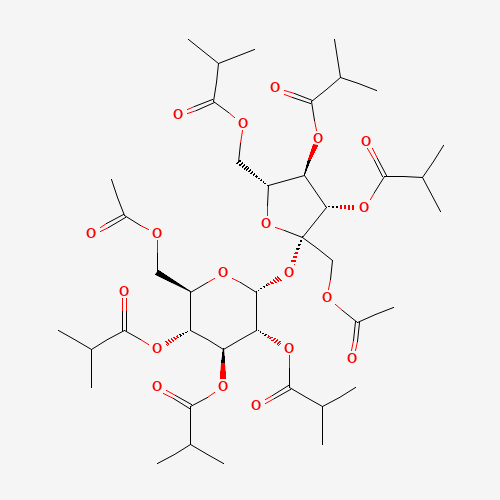
Sucrose acetate isobutyrate, or SAIB, is a beverage weighting agent. It is dense enough to bring flavour oils up to the density of the drink, so a citrus soft drink stays evenly cloudy instead of separating.
Where it is and isn’t permitted
| Jurisdiction | Status | Scope and limits | Citation |
|---|---|---|---|
| Australia and New Zealand | Permitted, with conditions | 4 food categories highest permitted level 200 mg/kg Show every food category
| Food Standards Code, Schedule 15, S15—5and 3 further provisionsretrieved 2026-10-17 |
| Canada | Permitted, with conditions | highest permitted level 300 mg/kg In: (Naming the flavour) flavour for use in beverages containing citrus or spruce oils. Purpose: Density adjusting agent. Limit: 300 ppm in the beverage as consumed. | Health Canada, List of Permitted Food Additives with Other Purposes of Use (List 8), item S.33retrieved 2026-10-17 |
| European Union | Permitted, with conditions | 2 food categories highest permitted level 300 mg/l Show every food category
| Regulation (EC) No 1333/2008and 1 further provisionretrieved 2026-10-18 |
| Great Britain | Permitted, with conditions | 2 food categories highest permitted level 300 mg/kg or mg/l Show every food category
| Assimilated Regulation (EC) No 1333/2008and 1 further provisionretrieved 2026-10-18 |
| Japan | No listing matchedThis site imports only Japan’s list of designated additives (Appended Table 1 to the Regulations for Enforcement of the Food Sanitation Act), matched by English name. Existing additives, natural flavouring agents and ordinary foods used as additives are permitted outside that list and are not imported, so an empty row does not show that Japan does not permit the substance. | ||
| South Korea | No listing matchedThis site imports Part III of South Korea’s Standards and Specifications for Food Additives, matched by CAS number, then INS number, then exact name. Mixed preparations and sanitisers are not imported, and an entry whose identifiers disagreed with a page’s is held for review, so an empty row does not show that South Korea does not permit the substance. | ||
| United States | Permitted, with conditions | 21 CFR 172.833retrieved 2026-10-17 | |
| Codex Alimentarius | Permitted, with conditions | 1 food category highest permitted level 500 mg/kg | CXS 192-1995 Table One, INS 444, food category 14.1.4retrieved 2026-09-07 |
How much is permitted
A listing usually limits the quantity as well as the food. Only one of the forms that takes is a figure: quantum satis and good manufacturing practice permit the amount the technological effect requires and no more, which is a limit rather than the absence of one. Figures below are the range across every food category this page is listed in, and categories differ between regulators — see how much is permitted.
| Australia and New Zealand | 200 mg/kg | 4 numeric limit |
|---|---|---|
| Canada | 300 mg/kg | 1 numeric limit |
| European Union | 300 mg/kg | 2 numeric limit |
| Great Britain | 300 mg/kg | 2 numeric limit |
| United States | — | 1 no quantity stated |
| Codex Alimentarius | 500 mg/kg | 1 numeric limit |
GRAS notices to the FDA
A GRAS notice is a company’s conclusion that a substance is generally recognised as safe for the use it describes. FDA’s letter responds to that conclusion, for that notifier and that use. It is not a listing in 21 CFR, and it is not counted as a US permission above. The substance and use are as FDA’s inventory words them; this site matched the notice to this page by exact name.
GRN No. 104 · Sucrose acetate isobutyrate · Eastman Chemical Company
Intended use: Use as a stabilizer of emulsions of flavoring oils in alcoholic beverages
FDA’s response (2002-08-16): FDA has no questions
What it is made from
Made by esterifying sucrose with acetic and isobutyric acids.
- Vegan
- Vegetarian
Compare other additives on the dietary indexes.
- CAS registry number
- 126-13-6
- InChIKey
- UVGUPMLLGBCFEJ-SWTLDUCYSA-N
- PubChem
- CID 31339
The two specifications, compared
The European Union sets identity and purity by regulation; JECFA publishes its own through FAO, advisory until a country adopts it. Both documents are below in full. These are the parameters each puts a number on.
| Parameter | European Union | JECFA |
|---|---|---|
| Assay | no less than 98.8 % | no less than 98.8 % |
| Lead | no more than 2 mg/kg | no more than 2 mg/kg |
| Arsenic | no more than 3 mg/kg | — |
| Mercury | no more than 1 mg/kg | — |
| Cadmium | no more than 1 mg/kg | — |
The two documents state the same figures for every parameter compared here.
How the EU defines it
The legal specification an additive must meet to be sold as this E number in the EU — what it is, how it may be made, and the purity it must reach. From Commission Regulation (EU) No 231/2012.
E 444 Sucrose acetate isobutyrate
Sucrose acetate isobutyrate is a mixture of the reaction products formed by the esterification of food grade sucrose with acetic acid anhydride and isobutyric anhydride, followed by distillation. The mixture contains all possible combinations of esters in which the molar ratio of acetate to butyrate is about 2:6
Synonyms: SAIB
Assay, identification and purity criteria
Description and assay
- Einecs
- 204-771-6
- Chemical name
- Sucrose diacetate hexaisobutyrate
- Chemical formula
- C₄₀H₆₂O₁₉
- Molecular weight
- 832-856 (approximate), C₄₀H₆₂O₁₉: 846,9
- Assay
- Content not less than 98,8 % and not more than 101,9 % of C₄₀H₆₂O₁₉
- Description
- A pale straw-coloured liquid, clear and free of sediment and having a bland odour
Identification
- Solubility
- Insoluble in water. Soluble in most organic solvents
- Refractive index
- [n]D ⁴⁰: 1,4492-1,4504
- Specific gravity
- [d]²⁵ D: 1,141-1,151
Purity criteria
- Triacetin
- Not more than 0,1 %
- Acid value
- Not more than 0,2
- Saponification value
- Not less than 524 and not more than 540
- Arsenic
- Not more than 3 mg/kg
- Lead
- Not more than 2 mg/kg
- Mercury
- Not more than 1 mg/kg
- Cadmium
- Not more than 1 mg/kg
How JECFA defines it
The international specification for identity and purity, prepared by the Joint FAO/WHO Expert Committee on Food Additives and published by FAO. It is a different document from any above, written by a different body and revised on its own cycle; it is advisory, and a country adopts it or does not.
INS 444 Sucrose Acetate Isobutyrate
A mixture of the reaction products formed by the esterification of food grade sucrose with acetic anhydride and isobutyric anhydride, followed by distillation. The mixture contains all possible combinations of esters in which the molar ratio of acetate to isobutyrate is about 2:6
Synonyms: SAIB, INS No. 444 SAIB
Assay, identification and purity criteria
Description and assay
- Specification history
- Prepared at the 46th JECFA (1996), published in FNP 52 Add 4 (1996) superseding specifications prepared at the 41st JECFA (1993), published in FNP 52 Add 2 (1993). Metals and arsenic specifications revised at the 61st JECFA (2003. An ADI of 0-20 mg/kg bw was established at the 46th JECFA (1996))
- Chemical names
- Sucrose diacetate hexaisobutyrate (approximate)
- C.A.S. number Chemical formula
- 137204-24-1; 27216-37-1; 126-13-6 C40H62O19 for sucrose diacetate hexaisobutyrate
- Structural formula
- where R1 = -CH2OCOCH3, and R2 = -CH2OCOCH(CH3)2, or -OCOCH(CH3)2
- Formula weight
- 832 - 856 (approximate), C40H62O19 = 846.9
- Assay
- Not less than 98.8% and not more than 101.9% of C40H62O19
- DESCRIPTION
- Pale straw coloured liquid, clear and free of sediment and having a bland odour
- FUNCTIONAL USES
- Density adjusting agent, cloud-producing agent in non-alcoholic beverages
- METHOD OF ASSAY
- Using the saponification value, calculate the percentage of C40H62O19 by the formula: where SV = saponification value
Identification
- Solubility (Vol. 4)
- Insoluble in water, soluble in most organic solvents
- Refractive index (Vol. 4 )
- n (40, D): 1.4492 - 1.4504
- Specific gravity (Vol. 4)
- d (25, 25): 1.141 - 1.151
- Infrared absorption
- The infrared spectrum of a potassium bromide dispersion of the sample corresponds with the reference infrared spectrum in the Appendix
Purity criteria
- Acid value (Vol. 4)
- Not more than 0.2 Proceed as directed under Acid Value , using 50 g of the sample and a microburette
- Saponification value (Vol. 4)
- Between 524 and 540 Use 1 g of the sample
- Triacetin
- Not more than 0.1% See description under TESTS
- Lead (Vol. 4)
- Not more than 2 mg/kg Determine using an atomic absorption technique appropriate to the specified level. The selection of sample size and method of sample preparation may be based on the principles of the method described in Volume 4, “Instrumental Methods.”
- Test: Triacetin
- Test by the following gas chromatographic procedure Apparatus: Gas chromatograph equipped with a flame ionization detector Column: Stainless steel, 1.5 m, 3.2 mm i.d. Preparation of sample: Dilute the sample by adding an equal volume of carbon disulfide. Conditions Stationary phase: SE-30, 3% Solid phase: Chromosorb AW-DMCS, 80-100 mesh Carrier gas: Helium Flow rate: 20 ml/min Temperatures - Column: Programmed at 10 o per min from 100 o to 300 o immediately after injection of the sample - Injector: 300 o Injected volume: 1 μl
- Test: Infrared spectrum
- Sucrose acetate isobutyrate
Every name it appears under
59 recorded names. A label may use any of them.
E number
- E444
INS number
- 444
CAS registry number
- 126-13-6
- 27216-37-1
As it appears in regulation
- Sucrose acetate isobutyrate
- Sucrose acetate isobutyrate (SAIB)
Other names
- CCRIS 8550
- E 444
- FCM no 308
- H5KI1C3YTV
- HSDB 5657
- INS NO.444
- INS-444
- Isobutyric acid, hexaester with sucrose diacetate
- Isobutyric acid, hexaester with sucrose diacetate (8CI)
- Saccharose acetate isobutyrate
- SAIB
- SAIB 100S
- Sucrose acetate 2-methylpropanoate
- Sucrose acetate isobutanoate
- sucrose acetate isobutylate
- SUCROSE ACETATE ISOBUTYRATE
- Sucrose acetoisobutyrate
- Sucrose di(acetate) hexaisobutyrate
- Sucrose Diacetate Hexaisobutyrate (1 mL)
- Sucrose diacetate hexaisobutyrate, 8CI
- Sucrose, diacetate hexaisobutyrate
- Sucrose, mixed acetate and isobutyrate octaesters
Systematic names
- ((2R,3R,4S,5S)-5-((acetyloxy)methyl)-5-(((2R,3R,4S,5R,6R)-6-((acetyloxy)methyl)-3,4,5-tris((2-methylpropanoyl)oxy)oxan-2-yl)oxy)-3,4-bis((2-methylpropanoyl)oxy)oxolan-2-yl)methyl 2-methylpropanoate
- 1-O-acetyl-3,4,6-tris-O-(2-methylpropanoyl)-beta-D-fructofuranosyl 6-O-acetyl-2,3,4-tris-O-(2-methylpropanoyl)-alpha-D-glucopyranoside
- 6-O-Acetyl-1,3,4-tris-O-(2-methyl-1-oxopropyl)-beta-D-fructofuranosyl alpha-D-glucopyranoside 6-acetate 2,3,4-tris(2-methylpropanoate)
- [(2R,3R,4S,5S)-5-(acetyloxymethyl)-5-[(2R,3R,4S,5R,6R)-6-(acetyloxymethyl)-3,4,5-tris(2-methylpropanoyloxy)oxan-2-yl]oxy-3,4-bis(2-methylpropanoyloxy)oxolan-2-yl]methyl 2-methylpropanoate
- alpha-D-Glucopyranoside, 6-O-acetyl-1,3,4-tris-O-(2-methyl-1-oxopropyl)-beta-D-fructofuranosyl, 6-acetate 2,3,4-tris(2-methylpropanoate)
The EU re-evaluation programme
Every additive authorised in the EU before 20 January 2009 was put back through EFSA by Commission Regulation (EU) No 257/2010, and this one is named in it. What the Regulation required is below; whether the opinion has since been published is not something this site records.
- To be evaluated by 31 December 2016. Named in Annex II, Part II, point 2 as “Sucrose acetate isobutyrate”, among the additives given priority within its class.
Hazard reference values
EFSA and JECFA have both set an acceptable daily intake for Sucrose acetate isobutyrate, and they agree: 20 mg/kg bw/day. An acceptable daily intake is a reference value set by a committee, not a threshold above which harm begins. See where the two committees differ.
Evidence and how bodies read it
What assessing bodies concluded
Each conclusion is paraphrased in the body's own framing, from the published opinion linked beneath it. Where bodies differ, both stand; this site does not adjudicate between them or add a view of its own.
EFSA 2016
The ANS Panel found no genotoxicity concern for sucrose acetate isobutyrate (E 444) and revised the ADI from the SCF's 10 mg/kg bw/day to 20 mg/kg bw/day. As no population group exceeded the ADI, it concluded that use at permitted or reported levels would not be of safety concern.
Common questions
Assembled from what is above, in the words the questions are usually asked in. Each answer is the same statement the relevant section makes, with the same citations behind it.
- What is E 444?
- E 444 is Sucrose acetate isobutyrate. Sucrose acetate isobutyrate, or SAIB, is a beverage weighting agent. It is dense enough to bring flavour oils up to the density of the drink, so a citrus soft drink stays evenly cloudy instead of separating.
- What is Sucrose acetate isobutyrate used for in food?
- It is listed as a stabiliser — the role Codex and the US assign it. This page shows every function each regulator records, with the citation for each.
- Where is Sucrose acetate isobutyrate permitted?
- Of the seven regulators this site reads, Australia and New Zealand, Canada, the EU, Great Britain, the US and the Codex standard permit it. Each permission is for named foods at named levels, not a blanket one; the table on this page gives them with citations.
- Is Sucrose acetate isobutyrate vegan?
- Yes. Sucrose acetate isobutyrate is not derived from animals, and is suitable for vegetarians. This page says what it is made from and how.
Sources for this page
- anz retrieved 2026-10-17
- ca retrieved 2026-10-17
- eu retrieved 2026-10-18
- gb retrieved 2026-10-18
- ecfr retrieved 2026-10-17
- gsfa retrieved 2026-09-07
- euspecs retrieved 2026-10-18
- jecfaspecs retrieved 2026-09-23
Full licence terms and publisher details on Sources. How this page is built and updated: Method.
Machine-readable: a JSON record of this additive is given on request —how to ask for access.
Follow changes to Sucrose acetate isobutyrate:Atom feed — regulatory events, and any change the weekly refresh detects in its provisions.