Triacetin
102-76-1 · 1,2,3-Propanetriol, 1,2,3-triacetate · 1,2,3-Propanetriol, triacetate · 1,2,3-Propanetriyl triacetate · 1,2,3-triacetoxypropane · 1,2,3-triacetyl-sn-glycerol · 1,2,3-Triacetylglycerol · 1,3-diacetyloxypropan-2-yl acetate · 2,3-diacetyloxypropyl acetate · 2-(Acetyloxy)-1-[(acetyloxy)methyl]ethyl acetate · 2-acetyloxy-1-(acetyloxymethyl)ethyl acetate · Acetic, 1,2,3-propanetriyl ester · Acetin, tri- · Blekin · BRN 1792353 · CAS-102-76-1 · CCRIS 9355 · EASTMAN Triacetin · Enzacetin · Enzactin · ENZACTIN (TN) · Estol 1581 · Euzactin · FEMA No. 2007 · FEMA Number 2007 · Fungacet · Fungacetin · Glycerin triacetate · Glycerine triacetate · Glycerol triacetate · Glyceroli Triacetas · Glyceryl triacetate · Glyceryltriacetate · Glyped · HSDB 585 · Ins no.1518 · Kesscoflex TRA · Kodaflex triacetin · Motisil · propane-1,2,3-triyl triacetate · tri-acetin · triacetin · TRIACETIN (GLYCEROL TRIACETATE) · Triacetin (USP/INN) · Triacetin, 99% · Triacetin, CP · Triacetin, FCC · Triacetin, USP · Triacetina · Triacetine · Triacetinum · Triacetyl glycerin · Triacetyl glycerine · Triacetyl glycerol · Triacetyl-glycerol · Triacetylglycerol · Ujostabil · Vanay · XHX3C3X673 · E1518 · Glyceryl triacetate · Glyceryl triacetate (triacetin) · Triacetin · GLICERIL TRIACETAT · Gliceril triacetat (triacetin) · GLICERIL-TRIACETÁT · Gliceril-triacetát (triacetin) · GLICERILTRIACETAT · gliceriltriacetat (triacetin) · GLICERILTRIACETATAS · Gliceriltriacetatas (triacetinas) · Gliceriltriacetāts (triacetīns) · GLICERĪNA TRIACETĀTS · GLYCERINTRIACETAT · Glycerintriacetat (Triacetin) · GLYCERYL TRIACETATE · Glyceryl triacetate (triacetin) · GLYCERYL-TRIACETÁT · GLYCERYLTRIACETAAT · Glyceryltriacetaat (triacetine) · GLYCERYLTRIACETAT · Glyceryltriacetát (triacetin) · GLYSEROLITRIASETAATTI · Glyseryylitriasetaatti (triasetiini) · GLÜTSERÜÜLTRIATSETAAT · Glütserüültriatsetaat (triatsetiin) · TRIACETAT DE GLICERIL · Triacetat de glicerină (triacetină) · TRIACETATO DE GLICERILO · Triacetato de glicerilo (triacetina) · TRIACETATO DI GLICERILE · Triacetato di glicerile (triacetina) · Triacetylglycerol (triacetín) · TRIACÉTATE DE GLYCÉRYLE · Triacétate de glycéryle (triacétine) · TRIAĊETAT TAL-GLIĊERIL · Triaċitat tal-gliċeril (triaċetin) · TRIOCTAN GLICEROLU · Trioctan glicerolu (triacetyna) · Τριακετίνη (τριγλυκερίδιο του οξικού οξέος) · ГЛИЦЕРИЛ ТРИАЦЕТАТ · Глицерил триацетат (триацетин)E number E1518CAS 102-76-1
Listed as a humectant, a carrier and a solvent by Codex, the US and Canada.
Listed as humectants (US, Codex) · carriers (CA, Codex) · solvents and vehicles (CA, US) · emulsifiers (Codex) · glazing and surface-finishing agents (US) · flavouring agents and adjuvants (US) · formulation aids (US) · processing aids (US)
- United States: Humectant — FDA, Substances Added to Food: TRIACETIN (GLYCEROL TRIACETATE)
- United States: Humectants — 21 CFR 184.1901, citing 21 CFR 170.3(o)(16)
- Codex Alimentarius: Humectant — CXS 192-1995 Table Three, INS 1518
- Canada: Carrier solvent — Health Canada, List of Permitted Solvents (List 15)
- Codex Alimentarius: Carrier — CXS 192-1995 Table Three, INS 1518
- Canada: Carrier solvent — Health Canada, List of Permitted Solvents (List 15)
- United States: Solvent or vehicle — FDA, Substances Added to Food: TRIACETIN (GLYCEROL TRIACETATE)
- United States: Solvents and vehicles — 21 CFR 184.1901, citing 21 CFR 170.3(o)(27)
- Codex Alimentarius: Emulsifier — CXS 192-1995 Table Three, INS 1518
- United States: Surface-finishing agent — FDA, Substances Added to Food: TRIACETIN (GLYCEROL TRIACETATE)
- United States: Flavoring agent or adjuvant — FDA, Substances Added to Food: TRIACETIN (GLYCEROL TRIACETATE)
- United States: Flavoring agents and adjuvants — 21 CFR 184.1901, citing 21 CFR 170.3(o)(12)
- United States: Formulation aid — FDA, Substances Added to Food: TRIACETIN (GLYCEROL TRIACETATE)
- United States: Formulation aids — 21 CFR 184.1901, citing 21 CFR 170.3(o)(14)
- United States: Processing aid — FDA, Substances Added to Food: TRIACETIN (GLYCEROL TRIACETATE)
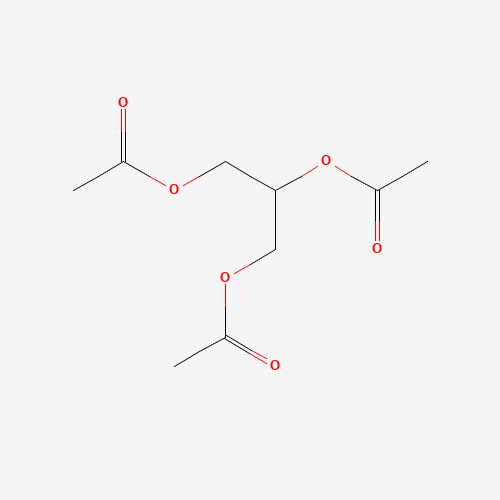
Triacetin is a solvent, carrier and humectant, used to hold flavourings in solution and to keep chewing gum base soft.
Where it is and isn’t permitted
| Jurisdiction | Status | Scope and limits | Citation |
|---|---|---|---|
| Australia and New Zealand | Permitted, with conditions | 54 food categories no numerical limit (good manufacturing practice) Show every food category
| Food Standards Code, Schedule 15, S15—5and 53 further provisionsretrieved 2026-10-17 |
| Canada | Permitted | no numerical limit (good manufacturing practice) 3 permitted uses Show every permitted use
| Health Canadaand 2 further provisionsretrieved 2026-10-17 |
| European Union | Permitted | 1 food category quantum satis. | Regulation (EC) No 1333/2008, Annex II, as amended by (EU) No 1129/2011retrieved 2026-10-18 |
| Great Britain | Permitted | 1 food category quantum satis. | Assimilated Regulation (EC) No 1333/2008, Annex II (as at 28 June 2024)retrieved 2026-10-18 |
| Japan | No listing matchedThis site imports only Japan’s list of designated additives (Appended Table 1 to the Regulations for Enforcement of the Food Sanitation Act), matched by English name. Existing additives, natural flavouring agents and ordinary foods used as additives are permitted outside that list and are not imported, so an empty row does not show that Japan does not permit the substance. | ||
| South Korea | Permitted, with conditions | Designated food additive: Standards and Specifications for Food Additives, Part III, 1. …Designated food additive: Standards and Specifications for Food Additives, Part III, 1. 일반식품첨가물 (general food additives), 트리아세틴 (“Triacetin”, the English the Code prints beside it). Main use (주용도) of 트리아세틴: 유화제, 껌기초제. Standard for use (사용기준) of 트리아세틴: (1) [to be used under the general standard for use in II. 2. 1), the minimum amount that achieves the technical effect, with no limit set for this additive in particular] “II. 2. 1)의 규정에 따라 사용하여야 한다.” The Korean is the standard as published. There is no official English translation of the current Code (the English version on MFDS’s website is the 2020 edition and has no legal effect); the English in square brackets is this site’s description of what each sentence does, not a translation of the foods or the levels. Compositional specifications (Part IV) are not imported, nor are the general standards in Part II, which apply to every additive. | Standards and Specifications for Food Additives (식품첨가물의 기준 및 규격), MFDS Notification, Part III (Standards for use, by item)retrieved 2026-10-18 |
| United States | Permitted | 21 CFR 184.1901retrieved 2026-10-17 | |
| Codex Alimentarius | Permitted | no numerical limit (good manufacturing practice) | CXS 192-1995 Table Three, INS 1518retrieved 2026-09-07 |
How much is permitted
A listing usually limits the quantity as well as the food. Only one of the forms that takes is a figure: quantum satis and good manufacturing practice permit the amount the technological effect requires and no more, which is a limit rather than the absence of one. Figures below are the range across every food category this page is listed in, and categories differ between regulators — see how much is permitted.
| Australia and New Zealand | — | 54 GMP |
|---|---|---|
| Canada | — | 3 GMP |
| European Union | — | 1 quantum satis |
| Great Britain | — | 1 quantum satis |
| South Korea | — | 1 no quantity stated |
| United States | — | 1 no quantity stated |
| Codex Alimentarius | — | 1 GMP |
No regulator sets a figure for Triacetin. That is not an absence of control: where the listing says quantum satis or good manufacturing practice, the quantity is limited to what the effect requires.
What it is made from
Made by reacting glycerol with acetic acid. The glycerol may be plant or animal in origin.
- Vegan status depends on the source
- Vegetarian status depends on the source
- May raise a halal question
- May raise a kosher question
This is not an omission. What this additive is made from is not fixed — depending on the manufacturer it may be plant, animal or microbial in origin, nobody is required to say which, and the same product can change source between production runs. Ask the manufacturer if it matters to you; a label cannot answer it.
Compare other additives on the dietary indexes.
- CAS registry number
- 102-76-1
- InChIKey
- URAYPUMNDPQOKB-UHFFFAOYSA-N
- PubChem
- CID 5541
The two specifications, compared
The European Union sets identity and purity by regulation; JECFA publishes its own through FAO, advisory until a country adopts it. Both documents are below in full. These are the parameters each puts a number on.
| Parameter | European Union | JECFA |
|---|---|---|
| Assay | no less than 98 % | no less than 98.5 % |
| Sulphated ash | no more than 0.02 % | no more than 0.02 % |
| Lead | no more than 2 mg/kg | no more than 2 mg/kg |
| Arsenic | no more than 3 mg/kg | — |
One parameter differs between the two documents. A difference is not a disagreement about safety: the two are revised on their own cycles, and an assay or a drying loss can be measured against a different preparation of the substance, which is why only the contaminant ceilings are marked. Within the EU the EU's figure is the one that binds.
How the EU defines it
The legal specification an additive must meet to be sold as this E number in the EU — what it is, how it may be made, and the purity it must reach. From Commission Regulation (EU) No 231/2012.
E 1518 Glyceryl triacetate
Synonyms: Triacetin
Assay, identification and purity criteria
Description and assay
- Einecs
- 203-051-9
- Chemical name
- Glyceryl triacetate
- Chemical formula
- C₉H₁₄O₆
- Molecular weight
- 218,21
- Assay
- Content not less than 98,0 %
- Description
- Colourless, somewhat oily liquid having a slightly fatty odour
Identification
- Test for acetate
- Passes test
- Test for glycerol
- Passes test
- Refractive index
- [n]D ²⁵ between 1,429 and 1,431
- Specific gravity (25 °C/25 °C)
- Between 1,154 and 1,158
- Boiling range
- Between 258 and 270 °C
Purity criteria
- Water content
- Not more than 0,2 % (Karl Fischer method)
- Sulphated ash
- Not more than 0,02 % (as citric acid)
- Arsenic
- Not more than 3 mg/kg
- Lead
- Not more than 2 mg/kg
How JECFA defines it
The international specification for identity and purity, prepared by the Joint FAO/WHO Expert Committee on Food Additives and published by FAO. It is a different document from any above, written by a different body and revised on its own cycle; it is advisory, and a country adopts it or does not.
INS 1518 Triacetin
Synonyms: Glyceryl triacetate, INS No. 1518 Glyceryl triacetate
Assay, identification and purity criteria
Description and assay
- Specification history
- Prepared at the 46th JECFA (1996), published in FNP 52 Add 4 (1996) superseding specifications prepared at the 19th JECFA (1975), published in NMRS 55B (1976) and in FNP 52 (1992). Metals and arsenic specifications revised at the 63rd JECFA (2004). An ADI 'not specified' was established at the 19th JECFA (1975)
- Chemical names
- Glyceryl triacetate
- C.A.S. number
- 102-76-1
- Chemical formula
- C 9 H 14 O 6
- Formula weight
- 218.21
- Assay
- Not less than 98.5% on the anhydrous basis
- DESCRIPTION
- Colourless, somewhat oily liquid having a slight, fatty odour
- FUNCTIONAL USES
- Humectant, solvent
- METHOD OF ASSAY
- Transfer about 1 g of the sample, accurately weighed, into a suitable pressure bottle, add 25 ml of 1N potassium hydroxide and 15 ml of isopropanol, stopper the bottle, and wrap securely in a canvas bag. Heat in a water bath maintained at 98±2 o for 1 h, allowing the water in the bath to just cover the liquid in the bottle. Remove the bottle from the bath, cool in ai r to room temperature, then loosen the bag, uncap the bottle to release any pressure, and remove the bag. Add 6 to 8 drops of phenolphthalein TS, and titrate the excess alkali with 0.5N sulfuric acid just to the disappearance of the pink colour. Perform a blank determination. Each ml of 0.5N sulfuric acid is equivalent to 36.37 mg of C 9 H 14 O 6 .
Identification
- Solubility (Vol. 4)
- Sparingly soluble in water, soluble in ethanol
- Test for glycerol
- Heat a few drops in a test tube with about 0.5 g of potassium bisulfate. Pungent vapours of acrolein are evolved
- Test for acetate (Vol. 4)
- Passes test To be performed on the solution resulting from the assay
Purity criteria
- Water (Vol. 4)
- Not more than 1.0% (Karl Fischer Method)
- Refractive index (Vol. 4)
- 1.429 - 1.431 at 25 o
- Specific gravity (Vol. 4)
- d (25, 25): 1.154 - 1.158
- Distillation range (Vol. 4)
- 258 - 270 o
- Sulfated ash (Vol. 4)
- Not more than 0.02% Test 5 g of the sample (Method II)
- Acidity
- Accurately weigh a sample of 25 g, dilute with 50 ml of neutralized ethanol, and add 5 drops of phenolphthalein TS. Not more than 1 ml of 0.02N sodium hydroxide is required to produce a pink colour.
- Unsaturated compounds
- To 10 ml of the sample in a glass-stoppered tube add dropwise a 1 in 100 solution of bromine in carbon tetrachloride until a permanent yellow colour is produced. No turbidity or precipitate appears after 18 h in the dark.
- Lead (Vol. 4)
- Not more than 2 mg/kg Determine using an atomic absorption technique appropriate to the specified level. The selection of sample size and method of sample preparation may be based on the principles of the method described in Volume 4, “Instrumental Methods.”
Authorised in other additives, enzymes, flavourings and nutrients
These authorisations are not for use in food. They let this substance be used inside another additive, a food enzyme, a flavouring or a nutrient preparation — often as a carrier — and it reaches food only as part of that product. Annex III to Regulation (EC) No 1333/2008.
| Part | May be used in | Maximum level | Citation |
|---|---|---|---|
| Annex III, Part 1: Carriers in food additives | All food additivesNote (1): Maximum level from all sources in foodstuffs 3 000 mg/kg (individually or in combination with E 1505, E 1517 and E 1518). In the case of beverages, with the exception of cream liqueurs, the maximum level of E 1520 shall be 1 000 mg/l from all sources. | quantum satis | Regulation (EC) No 1333/2008, Annex III, Part 1 |
| Annex III, Part 4: Food additives including carriers in food flavourings | All flavourings | 3 000 mg/kg from all sources in foodstuffs as consumed or as reconstituted according to the instructions of the manufacturer; individually or in combination. In the case of beverages, with the exception of cream liqueurs, the maximum level of E 1520 shall be 1 000 mg/l from all sources | Regulation (EC) No 1333/2008, Annex III, Part 4 |
| Annex III, Part 5, Section A: Food additives added in nutrients except in nutrients intended to be used in foodstuffs listed in Part E, point 01.10, of Annex II and foodstuffs for infants and young children listed in Part E, point 13.1, of Annex II | All nutrientsCan be used as a carrier: Yes, only as a carrier Note (1): Maximum level for E 1518 and E 1520 from all sources in foodstuffs 3 000 mg/kg (individually or in combination with E 1505 and E 1517). In the case of beverages, with the exception of cream liqueurs, the maximum level of E 1520 shall be 1 000 mg/l from all sources. | See note (1) | Regulation (EC) No 1333/2008, Annex III, Part 5, Section A |
Every name it appears under
102 recorded names. A label may use any of them.
E number
- E1518
CAS registry number
- 102-76-1
As it appears in regulation
- Glyceryl triacetate
- Glyceryl triacetate (triacetin)
- Triacetin
Other names
- 1,2,3-Propanetriol, 1,2,3-triacetate
- 1,2,3-Propanetriol, triacetate
- 1,2,3-Propanetriyl triacetate
- 1,2,3-triacetoxypropane
- 1,2,3-triacetyl-sn-glycerol
- 1,2,3-Triacetylglycerol
- 1,3-diacetyloxypropan-2-yl acetate
- 2,3-diacetyloxypropyl acetate
- 2-(Acetyloxy)-1-[(acetyloxy)methyl]ethyl acetate
- 2-acetyloxy-1-(acetyloxymethyl)ethyl acetate
- Acetic, 1,2,3-propanetriyl ester
- Acetin, tri-
- Blekin
- BRN 1792353
- CAS-102-76-1
- CCRIS 9355
- EASTMAN Triacetin
- Enzacetin
- Enzactin
- ENZACTIN (TN)
- Estol 1581
- Euzactin
- FEMA No. 2007
- FEMA Number 2007
- Fungacet
- Fungacetin
- Glycerin triacetate
- Glycerine triacetate
- Glycerol triacetate
- Glyceroli Triacetas
- Glyceryl triacetate
- Glyceryltriacetate
- Glyped
- HSDB 585
- Ins no.1518
- Kesscoflex TRA
- Kodaflex triacetin
- Motisil
- propane-1,2,3-triyl triacetate
- tri-acetin
- triacetin
- TRIACETIN (GLYCEROL TRIACETATE)
- Triacetin (USP/INN)
- Triacetin, 99%
- Triacetin, CP
- Triacetin, FCC
- Triacetin, USP
- Triacetina
- Triacetine
- Triacetinum
- Triacetyl glycerin
- Triacetyl glycerine
- Triacetyl glycerol
- Triacetyl-glycerol
- Triacetylglycerol
- Ujostabil
- Vanay
- XHX3C3X673
Hazard reference values
| Type | Value | Population | Assessed by | Opinion |
|---|---|---|---|---|
| ADI | not specified | — | JECFA | 2002 |
Evidence and how bodies read it
Studies, and the differing conclusions regulators drew from them, are curated rather than machine-read, and none has been written for this substance yet.
Common questions
Assembled from what is above, in the words the questions are usually asked in. Each answer is the same statement the relevant section makes, with the same citations behind it.
- What is E 1518?
- E 1518 is Triacetin. Triacetin is a solvent, carrier and humectant, used to hold flavourings in solution and to keep chewing gum base soft.
- What is Triacetin used for in food?
- It is listed as a humectant, a carrier and a solvent — the role Codex, the US and Canada assign it. This page shows every function each regulator records, with the citation for each.
- Where is Triacetin permitted?
- Of the seven regulators this site reads, Australia and New Zealand, Canada, the EU, Great Britain, South Korea, the US and the Codex standard permit it. Each permission is for named foods at named levels, not a blanket one; the table on this page gives them with citations.
- Is Triacetin vegan?
- It depends on the source, and a label will not tell you. Triacetin can be made from plant or animal material, manufacturers are not obliged to say which, and the same product can change between production runs. Anyone who needs to know has to ask the manufacturer.
Sources for this page
- anz retrieved 2026-10-17
- ca retrieved 2026-10-17
- eu retrieved 2026-10-18
- gb retrieved 2026-10-18
- kr retrieved 2026-10-18
- ecfr retrieved 2026-10-17
- gsfa retrieved 2026-09-07
- euspecs retrieved 2026-10-18
- jecfaspecs retrieved 2026-09-23
Full licence terms and publisher details on Sources. How this page is built and updated: Method.
Machine-readable: a JSON record of this additive is given on request —how to ask for access.
Follow changes to Triacetin:Atom feed — regulatory events, and any change the weekly refresh detects in its provisions.